How LLMs Works: Understanding the Technology Behind Large Language Models
By Sriram
Updated on Aug 11, 2026 | 6 min read | 4.51K+ views
Share:

All courses
Certifications
More
By Sriram
Updated on Aug 11, 2026 | 6 min read | 4.51K+ views
Share:
To understand how LLMs work, it's important to know that Large Language Models generate text by analyzing a prompt and predicting the most probable next token based on patterns learned during training. Rather than memorizing answers, they learn relationships between words, phrases, code, and concepts from massive datasets containing books, websites, articles, and programming code. This prediction process enables them to produce coherent, contextually relevant, and human-like responses.
This blog explains how large language models process text, learn from large datasets, generate responses, and their key limitations. You'll gain a practical understanding of how modern language models work and why they matter.
Build hands-on AI skills with upGrad’s Artificial Intelligence courses and Generative AI, learn AI and programming technologies through real-world projects.
Generative AI Courses to upskill
Explore Generative AI Courses for Career Progression
IIIT Bangalore
Executive Diploma in Machine Learning and AI360° Career Support
Large Language Models (LLMs) are AI systems designed to understand and generate human language. Instead of following predefined rules like traditional software, they learn patterns, relationships, and context from massive amounts of text data.
To understand how LLMs works, think of them as advanced prediction systems. When you ask a question or give a prompt, they don't retrieve a fixed answer. Instead, they generate responses by predicting the most likely sequence of words based on what they learned during training.
Modern LLMs are trained on diverse datasets that may include:
This broad exposure allows models to develop a general understanding of language and knowledge across many domains.
The following table highlights the core components of an LLM.
Component |
Purpose |
| Training Data | Provides examples of language patterns |
| Tokens | Break text into manageable units |
| Parameters | Store learned relationships |
| Transformer Architecture | Processes context and meaning |
| Attention Mechanism | Identifies important information |
| Inference Engine | Generates responses |
When users interact with an AI chatbot, the process feels almost instantaneous. Behind the scenes, however, several complex steps occur before a response appears.
The simplest way to understand how LLMs work is to follow the journey of a prompt from user input to generated output. Every interaction begins when a user enters text.
The model cannot directly understand words in the same way humans do. It must first convert language into numerical representations.
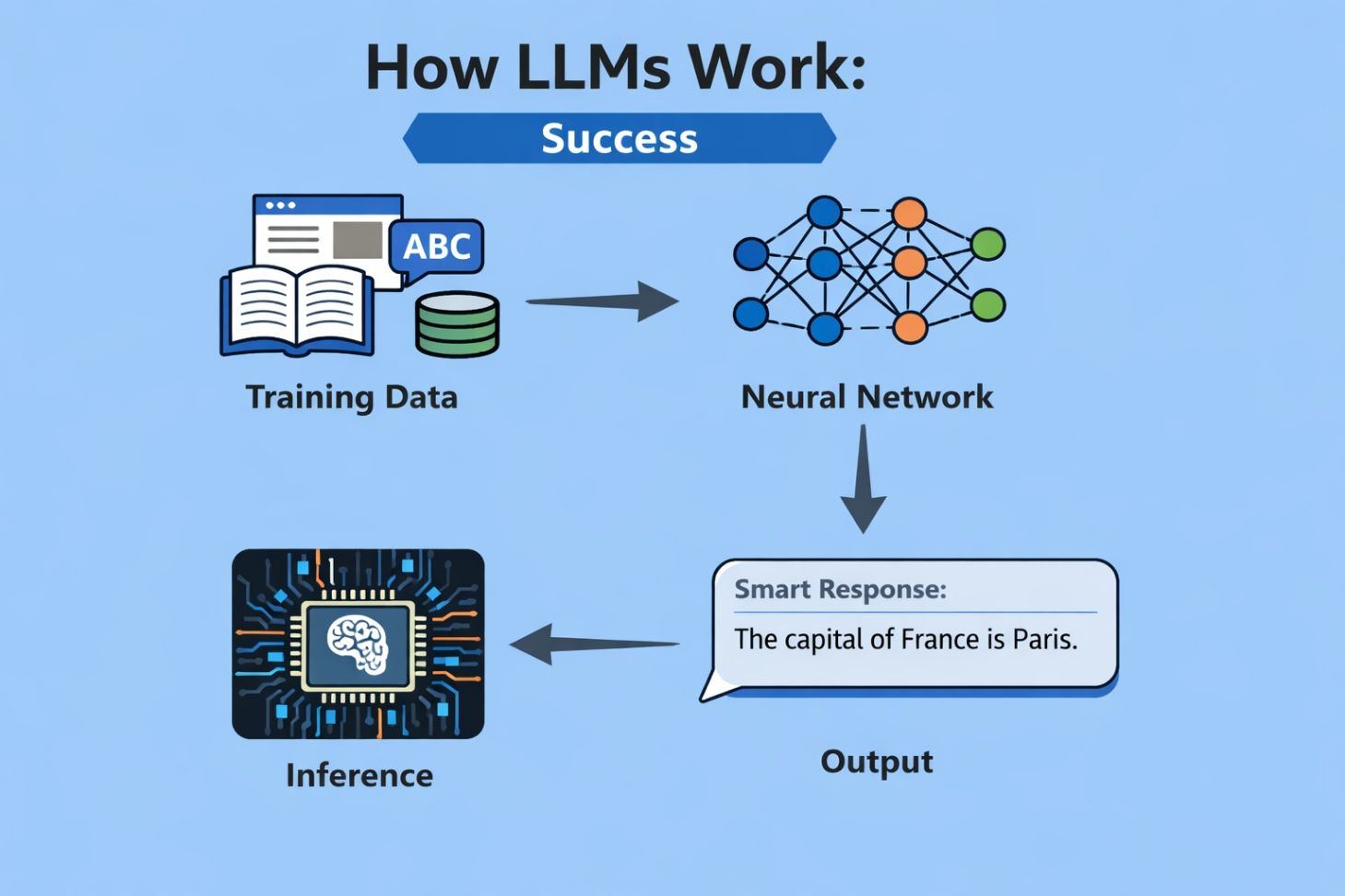
Before an LLM can answer questions or generate content, it must learn from vast amounts of text data. Understanding how LLMs works requires looking at the training process, where models learn language patterns, context, and relationships between words.
LLMs are trained on large datasets that include:
During pretraining, the model repeatedly predicts missing or next words. Over time, it learns language structure, writing styles, semantic relationships, and basic reasoning patterns.
Modern LLMs rely on transformers, which use a mechanism called self-attention. Self-attention helps the model identify the most important words in a sentence and understand context more effectively.
The table below summarizes the key components of a transformer model.
Component |
Function |
| Embeddings | Convert text into vectors |
| Self-Attention | Identifies relevant context |
| Multi-Head Attention | Analyzes multiple relationships |
| Feedforward Networks | Processes information |
| Positional Encoding | Maintains word order |
As models train on larger datasets and use more parameters, they often become better at:
However, larger models alone do not guarantee better performance. Data quality, training methods, and model design are equally important.
Also read : Difference Between LLM and Generative AI
A key part of understanding how LLMs works is knowing how they generate natural and context-aware responses. Rather than thinking like humans, LLMs analyze patterns learned during training and predict the most likely next token based on the input they receive.
LLMs use context to maintain meaningful conversations. They analyze the prompt and previous messages to understand relationships between ideas and generate relevant responses.
Every response is created by predicting the next most probable token. The model considers factors such as previous words, context, and user instructions to generate coherent text.
Modern LLMs are fine-tuned using human feedback and safety training. This helps them follow instructions, answer questions, summarize information, generate code, and provide more useful responses in real-world applications.
Also read : What are Large Language Models? Origin and Core Concepts
While understanding how LLMs works highlights their capabilities, it also reveals important limitations. Since LLMs learn patterns from data rather than truly understanding information, they can face challenges related to accuracy, reasoning, fairness, and computational requirements.
The table below summarizes the most common limitations of Large Language Models and their impact:
Limitation |
Description |
Impact |
| Hallucinations | Generates information that sounds correct but is inaccurate or fabricated | Incorrect answers and misinformation |
| Bias in Training Data | Learns biases present in training datasets | Potentially unfair or skewed outputs |
| Context Limitations | May lose track of information in long conversations | Inconsistent or incomplete responses |
| Reasoning Challenges | Struggles with complex, multi-step, or novel problems | Reduced accuracy in advanced tasks |
| High Computational Costs | Requires significant computing power for training and inference | Expensive deployment and maintenance |
| Transparency Issues | Difficult to understand why a model generated a specific response | Lower explainability and trust |
| Data Quality Dependence | Performance depends heavily on training data quality | Reduced reliability if data is flawed |
To address these challenges, organizations often combine LLMs with retrieval systems, databases, fact-checking tools, and human oversight to improve accuracy and reliability.
Read : What Is the Full Form of LLM?
The quick adoption of LLMs indicates their capability to address real-world issues in various sectors. Organisations are using them more and more to boost productivity, automate workflows and improve customer experiences.
As more organizations learn how LLMs works, they keep discovering new opportunities to integrate these models into products and business operations.
Today's applications are far beyond simple chatbots.
The following examples show where LLMs create value today.
Similarly, businesses use LLMs to automate support ticket responses and internal documentation tasks.
Schools and universities are increasingly using LLM powered tools to customize the learning experience.
These systems are used by students to :
But educators also emphasize the importance of using AI responsibly as it can sometimes give wrong answers.
Do Read : What are the Different Types of LLM Models?
Research continues to push LLM capabilities forward.
Several trends are shaping the next generation of AI systems.
The following developments are expected to influence the future evolution of LLMs:
Future LLMs will likely become more accurate, efficient, and specialized for industry-specific applications.
Read : LLM Examples: Real-World Applications Explained
Understanding how LLMs work helps explain the technology behind modern AI systems. LLMs learn from huge datasets, use transformer architectures to process language, and generate responses by predicting the most likely next token in context.
Although LLMs can generate relevant and human-like outputs, they also suffer from limitations such as hallucinations, bias and high computational costs. With growing AI adoption, understanding these fundamentals helps professionals use and evaluate AI systems more effectively.
Ready to start your journey? Book a free consultation with upGrad today to find the best path for your career.
Most LLMs cannot automatically learn from every conversation after deployment. Their knowledge typically comes from the data used during training. To access newer information, developers often connect models to external databases, search systems, or Retrieval-Augmented Generation (RAG) frameworks. This approach helps keep responses current without retraining the entire model.
LLMs generate responses using probability-based predictions rather than retrieving fixed answers. Factors such as temperature settings, prompt wording, and conversation context can influence the output. Even a small change in phrasing may lead the model to prioritize different patterns learned during training, resulting in varied responses.
LLMs can recognize language patterns and relationships at a very advanced level, but they do not possess human understanding or consciousness. They predict likely text based on training data. While their responses may appear insightful, they do not have personal experiences, beliefs, emotions, or real-world awareness like humans do.
Training a modern LLM often requires billions or even trillions of words collected from books, articles, websites, documentation, and other sources. The exact amount varies by model size and purpose. Larger datasets generally improve performance, but data quality, diversity, and relevance are just as important as volume.
LLMs use transformer architectures and attention mechanisms to analyze relationships between words across a prompt. Instead of reading text one word at a time, they evaluate how different tokens relate to each other. This helps them maintain context, follow conversations, and generate responses that align with the user's intent and previous inputs.
Traditional chatbots typically rely on predefined rules, scripts, or decision trees. LLMs generate responses dynamically based on learned language patterns. This allows them to handle a wider variety of questions, understand context more effectively, and adapt to conversations without requiring developers to manually program every possible response.
Transformers are the foundation of modern LLMs because they enable efficient processing of large amounts of text. Their self-attention mechanism helps identify important relationships between words and phrases. This architecture significantly improves context understanding, language generation quality, and scalability compared to older neural network approaches.
Yes. Most businesses use pre-trained models through APIs or cloud platforms instead of building models from scratch. Training a large model requires significant computational resources and expertise. Companies often customize existing models using fine-tuning, prompt engineering, or RAG systems to meet specific business requirements.
Accuracy depends on the task, training data, and available context. LLMs perform well for content generation, summarization, coding assistance, and general knowledge tasks. However, they can still produce hallucinations or outdated information. For high-stakes use cases, organizations often combine LLMs with fact-checking systems and human review processes.
If you want to work with LLMs, focus on prompt engineering, Python programming, machine learning fundamentals, transformer architectures, API integration, and Retrieval-Augmented Generation. Understanding how LLMs works can also help you evaluate outputs, improve workflows, and build practical AI applications across different industries.
LLMs generate human-like text by predicting the most likely next token based on patterns learned during training. They combine context understanding, attention mechanisms, and probability calculations to create coherent responses. This process allows them to produce natural language that often resembles human writing while still operating through statistical prediction.
730 articles published
Sriram K is a Senior SEO Executive with a B.Tech in Information Technology from Dr. M.G.R. Educational and Research Institute, Chennai. With over a decade of experience in digital marketing, he specia...
Speak with AI & ML expert
By submitting, I accept the T&C and
Privacy Policy