Understanding Multi Agent Systems: A Complete Beginner Guide
By Rahul Singh
Updated on May 13, 2026 | 11 min read | 3.77K+ views
Share:

All courses
Certifications
More
By Rahul Singh
Updated on May 13, 2026 | 11 min read | 3.77K+ views
Share:
Table of Contents
A multi-agent system is a setup where multiple autonomous AI agents work together in a shared environment to solve complex problems. Each agent can act independently, but they collaborate, coordinate, or compete to achieve better results than a single agent.
By breaking tasks into smaller parts, each agent focuses on a specific role such as research, writing, or verification. This improves efficiency, reduces processing time, and enhances overall system performance.
In this guide, you will learn what multi agent systems are, how they work, why businesses use them, and where they are applied in the real world.
Enroll now in upGrad’s Generative AI & Agentic AI courses and build future-ready AI skills today.
Agentic AI Courses to upskill
Explore Agentic AI Courses for Career Progression
IIIT Bangalore
Executive Diploma in Machine Learning and AI360° Career Support
Think of it like a team working on a project. Instead of one person doing everything, different people handle different roles. One-person research, another writes, another reviews. Each focus on a specific task, and together they complete the project faster and with better results.
In the same way, multi agent systems divide work among agents. Each agent handles a part of the problem, and their combined efforts lead to efficient and scalable solutions.
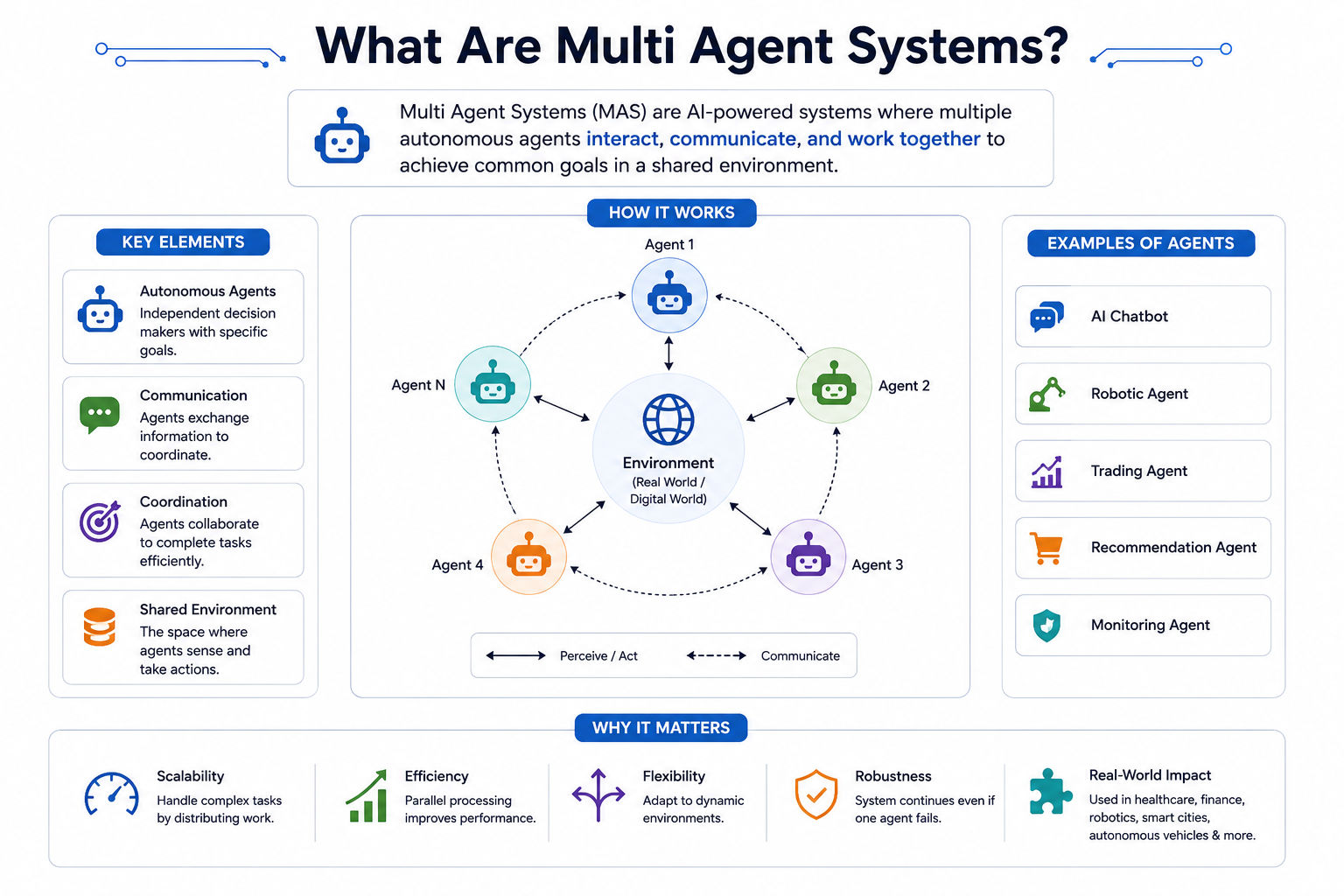
To understand how these systems work, you must look at what makes up an individual agent. There are three primary parts to every agent in these systems.
Also Read: What Is Agentic AI? The Simple Guide to Self-Driving Software
Coordination is the most important part of this technology. Without it, the agents might work against each other. For instance, two agents might try to use the same digital resource at the same time. This causes a conflict. To avoid this, multi agent systems use coordination protocols. These are sets of rules that tell agents when to wait and when to act.
Communication allows agents to share information. They might share what they have learned or what they plan to do next. This helps the entire group become smarter over time. The table below highlights the key differences between a standard single-brain AI and these cooperative systems.
| Feature | Single AI System | Multi Agent Systems |
| Decision Making | Centralized in one place | Decentralized across many |
| Scalability | Hard to grow | Very easy to add more |
| Robustness | Fails if the main brain fails | Continues even if one part fails |
| Complexity | High internal complexity | Simple parts, complex behavior |
By using this decentralized approach, the system becomes much more reliable. If one agent stops working, the others can usually pick up the slack. This makes the entire operation safer for critical tasks like managing power grids or healthcare data.
Also Read: 10+ Real Agentic AI Examples Across Industries (2026 Guide)
Multi agent systems work because each agent can act on its own while still contributing to a larger goal. These features make them useful for complex, real-time problems where a single system would struggle.
Each agent can make its own decisions based on data, rules, or learned behavior. It does not wait for constant human input.
This means agents can respond instantly to changes. For example, in a delivery system, each agent can choose the best route based on traffic conditions without asking a central controller.
Agents can share information and coordinate actions to solve a problem together. They do not work in isolation.
In many multi agent systems, there is no single point of control. Intelligence is spread across multiple agents.
This reduces dependency on one system and improves reliability. If one agent fails, others can continue working without stopping the entire system.
Also Read: Future of Agentic AI
You can add more agents as the system grows without rebuilding everything from scratch.
Agents can react to changes in real time. They adjust their behavior based on new data or conditions.
For instance, in a smart energy system, agents can shift power distribution based on demand changes. This helps the system stay efficient even when conditions change quickly.
Feature |
What it means |
| Autonomous decisions | Agents act independently |
| Collaboration | Agents work together |
| Distributed intelligence | No single control point |
| Scalability | Easy to expand |
| Adaptability | Responds to change in real time |
These features make multi agent systems powerful for handling dynamic, large-scale problems.
Also Read: Types of AI: From Narrow to Super Intelligence with Examples
The way you build and organize these agents is known as multi agent system architecture. This structure determines how agents find each other and how they share their work. It is essentially the blueprint for the entire digital organization.
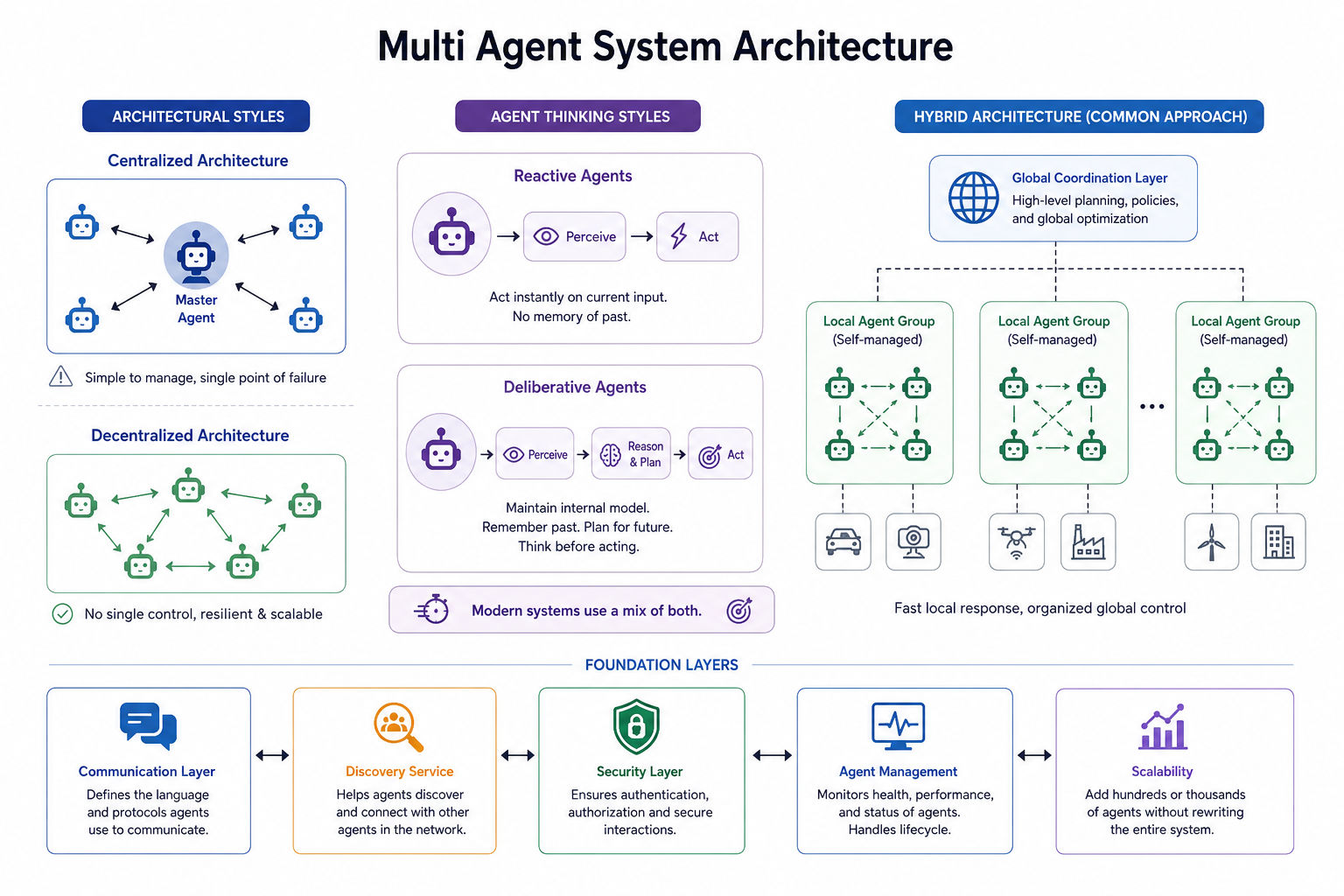
In a centralized architecture, there is usually a "master" agent. This master agent tells all the other agents what to do. It collects all the information and makes the big decisions. While this is simple to manage, it can be slow.
If the master agent has a problem, the whole system might stop. This is why many modern developers are moving toward decentralized structures. In these designs, no single agent is in charge. Every part of the multi agent system architecture is equal and independent.
Also Read: Intelligent Agent in AI: Definition and Real-world Applications
Inside the architecture, agents can also be categorized by how they think.
Reactive agents:
Deliberative agents:
Many industries now use hybrid multi agent system architecture. This combines the best of both worlds. It uses small groups of agents that manage themselves locally. Then, these groups report to a higher-level layer for global coordination. This keeps the system fast at the local level but organized at the global level.
Using a well-defined multi agent system architecture ensures that the technology can scale. You can add hundreds or even thousands of new agents without rewriting the entire code.
Also Read: Agentic AI Architecture: Components, Workflow, and Design
A multi agent system architecture is built from a few key components that work together. Each part has a clear role, and the system runs smoothly when all components are aligned.
Agents are the core of the system. They are the decision-makers that observe, think, and act based on their role. Each agent works independently but contributes to the overall goal. Some agents may handle data, others may take actions, and some may coordinate tasks.
Examples include:
The environment is the space where agents operate. It includes everything the agents interact with.
This can be:
Agents observe this environment, collect data, and act based on what they detect.
Also Read: Agentic RAG Architecture: A Practical Guide for Building Smarter AI Systems
Agents need to exchange information to work effectively. The communication layer handles this interaction.
It ensures:
For example, in a trading system, one agent may detect a signal and inform others to act.
What this means:
This component ensures agents work together without conflict. It defines how tasks are shared and managed.
It helps with:
For example, in a delivery system, coordination ensures two agents do not pick the same task.
What this means:
Also Read: Top Agentic AI Tools in 2026 for Automated Workflows
Agents rely on data and past experience to make decisions. The knowledge base stores this information.
It may include:
Component |
Role |
| Agents | Perform tasks and make decisions |
| Environment | Provides data and context |
| Communication Layer | Enables interaction |
| Coordination Mechanism | Manages cooperation |
| Knowledge Base | Supports decision-making |
These components define how a multi agent system architecture functions and scales in real-world applications.
Multi agent systems help you solve complex problems by distributing tasks across multiple agents. They improve efficiency and flexibility, but they also introduce coordination and design challenges. You need to understand both sides before using them in real-world systems.
Aspect |
Benefits |
Challenges |
| Performance | Parallel task execution improves speed | Coordination between agents can slow decisions |
| Scalability | Easy to add new agents as system grows | Managing large numbers of agents becomes complex |
| Flexibility | Adapts to dynamic environments | Hard to control behavior across agents |
| Reliability | System continues even if one agent fails | Failure handling can be difficult to design |
| Decision-making | Distributed intelligence improves outcomes | Conflicts between agents may occur |
| Communication | Enables real-time collaboration | Requires efficient communication protocols |
| Development | Modular design simplifies updates | Initial setup and design are complex |
| Security | No single point of failure | Vulnerable to malicious or faulty agents |
This balance helps you decide when multi agent systems are the right choice for your project.
Also Read: Top 10 Free AI Agents in 2026
Multi agent systems are widely used across industries where tasks are complex and distributed. Their ability to divide work across multiple agents makes them useful in real-time and large-scale environments.
Also Read: The Complete Guide to Knowledge-Based Agents in AI
Multi agent systems are becoming more important as AI systems grow in scale and complexity. You will see them move from simple task automation to fully coordinated, intelligent ecosystems.
Agents will not just share data. They will understand context and make joint decisions.
You will see systems where agents plan and execute tasks together without constant human input.
Multi agent systems will combine with generative AI models to improve outputs.
Also Read: AI Agent vs AI Assistant: What’s the Real Difference?
Future systems will operate in real time with minimal delay.
Examples include autonomous vehicles, trading systems, and smart cities.
You will see more fully autonomous systems powered by multi agent system architecture.
These systems will handle tasks with little human intervention.
Systems will handle thousands or even millions of agents.
This will support applications like global logistics and large IoT networks.
Also Read: Difference between Agentic AI and AI Agents
Multi agent systems will create demand for new roles.
You will need skills in AI, programming, and system design.
Multi agent systems help you build scalable and intelligent solutions by distributing tasks across agents. They improve efficiency, adaptability, and real-time decision-making in complex environments, making them a key part of future AI systems.
To acquire these future-ready skills, explore upGrad’s agentic AI courses and start building practical multi-agent applications for real-world use.
Want personalized guidance on Agentic AI and upskilling? Speak with an expert for a free 1:1 counselling session today.
A common example of multi agent systems is a smart traffic management network. Different traffic signals act as agents, monitor road conditions, and coordinate with nearby signals to reduce congestion and improve traffic flow in real time.
The main AI agent types include simple reflex, model-based, goal-based, utility-based, learning, hierarchical, and collaborative agents. These agents differ in how they process information, make decisions, and interact with environments or other agents inside intelligent systems.
There is no fixed number of agents in multi agent systems. A system may contain a few agents or thousands, depending on the application. The number usually depends on task complexity, scalability requirements, and the environment where the system operates.
The four common AI system categories are reactive machines, limited memory systems, theory of mind systems, and self-aware systems. Most modern AI applications today operate using reactive or limited memory approaches for decision-making and automation.
Multi agent system architecture improves efficiency by dividing large tasks into smaller responsibilities handled by separate agents. This allows systems to process information in parallel, reduce delays, and improve coordination in dynamic environments.
Yes, multi agent systems are an important area of artificial intelligence. They focus on how autonomous agents interact, collaborate, and make decisions within shared environments to solve problems more effectively.
They are widely used in autonomous vehicles, robotics, healthcare systems, smart cities, finance, and generative AI workflows. These applications rely on multiple agents working together to manage complex operations in real time.
Multi agent system architecture helps organize communication, coordination, and task distribution between agents. Without a proper structure, agents may conflict or fail to work efficiently in distributed AI systems.
Yes, many systems use machine learning techniques that allow agents to improve decisions over time. Agents can adapt to changes, learn patterns, and optimize their behavior based on past interactions and outcomes.
You need programming knowledge, AI fundamentals, distributed systems understanding, and problem-solving skills. Learning Python, reinforcement learning, and system design also helps when working with multi agent system architecture.
Multi agent systems are expected to play a major role in future generative AI workflows. Different agents will handle tasks like research, reasoning, verification, and execution together, leading to more accurate and scalable AI applications.
Yes, many modern GenAI and agentic AI courses include hands-on training in multi-agent orchestration, where learners design and manage multiple AI agents working together through structured workflows, tool usage, and task delegation. These programs focus on building scalable, real-world AI systems rather than single-agent chatbots or isolated prompts.
98 articles published
Rahul Singh is an Associate Content Writer at upGrad, with a strong interest in Data Science, Machine Learning, and Artificial Intelligence. He combines technical development skills with data-driven s...
Speak with AI & ML expert
By submitting, I accept the T&C and
Privacy Policy