Cohort Analysis in Data Science: A Complete Beginner to Advanced Guide
By Rahul Singh
Updated on Jun 03, 2026 | 10 min read | 4.77K+ views
Share:

All courses
Certifications
More
By Rahul Singh
Updated on Jun 03, 2026 | 10 min read | 4.77K+ views
Share:
Table of Contents
Cohort analysis is a behavioral analytics technique that groups users based on a shared characteristic or event within a specific time period, such as the month they signed up or made their first purchase. It then tracks how those groups behave over time to uncover patterns in engagement, retention, and customer value.
It is the most practical tools in data science. It helps you move beyond surface-level numbers and understand how specific groups of users behave over time. Instead of looking at all your users as one big blob, you zoom in on smaller groups who share something in common, like when they signed up or which campaign brought them in.
In this blog, you will learn exactly what cohort analysis in data science is, why it matters, how to run one from scratch, and how companies use it to make smarter decisions.
Popular Data Science Programs
Cohort analysis is a type of behavioral analytics where you group users based on a shared characteristic and then track how that group behaves over a defined time period.
The word "cohort" simply means a group. In data science, that group is usually defined by a specific event, like when a user first signed up, made their first purchase, or installed an app.
Imagine you are running an e-learning platform. Your total number of users is growing every month. But you notice that revenue is flat. Why?
Cohort analysis can tell you. You might find that users who joined in January complete more courses and buy more content than users who joined in March. That pattern would not show up in your overall numbers. It only becomes visible when you split users into cohorts.
That is the real power of cohort analysis. It makes hidden patterns visible.
Without Cohort Analysis |
With Cohort Analysis |
| All users lumped together | Users grouped by behavior or signup date |
| Averages can hide problems | You see performance by specific group |
| Harder to find root causes | Easier to trace patterns to their source |
| Retention trends look flat | Retention by cohort shows actual decline or improvement |
Also Read: What Is Data Science? Courses, Basics, Frameworks & Careers
Free Courses
Not all cohort analysis works the same way. The type you use depends on what question you are trying to answer.
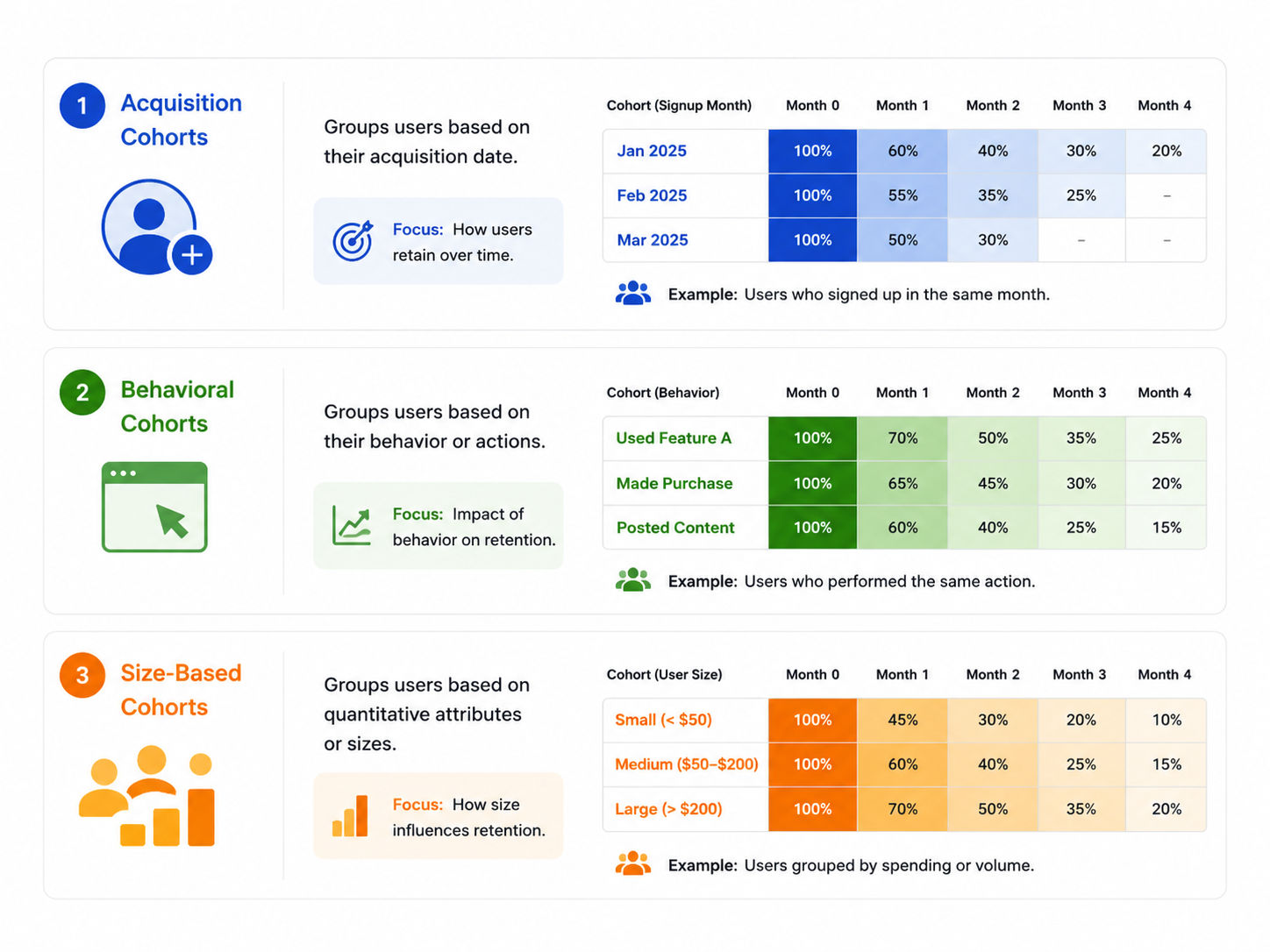
This is the most common type. Users are grouped based on when they first interacted with your product. For example, all users who signed up in the first week of April form one cohort. You then track how many of them came back in week two, week three, and so on.
This type of cohort analysis is excellent for measuring user retention and spotting when users tend to drop off.
Here, users are grouped based on a specific action they took, not just when they signed up. For example, users who watched at least one full video in their first session form a cohort. You then track whether those users are more likely to subscribe or make a purchase.
This type is useful for understanding the impact of specific user behaviors on long-term outcomes.
Also Read: Real Data Science Case Studies That Drive Results!
Sometimes companies group users by the size of their transaction or engagement. For example, users who spent more than a certain amount in their first month. This is helpful for understanding which customer segment drives the most value over time.
Cohort Type |
Grouping Basis |
Best Used For |
| Acquisition Cohort | Signup or first interaction date | Retention analysis, churn tracking |
| Behavioral Cohort | Specific user action | Feature impact, conversion analysis |
| Size-Based Cohort | Transaction or engagement size | Revenue analysis, LTV prediction |
Also Read: Career in Data Science: Jobs, Salary, and Skills Required
Data Science Courses to upskill
Explore Data Science Courses for Career Progression
IIIT Bangalore
Executive Post Graduate Certificate in Data Science & AIPlacement Assistance
Running a cohort analysis is not as complicated as it sounds. Here is a clear process to follow.
Before touching any data, get clear on what you want to learn. Good questions for cohort analysis include:
A clear question shapes every other decision in the process.
Choose what will define your groups. The most common approach is the acquisition date, usually broken into weekly or monthly buckets. For a SaaS product, you might group all users who signed up in January as one cohort, February as another, and so on.
Also Read: NLP in Data Science: A Complete Guide
Decide what you will measure for each cohort. Common metrics include:
You need clean, structured data. For a basic cohort analysis, you typically need:
This data usually lives in a database. You would query it using SQL or load it into Python with Pandas.
A cohort table is a matrix. Rows represent cohorts (usually grouped by month or week). Columns represent time periods after the cohort's start date. Each cell shows the metric value for that cohort at that point in time.
Here is a simplified example of a cohort retention table:
Cohort |
Month 0 |
Month 1 |
Month 2 |
Month 3 |
| Jan 2024 | 100% | 62% | 48% | 41% |
| Feb 2024 | 100% | 58% | 44% | 37% |
| Mar 2024 | 100% | 71% | 55% | 50% |
| Apr 2024 | 100% | 74% | 60% | 53% |
In this example, you can immediately see that March and April cohorts retained better at month 3. That is a signal worth investigating.
Also Read: Data Science Life Cycle: Phases, Tools and Best Practices
Raw numbers are hard to read. A heatmap is the most popular way to visualize cohort tables because darker cells show higher retention and lighter cells show drop-off. This makes patterns pop out instantly.
Tools like Python (Seaborn, Matplotlib), Tableau, Looker, and even Excel can produce cohort heatmaps.
Analysis is only useful when it drives a decision. If you notice that one cohort dropped sharply at month 2, investigate what changed. Did the product change? Was there a bug? Did a new competitor launch? Then test changes to see if retention improves for future cohorts.
Python is the go-to language for cohort analysis in data science. Here is how a typical workflow looks using Pandas.
You start by loading your event data. Your dataset usually has at minimum:
import pandas as pd

# Load your data
df = pd.read_csv('user_events.csv')
df['order_date'] = pd.to_datetime(df['order_date'])

# Assign each user to a cohort based on their first purchase month
df['cohort_month'] = df.groupby('user_id')['order_date'].transform('min').dt.to_period('M')

# Calculate how many months since the user joined
df['order_month'] = df['order_date'].dt.to_period('M')
df['months_since_join'] = (df['order_month'] - df['cohort_month']).apply(attrgetter('n'))from operator import attrgetter
# Count unique users per cohort and period
cohort_data = df.groupby(['cohort_month', 'months_since_join'])['user_id'].nunique().reset_index()
# Pivot to create the cohort matrix
cohort_table = cohort_data.pivot_table(index='cohort_month', columns='months_since_join', values='user_id')
# Convert to retention percentages
cohort_size = cohort_table.iloc[:, 0]
retention_table = cohort_table.divide(cohort_size, axis=0).round(3) * 100import seaborn as sns
import matplotlib.pyplot as plt
plt.figure(figsize=(14, 8))
sns.heatmap(retention_table, annot=True, fmt='.1f', cmap='Blues', linewidths=0.5)
plt.title('Monthly Cohort Retention Rate (%)')
plt.ylabel('Cohort Month')
plt.xlabel('Months Since First Purchase')
plt.tight_layout()
plt.show()This gives you a clean, visual cohort retention heatmap that makes patterns immediately clear.
Key things to watch for in the output:
Also Read: Top 70 Python Interview Questions & Answers: Ultimate Guide 2026
Cohort analysis shows up across almost every data-heavy industry. Here are some concrete examples.
Online stores use cohort analysis to track how customers who bought during a sale compare to regular shoppers. They look at whether discount buyers come back or just churn after the deal ends. This directly shapes how they plan future promotions.
Software companies live and breathe retention. A SaaS business typically watches how long it takes for a new cohort to cancel their subscription. If free trial users who watched a demo video stick around longer than those who did not, that is a behavioral cohort insight worth acting on.
Also Read: Top Applications of Data Science in Non-Tech Industries
App developers track day 1, day 7, and day 30 retention for each new version they release. If a new release causes a drop in day-7 retention for that month's cohort, they know something broke in the user experience.
For platforms like upGrad, cohort analysis helps understand which batches of learners complete their programs, when dropout risk peaks, and what engagement patterns predict successful completion. This lets teams intervene early with learners who show warning signs.
Banks and fintech companies use cohort analysis to understand credit behavior. They group customers who took loans in the same quarter and track repayment patterns over time to manage risk better.
Also Read: Top 14 Data Analytics Real Life Applications Across Industries
Subscribe to upGrad's Newsletter
Join thousands of learners who receive useful tips
Even experienced analysts make these errors. Knowing them ahead of time saves you from drawing wrong conclusions.
Also Read: Top 10 Real-Time Data Science Projects You Need to Get Your Hands-on
Cohort analysis is not just a technique for data scientists. It is a way of thinking about your users more carefully. It replaces "how are things going overall" with "how is this specific group of users doing, and why."
If you want to go deeper into data science tools and techniques like this, upGrad offers Data Science courses that take you from the fundamentals all the way to advanced analytics so you are ready to apply these skills in real jobs.
Want personalized guidance on Data Science and upskilling? Speak with an expert for a free 1:1 counselling session today.
Cohort analysis is a method where you group users who share a common experience, like signing up in the same month, and then track how that group behaves over time. It helps you spot patterns that get hidden when you look at all users together.
Segmentation groups users based on static characteristics like age or location. Cohort analysis groups users based on a shared time-based experience and then tracks how that group changes over time. Cohort analysis is dynamic while segmentation is usually a snapshot.
Product managers use cohort analysis to measure how product changes affect user retention, identify which features drive long-term engagement, and understand at what point users tend to drop off. It connects product decisions directly to measurable outcomes.
Take the number of users from a cohort who were active in a given period and divide it by the total number of users in that cohort at the start. Multiply by 100 to get a percentage. For example, if 300 out of 500 January users came back in February, the month-1 retention rate is 60%.
Common tools include Python with Pandas and Seaborn for custom analysis, SQL for querying databases, and business intelligence tools like Tableau, Looker, Mixpanel, and Amplitude for product analytics teams. Excel can handle simple cohort tables as well.
In machine learning, a cohort is a subset of data grouped by a shared attribute, often used for fairness analysis or model evaluation. You might evaluate whether a model performs equally well across cohorts defined by age, region, or signup period to identify bias or performance gaps.
A/B testing compares two groups who have been randomly assigned to different experiences to test a change. Cohort analysis tracks naturally formed groups over time without randomized treatment. Both are useful, but they answer different questions. A/B testing tests a hypothesis; cohort analysis surfaces patterns from historical behavior.
Cohort churn analysis is the process of tracking how many users from a specific cohort stop using your product over time. It helps you understand at which point users are most likely to leave and whether that churn rate is improving or worsening across newer cohorts.
Cohort analysis is primarily descriptive and diagnostic rather than predictive. However, identifying patterns in cohort data can inform predictive models. For example, if users who complete onboarding within 3 days consistently show higher long-term retention, you can use that as a feature in a churn prediction model.
LTV stands for Lifetime Value. In the context of cohort analysis, you track how much revenue each cohort generates over time. Comparing LTV across cohorts shows you which acquisition channels, campaigns, or time periods brought in your most valuable customers, which helps with budget allocation.
For most businesses, reviewing cohort data monthly is a good rhythm. High-growth startups or product teams pushing frequent updates may benefit from weekly cohort reviews. The key is consistency. Running cohort analysis regularly lets you spot whether changes you are making are actually improving retention or other key metrics over time.
96 articles published
Rahul Singh is an Associate Content Writer at upGrad, with a strong interest in Data Science, Machine Learning, and Artificial Intelligence. He combines technical development skills with data-driven s...
Speak with Data Science Expert
By submitting, I accept the T&C and
Privacy Policy
Start Your Career in Data Science Today
Top Resources
Executive Diploma
12 Months
Master's Degree
18 Months
Bootcamp
6 Months