Traditional Programming vs Machine Learning
By Sriram
Updated on Jun 25, 2026 | 7 min read | 6K+ views
Share:

All courses
Certifications
More
By Sriram
Updated on Jun 25, 2026 | 7 min read | 6K+ views
Share:
Table of Contents
Traditional programming and machine learning solve problems differently. Traditional programming depends on explicit rules written by developers to process data and generate outputs. In contrast, machine learning analyzes large datasets to identify patterns and automatically learn the rules needed for predictions or decisions. This enables ML systems to adapt, improve over time, and handle complex tasks that are difficult to define with fixed rules.
In this blog, you'll learn how both approaches work, where each performs best, their advantages and limitations. You'll also explore practical examples that make the differences easier to understand.
Build hands-on AI & ML skills with upGrad’s Artificial Intelligence courses and machine learning. Learn generative AI, ML and programming technologies through real-world projects.
Popular AI Programs
Both traditional programming and machine learning sound similar as both takes input and gives output. However, they are very different in their decision making, management of complexity, ability to adapt to change and ability to learn.
Grasping the distinctions enables developers and businesses to select the appropriate methodology for specific challenges, be it rule-based logic or intelligence derived from data.
The following points summarise the major differences:
Feature |
Traditional Programming |
Machine Learning |
| Learning Capability | Does not learn from experience. Behavior remains fixed unless developers update the code. | Learns from data and improves performance through training and retraining. |
| Data Dependency | Relies primarily on developer-defined rules and logic. | Depends heavily on the quality, quantity, and relevance of data. |
| Transparency | Easy to understand and explain because all rules are explicitly written. | Can be difficult to interpret, especially with complex models like deep learning networks. |
| Flexibility | Works best when rules and conditions remain stable over time. | Adapts well to changing patterns and dynamic environments. |
| Maintenance | Requires manual updates whenever business rules change. | Requires ongoing model monitoring, retraining, and performance evaluation. |
| Explicit Rules | Yes, developers define all decision-making rules. | No, the model learns patterns automatically from data. |
| Ease of Explanation | High; decisions can be traced back to specific rules. | Often lower; some models operate as "black boxes." |
| Handling Complexity | Suitable for simple to moderately complex problems. | Excels at recognizing complex patterns in large datasets. |
| Training Data Requirement | Not required. | Essential for model development and accuracy. |
| Adaptability | Limited; changes require code modifications. | High; models can adapt through retraining on new data. |
Also read : Machine Learning Course Syllabus: A Complete Guide to Your Learning Path
Free Courses
Traditional programming is the conventional method of software development where developers write explicit instructions that tell a computer exactly how to perform a task. The program follows predefined rules and produces outputs based on those rules.
This approach works well when the problem is predictable and the decision-making logic can be clearly defined in advance.
Traditional programming follows a rule-based workflow. Developers analyze a problem and create step-by-step instructions that the computer executes.
The typical workflow includes:
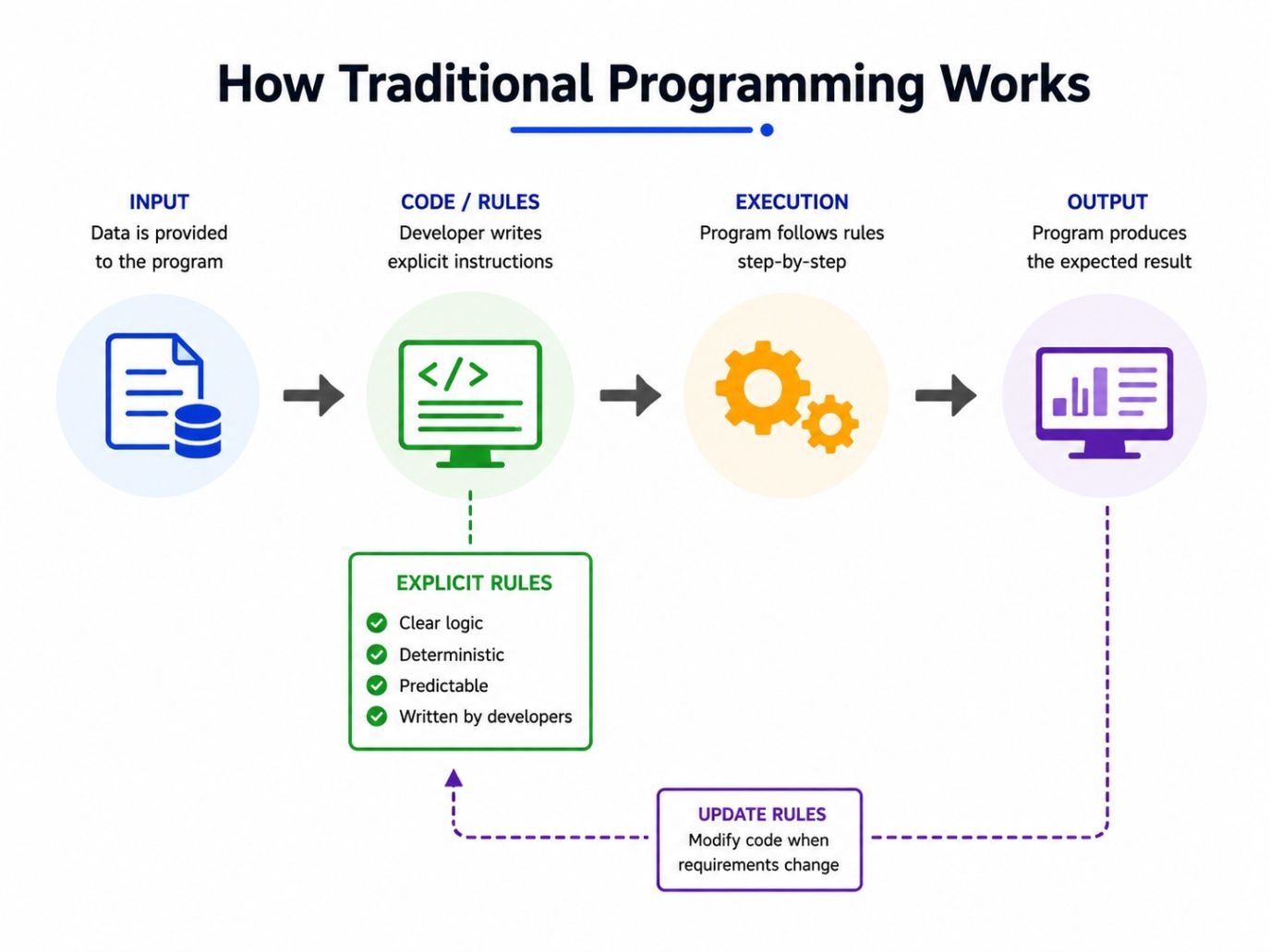
Think of an email spam filter
Developers can write rules such as:
These rules might work well for simple cases. But as spam techniques evolve, the rules need to be continually refreshed by developers to stay accurate.
Do read : Machine Learning Course Syllabus: A Complete Guide to Your Learning Path
AI Courses to upskill
Explore Artificial Intelligence Courses for Career Progression
Machine learning is a branch of artificial intelligence that enables systems to learn patterns from data rather than relying solely on manually written rules. Instead of programming every decision, developers train models using historical data.
This allows machine learning systems to identify trends, make predictions, and improve performance over time.
Machine learning starts with data rather than predefined instructions. The algorithm analyzes examples and learns patterns that help it make future predictions.
The typical workflow includes:
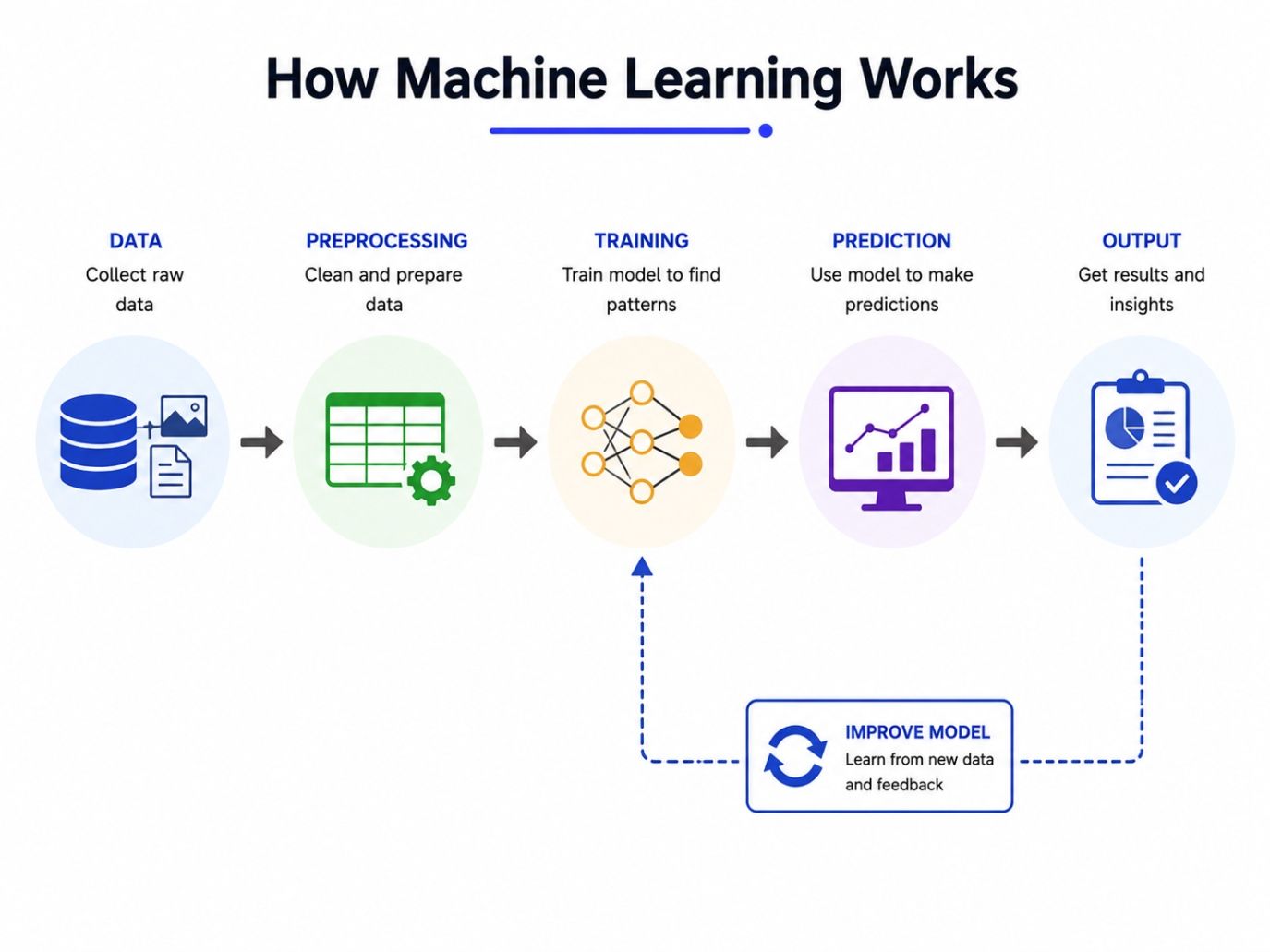
Imagine a company wants to build software that can tell whether there’s a cat in an image.
Instead of creating thousands of rules for ears, whiskers, fur patterns and body shapes, developers give the model a large set of images labelled as:
The machine learning algorithm studies these examples, and automatically learns distinguishing features.
The trained model can correctly identify cats even when:
This ability to learn from data is what makes machine learning so effective for image recognition, speech processing, recommendation systems and predictive analytics.
Also Read : Feature Reduction in Machine Learning
The table below highlights the major advantages and limitations of traditional programming and machine learning. Understanding these tradeoffs can help businesses, developers, and data professionals choose the most effective approach for solving specific problems.
Approach |
Advantages |
Limitations |
| Traditional Programming | Predictable results, easy debugging, low data requirements, transparent decision-making. | Limited adaptability, struggles with complex patterns, requires manual rule updates. |
| Machine Learning | Learns from data, detects patterns, handles large datasets, improves accuracy over time. | Needs large datasets, requires retraining, less transparent, can inherit data bias. |
Also Read : What Is a Natural Language in Computer Programming?
Traditional programming and machine learning differ in how they solve problems. Conventional programming adheres to specified rules defined by programmers, which works well for tasks that are predictable and structured.
Machine learning learns patterns from the data and adapts to the complex scenarios. While traditional programming provides consistency and transparency, machine learning shines in dealing with large datasets and dynamic challenges. Many modern applications employ both approaches for better results.
Want personalized guidance on AI and upskilling? Speak with an expert for a free 1:1 counselling session today.
No. Machine learning and traditional programming serve different purposes. Many business applications still rely on predefined rules for security, compliance, and transaction processing. Machine learning works best when patterns are difficult to define manually. Most modern software combines both approaches rather than replacing one with the other.
Traditional programming is a better choice when the logic is clear, stable, and predictable. Examples include payroll systems, tax calculations, inventory management, and workflow automation. If developers can easily define the rules, using machine learning may add unnecessary complexity and maintenance costs.
Not always. Some machine learning models can work with smaller datasets, especially when combined with domain expertise and quality data preparation. However, larger datasets generally improve accuracy and reliability. The quality of data often matters more than the sheer volume of records available.
In many cases, yes. Traditional software requires updates when business rules change. Machine learning systems need ongoing monitoring, retraining, and performance evaluation. Data quality issues can also affect results. Maintenance often involves both software engineering and data science expertise.
Traditional programming uses predefined rules written by developers to process inputs and generate outputs. Machine learning learns patterns directly from data and uses those patterns to make predictions. The main distinction is that one follows explicit instructions, while the other learns from examples and improves through experience.
Yes. Small businesses increasingly use machine learning through affordable cloud platforms and software tools. Common applications include customer segmentation, sales forecasting, chatbot automation, recommendation systems, and fraud detection. Businesses do not always need a dedicated AI team to start using practical machine learning solutions.
The answer depends on the problem. Traditional programming performs well when rules are clearly defined and outcomes must remain consistent. Machine learning performs better when dealing with complex patterns, large datasets, and changing conditions. In the discussion of traditional programming vs machine learning, the best option depends on the specific use case.
Machine learning models learn from the data they receive. If the data contains errors, gaps, or bias, predictions may be inaccurate. Models can also struggle when new situations differ from their training data. Regular evaluation, retraining, and high-quality datasets help improve performance over time.
Traditional programming powers systems such as calculators, ATM software, and online payment processing. Machine learning drives recommendation engines, voice assistants, spam filters, and fraud detection tools. Understanding traditional programming vs machine learning becomes easier when you compare these everyday applications and how they make decisions.
Yes. Programming remains an important skill in machine learning. Developers use languages such as Python to clean data, build models, automate workflows, and deploy solutions. Strong programming fundamentals also help professionals understand algorithms, troubleshoot issues, and optimize machine learning applications.
Most beginners find traditional programming easier because it focuses on clear rules, logic, and structured problem-solving. Machine learning adds concepts such as statistics, data preparation, model training, and evaluation. Learning programming first often creates a stronger foundation before moving into machine learning and artificial intelligence topics.
727 articles published
Sriram K is a Senior SEO Executive with a B.Tech in Information Technology from Dr. M.G.R. Educational and Research Institute, Chennai. With over a decade of experience in digital marketing, he specia...
Speak with AI & ML expert
By submitting, I accept the T&C and
Privacy Policy
Top Resources
Master's Degree
18 Months
Executive Diploma
12 Months
IIIT Bangalore
Executive Programme in Generative AI & Agentic AI for LeadersIndia’s #1 Tech University
Dual Certification
5 Months