Machine Learning Language: A Beginner’s Guide to the Best Programming Languages
By Sriram
Updated on Jun 27, 2026 | 8 min read | 7.87K+ views
Share:

All courses
Certifications
More
By Sriram
Updated on Jun 27, 2026 | 8 min read | 7.87K+ views
Share:
Table of Contents
Choosing machine learning language is one of the initial decisions every person who wants to be a machine learning engineer, data scientist or AI enthusiast has to make. The programming language you use can affect how fast you build models get to use libraries work with your team and put applications into use. Understanding what each language can do well and what it can't do helps you learn faster and work on projects without any doubts.
In this blog, you'll learn what a machine learning language is, why programming languages are important in machine learning, which languages are best for beginners and professionals. Compare machine learning languages, explain where each one excels, share practical examples, and help you choose the right language based on your goals.
ML fluency is the skill employers want. Explore Machine Learning Courses Online from upGrad and build your machine learning language expertise.
Popular AI Programs
Machine learning language is a type of programming language that people use to build and train machine learning models. They also use it to evaluate and deploy these models. These languages give us the tools we need to work with data and implement algorithms. We can even automate workflows. Create smart applications with them.
Machine learning is about teaching computers to find patterns in data on their own. It does not want them to just follow instructions. Programming languages make this happen because they let developers write code that looks at data and trains algorithms; this code can even make predictions.
There are languages that people use for machine learning today. Each machine learning language has different strengths; depending on what kind of project you're working on and what you need, how the language will perform and what libraries it has and the learning curve.
Also Read: Machine Learning Tutorial: Basics, Algorithms, and Examples Explained
Selecting the language for machine learning is really important. It does not just affect how you write code. For example, if you are building a recommendation system, you might want to choose a language that lets you develop fast. Python is a choice here.
On the hand, if you are working on applications that need to run fast, you might combine Python with C++. This is because C++ helps make things run faster. The organization working on high-performance applications may use Python with C++.
It influences:
Free Courses
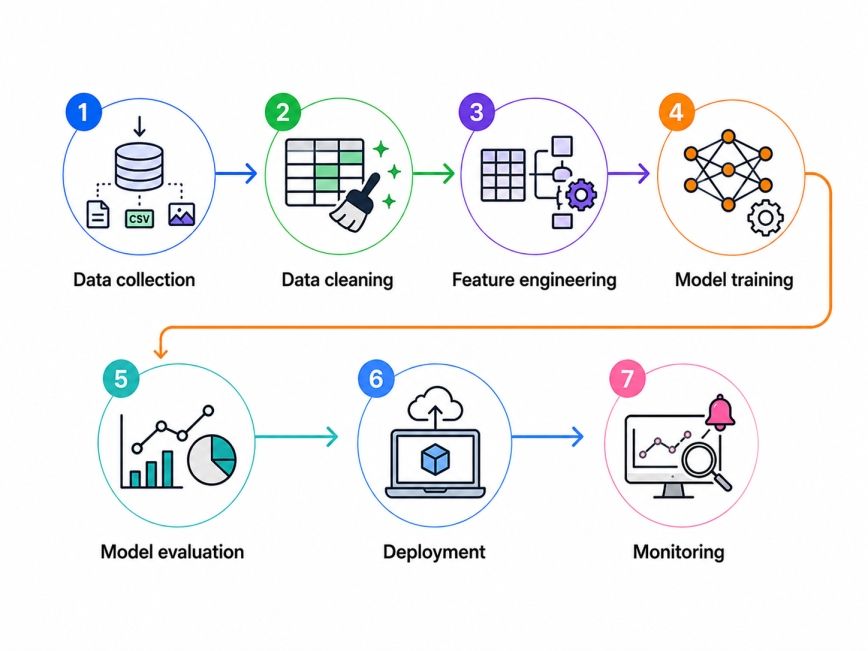
Machine learning workflows usually have similar steps no matter what programming language people use for machine learning. Every major machine learning language supports these tasks, although the available tools and libraries differ.
Task |
Purpose |
| Data collection | Gather structured or unstructured data |
| Data cleaning | Remove errors and prepare datasets |
| Feature engineering | Create meaningful input variables |
| Model training | Train algorithms using data |
| Model evaluation | Measure prediction accuracy |
| Deployment | Make the model available to users |
| Monitoring | Track model performance over time |
AI Courses to upskill
Explore Artificial Intelligence Courses for Career Progression
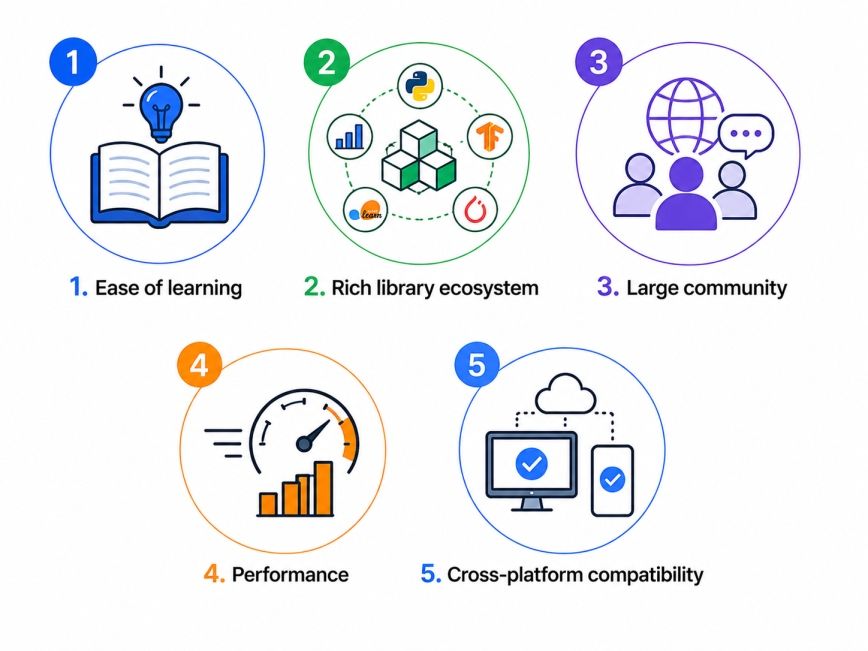
A good programming language for machine learning provides benefits.
1. Ease of learning
Beginners should be able to understand the syntax without spending months learning complex programming concepts.
2. Rich library ecosystem
Popular libraries reduce development time because many algorithms are already implemented.
3. Large community
An active developer community means better tutorials, documentation, and faster solutions to coding problems.
4. Performance
Some machine learning applications require handling millions of records or making predictions in real time.
5. Cross-platform compatibility
Developers often work across different operating systems and cloud platforms.
Imagine you want to predict house prices.
You can do most of the work for house prices with a few lines of code. This is because we have good machine learning libraries now. These libraries help the developers to think about the picture and solve problems, for house prices instead of implementing algorithms from scratch.
Using a machine learning language, you would:
Not every programming language is good for machine learning. Some companies use languages for machine learning, in one project. For example, Python may do model development while Java does enterprise deployment, and C++ powers the performance-critical components.
The best language to use really depends on what you want to learn, what your project needs, and what you want to do with your career. Instead of looking for the best language, it is better to know what each language is used for in machine learning. You should understand where each language fits in the picture of machine learning.
General Programming Language |
Machine Learning Language Suitability |
| Python | Excellent |
| R | Excellent for statistics |
| Java | Very Good |
| C++ | Excellent for performance |
| Julia | Growing rapidly |
| JavaScript | Useful for browser-based AI |
Also Read: Which Language Is Best for AI?
Programming languages is good for solving different problems. Some programming languages make it easy for people to learn programming languages. Other programming languages are better at doing things working with big programs.
When you know what each programming language is good, you can use your time to learn the programming languages.
Python remains the most popular language used for machine learning worldwide.
Its popularity comes from three major advantages:
Popular libraries include:
Python is suitable for:
R was originally developed for statistics and data analysis. It remains one of the strongest languages used for machine learning when statistical modeling and visualization are the primary focus.
Advantages include:
R is widely used in:
Java has long been a favorite for enterprise software development. It also serves as a reliable machine learning language for production environments where stability and scalability are essential.
Key strengths include:
Java is commonly used for:
C++ is known for speed. Although it requires more programming knowledge, it powers many machine learning frameworks behind the scenes.
Developers choose C++ when they need:
Applications include:
While many professionals learn languages, Python is still the best place to start. This is because Python is simple and has an ecosystem. When you get the hang of it learning languages gets easier. This is especially true if your projects need to run or work with big businesses.
Language |
Beginner Friendly |
Speed |
Libraries |
Best For |
| Python | Excellent | High | Excellent | General machine learning |
| R | Good | Moderate | Excellent | Statistics and analytics |
| Java | Moderate | High | Good | Enterprise AI |
| C++ | Difficult | Excellent | Moderate | Performance-intensive AI |
| Julia | Good | Excellent | Growing | Scientific computing |
| JavaScript | Good | Moderate | Growing | Browser-based machine learning |
When you want to learn machine learning, you need to pick the language. This depends on what you want to learn, what your project needs, and what you want to do with your career. A lot of people who're new, to this think they have to learn every language before they can start with machine learning. Really most people start with one language and then learn more as their projects get harder.
The best language to choose is the one that lets you work on projects without making things too complicated. If you are just starting out, it is better to learn one language well instead of trying to learn a little bit of many languages. Machine learning is the key so you should focus on learning one language that will help you with machine learning.
Before selecting a language used for machine learning, ask yourself a few practical questions. Your answers can guide your decision.
Goal |
Recommended Language |
| Learning machine learning | Python |
| Statistical analysis | R |
| Enterprise software | Java |
| High-performance AI | C++ |
| Scientific computing | Julia |
| Browser-based AI | JavaScript |
Subscribe to upGrad's Newsletter
Join thousands of learners who receive useful tips
Machine learning is changing fast. Python is still the choice for machine learning. Developers now use many languages, cloud platforms, and special frameworks to make AI applications.
Knowing these trends can help you get ready for what's next. It can help you find chances in machine learning. Machine learning is. Being prepared is key.
Python shows no signs of slowing down. Python gets new frameworks and tools first. This is why Python is the number one choice for researchers and developers.
Its success comes from:
As the size of Artificial Intelligence models gets bigger, how fast they can be executed becomes important.
This is why people are looking at languages like C++, Julia, and Rust, for jobs that need a lot of power. These languages help developers use memory in a way and make real-time applications faster.
Instead of taking the place of Python these languages usually work with Python.
Not every machine learning solution needs much code. Modern AutoML platforms tasks, like:
These tools reduce development time but still rely on programming languages behind the scenes.
Modern AI systems combine multiple technologies. This collaborative approach means professionals increasingly learn several languages used for machine learning during their careers.
A typical workflow may include:
Task |
Technology |
| Data storage | SQL |
| Data processing | Python |
| Model deployment | Java |
| Performance optimization | C++ |
| Cloud infrastructure | Docker and Kubernetes |
To become a professional in the field of intelligence learning a language used for machine learning is just the beginning. A good machine learning professionals need to have programming skills and also be able to analyze things well.
Employers also value:
Selecting the right machine learning language is less about finding a single winner and more about choosing the best tool for your goals. Python remains the preferred option for beginners because of its simplicity, extensive libraries, and active community. However, R, Java, C++, Julia, and JavaScript each play important roles in different machine learning applications.
As your experience grows, learning additional languages used for machine learning will become a natural next step. The most successful professionals are those who combine strong programming skills with practical experience and a willingness to keep learning.
Want to explore more about management accounting? Book your free 1:1 personal consultation with our expert today.
Python is widely considered the best machine learning language for beginners because its syntax is easy to understand and it offers a rich collection of libraries. It also has extensive documentation, tutorials, and community support, making it easier to build projects and learn concepts quickly.
No. Although Python is the most popular language used for machine learning, professionals also use R, Java, C++, Julia, and JavaScript depending on project requirements. The right language depends on factors such as performance, deployment needs, and statistical analysis.
Many organizations combine languages used for machine learning to improve efficiency. Python may handle model development, SQL manages data, Java supports enterprise deployment, and C++ optimizes performance. Each language contributes its strengths to the overall workflow.
Yes, but learning basic programming significantly improves your understanding of machine learning concepts. Starting with Python allows beginners to focus on algorithms and data rather than complex syntax. Building small projects is often the fastest way to gain confidence.
Python is the preferred machine learning language for deep learning because major frameworks such as TensorFlow, PyTorch, and Keras are built around it. These frameworks simplify neural network development and support both research and production applications.
R excels in statistics, data analysis, and visualization, while Python offers broader support for machine learning and artificial intelligence. If your work focuses on predictive modeling and AI applications, Python is usually the more practical choice.
Yes. SQL complements any language used for machine learning because most real-world projects involve retrieving and managing data stored in databases. Knowing SQL alongside Python makes you more effective in data science and machine learning roles.
C++ delivers excellent execution speed and memory efficiency, making it suitable for performance-intensive applications such as robotics and autonomous systems. However, many developers still build models in Python before optimizing critical components with C++.
Some newer languages, including Julia and Rust, are gaining attention because of their speed and modern design. However, Python continues to dominate thanks to its mature ecosystem, extensive libraries, and widespread industry adoption.
Most beginners can learn Python fundamentals within a few months through consistent practice. Becoming proficient in machine learning takes longer because it also requires understanding mathematics, statistics, data preprocessing, and model evaluation.
Knowledge of a machine learning language can lead to roles such as machine learning engineer, data scientist, AI engineer, research scientist, NLP engineer, computer vision specialist, and data analyst. Demand continues to grow across healthcare, finance, retail, manufacturing, and technology.
730 articles published
Sriram K is a Senior SEO Executive with a B.Tech in Information Technology from Dr. M.G.R. Educational and Research Institute, Chennai. With over a decade of experience in digital marketing, he specia...
Speak with AI & ML expert
By submitting, I accept the T&C and
Privacy Policy
Top Resources
Master's Degree
18 Months
Executive Diploma
12 Months
IIIT Bangalore
Executive Programme in Generative AI & Agentic AI for LeadersIndia’s #1 Tech University
Dual Certification
5 Months