Agentic AI in Banking: Use Cases, Benefits, and Challenges
By upGrad
Updated on Oct 27, 2026 | 6 min read | 24.35K+ views
Share:

All courses
Certifications
More
By upGrad
Updated on Oct 27, 2026 | 6 min read | 24.35K+ views
Share:
Table of Contents
Quick Insights:
Build AI skills aligned with agentic systems and autonomous workflows with upGrad’s Generative AI and Agentic AI courses. Get hands-on experience with LLMs, RAG systems, and intelligent automations.
Agentic AI Courses to upskill
Explore Agentic AI Courses for Career Progression
IIIT Bangalore
EPGP in Applied AI and Agentic AIIIIT Bangalore
Executive Diploma in Machine Learning and AI360° Career Support
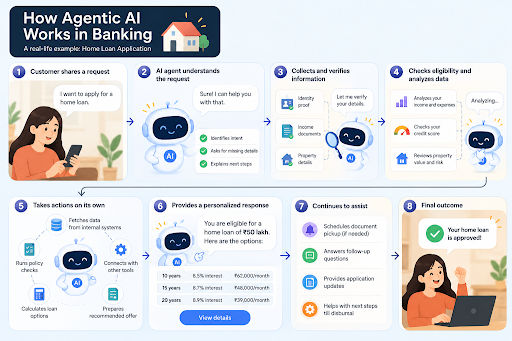
Agentic AI in banking means AI systems that can handle a task in many different steps. They can use data and approved tools, check the results, and decide what to do next. But they follow bank rules.
For example: When a bank receives a loan application,
This means: AI agents can do tasks along with answering questions.
AI agents follow these steps:
Most AI agents use large language model (LLMs) to understand the task and decide what to do next. It also uses approved tools, keeps track of the work done so far, and follows strict rules. These rules set limits on what it can access, what actions it can take, and when it must stop and ask a person or user for help.
Both types of AI help banks, but they work differently.
| Feature | Traditional AI | Agentic AI |
| Main role | Predicts outcomes or classifies data. | Plans steps and completes tasks. |
| What it does | Gives a result for a person to act on. | Takes action on its own but within set limits. |
| Type of task | Handles one task, such as checking a credit score. | Handles several steps across different systems. |
| Handling changes | May need new rules or retraining. | Can change its next steps based on new information. |
| Banking example | Marks a transaction as high risk. | Reviews the transaction, collects details, flags it, and prepares a case report. |
In simple terms, traditional AI gives banks predictions or results and agentic AI can take the next steps to complete a task.
Also Read: Generative AI vs Traditional AI
Want to build real-world systems using modern Agentic AI Frameworks? Enroll in our Executive Post Graduate Programme in Applied AI and Agentic AI and advance your AI career today.
We know banks handle thousands of transactions, customer requests, and documents every day. Agentic AI can help with this work by checking information, using banking systems, and completing tasks within the bank's rules. Here are five examples where it can help.
Banks receive many alerts about suspicious or unusual transactions. Checking every alert takes time, so AI agents can help review them.
This helps fraud teams review cases faster and spend more time on serious risks. It can also help reduce false alarms.
AI agents can help customers with everyday banking requests. From checking account information to managing payments.
For example, an AI agent may:
If a request is sensitive or difficult to handle, the agent passes it to a bank employee along with the conversation history.
Loan applications include many documents and checks. AI agents can help bank employees handle this work.
They can:
So, AI agents may help speed up the initial approval process within the bank's rules. Then a credit officer can review complex cases and make the final decision.
Learn More: Future of Agentic AI
Banks verify a customer's identity before opening an account or providing certain services. This process is known as Know Your Customer or KYC.
AI agents can help by:
This can make account opening faster and help reduce errors.
Banks need to follow rules, maintain records, and check that transactions are handled correctly or not. AI agents can help with many tasks like this.
Compliance tasks include:
Back-office tasks include:
These tasks take time to do manually. AI agents can help banks handle them faster, while staff review important decisions and unusual cases.
Also Read About : Agentic AI Examples Across Industries
Take the next step in your leadership journey with IIM Kozhikode’s Strategic AI for Business Professionals programme. Learn how to use AI to make smarter business decisions, improve business outcomes, and lead confidently in an AI-first world, all without coding.
Agentic AI can help banks complete everyday tasks faster, assist customers at any time, and spot potential risks sooner.
Know more about the use of AI in Banking and Finance
Banks handle customers' money and sensitive customer data. An AI mistake can lead to financial losses, security problems, or harm to customers.
Read About: Agentic AI Architecture
Banks need to decide which tasks AI agents should handle, set rules for their work, and test them before using them in daily banking operations.
Know About: Agentic AI Engineer: Career Guide
Conclusion
Agentic AI in Banking can help banks check documents, flag unusual transactions, and handle routine tasks with less manual effort. This can speed up services and give bank staff more time to focus on complex cases.
But, banks must protect customer data, check AI decisions, and review the important actions or decisions by themselves.
Banks should start with simple tasks and test how well the AI agents work. They should fix any problems and improve the system over time. This can help banks make their services faster and more efficient while protecting customer trust.
Curious which courses can help you gain expertise is Agentic AI? Contact upGrad for personalized counseling and valuable insights.
Similar Reads:
An AI agent is a software tool that performs tasks to reach a goal. Agentic AI is a system where one or more AI agents can plan tasks, make decisions, and take action on their own. In simple words, AI agents perform tasks, while agentic AI describes how they work together to achieve a goal.
Agentic AI helps banks handle requests faster and reduces repetitive work. It can improve customer service, find suspicious transactions, and help banks manage risks. It also gives bank employees more time to handle complex cases that need human judgement.
Banks can use agentic AI for different tasks, such as:
Yes. AI agents can monitor transactions in real time and compare them with a customer's usual spending habits. They can flag unusual payments, alert bank staff, and prepare reports for further checks. This helps banks respond faster, but some actions may still need human approval.
Agentic AI can be safe when banks use the right security measures. Banks must control which data each agent can access and protect sensitive information with encryption. They should also keep records of the agent's actions, test it regularly, and have people review its work to catch mistakes.
Agentic AI can handle repetitive tasks, such as checking documents and sorting requests. This gives employees more time to focus on customers, complex cases, and important decisions. Some jobs may change or become less common. Employees may also need new skills to manage and check AI systems.
AI agents can check loan documents, review customer details, and suggest whether a loan should be approved. However, a bank may require a human to review the application before making the final decision. This depends on the bank's rules and the regulations it must follow.
A regular chatbot mainly answers questions using stored information or prepared responses. An AI agent can also use banking tools to complete tasks. For example, a chatbot may explain how to report a failed transaction. An AI agent may also help raise a complaint in the bank's system if it has the required access and permission.
The main risks include data leaks, cyberattacks, unfair decisions, and errors that are hard to explain. AI agents may also fail to follow banking rules or face problems when working with older banking systems. Banks need strong security checks, clear rules, and human supervision to reduce these risks.
AI agents can answer customer questions on banking apps and websites at any time. They can also help with simple tasks, such as checking transaction details and raising service requests. They can use relevant account details and past interactions to give more useful answers. This also means customers may not need to repeat the same information.
Banks must set clear rules for what AI agents can do and which actions need human approval. They should keep records of the agents' actions and check their decisions for unfair results. Banks must also review how well these systems work and update their controls when banking rules change.
Not every small bank needs agentic AI right away. However, it can help them with tasks such as customer support, document checks, and customer onboarding. Small banks can start with AI tools from trusted providers instead of building their own systems.
Banks should start with a simple, low-risk task, such as checking documents or answering employee questions. They should set clear goals and decide which actions need human approval. Before launching the system, they should test it carefully. After launch, they should track its results and check for errors before giving it more tasks.
The data depends on the task an AI agent needs to perform. It may need customer details, transaction records, identity documents, or banking rules. Banks should only give the agent access to the information it needs to complete its task.
Yes. Banks are already using or testing AI agents for customer support, fraud monitoring, and daily tasks. However, not all banks use these systems in the same way. Some are still testing them, while others are introducing them with security checks to reduce mistakes and protect customer data.
1321 articles published
We are an online education platform providing industry-relevant programs for professionals, designed and delivered in collaboration with world-class faculty and businesses. Merging the latest technolo...
Speak with AI & ML expert
By submitting, I accept the T&C and
Privacy Policy