Uniform Cost Search in Artificial Intelligence: Complete Beginner’s Guide
By Sriram
Updated on Jul 02, 2026 | 8 min read | 2.24K+ views
Share:

All courses
Certifications
More
By Sriram
Updated on Jul 02, 2026 | 8 min read | 2.24K+ views
Share:
Table of Contents
Uniform Cost Search in Artificial Intelligence is a search algorithm used in AI to find the cheapest path through a weighted graph, not the shortest in terms of steps, but the one that costs the least overall. It works by always exploring the lowest-cost option first, using a priority queue to keep track of where it's been and what it might explore next. Think of it like a traveler who, at every crossroad, always takes the road with the smallest toll rather than the one with the fewest turns.
In this guide, you'll learn what uniform cost search is, how it works, its algorithm, properties, advantages, limitations, complexity, real-world applications, and how it compares with other popular search methods.
Explore Artificial Intelligence Courses from upGrad and Master AI search algorithms like Uniform Cost Search and build intelligent problem-solving systems.
Popular AI Programs
Uniform cost search in artificial intelligence is a simple way to find the best path. It looks at all the options. Picks the one that costs the least. Uniform cost search (UCS) does this by adding the cost of each step to get to a point. It always chooses the option that costs the least.
This way of doing things works well when you know how much each step costs, and none of those costs are negative. Uniform cost search is similar to something called Dijkstra's shortest-path algorithm. People often use cost search when they are dealing with weighted graphs, where different things you can do have different costs.
Also Read: Informed Search in Artificial Intelligence: Types & Examples
Property |
Description |
| Search Type | Uninformed |
| Data Structure | Priority Queue |
| Evaluation Function | g(n) |
| Goal | Lowest-cost path |
| Optimal | Yes |
| Complete | Yes |
Because the cheapest path is always explored first, UCS guarantees the least-cost solution under valid conditions.
The main idea behind Uniform cost search in artificial intelligence is simple:
Also Read: Problem Solving in Artificial Intelligence
Free Courses
The UCS algorithm in artificial intelligence follows a systematic process to ensure that the minimum-cost path is found.
Before diving in, here's the weighted graph we'll be navigating throughout this example:
Path |
Cost |
| S → A | 2 |
| S → B | 5 |
| A → C | 4 |
| B → C | 1 |
| C → G | 3 |
Where S = Start and G = Goal
Step 1: Initialize
We kick things off by placing the starting node into the priority queue with a cost of zero because we haven't moved yet.
Node |
Cost |
| S | 0 |
Step 2: Expand S
From the start, we look at all the roads leading out and add each neighbor along with its travel cost.
Node |
Cost |
| A | 2 |
| B | 5 |
Step 3: Expand A
Since A is the cheapest option right now, we head there first and discover a path leading to C.
Node |
Cost |
| C | 6 |
| B | 5 |
Step 4: Expand B
B, now sits at the front of the queue, so we explore it next and find another route to C with the same total cost.
New path to C: 5 + 1 = 6 (same as before, so no update needed)
Node |
Cost |
| C | 6 |
Step 5: Expand C
With C next in line, we expand it and finally spot the goal node G sitting just one step ahead.
Node |
Cost |
| G | 9 |
Step 6: Reach the Goal
The moment G gets pulled out of the priority queue; the algorithm knows it's done we've found the cheapest path.
Optimal Path: S → A → C → G
Optimal Path Cost = 9
AI Courses to upskill
Explore Artificial Intelligence Courses for Career Progression
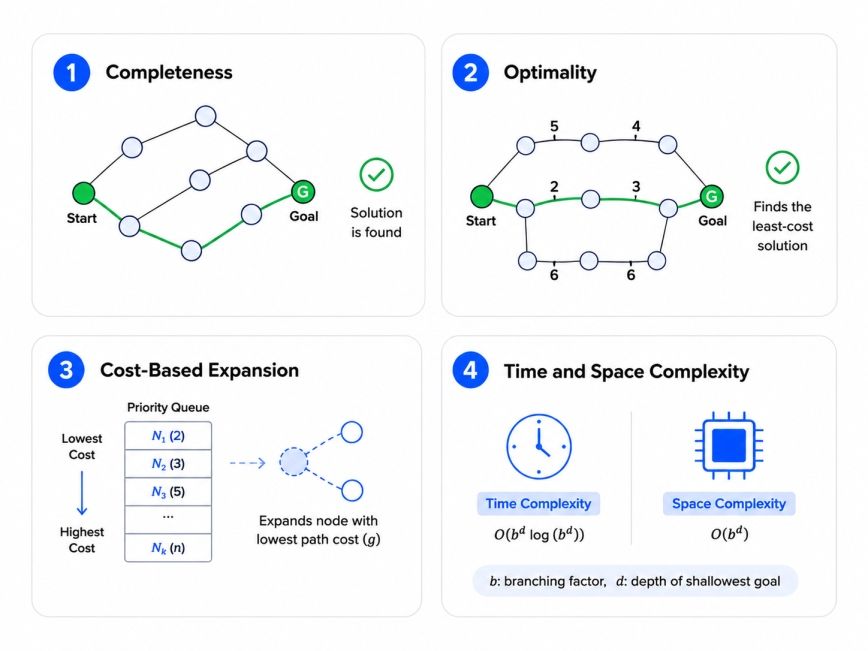
Uniform Cost Search is valued for its ability to find the most cost-effective path in a search space. Its key properties explain why it remains a foundational algorithm in artificial intelligence.
Uniform Cost Search is a complete algorithm. This means that if a solution exists and every step has a positive cost, the algorithm will eventually find that solution. It systematically explores paths in order to increase cost, ensuring that no valid path is permanently overlooked.
One of the biggest strengths of UCS is its optimality. The algorithm always returns the lowest-cost solution as long as all edge costs are non-negative. This makes it a dependable choice for problems where finding the cheapest path matters more than finding a quick solution.
Unlike algorithms that explore nodes based on depth or order of discovery, UCS expands nodes according to their cumulative path cost. At every step, it selects the node with the lowest total cost from the priority queue, helping it move toward the most economical solution.
The theoretical complexity of UCS is expressed as:
Metric |
Complexity |
| Time | O(b^(1 + C*/ε)) |
| Space | O(b^(1 + C*/ε)) |
Where:
In practice, UCS can become resource-intensive when dealing with large search spaces. Since it stores many nodes in memory while searching for the lowest-cost path, both execution time and memory usage can increase significantly as the problem size grows.
Also Read: A* Algorithm: Easy Guide to Concepts & Implementation
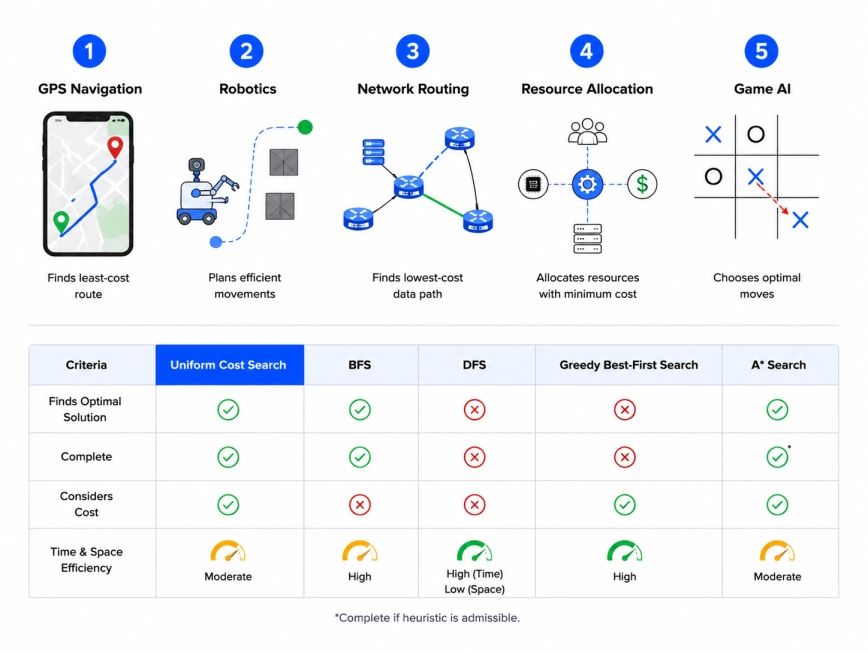
UCS isn't just a classroom concept. Once you start looking, you'll spot its logic, working quietly behind some of the tools and systems we rely on every day.
Ever wondered how your GPS figures out the cheapest route and not just the fastest one? That's UCS thinking in action it weighs every possible path based on real-world costs before making a suggestion.
Cost Factor |
What It Considers |
| Distance | How far you'll actually travel |
| Tolls | Extra charges along certain roads |
| Fuel Costs | How much your engine will burn on that route |
Robots don't have unlimited battery life, so every movement counts. UCS helps them pick paths that get the job done while burning as little energy as possible like a smart traveler who avoids unnecessary detours.
Challenge |
How UCS Helps |
| Limited battery | Finds the least energy-consuming path |
| Complex terrain | Weighs movement cost across different surfaces |
When you send a message or load a webpage, your data doesn't always take one straight road it hops across multiple routes. UCS helps find the path where transmission costs are kept as low as possible.
Route |
Transmission Cost |
| Path A → B → D | 4 |
| Path A → C → D | 7 |
| Best Route | Path A → B → D |
Organizations deal with limited budgets, staff, and time every single day. UCS-style thinking helps them map out the most cost-efficient way to assign resources without overshooting their limits.
Resource |
Goal |
| Budget | Minimize spending |
| Workforce | Assign tasks efficiently |
| Time | Reduce delays and waste |
Ever noticed how game characters seem to dodge danger and find clever shortcuts? That's cost-based pathfinding at work characters quietly calculate which route costs them the least in movement, health, or risk before taking a single step.
Cost Factor |
What the Character Avoids |
| Movement Cost | Long, exhausting routes |
| Risk Factor | Enemy territory or traps |
| Chosen Path | Safest, cheapest route to the goal |
Also Read: Applications of Artificial Intelligence and Its Impact
Before working with UCS, it helps to get comfortable with a few key ideas that the algorithm leans heavily.
1. Path Cost
Think of this as your running total every edge you cross adds to the bill, and this keeps track of it all.
Term |
Meaning |
| Path Cost | The total accumulated cost from the start node to the current node |
Example:
If you travel S → A → C, and the edges cost 2 and 4, your path cost at C is:
Journey |
Cost Breakdown |
Total |
| S → A | 2 | 2 |
| A → C | 4 | 2 + 4 = 6 |
2. Priority Queue
Forget first-come, first-served — this queue plays favorites, always putting the cheapest node at the front of the line.
Regular Queue |
Priority Queue |
| Orders by arrival time | Orders by lowest cost |
| Not ideal for UCS | Essential for UCS |
Example:
Node |
Cost |
Position in Queue |
| B | 5 | 2nd |
| A | 2 | 1st |
| C | 6 | 3rd |
A jump to the front because it has the lowest cost.
3. g(n)
This is simply the algorithm's way of asking - "how much did it actually cost me to get here from the very beginning?"
Term |
Meaning |
| g(n) | The exact cost from the start node to node n |
Example:
Node (n) |
Path Taken |
g(n) |
| A | S → A | 2 |
| C | S → A → C | 6 |
| G | S → A → C → G | 9 |
The higher you go down the path, the more g(n) grows and UCS always chases the smallest one first.
Consider a navigation app.
You have two routes:
Route |
Distance |
Cost |
| Route A | 5 km | ₹200 toll |
| Route B | 8 km | ₹20 toll |
A simple shortest-path algorithm may choose Route A because it has fewer steps or shorter distances. UCS chooses Route B if the overall cost is lower.
This makes the algorithm useful in situations where:
Subscribe to upGrad's Newsletter
Join thousands of learners who receive useful tips
Understanding the strengths and weaknesses of UCS helps determine when it should be used.
Advantages |
Limitations |
| Optimal solution | Large memory consumption |
| Complete search | Can be slow |
| Handles weighted paths | Poor scalability |
| No heuristic needed | Cannot handle negative costs |
Choose UCS when:
Avoid UCS when:
Uniform Cost Search remains one of the foundational search techniques in artificial intelligence. By expanding the lowest-cost path first, it guarantees optimal solutions and works effectively in weighted environments where actions have different costs.
Although it may consume significant memory and processing time for large problems, its reliability makes it an essential algorithm for AI students, developers, and researchers. Whether used in route planning, robotics, network optimization, or game development, uniform cost search in artificial intelligence continues to be a practical and widely taught method for solving cost-based search problems.
Want to explore more about Uniform Cost Search in Artificial Intelligence? Book your free 1:1 personal consultation with our expert today.
The main purpose of uniform cost search in artificial intelligence is to find the least-cost path between a start state and a goal state. It evaluates cumulative costs rather than the number of steps. This makes it suitable for weighted graphs where different actions have different costs.
They are closely related and often considered equivalent for shortest-path problems with non-negative edge weights. However, UCS is usually discussed in AI search problems, while Dijkstra's algorithm is commonly taught in graph theory and computer science.
A priority queue allows the algorithm to always select the node with the smallest cumulative cost. This ensures that cheaper paths are explored before expensive ones. As a result, UCS can guarantee optimal solutions under valid conditions.
Yes, but its behavior changes. Without a goal state, the algorithm can continue exploring nodes and calculating shortest paths. In practice, UCS is usually applied when a specific destination or target state exists.
Uniform Cost Search is not designed for graphs with negative edge costs. Negative values can violate the assumptions behind the algorithm and may lead to incorrect path selection. Alternative algorithms are preferred in such cases.
It depends on the problem. UCS is better when path costs vary because it considers actual costs. BFS is often faster and simpler when all edges have equal cost and cost optimization is unnecessary.
It is called uninformed because it does not use any heuristic information about the goal. Decisions are based entirely on the path cost accumulated from the start node. No prediction about future states is involved.
UCS is commonly used in navigation systems, robotics, logistics planning, game development, and communication networks. These applications often involve varying costs where finding the cheapest path is more important than finding the shortest route.
Yes, UCS is optimal when all step costs are non-negative. It explores paths in increasing order of cost, ensuring that the first solution found is the least expensive available path.
The biggest drawback is memory consumption. As the search space grows, the priority queue can become very large. This increases both storage requirements and processing time for complex problems.
Yes. Learning UCS first helps build a strong understanding of cost-based search strategies. Once the concepts of path costs, optimality, and priority queues are clear, understanding A* and heuristic search becomes much easier.
730 articles published
Sriram K is a Senior SEO Executive with a B.Tech in Information Technology from Dr. M.G.R. Educational and Research Institute, Chennai. With over a decade of experience in digital marketing, he specia...
Speak with AI & ML expert
By submitting, I accept the T&C and
Privacy Policy
Top Resources
Master's Degree
18 Months
Executive Diploma
12 Months
IIIT Bangalore
Executive Programme in Generative AI & Agentic AI for LeadersIndia’s #1 Tech University
Dual Certification
5 Months