Linear Algebra for Data Science
By Rahul Singh
Updated on Jun 02, 2026 | 15 min read | 4.22K+ views
Share:

All courses
Certifications
More
By Rahul Singh
Updated on Jun 02, 2026 | 15 min read | 4.22K+ views
Share:
Table of Contents
Linear algebra is a fundamental branch of mathematics that forms the backbone of data science and machine learning. It provides the tools needed to represent data using vectors and matrices, perform complex calculations efficiently, and uncover patterns within large datasets.
From linear regression and recommendation systems to neural networks and dimensionality reduction techniques, linear algebra helps power many of the algorithms used in modern data science. Understanding these concepts allows data scientists to better interpret models, optimize performance, and solve real-world analytical problems.
This blog takes you through everything you need to know about linear algebra for data science.
Popular Data Science Programs
Data scientists work with numbers. Lots of them. A single image contains millions of pixels, each with color values. A customer database might have thousands of records with hundreds of features each. When you work at this scale, you need a language that describes operations on groups of numbers efficiently. That language is linear algebra for data science.
Linear algebra for data science isn't just theoretical math sitting in textbooks. It directly impacts your work every single day.
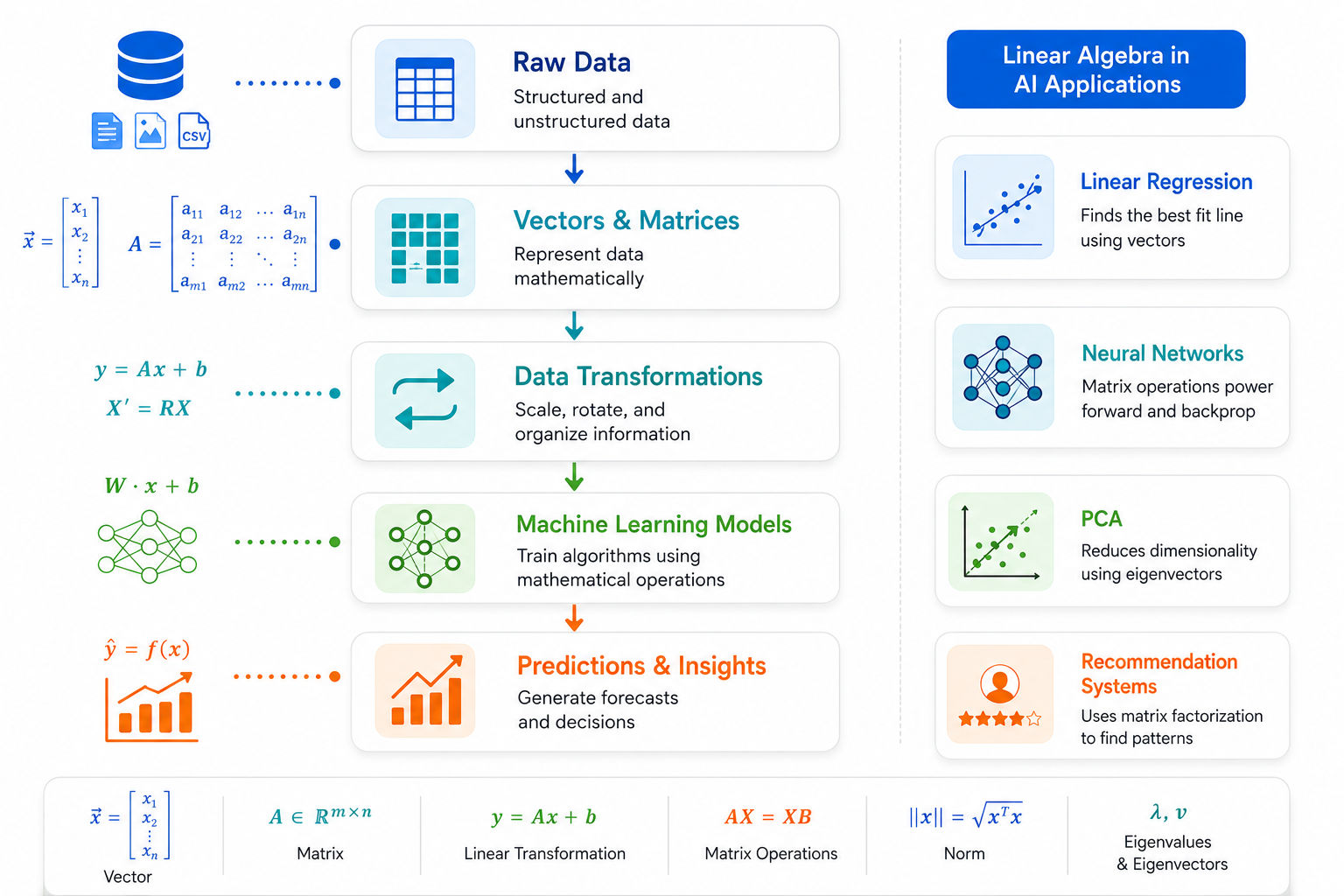
Here's what happens without understanding it: You use a pre-built library to train a model. The model performs badly. You have no idea why. You tweak random parameters hoping something works. This is guessing, not data science.
Many people try to skip linear algebra for data science and jump straight to coding. This creates blind spots. You might build a model that technically works but is inefficient. You won't understand why your neural network converged so slowly or why your regularization parameter matters. You'll follow tutorials without really grasping what's happening.
The good news: Learning linear algebra for data science is simpler than you think. You don't need calculus. You don't need complex proofs. You need practical understanding of how numbers group together and transform.
Also Read: Math for Machine Learning: Essential Concepts You Must Know
Free Courses
Linear algebra for data science rests on a few fundamental ideas. Master these, and everything else clicks into place.
Think of these as different ways to organize numbers.
Concept |
Example |
Use in Data Science |
| Scalar | 5 | A single prediction value |
| Vector | [2, 4, 6] | A single customer's features |
| Matrix | 100x50 grid | 100 customers, 50 features each |
You don't need to manually multiply huge matrices. Your computer does that. But you need to understand what these operations do and when to use them.
This is where it gets interesting. An eigenvector is a direction that doesn't change when you apply a transformation. The eigenvalue tells you how much it scales.
Imagine a transformation that stretches space. Most directions get twisted and squished. But certain special directions only stretch or compress, they don't rotate. Those are eigenvectors.
Why does this matter for linear algebra for data science? Principal Component Analysis, one of the most important dimensionality reduction techniques, works entirely on eigenvectors and eigenvalues. When you reduce your 100 features to 10 important ones, you're finding the eigenvectors with the largest eigenvalues.
Some columns in your data might be redundant. If column A is always exactly 2 times column B, you have only one unique piece of information, not two.
Linear independence means none of your columns are redundant combinations of other columns. Rank counts how many independent columns you have.
In linear algebra for data science, rank matters because:
Also Read: Scalar Matrix: Definition, Properties and Examples
Data Science Courses to upskill
Explore Data Science Courses for Career Progression
IIIT Bangalore
Executive Post Graduate Certificate in Data Science & AIPlacement Assistance
Here's where linear algebra for data science connects to what you actually build.
Linear regression finds the line that best fits your data. You might think of it as a simple algorithm. But it's pure linear algebra.
Your goal is to solve: y = Xw + error
X is your feature matrix. w is the weight vector you're solving for. y is your target. Linear algebra for data science solves this by finding the w that minimizes error. The solution involves matrix multiplication, transpose, and inversion.
When something goes wrong with linear regression (predictions don't work, coefficients are huge, results are unstable), linear algebra for data science explains why. Maybe X has linearly dependent columns. Maybe X is poorly scaled. Maybe the matrix is nearly singular. These are linear algebra problems.
You have 100 features. Most are noise. PCA extracts the 10 most important ones.
How? By finding eigenvectors of the covariance matrix. The eigenvectors with largest eigenvalues point in the directions where your data varies most. Those are your principal components.
PCA is 100% linear algebra for data science. Understanding eigenvectors is the only way to truly understand PCA.
A neural network is layers of matrix multiplications with nonlinear functions in between.
Input layer: 784 values (pixels from an image) Multiply by a weight matrix: 784 x 128 Get 128 values Multiply by another matrix: 128 x 64 Get 64 values Continue until you get your prediction
Every operation is linear algebra. Every optimization uses linear algebra concepts. Backpropagation? Matrix chain rule. Gradients? Partial derivatives of matrix operations.
Deep learning without understanding linear algebra for data science is like building a car without understanding wheels. It might run, but you won't fix it when it breaks.
Also Read: Deep Learning vs Neural Networks: What’s the Difference?
SVMs work by finding a hyperplane (a high-dimensional line) that separates two classes with maximum margin.
Finding that hyperplane? Linear algebra for data science. Understanding how kernels transform data into higher dimensions? Linear algebra for data science. Everything comes back to vectors, matrices, and transformations.
Linear algebra for data science shows up everywhere in real work. Here's what you'll actually use.
Your income feature ranges from 20,000 to 2,000,000. Your age feature ranges from 18 to 80. Machine learning algorithms treat both equally. This breaks your model.
Normalization fixes this by transforming each vector. Linear algebra for data science teaches why this matters and how to do it correctly. A simple formula handles it: (x - mean) / standard deviation.
You have 500 features. Your model is slow and overfits. PCA uses eigendecomposition to reduce to 50 features while keeping 95% of information.
This saves computation, reduces overfitting, and often improves results. It's applied linear algebra for data science solving a real problem.
Ridge regression and Lasso regression add penalty terms to prevent overfitting. These techniques use matrix properties to work.
Understanding these requires linear algebra for data science. You need to know how norms work, why they prevent overfitting, and when to use which one.
Also Read: Different Types of Regression Models You Need to Know
Netflix recommends movies. Spotify recommends songs. How? Matrix factorization.
You have a huge matrix: millions of users, thousands of movies, sparse ratings. You decompose this matrix into smaller ones that reveal hidden patterns. A user who likes action movies and a user who likes thrillers might have similar latent features.
This entire field is linear algebra for data science applied to business problems.
Ready to learn linear algebra for data science? Here's a practical approach.
Forget traditional linear algebra textbooks full of proofs. You don't need to know why the rank-nullity theorem works. You need intuition for what it means.
Read 3Blue1Brown's Essence of Linear Algebra series first. It teaches through animation and intuition. You'll understand what matrices do, how transformations work, and why eigenvectors matter. This takes 2-3 hours and changes everything.
After intuition comes application.
Theory without code is meaningless. Code without theory is blind guessing.
Write Python code using NumPy. NumPy handles linear algebra operations efficiently.
Here's what to code:
When you manually build PCA using NumPy, you'll understand it forever. Watching a tutorial isn't enough.
Build these projects to cement your knowledge:
Each project teaches linear algebra for data science through doing.
Linear algebra for data science is not optional. It's the foundation of everything you build. The best data scientists aren't the ones who memorize the most algorithms. They're the ones who understand the math underneath.
You don't need to become a mathematician. You don't need to spend months on theory. You need practical understanding of vectors, matrices, transformations, and decompositions. You need to recognize when algorithms use these concepts and why they work.
Still confused about choosing the right place to learn Linear Algebra? Speak with an expert for a free 1:1 counselling session today and upskill yourself.
You can learn machine learning without it, but you'll hit a ceiling quickly. Linear algebra for data science teaches you why algorithms work and how to fix them when they break. Learning both together actually saves time. Start with intuition-based linear algebra, not heavy proofs.
A matrix is a mathematical concept, a 2D array is how computers implement it. In Python, NumPy arrays are used for matrix operations. Linear algebra for data science talks about mathematical matrices, but practically you work with NumPy arrays.
Eigenvalues tell you the importance of different directions in your data. In PCA, eigenvectors with large eigenvalues point toward where your data varies most. These become your principal components in linear algebra for data science applications.
Element-wise multiplication multiplies corresponding elements: [2,4] × [3,5] = [6,20]. Matrix multiplication is more complex, combining rows and columns: it's how you apply models to data. Linear algebra for data science focuses on matrix multiplication because that's what machine learning uses.
A singular matrix has no inverse and determinant equals zero. This happens when columns are linearly dependent (redundant). In linear algebra for data science, singularity signals problems: correlated features, insufficient data, or numerical instability that will break your model.
You can build models, yes. But you won't understand why they work or fail. You won't optimize them. When competitors use linear algebra for data science knowledge to build better models, you'll be left behind. Understanding the math makes you a better practitioner.
Normalization transforms vectors to have standard scale and distribution. It's a linear algebra operation that prevents features with large ranges from dominating your model. In linear algebra for data science, understanding norms (vector magnitude) helps you design better normalization strategies.
Neural networks are stacked matrix multiplications. Each layer multiplies input by a weight matrix. Linear algebra for data science explains every operation: forward pass is matrix multiplication, backward pass uses the chain rule on matrices, optimization adjusts matrices to minimize loss.
No, they're different. Linear algebra deals with linear transformations and vector spaces. Calculus deals with change and rates. Machine learning uses both. Linear algebra for data science teaches you about spaces and transformations, while calculus teaches you about optimization (finding minimums and maximums).
With focused learning, 3-4 weeks for fundamentals. Another 4-8 weeks to build real projects. The important part isn't time spent; it's practical application. Code while you learn. People who spend 2 months learning through projects understand more than people who spend 6 months reading textbooks.
Learn Python basics first (variables, loops, functions). Then learn linear algebra with NumPy simultaneously. This way, you build intuition while practicing coding. Linear algebra for data science makes sense better when you can implement it immediately in Python instead of doing pencil-and-paper exercises.
98 articles published
Rahul Singh is an Associate Content Writer at upGrad, with a strong interest in Data Science, Machine Learning, and Artificial Intelligence. He combines technical development skills with data-driven s...
Speak with Data Science Expert
By submitting, I accept the T&C and
Privacy Policy
Start Your Career in Data Science Today
Top Resources
Executive Diploma
12 Months
Master's Degree
18 Months
Bootcamp
6 Months