How to Publish a Research Paper in a Reputable Journal: A Beginner's Guide
By upGrad
Updated on Nov 10, 2026 | 6 min read | 2.46K+ views
Share:

All courses
Certifications
More
By upGrad
Updated on Nov 10, 2026 | 6 min read | 2.46K+ views
Share:
Key highlights
Explore upGrad’s DBA programmes to develop advanced research capabilities, gain practical business insights, and prepare for senior leadership roles.
Most first rejections have little to do with weak science. It can arise from selecting the wrong journal, sending incomplete work, or ignoring author guidelines.
The first thing one needs to know before deciding on the publication of a research article is basically three aspects: type of research article, characteristics of a reputable journal, and submission requirements.
The fact is that each journal publishes certain types of articles.
Article type |
Typical length |
Best for |
| Original research article | 4,000 to 8,000 words | New data, experiments, or analysis |
| Review article | 5,000 to 10,000 words | Summarising existing studies on one topic |
| Short communication | 1,500 to 3,000 words | Early or tightly focused findings |
| Case study | 2,000 to 4,000 words | A detailed look at one case or setting |
There must be a clear process of peer review, a listed editorial board with legitimate affiliations, and an obvious indexing history which you can check yourself from the website of the index rather than the badge at the homepage of the journal.
Check for listings at Scopus, Web of Science, PubMed, or DOAJ.Search the database directly. Don’t rely on a logo.
You’ll also need a few things ready before you write the submission.
One more thing to keep in mind. Plan for months, not weeks. Even strong papers get rejected once or twice before they land, and that doesn’t mean your research is poor.
Explore upGrad’s Doctor of Business Administration from ESGCI to develop advanced research capabilities, gain practical business insights, and prepare for senior leadership roles.
Here’s how to get a research paper published in an 8-step process. We will cover each detail of what you should be doing to get your research paper published, from choosing a research topic to completing the process. And for beginners, this journal submission process is going to give you all the information you need.
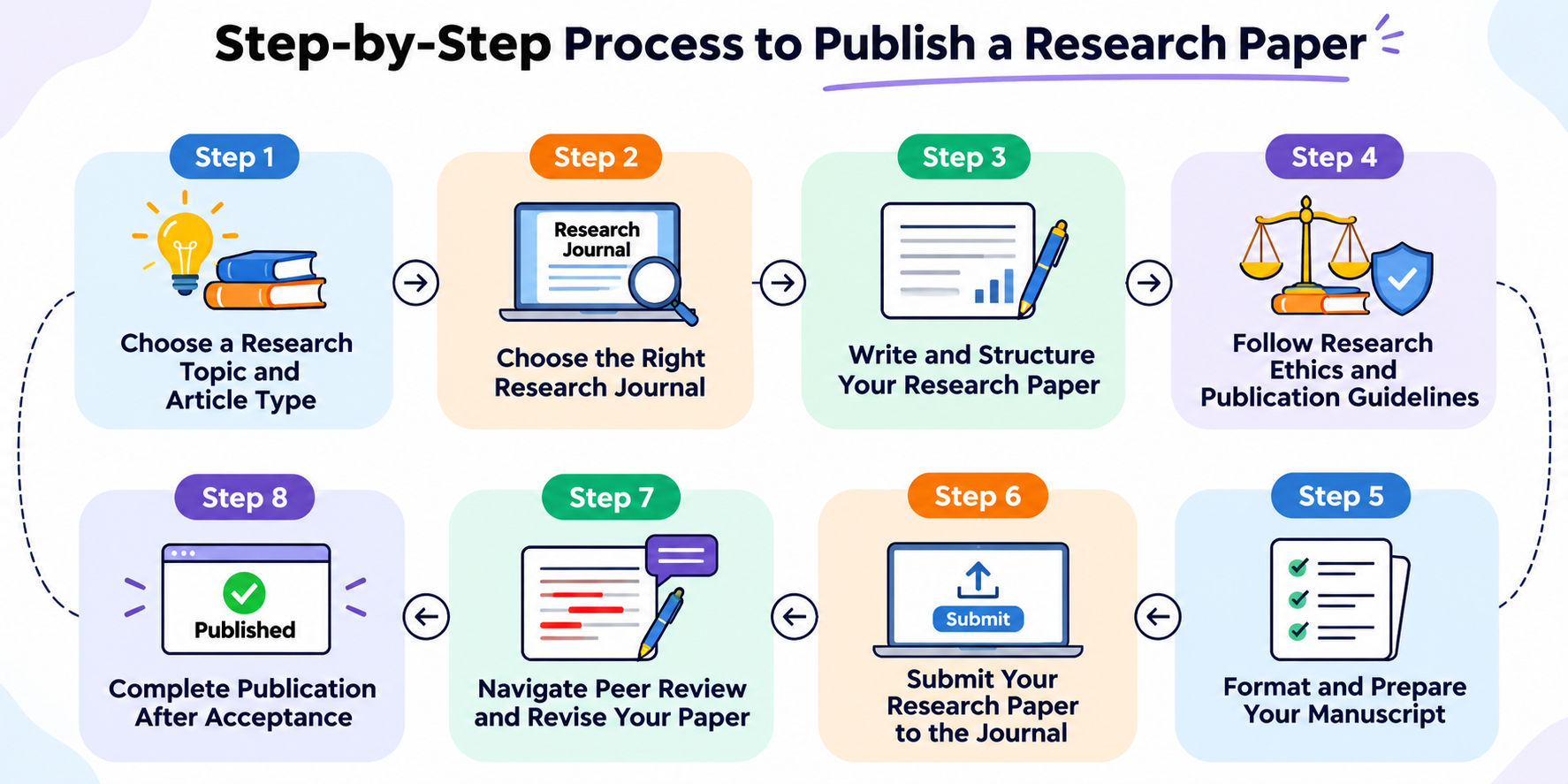
Step by step process to publish a paper
Start with a question you can answer using data you actually have. Don't choose a broad topic, for example, like ‘climate change’. A narrow one, like ‘the effect of groundwater depletion on rice yields in one Indian district’, will be a more logical choice. The main agenda of the research has to be very specific.
Then check the gap. Check Google Scholar and Scopus for articles in the past five years. If ten articles have already addressed your question, revise it by adding a novel data set, location, or approach.
Now it is time to choose an article type. An original article or short communication would be the most suitable option for first-time researchers. Reviews may seem easier, but they should be based on a certain methodology.
This choice of yours will shape the next path you have to follow. Make a list of journals where you wish to publish. You should use those journals where you cite papers since they are interested in the field where you have done your research.
Assess them based on several factors such as aims and scope, indexing, time to decision, Article Processing Charges (APCs), and acceptance rate. Scope remains the most important factor out of all these. A high-quality paper submitted to an inappropriate journal is not going to work.
Software like Elsevier Journal Finder, Springer Journal Suggester, and Jane for biomedicine can assist in narrowing down your choices. Just consider the suggestions of these journals as an initial step only. Go through the last two or three issues of the journal to check whether your kind of work is published in the journal or not.
Almost all the journals need you to write in the IMRaD format structure which stands for Introduction, Method, Result, and Discussion.
Section |
What it should do |
| Title | Explain the topic and observations in under 15 words |
| Abstract | Cover problem, method, result, and meaning in 150 to 250 words |
| Introduction | Show the gap and state your research question |
| Methods | Give enough detail for another researcher to repeat your work |
| Results | Report findings with tables and figures, without interpretation |
| Discussion | Explain what results mean, compare with earlier work, and admit limitations |
| Conclusion and references | Close the argument and cite every source properly |
Start with writing the methods used and the results which you found. Keep the introduction and abstract for the last. As these will be found once the research is done. Use shorter sentences and skip the technical words for reviewers outside of your niche. Mention the limitations too.
Reputable scientific journals adhere to principles provided by COPE and ICMJE, with violating them resulting in the paper’s retraction even after a few years of publication. Breaking them can get a paper retracted even years after publication.
The basics are simple.
Must read: Best AI Tools for Research
Every journal has author guidelines. Read them twice. Word limits, reference style (APA, Vancouver, or IEEE), figure resolution, heading levels, and line spacing all matter. Editors can reject papers over sloppy formatting.
Reference managers like Zotero, Mendeley, and EndNote can save you hours. Proofread out loud. Ask a colleague outside your field to read the draft, because they’ll spot unclear passages fast.
Prepare these files before you open the submission portal.
Get registered at the journal’s submission portal. They use ScholarOne, Editorial Manager, or OJS portals. Attach all necessary files, provide information about authors, list key words and abstract.
Be concise in your cover letter. Mention the title of your paper, the main result of research and relevance for the journal. Confirm that the paper is not being considered anywhere else.
Propose three to five potential reviewers if you are asked for that and exclude people who have worked with you recently. And then just wait. Editors will make a quick check and many papers are desk rejected at this step.
A few weeks later, you’ll get one of four decisions.
Decision |
What it means |
Your move |
| Accept | Rare on the first round | Move to production |
| Minor revision | Small fixes needed | Revise within 1 to 2 weeks |
| Major revision | Serious changes, but the door is open | Revise carefully, often over 4 to 8 weeks |
| Reject | Not suitable for this journal | Learn from comments and submit elsewhere |
Don’t take reviews personally. Reviewers can sound harsh. Read the comments once, wait a day, then read them again.
Write a point by point response letter. Quote each comment, explain what you changed, and say where. If you disagree, say so politely and back it with evidence. Highlight changes in the revised manuscript. Reviewers who see their points handled clearly usually recommend acceptance.
Must read: Primary vs Secondary Research: Which Method Is Right for Your Study?
Once accepted, you’ll sign a copyright transfer or open access licence form. If the journal charges an article processing fee, you’ll pay it now.
Proofs arrive a few weeks later. Check names, affiliations, figure labels, and reference details. Production editors fix typos, but they won’t catch a wrong label on your data.
Your paper then gets a DOI and goes online, sometimes first as an accepted manuscript and later inside an issue. Save the DOI and the publisher’s PDF link. You’ll need both next.
Also read: Data Science Research Papers: A Complete Guide for Students and Professionals
DBA Courses to upskill
Explore DBA Courses for Career Progression
IIIT-B & IIM, Udaipur
Chief Technology Officer & AI Leadership ProgrammeThe answer ranges from nothing to several thousand dollars. It depends on the journal’s model, not on its quality.
Route |
Typical cost |
Notes |
| Subscription journal with no author fee | $0 | Readers or libraries pay. Many society journals work this way. |
| Diamond open access | $0 | Funded by institutions or societies |
| Gold open access | $500 to $4,000 | Article processing charge paid by author or funder |
| Hybrid journal, open access option | $2,000 to $5,000 | Optional fee inside a subscription journal |
| Indian and regional journals | Rs 0 to Rs 15,000 | Varies widely, so verify indexing first |
Add smaller costs too. Language editing, plagiarism checks, and professional figure design can add up if you pay for them.
There are ways for how to publish a research paper for free. Here are the ways to do it:
Free doesn’t mean easy, though. Fee-free journals often get heavy submission volumes and may respond slowly.
Also Explore: Likert Scale Examples
Many researchers ask how to publish a research paper in India without paying heavy fees. Start with Indian journals indexed in Scopus or Web of Science, since they’re often cheaper than international gold open access titles.
Ask your research office about APC support. Some universities and funders, including bodies like DST and ICMR for funded projects, allow publication costs in grants. India’s UGC has changed its policy on journal lists in recent years, so confirm what your university accepts before you commit.
Be careful with very cheap, very fast Indian journals. A low price is still fine, but if it promises that you will get accepted in a week, then there are very high chances its a scam.
Also read: Text Summarization in NLP: Key Concepts, Techniques and Implementation
You can expect four to twelve months from first submission to online publication. Some fields move faster, but humanities and social science journals often move much more slowly.
Stage |
Typical time |
| Writing and formatting | 1 to 3 months |
| Editorial screening | 1 to 2 weeks |
| Peer review | 4 to 12 weeks |
| Author revision | 2 to 8 weeks |
| Second review | 2 to 6 weeks |
| Acceptance to online | 2 to 8 weeks |
These ranges are all approximate. A single slow reviewer can add six weeks, and editors can’t do anything about it.
Here’s what can help. Check the journal’s published time to first decision before you submit. If you hear nothing after three months, send a polite status email to the editor. Never send the paper to another journal at the same time without withdrawing it first.
And beware of publications that promise only seven days. Real peer review takes longer than that.
Do read: How to Write a Research Proposal: Structure, Steps and Common Mistakes
Predatory journals charge fees but skip real peer review. They damage your CV, and a paper in one is hard to undo.
Picture this. You get an email addressed to Esteemed Professor, offering publication in three days for $80. It looks flattering. But It’s a trap. Reputable journals don’t cold email you with guaranteed acceptance.
Watch for these red flags.
Now verify the journal yourself.
If you’ve already published in a predatory journal, don’t panic. Ask for withdrawal in writing. Be honest about it, move on, and choose a better journal for the next paper.
Must read: PhD Eligibility Criteria: Essential Steps, Tips, and Alternatives
Publication isn’t the finish line. A paper nobody reads does little for your career.
Consider reviewing for journals too. It teaches you what editors want, and it shows up well on a CV.
Conclusion
Now that you know how to publish your research paper, it’s time for your research. Publishing your research is a great milestone not only in your academic career but also in your professional one. It doesn’t matter whether you are a student or an independent researcher; the ideal time to begin is now. Pick one journal that suits you. Read its guidelines. Follow ethics rules from day one. Take reviewer comments and implement them. There is no shortcut to this, so invest the hard work.
The right journal, proper manuscript, and patience are all the weapons you have in this battle.
Seeking professional guidance for your next career step? Book a free 1:1 counseling session with us now to avail complete guidance!
Yes. There are many journals that publish work by students, and there are also specialized journals for the publication of work done by undergraduate students. For publication in such journals, you must have original findings, proper methodology, and proper guidance. You can start with student journals or proceedings of conferences if a reputable journal seems beyond your reach.
No. A PhD is not essential for publication in journals. The work will be judged on its merit, and not on the basis of the author's qualifications. Masters' level students, practitioners, and independent researchers all publish their work. Original findings and proper methodology are all that are required. Many first publications are derived from thesis chapters or work assignments and are usually co-authored with an experienced person.
It is possible, but it will be more difficult. Some journals require the author to have an affiliation to their institution, so being an independent author might create more questions. A mentor will help you proofread your paper, identify methodological mistakes, and choose a journal to submit to. Without a mentor, find somebody from among your colleagues to do that and use your university's research assistance services.
The length of research papers is usually stated in words rather than in pages. For an original article it is 4,000 - 8,000 words, which means about 8 to 20 pages double-spaced.
No. Submitting the same research paper to different journals simultaneously is referred to as simultaneous submission and is prohibited in nearly all journals. If two editors get to know about it, they will reject the research paper. Submit to one journal first and then to the other after the response.
The list of documents that need to be submitted for publishing a research paper includes the manuscript, title page, cover letter, figures, tables, and supplemental files. In addition, many journals require an ethics approval form, funding statement, conflict of interest form, author contributions statement, and copyright transfer form.
Cover letters are brief notes sent to the editors. The letter should include the paper’s title, main result, and justification for why it is suitable for the particular journal. You should add that the paper is not published or submitted elsewhere. Do not exceed one page and mention the editor’s name.
Yes, but there are restrictions. AI tools can be used for language editing if they are disclosed. AI cannot be listed as authors. You remain liable for everything mentioned in your work, no matter who wrote it. Never let AI make up citations or other data. Check out the journal's AI policy.
Both are journal indexing databases, but they have different selection criteria. Scopus, which is an Elsevier product, indexes more journals. Web of Science, which belongs to Clarivate, is selective and provides impact factors. Journals included in either database are generally accepted; however, some universities have particular requirements.
Search for journals that provide author assistance, publish short communications, or that explicitly state their willingness to consider early career scholars' contributions. You can search for DOAJ and use journal-finding resources. Then look at recent issues and see if there are any novice authors.
Certainly. Send an email to the editor with the manuscript ID and explain your reasons. The earlier you withdraw your research paper, the better, as the reviewers might already have worked on it, which could annoy the editors. Some publishers keep track of withdrawals.
1351 articles published
We are an online education platform providing industry-relevant programs for professionals, designed and delivered in collaboration with world-class faculty and businesses. Merging the latest technolo...
Speak with DBA expert
By submitting, I accept the T&C and
Privacy Policy