Primary vs Secondary Research: Which Method Is Right for Your Study?
By upGrad
Updated on Nov 04, 2026 | 5 min read | 24.35K+ views
Share:

All courses
Certifications
More
By upGrad
Updated on Nov 04, 2026 | 5 min read | 24.35K+ views
Share:
Table of Contents
Quick Insights:
Looking to apply research and analytical skills to real business challenges? Explore the Doctor of Business Administration (DBA) programme to develop innovative ideas, build business expertise and prepare for leadership roles.

The main difference between primary and secondary research is the source of the data. Primary research involves collecting new information directly for a study. Secondary research uses information that has already been collected by others.
| Basis | Primary Research | Secondary Research |
| Meaning | Collecting original data | Using existing data |
| Purpose | Answering specific research questions | Studying available information |
| Data source | Direct responses and observations | Published studies and reports |
| Methods | Surveys, interviews and experiments | Literature reviews and data analysis |
| Time | Usually takes more time | Usually takes less time |
| Cost | Can involve higher costs | Often more affordable |
| Example | Conducting a customer survey | Reviewing an existing market report |
Also Read: Qualitative vs. Quantitative Research
Primary research involves collecting original data for a specific study. Researchers decide what information they need, who they want to collect it from and how they will gather it.
For example: Researchers studying student satisfaction may conduct surveys or interviews with students. The responses provide information collected specifically for that study.
Secondary research involves using information that has already been collected by others. This may include published research papers, books, reports and different types of data.
For example: Researchers studying student satisfaction can check existing education reports. This helps them understand earlier findings to use as a starting point for their study.
Now that you understand the basic difference, let's look at the methods researchers use to collect and study data.
Want to build your research skills and make better business decisions? Explore upGrad’s Chief Technology and AI Officer Program to learn how to use AI and technology to solve real business challenges.
Both research methods use different ways to collect and study information. Primary research involves gathering new data and secondary research focuses on studying information that is already available. Here are the common methods and examples of each.
Also Learn: What is Data Analytics?
Example: Studying online learning
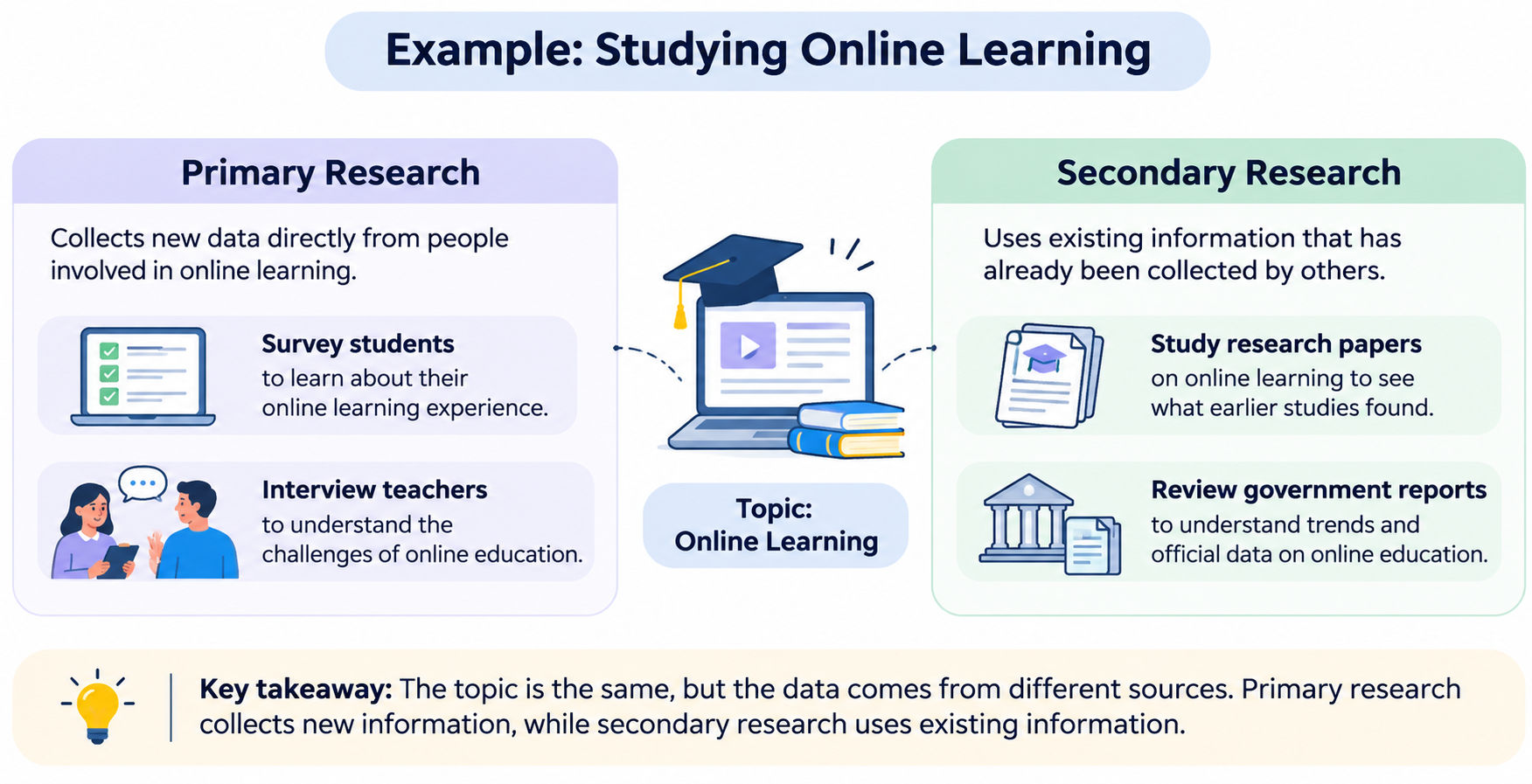
As you can see in the example, the topic is the same, but the data is coming from different sources. Primary research collects new information and secondary research uses existing information.
Helpful Guide: Data Collection Methods
DBA Courses to upskill
Explore DBA Courses for Career Progression
IIIT-B & IIM, Udaipur
Chief Technology Officer & AI Leadership ProgrammeResearchers use different sources for primary and secondary research. It is also important to check where the data comes from and whether it can be trusted.
Primary sources: Survey responses, interview records, experiment results, observation records and original research findings.
Secondary sources: Academic journals, books, government reports, industry reports, research databases and published datasets.
Explore: Top Data Collection Tools
Neither method is always more reliable. It depends on how the data was collected and whether the source can be trusted. Here are a few things to check:
Learn: Mixed Methods Research
The right research method depends on what you want to find out, the data you need and the time and resources you have. Here is when you can use each method.
Use primary research when:
Use secondary research when:
Read About: Data vs Information
Yes. You can use both methods in the same study. Secondary research helps you understand what is already known. Primary research helps you collect new information and find answers to questions that existing studies may not cover.
Example combining Primary and Secondary Research:
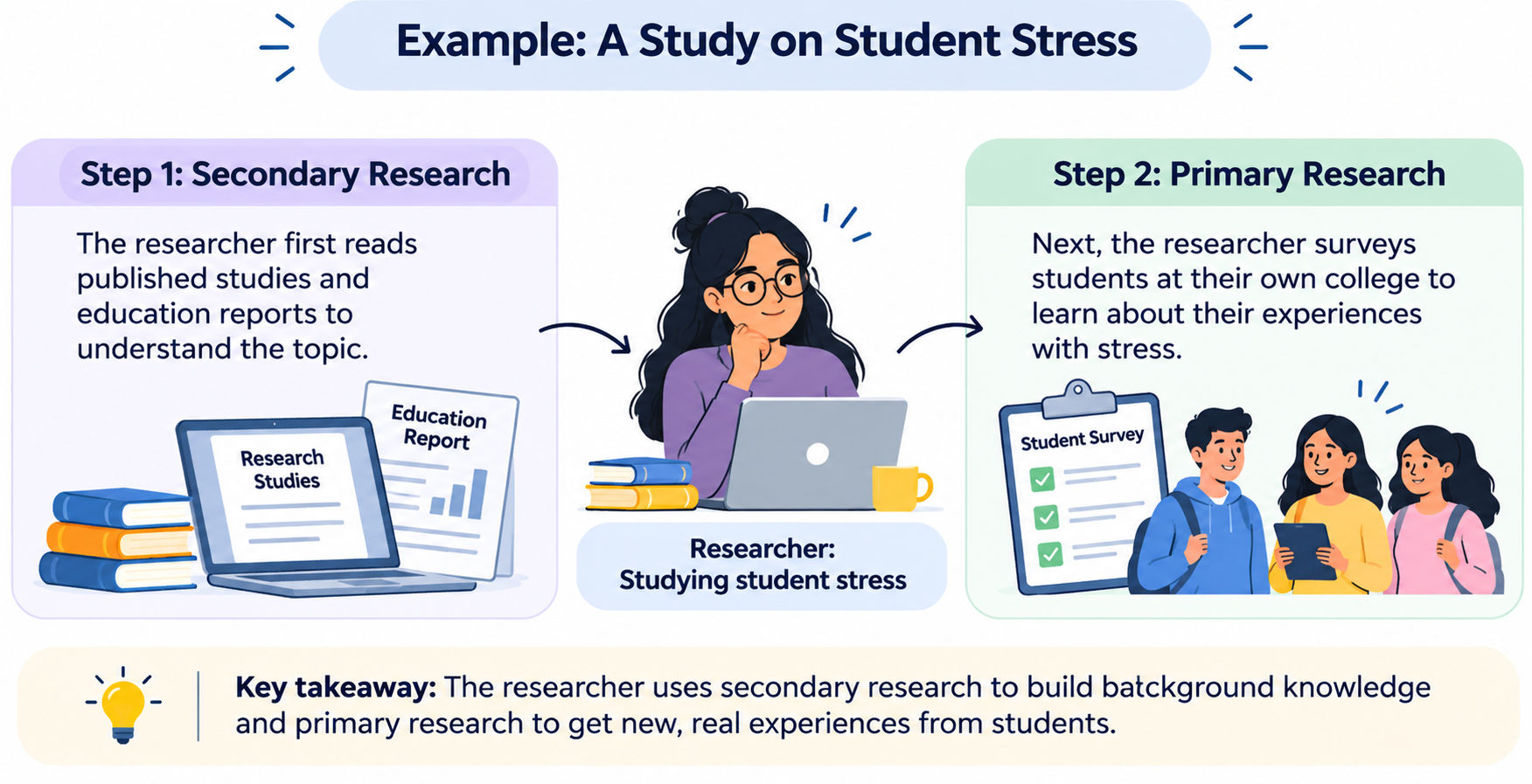
Both methods can work together. Secondary research helps you understand the topic. Primary research helps you collect new information. Using both gives you a clearer picture of the subject.
Conclusion:
To choose between Primary vs Secondary research consider your research goals, the information you need, and the time and resources available.
If existing studies are giving enough information, secondary research may be a good choice. If you need answers to specific questions, primary research can help you collect the required data. You can also combine both methods to get a better understanding of your topic.
You can book a free consultation call with our experts and get personalized guidance to discover good courses to shape your learning path.
More Similar Reads:
Primary data is new information collected directly by a researcher for a specific study. For example, survey responses and interview answers are primary data. Secondary data is information that already exists, such as published reports, research papers and government records.
Yes. You can use secondary research in a dissertation to study existing information and understand what other researchers have found. It is often used in literature reviews. However, some universities may also require you to collect original data, so check your university's guidelines.
Collecting primary data can take time, money and effort. Researchers may also find it difficult to reach the right participants or get enough responses. Poorly written survey questions and personal opinions can affect the results.
The citation method depends on the style your university requires, such as APA, MLA or Harvard. When using published information, mention the original author and source. For data you collect yourself, explain how you collected it in the methodology section.
Yes. A research paper can use both types of data to study a topic in more detail. For example, a researcher may review existing market reports and then conduct customer surveys to collect fresh information.
Qualitative research focuses on people's opinions, experiences and views. It often uses interviews and open-ended questions. Quantitative research uses numbers to measure results. It may use surveys with fixed answers, test scores or statistical data.
Yes. Online surveys are a common way to collect primary data. Researchers can share a questionnaire using email or online forms and collect responses directly from participants. The answers are new data collected for the study.
A literature review helps researchers understand what is already known about a topic. It brings together findings from existing research papers, books and reports. It also helps identify areas that need more research.
Check the source before using its information in your study. Look at these factors:
A case study can be either primary or secondary research. If you collect information by interviewing people or observing an organisation, it is primary research. If you study an existing case using published reports and documents, it is secondary research.
Yes. Government websites often provide data on population, education, health, employment and other topics. Researchers can use these records to study trends and compare information without collecting the data themselves.
Primary research collects new data using methods such as surveys, interviews and experiments. A systematic review studies existing research papers on a specific topic. It follows a planned process to find, assess and compare earlier studies, so it is a type of secondary research.
1339 articles published
We are an online education platform providing industry-relevant programs for professionals, designed and delivered in collaboration with world-class faculty and businesses. Merging the latest technolo...
Speak with DBA expert
By submitting, I accept the T&C and
Privacy Policy