How to Write a Research Proposal: Structure, Steps and Common Mistakes
By upGrad
Updated on Nov 10, 2026 | 8 min read | 2.36K+ views
Share:

All courses
Certifications
More
By upGrad
Updated on Nov 10, 2026 | 8 min read | 2.36K+ views
Share:
Table of Contents
Key Highlights
Planning to turn your research proposal into a full doctoral degree? Explore upGrad’s Doctor of Business Administration (DBA) programme to build advanced research skills, work with experienced mentors and earn a globally recognised qualification.
The research proposal format for PhD, length, and focus of a research proposal change with the reader. Also, it changes with the decision the proposal supports. So, first finalize which type of proposal you are writing first.
Below are the four types of research proposals:
This is the toughest type. So, your proposal should show that you can run a doctoral project on your own. It is more important when you bring your own topic. However, some universities give you the liberty to shape your proposal after you enroll.
Usually, for PhD admission, you have to write 1,000 to 3,000 words. In that space, assessors look for three things:
Do read: How to Publish a Research Paper in a Reputable Journal: A Beginner's Guide
Think of a master’s proposal as a permission slip.
Your department wants to see that your topic makes sense. Also, they want proof that you can complete it within the program. Here, you have to write 2,000 to 3,000 words.
Here, your reviewers may not know your field well. So, use plain language to explain your research proposal, and make a strong case for why your work matters.
These three things help your grant proposals stand out:
This is the easiest type, as it takes one to three pages maximum.
Treat it as an outline, not a full document. Cover your question, your approach and a rough schedule. The goal is simple. Show your lecturer that the idea is focused and achievable before you begin.
Also read: Best PhD Programs in India in 2026: Which One Should You Choose?
There is no single correct length. Too short, and your proposal looks underprepared. Too long, and it looks like you can’t follow instructions. The right length depends on the proposal type and your subject area. Most of all, it depends on what the institution or funder asks for.
No limit given? Use these ranges as a starting point.
Proposal type |
Typical length |
Notes |
| Undergraduate or honours | 1-3 pages | Often an outline, not a full document |
| Master’s thesis | 2,000-3,000 words | Includes a short literature review and methods |
| PhD admission | 1,000-3,000 words | Varies widely between universities |
| Grant or funding | Set by the funder | Often counted in pages or characters, not words |
The subject area also shifts the numbers. Arts, humanities and social sciences proposals tend to run longer than STEM ones. The argument and theory need more room. Many STEM applicants join a set lab project.
The institution’s own rules always win. That includes this guide. Before you write a single line, do these four things:
Must read: PhD Eligibility Criteria: Essential Steps, Tips, and Alternatives
DBA Courses to upskill
Explore DBA Courses for Career Progression
IIIT-B & IIM, Udaipur
Chief Technology Officer & AI Leadership ProgrammeMost proposals follow the same order. It looks a lot like a thesis, minus the results and discussion. Section names vary by university and by field, so don’t treat this list as a rule. If your university gives you its own headings, use them.
The title should say what the project is about. Nothing more. Puns and quotes can wait for the thesis.
A supervisor should be able to read it and know straight away whether the project is in their area. So name the topic and the focus. Add the setting or the group you’re studying if it helps.
Short proposals usually skip this. Longer ones and grant applications tend to need it.
It’s the whole proposal written in 150 to 250 words. Write it after everything else, when you know what the document says. It also has to work alone, because some reviewers won’t read past it.
The introduction is your pitch, and it has to do four jobs in a small space.
Don’t go source by source. Group them by theme or debate instead. Show where researchers agree, where they clash, and what nobody has answered yet.
You also don’t have to cover everything at this stage. Ten well-chosen sources will convince a reviewer of more than forty that barely connect.
This section answers the question “how will you actually do it?” and it is where feasibility is proven or lost. Cover the following:
Also Explore: Likert Scale Examples
Start with what the research will produce. That could be a new theory, a dataset, a practical framework, policy recommendations, or stronger evidence for practitioners. Then explain why any of it matters outside your thesis.
You don’t have to promise a result. Exploratory work is fine. But name the people who could benefit and say how.
Don’t blur the two ideas. Outcomes are what exist when you finish. Significance is what those outcomes allow other people to do.
The timeline shows your plan is realistic. Split the project into phases, give each a rough length, and show how they connect. A small table works best.
Phase |
Main tasks |
Duration |
| 1. Preparation | Literature review, refine questions, ethics approval | Months 1-3 |
| 2. Data collection | Interviews or experiments | Months 4-8 |
| 3. Analysis | Coding, statistics, interpretation | Months 9-12 |
| 4. Writing up | Drafting, revision, submission | Months 13-18 |
Leave some slack. Ethics approval drags on. Participants are hard to find. A schedule with a bit of breathing room looks more believable than one where every task fits perfectly.
Planning to pursue a doctorate while you work? Explore upGrad’s DBA from Golden Gate University, a WASC-accredited, online programme with training in qualitative and quantitative research, designed for experienced professionals.
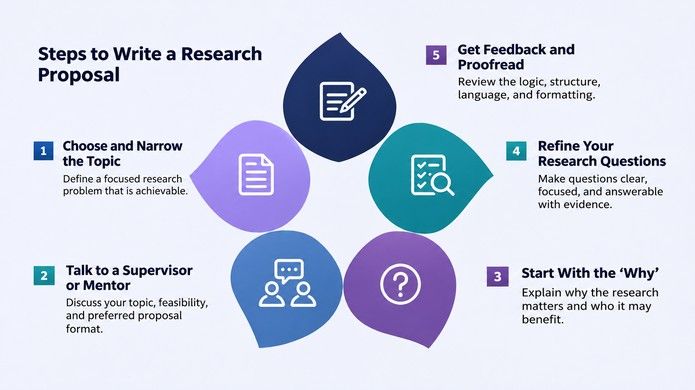
Only understanding the structure will not help you write a better research proposal. For that, you should know these five steps.
Most proposals fail because the topic is too big. Dull topics are rarely the problem. “Social media and mental health” could fill a whole career. “How daily Instagram use relates to exam anxiety among Indian college students” can be finished in three years.
Narrow it in three passes:
You can usually tell it’s narrow enough if you can state the topic in one sentence. Use “and” no more than once.
The first chat is your chance to ask a few things from a mentor or supervisor. Like, do they have room for a new student? Is there funding for research costs? Do your interests overlap with theirs?
Once you get some encouragement, ask what research proposal format they prefer. Some supervisors will share a successful past proposal. That is worth more than any generic template.
Can’t reach your first choice? Any academic who has written or reviewed proposals can give you useful feedback.
Before you start writing the research proposal, write an answer to this question. Why does this research matter, and to whom?
Reviewers remember the purpose. They forget technique. Picture yourself explaining the project in 60 seconds. You’d talk about the problem and the difference your work could make. You wouldn’t mention the statistical tests.
Add the purpose at the beginning of the introduction. The method still needs detail, but it should read as the route to something worthwhile. It isn’t the point itself.
Your questions will almost certainly change after wide reading and a first draft of the method. Go back and tighten the wording.
Good research questions share a few traits:
Share the draft with a supervisor, a peer or someone in the department. Ask specific questions. Is the gap clear? Does the timeline look realistic? A vague “looks fine” doesn’t help you much.
Someone outside your subject is worth asking too. They’ll spot unclear writing fast.
Then proofread in two separate passes:
Also read: Career in India After PhD
Most rejected proposals fail for a few avoidable reasons. Check your draft against these four before you submit.
A huge topic can’t be finished in the time you have. It also tells the reviewer you haven’t decided what you want to study.
Fix: Add a specific population, place, and time frame. Keep going until the project clearly fits your timeline.
If the question can’t be answered with evidence, the reviewer won’t know what you plan to do.
Fix: Name the variables and the group. Say what kind of answer you expect.
Typos, unclear sentences and ignored formatting rules hint at the same carelessness in your research.
Fix: Get feedback first. Then proofread twice, once for content and once for language. Leave the final draft overnight and read it one last time.
Also read: What is the DBA Degree Format - Coursework, Research, Dissertation
Conclusion
When you write a research proposal, it should convince the reader that your research is important for your field. Each section should back up your goals, from title to timeline.
Before writing, check your institution’s guidelines to build a clear structure. Open the research proposal with a clear introduction, and follow a method that helps answer your questions. In the end, close with expected outcomes and the timeline.
Your proposal is a plan, so it does not have to be perfect. Pick a topic; you can talk to your supervisor for clearance and revise the proposal more than once.
Seeking professional guidance for your next career step? Book a free 1:1 counseling session with us now to avail complete guidance!
A research proposal is a short document explaining what you want to study, why it matters and how you will do it. Written before the research begins, it works as both a pitch and a plan for reviewers.
A proposal looks ahead and argues for work you intend to do. A thesis looks back and reports completed research with real data, analysis and conclusions. The proposal is also much shorter, and your direction may shift by thesis time.
No. A statement of purpose explains who you are, what shaped your interests and why you want the degree. A research proposal describes the specific project you plan to carry out. Many PhD applications require both, so avoid repeating paragraphs.
Often not. Many STEM programmes advertise projects with defined aims, so applications focus on grades, skills and experience. Some departments and independent fellowships still ask for a statement of research interests, so check the application page or email the department.
Yes, most students refine their topic as they read and collect early data. Small adjustments usually need only your supervisor’s agreement. A complete change is harder, especially when funding is tied to the original project, so discuss it early.
Future tense suits a proposal, since the work is yet to be done, for example “this study will examine.” First person is common in humanities and social sciences, while some sciences prefer an impersonal style. Follow your field’s conventions consistently.
Use whatever the institution specifies, because formatting rules are easy to check. If none are given, choose a readable 11 or 12 point font with generous spacing. Pick one referencing style, such as APA or Harvard, and apply it consistently.
Draw on your undergraduate or master’s project, relevant coursework, work experience or a topic you have followed for years. Be honest about skills you still need and how the PhD will build them. Clear thinking matters more than publications.
Yes, if it is brief. A small pilot result shows your method works and that you have already engaged with the problem. Keep it to a short paragraph or one table, because long results sections turn a proposal into a mini thesis.
It depends on the institution’s policy, so read it first. Many allow AI for brainstorming or grammar checks, but expect the argument, design and citations to be your own. Verify every reference yourself, and disclose AI use if required.
Ask for feedback and look for patterns, such as weak fit with the department, a broad question or a mismatched method. Revise, get a supervisor or mentor to review the new draft, and reapply with a version tailored to each institution.
1353 articles published
We are an online education platform providing industry-relevant programs for professionals, designed and delivered in collaboration with world-class faculty and businesses. Merging the latest technolo...
Speak with DBA expert
By submitting, I accept the T&C and
Privacy Policy