Likert Scale Examples: Design Better Surveys and Analyse the Results
By upGrad
Updated on Nov 10, 2026 | 7 min read | 5.91K+ views
Share:

All courses
Certifications
More
By upGrad
Updated on Nov 10, 2026 | 7 min read | 5.91K+ views
Share:
Table of Contents
Quick Insights
Explore upGrad’s DBA programmes to develop advanced research capabilities, gain practical business insights, and prepare for senior leadership roles.
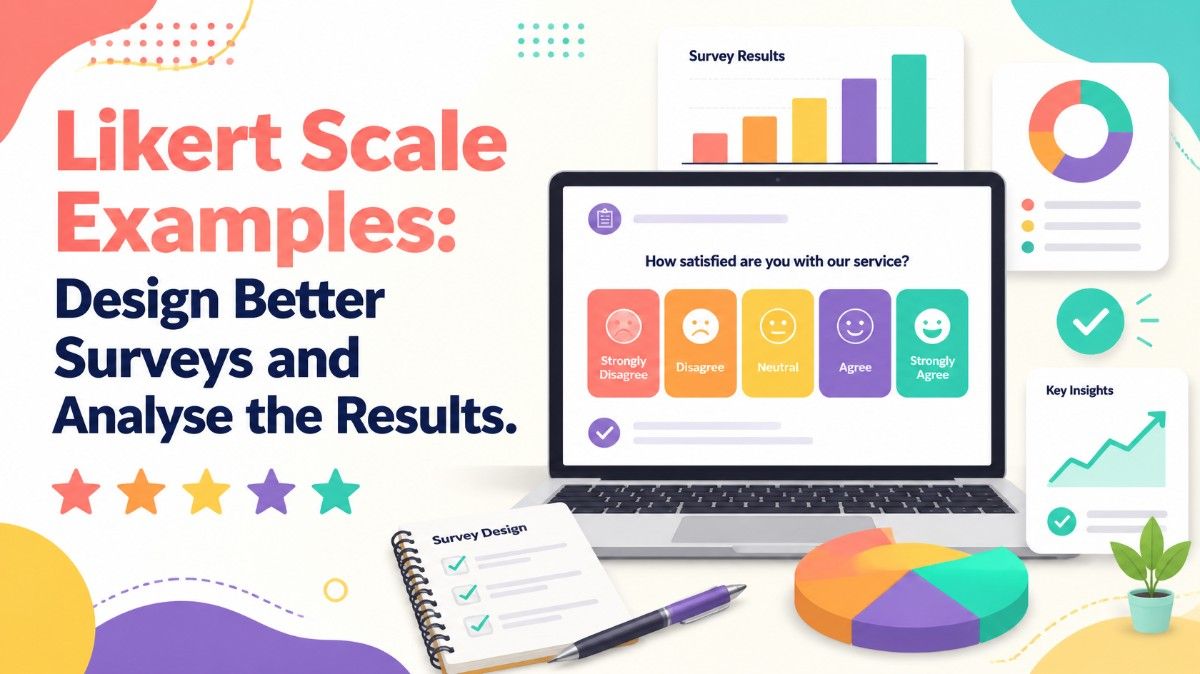
You can see, the image shows a five-point Likert scale used to collect survey responses, along with charts that help organise and analyse feedback.
A Likert scale is a survey tool that helps measure people's opinions, feelings and experiences. It gives people different answer options instead of limiting them to a simple yes or no.
For example, imagine asking a customer, "How satisfied are you with our service?" They can choose an answer ranging from very dissatisfied to very satisfied. This helps you understand how they actually feel about the service.
A Likert scale follows a simple process:
For example, here is a 5-point Likert scale that measures agreement:
| Score | Response |
| 1 | Strongly disagree |
| 2 | Disagree |
| 3 | Neither agree nor disagree |
| 4 | Agree |
| 5 | Strongly agree |
However, a Likert item and a full Likert scale are not exactly the same.
Explore upGrad’s Doctor of Business Administration from ESGCI to develop advanced research capabilities, gain practical business insights, and prepare for senior leadership roles.
Likert scales can be used in different types of surveys. The answer options depend on what you want to know. For example, you can use agreement options to collect opinions, frequency options to understand habits and satisfaction options to collect feedback about an experience.
Here are 10 Likert scale question examples that you can use in your own surveys.
This scale helps you understand whether people agree or disagree with a particular statement.
Statement: The product is easy to use.
Answer options:
Use: Businesses can use this scale to understand what customers think about their products or services.
This scale helps businesses understand how happy customers are with their services.
Question: How satisfied are you with our customer support?
Answer options:
Use: Businesses can use these responses to understand customer satisfaction and find areas that need improvement.
Companies can use this scale to understand how employees feel about their workplace.
Statement: I am happy with my current work environment.
Answer options:
Use: HR teams can use this feedback to understand employee opinions about their work environment.
A frequency scale helps you understand how often someone does a particular activity.
Question: How often do you use our mobile application?
Answer options:
Use: Businesses can use these responses to understand how frequently customers use their products or services.
This scale helps you understand how important a particular feature or service is to people.
Question: How important is fast delivery when shopping online?
Answer options:
Use: Online stores can use these responses to understand what customers look for when shopping.
Useful Guide: Different Types of Sampling Methods
A quality scale helps people rate the quality of a product or service.
Question: How would you rate the quality of our product?
Answer options:
Use: Businesses can collect feedback about product quality and understand where they need to improve.
This scale helps measure how likely someone is to take a particular action.
Question: How likely are you to recommend our service to a friend?
Answer options:
Use: Businesses can use this feedback to understand whether customers are willing to recommend their services to others.
Schools and colleges can use this scale to understand how students feel about their learning experience.
Statement: The study material is easy to understand.
Answer options:
Use: Teachers and educational institutions can use these responses to improve study materials and teaching methods.
This scale helps businesses understand how easy or difficult customers find a product to use.
Question: How easy was it to set up the product?
Answer options:
Use: Product teams can use this feedback to find problems customers may face while setting up or using a product.
Event organisers can use this scale to understand how people feel about an event.
Question: How satisfied are you with the organisation of the event?
Answer options:
Use: Organisers can use these responses to understand what attendees liked and what needs to be improved.
Must read: Best AI Tools for Research
DBA Courses to upskill
Explore DBA Courses for Career Progression
IIIT-B & IIM, Udaipur
Chief Technology Officer & AI Leadership ProgrammeLikert scales can have different numbers of answer options. Some have three choices, while others have five or seven. The right scale depends on what you want to ask and how much detail you need from the responses.
A 3-point Likert scale gives people three options to share their opinions.
Answer options:
This scale works well for short surveys where you only need a basic understanding of people's opinions.
A 4-point Likert scale gives people four answer options.
Answer options:
Unlike a 3-point scale, it does not have a neutral option. People must choose whether they agree or disagree with a statement.
A 5-point Likert scale is one of the most commonly used formats. It gives people five options to express their opinions.
Answer options:
This scale is easy to understand and includes a neutral option for people who neither agree nor disagree.
A 7-point Likert scale gives people seven answer options. It is useful when researchers want more detailed feedback.
Answer options:
For example, someone who only slightly agrees with a statement can choose "Somewhat agree" instead of "Agree." This helps researchers understand opinions in more detail.
Explore: Top Data Collection Tools
Both formats are commonly used in surveys. The main difference is the number of answer options they offer.
| Factor | 5-Point Likert Scale | 7-Point Likert Scale |
| Answer options | 5 | 7 |
| Neutral option | Yes | Yes |
| Ease of answering | Quick and simple | Requires more thought |
| Feedback | Basic level of detail | More detailed opinions |
| Best for | General surveys | Surveys that need more detailed feedback |
A 7-point scale gives people more choices, but that does not always make it better. Choose a scale that is easy for your audience to understand and answer.
Real Life Likert Scale Example:
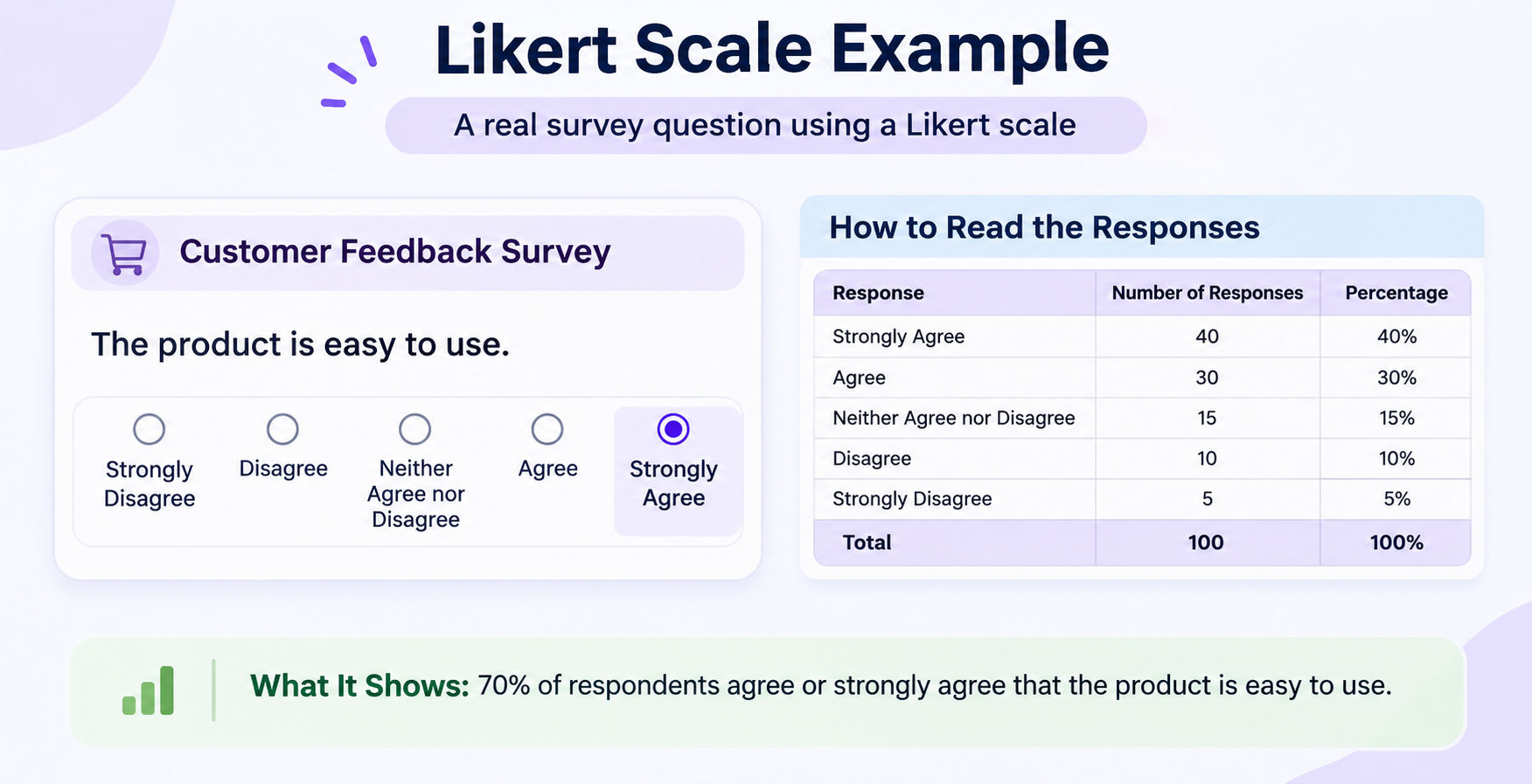
Know the difference between: Data vs Information
A good Likert scale survey starts with clear questions and suitable answer options. You also need to understand how to read the responses and use them to make better decisions. Here are some simple ways to design a survey and analyse its results.
The way you frame a question can affect how people answer it. Keep these points in mind when creating your survey:
Learn: Mixed Methods Research
Once people complete your survey, the next step is to understand their answers. You can follow these steps to analyse the results:
Also Read: Professional Ways to Respond to a Negative Review
Example: Analysing Customer Satisfaction
Suppose an online store asks 100 customers, "Are you satisfied with our online shopping experience?" The responses are:
| Response | Number of customers |
| Very satisfied | 30 |
| Satisfied | 40 |
| Neutral | 15 |
| Dissatisfied | 10 |
| Very dissatisfied | 5 |
What do these results tell us?
This gives the store a clear idea of how customers feel about their shopping experience. It can use this feedback to find out what is working well and what needs improvement.
<text color="secondary" size="xs">Note: For individual Likert scale questions, it is useful to show how many people selected each answer and the percentage for each option. Do not depend only on average scores, as the difference between answer options may not always be equal.</text>
Must read: Primary vs Secondary Research
Likert scales are useful for collecting and understanding people's opinions, but they also have some limitations. Let's look at their main advantages and disadvantages.
Likert scales are widely used in surveys because they make it easier to collect and understand people's opinions.
Although Likert scales are useful, they also have a few limitations:
Know: How to Get a Doctorate Degree in India
Conclusion:
A Likert scale helps you understand what people think and feel about a product, service or experience. Choose the right scale, ask clear questions and look at all the responses to understand the results. A well-planned Likert scale survey can help businesses and researchers collect useful feedback and make better decisions.
Seeking professional guidance for your next career step? Book a free 1:1 counseling session with us now to avail complete guidance!
More Helpful Reads:
A 5-point Likert scale gives respondents five options to share their opinions. These usually range from strongly disagree to strongly agree, with a neutral option in the middle. It is commonly used in customer feedback, employee surveys and academic research.
A 10-item Likert scale usually refers to a survey with 10 related statements or questions. Respondents answer each one using the same set of options, such as strongly disagree to strongly agree. Researchers study these answers to understand people's opinions about a particular topic.
To analyse a 5-point Likert scale, first assign a score from 1 to 5 to each answer. Then count how many people selected each option and calculate the percentage. Finally, look at the responses to understand whether most people agree, disagree or have a neutral opinion.
No, a Likert scale does not always have seven points. It can have 3, 4, 5, 6, 7 or more answer options. The 5-point and 7-point formats are commonly used, but the choice depends on the survey and the level of detail required.
A Likert scale uses a set of ordered options to understand people's opinions, feelings or level of agreement. A rating scale is a broader term that includes different ways of giving a rating, such as stars, numbers or labels. A Likert scale is one type of rating scale.
Some common Likert scale options include strongly disagree to strongly agree, very dissatisfied to very satisfied and never to always. You can also use options such as very unlikely to very likely. The choice depends on what you want to understand through your survey.
Use a Likert scale when you want to understand what people think or feel about something. It is useful for measuring customer satisfaction, employee opinions, student feedback and product experiences. It also helps collect responses in an organised format.
A neutral option allows respondents to share that they neither agree nor disagree with a statement. It is usually placed in the middle of a 5-point or 7-point Likert scale. This option is useful when someone does not have a positive or negative opinion.
A 5-point Likert scale gives respondents five answer options, while a 7-point scale gives them seven. The 5-point format is simpler and quicker to answer. The 7-point format offers more choices and helps respondents share their opinions in greater detail.
Yes, a Likert scale can have an even number of options, such as four or six. These formats do not include a neutral option in the middle. This means respondents must choose an option that shows whether they lean towards agreement or disagreement.
A Likert scale has fixed answer options, so respondents may not always find an option that matches their exact opinion. It also shows what people think but does not explain why they feel that way. Adding an open-ended question can help collect more detailed feedback.
You can present Likert scale results using tables, percentages and bar charts. Show how many people selected each answer to make the results easy to understand. This helps readers identify common opinions and compare responses.
1353 articles published
We are an online education platform providing industry-relevant programs for professionals, designed and delivered in collaboration with world-class faculty and businesses. Merging the latest technolo...
Speak with DBA expert
By submitting, I accept the T&C and
Privacy Policy