Best Data Engineering Books for Beginners and Professionals
By Sriram
Updated on Jul 17, 2026 | 5 min read | 2.69K+ views
Share:

All courses
Certifications
More
By Sriram
Updated on Jul 17, 2026 | 5 min read | 2.69K+ views
Share:
Table of Contents
Key Takeaway
In this blog, you'll get a shortlist of books that actually teach something useful, a comparison table to save time, and a roadmap that tells you what to read first.
Explore upGrad's Data Science programs to build practical skills in data analysis, machine learning, statistics, data visualization, predictive modeling, big data technologies, and real-world problem-solving through hands-on projects, industry tools, and case studies.
Popular Data Science Programs
A computer science graduate has different learning needs than a software engineer moving into data engineering. Someone preparing for interviews doesn't need the same depth as an architect designing large-scale data platforms. That's why choosing the right book matters almost as much as reading it.
Before buying a book, ask yourself one question. What do I want to achieve? Your answer will narrow the options quickly.
Authors: Joe Reis and Matt Housley
If you could read only one book before entering the field, this would be a strong choice.
Unlike many technical books that jump directly into tools, this one explains why modern data engineering works the way it does. It introduces concepts first and technologies second, helping readers build a foundation that stays useful even as tools evolve.
Aspect |
Details |
| Best For | Beginners, career changers, junior data engineers, and software developers transitioning into data engineering |
| What You'll Learn | Data engineering lifecycle, data pipelines, storage systems, data architecture, cloud fundamentals, data governance, and team collaboration |
| Why Read This Book? | The explanations are easy to follow without oversimplifying complex topics, making it one of the most recommended books for building a strong foundation in data engineering. |
| Key Strengths | Beginner-friendly language, covers modern data engineering practices, explains concepts before introducing tools, includes practical scenarios, and remains valuable as your experience grows |
| Limitations | Readers expecting step-by-step tutorials for Spark, Airflow, or Kafka may find the implementation details limited. The book focuses on core principles rather than detailed tool-specific guidance. |
| Practical Skills You'll Gain | Learn how modern data platforms are designed, understand architectural decision-making, and see how different technologies work together in real-world production environments. |
| Verdict | An excellent starting point for anyone beginning a career in data engineering or looking to build strong conceptual foundations before learning specific tools. |
Author: Martin Kleppmann
Few technical books have earned as much respect among experienced engineers. This isn't a beginner's guide. Instead, it explains the systems behind large-scale applications that process enormous amounts of data every day. Although it isn't written exclusively for data engineers, many professionals consider it essential because it develops the thinking required to design reliable, scalable systems.
Aspect |
Details |
| Best For | Intermediate engineers, senior data engineers, platform architects, and software engineers working with distributed systems |
| What You'll Learn | Distributed databases, replication, partitioning, transactions, consistency models, fault tolerance, and scalability |
| Why Read This Book? | It bridges complex theory with real-world engineering challenges, making advanced distributed systems concepts easier to understand and apply in production environments. |
| Key Strengths | Exceptional explanations of distributed systems, timeless engineering principles, practical architectural insights, excellent diagrams, and strong industry recognition |
| Limitations | The content is technically demanding. Readers without prior experience in databases or backend systems may find the initial chapters challenging and may need to revisit concepts for better understanding. |
| Practical Skills You'll Gain | Learn to evaluate architectural trade-offs, design resilient and scalable systems, and understand how modern production data platforms handle reliability, consistency, and heavy workloads. |
| Verdict | A must-read for experienced professionals who want to deepen their understanding of distributed systems and build expertise in designing large-scale data platforms. |
Author: Paul Crickard
Many aspiring engineers already know Python.
This book builds on that advantage by showing how Python fits into modern data engineering workflows. Instead of discussing concepts in isolation, it demonstrates how programming supports data ingestion, transformation, orchestration, and automation.
Aspect |
Details |
| Best For | Python developers, data analysts, junior data engineers, and self-learners |
| What You'll Learn | Python for ETL, data pipelines, APIs, workflow automation, scheduling, and data integration |
| Why Read This Book? | The book emphasizes practical implementation with hands-on examples, making it easy to build small projects while learning modern data engineering workflows. |
| Key Strengths | Strong implementation focus, project-based learning, clear code examples, a balanced mix of concepts and coding, and valuable guidance for building a professional portfolio |
| Limitations | It assumes you already have a working knowledge of Python. Beginners with no programming experience should first learn Python fundamentals before tackling the exercises. |
| Practical Skills You'll Gain | Learn to write Python scripts for ETL processes, automate routine data engineering tasks, integrate data from multiple sources, and build reliable workflows similar to those used in production environments. |
| Verdict | One of the best books for readers who want to strengthen their Python skills while gaining practical, hands-on experience in real-world data engineering. |
Also read: Data Science Books for Every Learner: From Basics to Advanced
Authors: Ralph Kimball and Margy Ross
Some books become industry references. This is one of them. Although it's been around for years, The Data Warehouse Toolkit still shapes how organizations design analytical databases. If you're interested in business intelligence, reporting systems, or dimensional modeling, this book deserves a place on your shelf.
Aspect |
Details |
| Best For | Data engineers working with analytics, BI developers, data warehouse professionals, and intermediate learners |
| What You'll Learn | Dimensional modeling, fact and dimension tables, star and snowflake schemas, slowly changing dimensions (SCDs), and data warehouse design |
| Why Read This Book? | It focuses on timeless data warehouse design principles rather than specific tools, making its concepts valuable across different technologies and enterprise environments. |
| Key Strengths | Industry-standard reference, practical data modeling techniques, real-world business examples, and well-defined design patterns |
| Limitations | Some implementation examples are based on traditional data warehouse environments. You'll need additional resources to learn modern cloud-native data platforms and architectures. |
| Practical Skills You'll Gain | Learn to design efficient analytical databases, create scalable dimensional models, and build data warehouses that support reporting, dashboards, and business intelligence while maintaining performance and reliability. |
| Verdict | An essential reference for anyone who wants to master dimensional modeling and build strong foundations in data warehouse design for analytics and business intelligence. |
Author: James Densmore
Sometimes you don't need a 600-page textbook.
You need practical guidance you can apply during a project. That's where this book stands out.
Aspect |
Details |
| Best For | Working professionals, junior engineers, and developers building data pipelines |
| What You'll Learn | Pipeline architecture, data movement, workflow design, data quality, and pipeline maintenance |
| Why Read This Book? | It delivers practical guidance in a concise format, making it an excellent resource for understanding the fundamentals of designing and managing reliable data pipelines. |
| Key Strengths | Easy to read, practical advice, modern engineering examples, and useful as a quick desk reference for day-to-day work |
| Limitations | The book is intentionally concise. Readers seeking in-depth technical discussions or advanced implementation details will need additional resources. |
| Practical Skills You'll Gain | Learn how to design, monitor, troubleshoot, and maintain reliable data pipelines that support production workloads while following industry best practices. |
| Verdict | A great practical guide for engineers who want a quick yet valuable introduction to building and maintaining efficient data pipelines. |
Must read: What Does a Data Engineer Do? Comprehensive Guide
Authors: Tyler Akidau, Slava Chernyak, and Reuven Lax
Streaming data changes everything.
Instead of processing yesterday's data overnight, companies increasingly process events the moment they happen. This book explains the engineering principles behind those real-time systems.
Aspect |
Details |
| Best For | Experienced engineers, data platform teams, and engineers working with streaming applications |
| What You'll Learn | Event streaming, windowing, stream processing, time semantics, and distributed computation |
| Why Read This Book? | It provides an in-depth understanding of stream processing concepts and explains how modern real-time data systems are designed to handle continuous, high-volume event streams. |
| Key Strengths | Excellent technical depth, strong conceptual explanations, and highly relevant insights for building and managing modern data platforms |
| Limitations | The material is technically advanced. Readers without prior experience in distributed computing or large-scale data systems may find some chapters challenging and may need supplementary resources. |
| Practical Skills You'll Gain | Learn how large-scale streaming platforms process millions of events efficiently, manage time-based data accurately, and build reliable real-time data processing systems. |
| Verdict | An excellent resource for experienced data engineers who want to deepen their expertise in stream processing and modern real-time data architectures. |
Authors: Danil Zburivsky and Lynda Partner
Cloud-first data engineering has become the norm.
This book focuses on designing data platforms that take advantage of cloud infrastructure instead of treating the cloud as just another server.
Aspect |
Details |
| Best For | Cloud engineers, intermediate data engineers, and solution architects |
| What You'll Learn | Cloud platform design, storage strategies, security, data governance, and infrastructure planning |
| Why Read This Book? | It explains the principles behind designing modern cloud-based data platforms, helping readers understand architectural decisions instead of focusing on a single cloud provider. |
| Key Strengths | Covers modern cloud architecture, introduces practical cloud engineering concepts, and includes enterprise-focused discussions relevant to real-world data platforms |
| Limitations | Readers looking for vendor-specific, step-by-step tutorials for platforms like AWS, Azure, or Google Cloud won't find detailed implementation guidance. |
| Practical Skills You'll Gain | Learn how to design scalable, secure, and reliable cloud data platforms while understanding storage, governance, and infrastructure planning for enterprise analytics environments. |
| Verdict | A valuable read for professionals looking to strengthen their understanding of cloud-native data platform architecture and enterprise data engineering practices. |
Author: Zhamak Dehghani
Not every engineering problem is technical.
Sometimes the biggest challenge is organizational. Data Mesh explores a different way of thinking about data ownership and platform design.
Aspect |
Details |
| Best For | Architects, engineering managers, and senior data professionals |
| What You'll Learn | Domain-driven ownership, data products, decentralized architecture, and organizational design |
| Why Read This Book? | It introduces the Data Mesh approach, helping readers understand how organizations can scale data ownership and governance through decentralized teams and product thinking. |
| Key Strengths | Offers a fresh perspective on data architecture, promotes strategic thinking, and includes real-world organizational examples that illustrate Data Mesh principles in practice |
| Limitations | It isn't designed as a beginner's technical guide. The book emphasizes architectural concepts, organizational strategies, and operating models rather than hands-on implementation. |
| Practical Skills You'll Gain | Learn when a Data Mesh architecture is appropriate, recognize situations where it may not be the best fit, and understand how organizations can redesign data ownership and collaboration at scale. |
| Verdict | An excellent choice for experienced professionals who want to explore modern data architecture strategies and understand how Data Mesh can reshape enterprise data management. |
Must read: Career in Data Science: Jobs, Salary, and Skills Required
Enterprise systems rarely rely on one technology.
This book explores how different components work together to build modern data platforms that support analytics, machine learning, and operational workloads.
Aspect |
Details |
| Best For | Enterprise engineers, architects, and technical leads |
| What You'll Learn | Platform architecture, data storage, governance, security, and enterprise platform design |
| Why Read This Book? | It provides a broad understanding of modern enterprise data platforms, explaining how different architectural components work together to support scalable, secure, and reliable data systems. |
| Key Strengths | Broad architectural coverage, real-world enterprise use cases, and a strong focus on modern platform design principles |
| Limitations | Some chapters assume prior experience with enterprise infrastructure, making the content more suitable for readers with an intermediate to advanced technical background. |
| Practical Skills You'll Gain | Learn how to design, evaluate, and maintain enterprise-scale data platforms that remain reliable, secure, and adaptable as organizational data needs continue to grow. |
| Verdict | A valuable resource for experienced professionals looking to deepen their knowledge of enterprise data platform architecture and long-term system design. |
Authors: Bill Chambers and Matei Zaharia
Apache Spark appears in countless production environments.
If your work involves processing massive datasets, understanding Spark isn't optional.
Aspect |
Details |
| Best For | Big data engineers, intermediate developers, and data platform teams |
| What You'll Learn | Spark architecture, DataFrames, Spark SQL, machine learning workflows, and performance optimization |
| Why Read This Book? | Written by Spark experts, the book offers a thorough understanding of Apache Spark while combining technical concepts with practical examples that reflect real-world big data processing. |
| Key Strengths | Authored by Spark experts, detailed technical explanations, practical examples, and strong coverage of Spark's core features and performance tuning |
| Limitations | Readers without a solid understanding of distributed computing concepts may find some topics challenging. Learning the fundamentals first will make the material easier to follow. |
| Practical Skills You'll Gain | Learn to build and optimize Spark applications, process large datasets efficiently, use Spark SQL and DataFrames effectively, and understand how architectural decisions influence performance at scale. |
| Verdict | A must-read for data engineers and developers who want to build strong Apache Spark skills and work confidently with large-scale data processing systems. |
Author: Luciano Ramalho
Good engineers write clean code.
This book isn't about data engineering directly. Instead, it teaches advanced Python techniques that improve code quality, readability, and efficiency.
Aspect |
Details |
| Best For | Python developers, intermediate engineers, and automation specialists |
| What You'll Learn | Advanced Python, object-oriented programming, functional programming, and performance optimization |
| Why Read This Book? | It helps you move beyond basic Python by teaching advanced programming techniques that improve code quality, efficiency, and maintainability for real-world engineering projects. |
| Key Strengths | Clear explanations, practical coding techniques, excellent examples, and strong emphasis on writing clean and efficient Python code |
| Limitations | The book is best suited for readers who already have a solid understanding of Python fundamentals. Beginners should first learn the basics before exploring the advanced topics covered here. |
| Practical Skills You'll Gain | Learn to write cleaner, faster, and more maintainable Python code, optimize application performance, and apply advanced programming concepts to data engineering and automation projects. |
| Verdict | An excellent resource for developers who want to strengthen their Python expertise and write production-quality code for data engineering and automation workflows. |
This book feels different.
Instead of following one long narrative, it collects short lessons from experienced professionals across the industry. Each chapter focuses on one practical insight, making it easy to read in small sessions.
Aspect |
Details |
| Best For | Beginners, experienced engineers, team leads, and professionals committed to continuous learning |
| What You'll Learn | Engineering mindset, team collaboration, data quality, system reliability, and career development advice |
| Why Read This Book? | The book shares practical lessons from experienced data engineers, helping readers develop both technical judgment and professional skills that are valuable throughout their careers. |
| Key Strengths | Short, easy-to-read chapters, real-world insights, simple to revisit for quick learning, and a balanced focus on technical knowledge and professional growth |
| Limitations | It is intended to complement more comprehensive technical books rather than serve as a standalone resource for learning data engineering fundamentals. |
| Practical Skills You'll Gain | Learn engineering best practices, improve collaboration and decision-making, strengthen your focus on data quality and system reliability, and develop habits that enhance day-to-day performance in real-world data engineering roles. |
| Verdict | A valuable companion book for data engineers at every stage of their career, offering practical wisdom and professional insights that extend beyond technical concepts. |
Build job-ready expertise in data science, machine learning, business analytics, and Agentic AI with upGrad's Professional Certificate Programme in Data Science & Agentic AI from IIIT Bangalore. Learn Python, SQL, Power BI, RAG, and AI workflows through hands-on projects, real-world case studies, and an industry-focused capstone designed for practical problem-solving.
Free Courses
A book built for someone with five years of SQL experience won't help a college graduate who's still learning Python basics. Before you pick a title, think about three things.
Your experience level. Beginners need foundational concepts explained slowly. Professionals need depth on distributed systems, cloud platforms, and production trade offs.
Your learning goal. Are you trying to land your first job? Prepare for interviews? Or fix gaps in your current role? Each goal points to a different book.
How you learn best. Some readers want theory first. Others want to type code from page one. If you're the second type, prioritize books with GitHub repos and hands-on labs.
Here's a quick way to map your situation to a book type.
Your Situation |
What to Look For |
| New to data engineering | Beginner-friendly, low jargon, clear examples |
| Switching from software engineering | Books that connect coding skills to data systems |
| Preparing for interviews | System design and SQL-heavy content |
| Already working as a data engineer | Advanced architecture and distributed systems |
A book that ticks these boxes will teach you faster than one chosen at random. That's the whole point of this list.
Data Science Courses to upskill
Explore Data Science Courses for Career Progression
IIIT Bangalore
Executive Post Graduate Certificate in Data Science & AIPlacement Assistance
If you're short on time, this table provides a quick overview of the best books data engineering. Later sections explain each book in detail, including its strengths, limitations, and who'll benefit most from reading it.
Book |
Best For |
Difficulty |
| Fundamentals of Data Engineering | Beginners | Easy |
| Designing Data-Intensive Applications | Professionals | Hard |
| Data Engineering with Python | Beginners to Intermediate | Medium |
| The Data Warehouse Toolkit | Intermediate | Medium |
| Data Pipelines Pocket Reference | Intermediate | Easy |
| Streaming Systems | Advanced | Hard |
| Designing Cloud Data Platforms | Professionals | Hard |
| Data Mesh | Advanced | Hard |
| Architecting Modern Data Platforms | Professionals | Hard |
| Spark: The Definitive Guide | Intermediate | Medium |
| Fluent Python | Beginners | Medium |
| 97 Things Every Data Engineer Should Know | All levels | Easy |
None of these books cover everything on their own. That's why the roadmap later in this guide matters more than any single title.
Do read: The Future of Data Engineering: Trends, Skills, and Insights
If you're just starting out, don't jump into distributed systems theory on day one. You'll drown in jargon you can't yet use. Here are some of the best books for data engineers beginners:
Fundamentals of Data Engineering is the closest thing to a starting point most engineers agree on. It explains the full data lifecycle without assuming prior experience. You won't finish it as an expert, but you'll finally understand how the pieces fit together.
Data Engineering with Python works well if you already know basic Python and want to apply it. The book walks through pipeline building step by step, which suits people who learn by doing rather than reading theory.
Fluent Python isn't a data engineering book by name. It's still worth including here because weak Python fundamentals slow down almost every beginner. Solid Python skills make every other book on this list easier to digest.
A common mistake beginners make? Skipping SQL practice because it feels basic. Don't. Weak SQL shows up in interviews faster than weak Python does.
Also read: How to Become a Big Data Engineer: 8 Steps, Essential Skills, and Career Opportunities
Once you're working in the field, the best books data engineering that helped you as a beginner won't stretch you anymore. You need material that deals with scale, failure, and trade offs.
Designing Data-Intensive Applications remains one of the most referenced books in the industry, even years after release. It's dense. Expect to reread chapters. But it explains why systems behave the way they do under load, which few books manage to do well.
Streaming Systems and Data Mesh target engineers dealing with real-time data and decentralized architecture. These aren't beginner books, and they shouldn't be. They assume you've already built pipelines and hit their limits.
Architecting Modern Data Platforms and Designing Cloud Data Platforms fit engineers moving toward cloud-native setups. If your company is migrating off legacy systems, these two will save you from repeating other people's mistakes.
Here's the honest part. These books won't replace real production experience. They'll sharpen the instincts you already have from working in the field.
Must read: Advance Your Career with Online Data Engineering Courses 2026
Learning data engineering by reading alone isn't enough. You need books that encourage you to write code, build pipelines, and solve practical problems. The best books data engineering with hands-on projects combine theory with exercises, helping you apply concepts in real-world scenarios and build a portfolio along the way.
Here's a comparison of books that offer the strongest practical learning experience.
Book |
Hands-on Learning |
Project Focus |
Best For |
| Data Engineering with Python | Extensive coding exercises | ETL pipelines, APIs, workflow automation | Beginners, Python developers |
| Spark: The Definitive Guide | Practical Spark examples | Big data processing, Spark SQL, optimization | Intermediate developers |
| Data Pipelines Pocket Reference | Real-world pipeline scenarios | Pipeline design, monitoring, maintenance | Working professionals |
| Fundamentals of Data Engineering | Practical case studies | Modern data engineering concepts and architecture | Beginners and career changers |
| Fluent Python | Coding exercises | Python programming and automation | Developers improving Python skills |
If your goal is to become job-ready, Data Engineering with Python is the strongest starting point because it combines practical coding with real-world data engineering workflows. Once you're comfortable with the basics, move on to Spark: The Definitive Guide or Data Pipelines Pocket Reference to gain experience with production-scale data processing and pipeline design.
Must read: Big Data Tutorial for Beginners: All You Need to Know
Preparing for a data engineering interview takes more than solving coding problems. Interviewers often assess your understanding of data pipelines, database design, distributed systems, and real-world architecture. The best books for data engineers help you build that knowledge while improving your ability to explain technical concepts with confidence.
Here's a comparison of the most useful data engineering books for interview preparation.
Book |
Interview Focus |
Best For |
| Fundamentals of Data Engineering | Data engineering lifecycle, architecture, cloud concepts | Beginners and career changers |
| Designing Data-Intensive Applications | Distributed systems, scalability, system design | Intermediate and experienced professionals |
| 97 Things Every Data Engineer Should Know | Engineering best practices, reliability, real-world scenarios | All experience levels |
| The Data Warehouse Toolkit | Data modeling, dimensional design, warehousing | Analytics and BI-focused roles |
| Data Engineering with Python | ETL, APIs, workflow automation, Python implementation | Python developers and junior engineers |
For most candidates, a combination of Fundamentals of Data Engineering and Designing Data-Intensive Applications provides the strongest preparation. The first builds a solid foundation, while the second develops the architectural thinking needed to answer system design and scalability questions in technical interviews.
Also read: Top 24 Data Engineering Projects in 2026 With Source Code
Should you read a book or take a course? It depends on what you're missing. Books encourage deep thinking. Courses usually provide structure, guided projects, and instructor support. Instead of choosing one over the other, many successful engineers combine both.
Books |
Online Courses |
| Lower cost, often one-time purchase | Higher cost, sometimes subscription-based |
| Deeper explanations of concepts | Faster, more guided pace |
| No structured feedback | Includes quizzes, projects, mentor support |
| Best for self-paced learners | Best for learners who need accountability |
| No certification | Often includes a certificate |
Books teach you to think. Courses teach you to execute within a structure. If you're someone who finishes what you start without deadlines, books alone can work. If you need structure to stay consistent, pair a book with a course covering the same topic.
Do read: Data Engineer Salary in India
You may ask, can I learn Data Engineering from books alone? Yes, you can build a strong foundation through books, but reading alone won't make you job-ready. The best data engineering books explain core concepts such as data pipelines, data modeling, distributed systems, and cloud architecture. However, practical experience is just as important.
To become a skilled data engineer, combine books with hands-on practice by building small projects, writing Python and SQL code, using cloud platforms, and creating a GitHub portfolio. This combination helps you apply what you've learned and prepares you for real-world data engineering roles.
Reading books in random order wastes time. Here's a sequence that builds on itself.
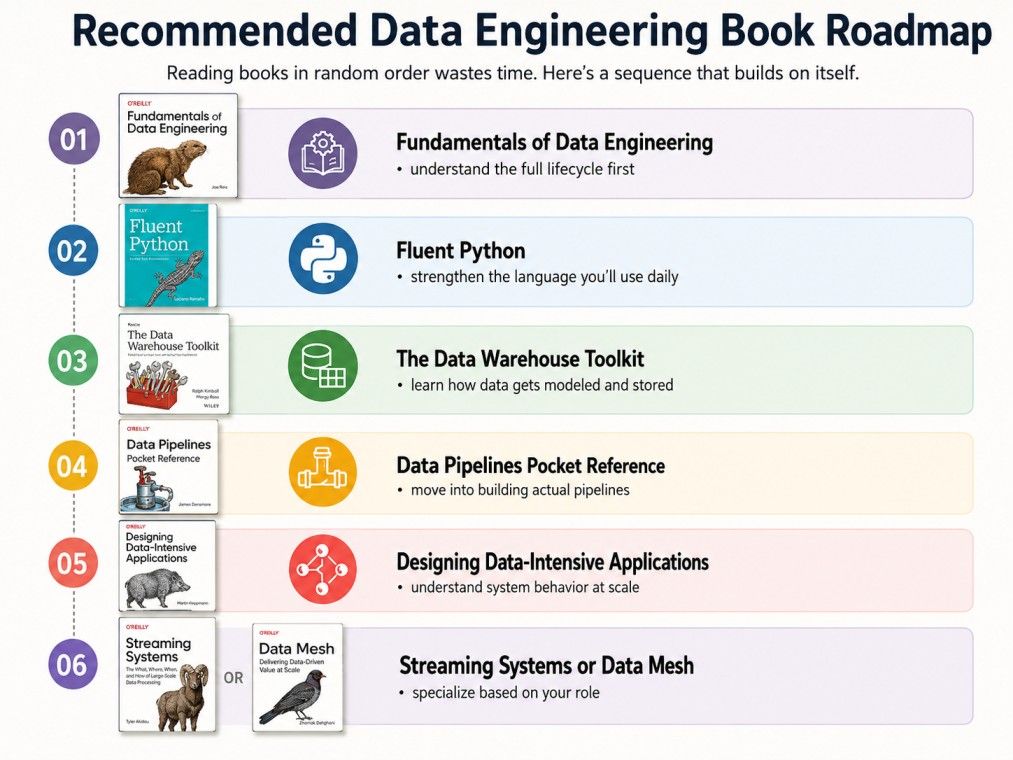
Don't rush this. Reading six dense books in a month won't teach you anything if you skip the coding practice between them. Build something small after each book, even if it's just a five-table pipeline on your laptop.
Data engineering books work best when they're read alongside a project, not instead of one.
Data engineering books won't make you job-ready by themselves. They will give you the mental models and vocabulary that make real projects easier to understand. That combination, not any single book, is what actually gets people hired. Choosing the right data engineering books can save months of trial and error. A well-planned reading list helps you build strong fundamentals, understand modern architectures, and prepare for real engineering challenges without feeling overwhelmed.
Start with one book that matches your current skill level, apply what you learn through small projects, and gradually move toward more advanced topics. That's a practical path to becoming a confident data engineer, and it's one that continues to pay off throughout your career.
Ready to start your journey? Book a free consultation with upGrad today to find the best path for your career.
If you're starting from scratch, Fundamentals of Data Engineering is widely regarded as the best first choice because it explains the complete data engineering lifecycle without assuming prior knowledge. Once you're comfortable with the basics, move to a practical book like Data Engineering with Python for hands-on experience.
Experienced professionals should focus on books that cover system design, scalability, and architecture. Titles such as Designing Data-Intensive Applications, Streaming Systems, and Data Mesh are among the best books for data engineers looking to deepen their understanding of large-scale production systems.
Yes. While some tool-specific examples may be dated, books that teach core principles such as data modeling, distributed systems, and architecture remain highly relevant. Concepts from titles like The Data Warehouse Toolkit and Designing Data-Intensive Applications continue to apply across modern cloud platforms.
There's no fixed number. Reading two or three carefully selected books while building practical projects usually provides more value than reading many books without applying the concepts. Employers generally value hands-on skills alongside a strong theoretical foundation.
The answer depends on your career stage. Beginners benefit most from Fundamentals of Data Engineering, while professionals aiming for senior or architect roles should consider Designing Data-Intensive Applications and Data Mesh. Choosing books that match your goals leads to better long-term career growth.
Start by identifying your learning objective. If you want conceptual clarity, choose foundation books. If your goal is coding and implementation, select project-based titles. Reading reviews, checking the table of contents, and matching the book's difficulty to your experience can help you make a better choice.
Yes. Learning the fundamentals first makes cloud technologies much easier to understand. Once you're familiar with data pipelines, storage, and architecture, you'll find AWS, Azure, or Google Cloud services much easier to learn because you'll understand the problems those tools are designed to solve.
Programming books focus on writing efficient code, language syntax, and software development practices. Data engineering books vs data science books also differ because data engineering emphasizes data pipelines, storage, and infrastructure, while programming books rarely cover these broader architectural concepts or production data workflows.
Industry discussions consistently recommend Fundamentals of Data Engineering, Designing Data-Intensive Applications, The Data Warehouse Toolkit, and Spark: The Definitive Guide. These titles appear frequently in expert recommendations because they teach concepts that remain valuable across different tools and technology stacks.
For most learners, starting with one or two beginner-friendly books is the better approach. They build confidence and establish the fundamentals before you tackle advanced architecture or distributed systems. A gradual progression usually leads to better understanding than jumping into highly technical material immediately.
Reading actively makes a big difference. Take notes, summarize each chapter, recreate examples, and build a small project after finishing every major topic. Applying concepts immediately helps reinforce your understanding and makes it much easier to recall ideas during interviews or real-world engineering work.
721 articles published
Sriram K is a Senior SEO Executive with a B.Tech in Information Technology from Dr. M.G.R. Educational and Research Institute, Chennai. With over a decade of experience in digital marketing, he specia...
Speak with Data Science Expert
By submitting, I accept the T&C and
Privacy Policy
Start Your Career in Data Science Today
Top Resources
Master's Degree
18 Months
Executive Diploma
12 Months
Bootcamp
6 Months