Turing Test in Artificial Intelligence: Process, Examples, Limitations
By Sriram
Updated on Jun 19, 2026 | 6 min read | 2.38K+ views
Share:

All courses
Certifications
More
By Sriram
Updated on Jun 19, 2026 | 6 min read | 2.38K+ views
Share:
Table of Contents
The Turing test in artificial intelligence is a very famous concept in AI history. It was proposed by mathematician and computer scientist Alan Turing in 1950. The test tries to answer a powerful question: Can machines think?
Turing did not try to define AI. Instead, he suggested evaluating if a machine can imitate conversation well enough to be mistaken for a real person. If you are curious about AI, machine learning, or modern tools like ChatGPT, it is essential to understand the Turing test in artificial intelligence.
In this guide you’ll learn what the Turing test in artificial intelligence (AI) is, how it works. Additionally, you’ll learn why it matters, strengths, limitations, and whether today's AI systems have actually passed the Turing test in artificial intelligence.
From Turing's vision to today's AI breakthroughs. Explore Artificial Intelligence Courses and Machine Learning Courses Online from upGrad and start your journey into intelligent machines.
Popular AI Programs
The Turing test in artificial intelligence is a way to see if a machine can demonstrate human-like intelligence through conversation.
Alan Turing introduced the idea in his landmark paper in 1950 “Computing Machinery and Intelligence” Instead of debating about what it means by “thinking” Alan Turing came up with a simple practical experiment called the “Imitation Game.”
Also Read: How to Learn Artificial Intelligence and Machine Learning
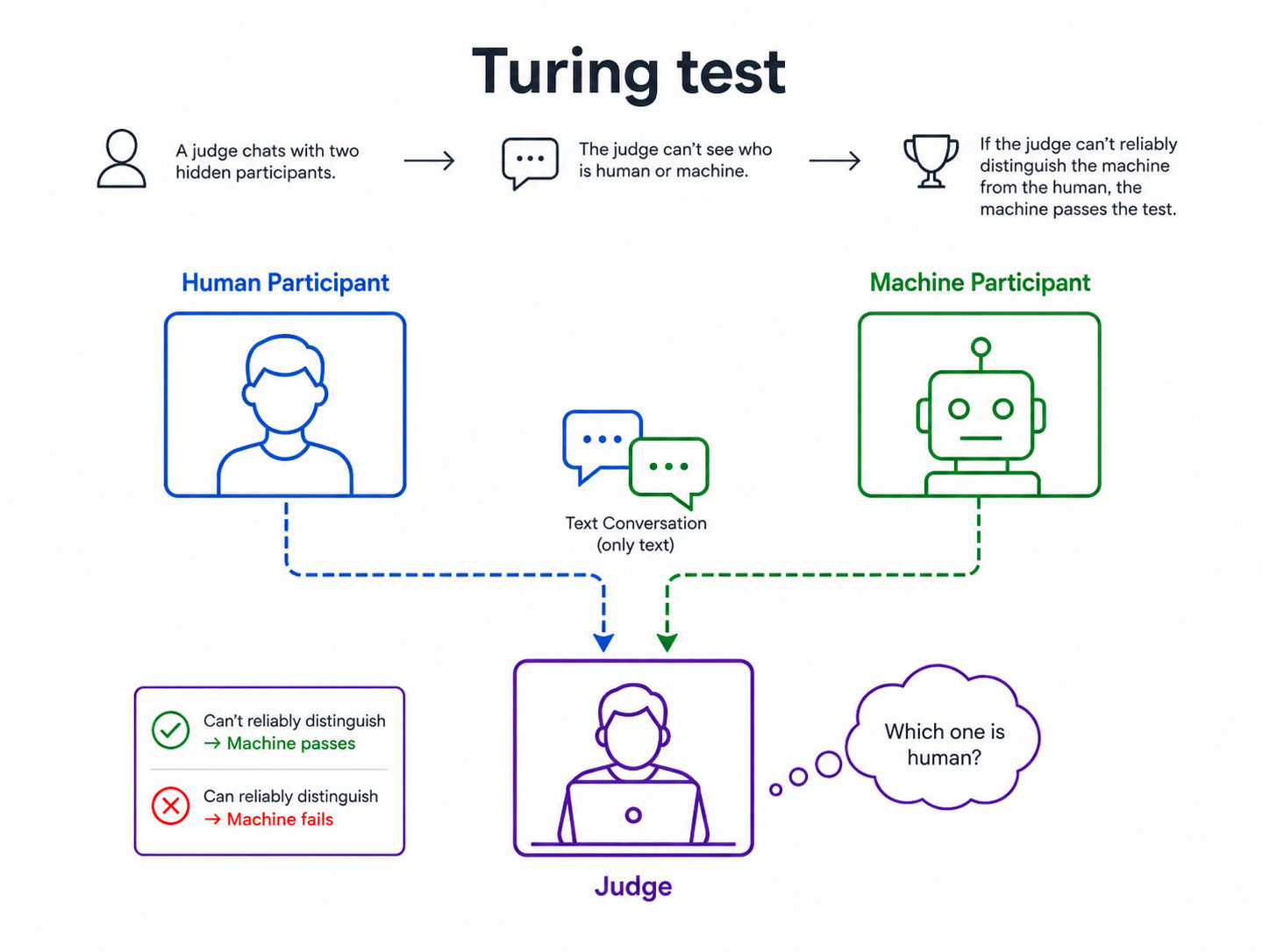
People usually talk to each other through text when they do this. This way what the other person looks like, or how they are, their physical appearance does not affect the outcome.
And if the person judging cannot figure out which one is the machine, then the machine is said to have passed the test.
Here a human judge will communicate with two unseen participants:
To simply define:
Term |
Meaning |
| Turing Test | A test that evaluates whether a machine can imitate human conversation |
| Judge | Human evaluator asking questions |
| Human Participant | Real human answering questions |
| Machine Participant | AI system attempting to appear human |
Also Read: Artificial Intelligence in Software Testing: Transforming Quality Assurance
At that time, there was a debate among the researchers about whether machines could think.
Turing did not get into arguments and instead focused on what people could see machines do. His way of thinking was simple:
Then it may be reasonable to consider it intelligent.
Free Courses
People still talk about chatbots and large language models. They often mention the Turing Test in artificial intelligence.
The concept helps researchers
Also Read: A Complete Guide to AI Architecture
Although the Turing test was created over 70 years ago, it still influences AI research today. The test initiated a practical way to evaluate machine intelligence.
Instead of asking abstract philosophical questions, it focused on measurable behavior.
Its impact can still be seen in:
Related Article: How Is Agentic AI Different from Traditional Virtual Assistants?
AI Courses to upskill
Explore Artificial Intelligence Courses for Career Progression
To understand the Turing test in AI, let's look at how it was first done
The traditional version includes three participants. This establishment remains the base of many modern explanations of the test.
Participant |
Role |
| Human Judge | Asks questions |
| Human Respondent | Answers honestly |
| Machine | Tries to appear human |
Let's Recall the step-by-step process on how it was done
The judge sends questions to both participants.
Questions may include:
Both participants respond through text.
The judge examines:
Finally, the judge will decide which participant is human. If the machine frequently fools the judge, then it was considered that the machine had performed well in the test.
Example of the process
Judge: What did you do last weekend?
Human: I visited my family and watched a cricket match.
AI: I spent time reading articles and discussing sports online.
The judge then looks for clues to determine which answer came from a machine.
Turing deliberately removed visual and physical cues because this allows the evaluation to focus entirely on conversation and intelligence rather than appearance. That decision also remains important because many modern AI applications operate primarily through text interfaces.
Therefore, the Turing Test in artificial intelligence measures how well a machine can talk like a human that feels natural. This test is not about how a machine looks or sounds.
Related Article: Text Classification in NLP: From Basics to Advanced Techniques
To perform well, an AI must demonstrate:
Skills Required for Passing
Skill |
Importance |
| Language Processing | Very High |
| Reasoning | High |
| Context Retention | High |
| Knowledge Retrieval | Medium |
| Social Understanding | High |
Also Read: How to Learn Machine Learning – Step by Step
Since 1950, Turing tests have been tested in several AI systems by researchers.
This test has indeed received a historical milestone
Year |
Event |
| 1950 | Alan Turing proposes the imitation game |
| 1966 | ELIZA chatbot demonstrates early conversational AI |
| 1991 | Loebner Prize competition begins |
| 2022 onwards | Large language models revive Turing Test debates |
ELIZA was one of the earliest chatbots. It was a simple technology, yet many people were convinced that they were having a natural conversation; they felt like ELIZA understood them.
This highlighted how easily humans can attribute intelligence to machines.
With the vast capabilities of the modern AI system. People are wondering “what is Turing test in artificial intelligence” and have modern systems passed it?
Today's AI models can:
There is no single answer that is universally accepted. Some researchers are on the opinion that modern language models can trick users during short chats.
Others argue that passing a rigorous version of the test requires much deeper understanding and consistency. Recent academic studies show that conclusions vary depending on how the test is designed.
The test remains useful because it encourages discussion around:
Even if Turing test is no longer the only benchmark, in testing artificial intelligence, it remains one of the most recognizable measures of machine behavior.
Developers use concepts inspired by the Turing Test when improving:
Also Read: How to Learn Artificial Intelligence and Machine Learning
Subscribe to upGrad's Newsletter
Join thousands of learners who receive useful tips
Despite its influence, many experts believe the Turing test in artificial intelligence has important limitations.
One of the most common criticisms is that machines can seem smart without truly understanding the things it says.
Turing test on the other hand only measures behavior, not actual comprehension.
John Searle, a philosopher came up with the famous Chinese Room Argument, a thought experiment on Chinese Room.
He said that a system can generate responses without genuinely understanding their meaning.
Different judges may reach different conclusions on a same AI system.
Some factors can influence outcomes, such as:
Many AI systems perform well during brief interactions. Longer conversations often reveal weaknesses such as:
The Turing Test evaluates only a narrow slice of our human capabilities.
Whereas human intelligence is vast and it includes:
Major Criticisms in table format
Criticism |
Explanation |
| Focus on imitation | Acting human is not the same as understanding |
| Subjective evaluation | Results depend on judges |
| Limited scope | Measures conversation more than intelligence |
| Easy to manipulate | Systems may use tricks rather than reasoning |
Many researchers consider Turing test to be still useful, but it should not be the only benchmark for judging machine intelligence.
Recent studies suggest that stronger and more structured versions of the test may still provide useful insights into machine intelligence.
The Turing test in artificial intelligence is like a beginning step. It helps to see if a machine can think like a human. It is not a final measure of intelligence.
Modern AI evaluation often includes:
The Turing test in artificial intelligence remains one of the most influential ideas in the history of AI. Proposed by Alan Turing in 1950, it shifted the conversation from defining intelligence to observing behavior. The test asks a simple question: can a machine communicate so naturally that people cannot distinguish it from a human?
While modern AI systems have achieved impressive conversational abilities, experts continue to debate whether passing the test truly demonstrates intelligence. The test has limitations, but its importance is undeniable. It shaped decades of AI research and continues to influence how we think about machine intelligence, language models, and the future relationship between humans and AI.
Want to explore more about, Turing test in artificial intelligence? Book your free 1:1 personal consultation with our expert today.
A Turing Test is a method used to determine whether a machine can imitate human conversation well enough to be mistaken for a real person. The concept was introduced by Alan Turing in 1950. It remains one of the most discussed ideas in artificial intelligence research.
The turing test in artificial intelligence is a conversational evaluation where a human judge interacts with both a machine and another human. If the judge cannot reliably identify the machine, the AI is considered successful in the test. The focus is on behavior rather than internal processing.
The purpose of the Turing Test is to evaluate whether a machine can display human-like conversational intelligence. It provides a practical framework for studying machine behavior without requiring a precise definition of intelligence itself.
The three participants are a human judge, a human respondent, and a machine. The judge communicates with both participants and attempts to determine which one is the machine based solely on their responses.
There is no universally accepted answer. Some experiments suggest that ChatGPT can fool people in certain conversational settings. However, many researchers argue that passing a rigorous version of the Turing Test requires more than short-term conversational success.
The Turing Test introduced one of the first practical methods for evaluating machine intelligence. It influenced decades of AI research and continues to shape discussions about language models, chatbots, and human-computer interaction.
The test focuses mainly on conversational ability. Critics argue that a machine may imitate human responses without truly understanding them. Because of this, many researchers believe the test alone cannot fully measure intelligence.
Yes. Although modern AI evaluation methods have expanded significantly, the Turing Test remains an important historical and conceptual benchmark. It continues to inspire new ways of measuring machine intelligence.
Some advanced chatbots can convince users they are human during short conversations. However, longer interactions often reveal limitations. Success depends on the specific test design and evaluation criteria.
Passing the Turing Test demonstrates human-like conversational behavior. Intelligence, however, may include reasoning, creativity, learning, planning, and understanding. Many experts believe these qualities extend beyond simple imitation.
Researchers now use reasoning benchmarks, problem-solving evaluations, safety assessments, and knowledge tests alongside conversational assessments. These methods provide a broader view of AI capabilities than the traditional Turing Test alone.
699 articles published
Sriram K is a Senior SEO Executive with a B.Tech in Information Technology from Dr. M.G.R. Educational and Research Institute, Chennai. With over a decade of experience in digital marketing, he specia...
Speak with AI & ML expert
By submitting, I accept the T&C and
Privacy Policy
Top Resources
Master's Degree
18 Months
Executive Diploma
12 Months
IIIT Bangalore
Executive Programme in Generative AI & Agentic AI for LeadersIndia’s #1 Tech University
Dual Certification
5 Months