Mutual Funds Artificial Intelligence: What Every Investor Should Know
By upGrad
Updated on Jun 22, 2026 | 9 min read | 1.59K+ views
Share:

All courses
Certifications
More
By upGrad
Updated on Jun 22, 2026 | 9 min read | 1.59K+ views
Share:
Mutual funds artificial intelligence is changing the way investment decisions are made. Fund managers now use AI to analyze market data, identify investment opportunities, assess risks, and monitor portfolios faster than ever before. What once took days of research can now happen in minutes.
AI isn't just for tech companies anymore. It's quietly changing how mutual funds are built, managed, and sold to everyday investors.
This blog breaks down exactly how mutual funds artificial intelligence works, where it's already being used in India, what it does better than traditional methods, and where it still falls short.
Explore upGrad's Management, AI and MBA programs to build skills in strategic management, business analytics, AI-powered decision-making, financial planning, innovation management, and leadership for the future of business.
Popular AI Programs
Mutual funds artificial intelligence refers to the use of AI technologies such as machine learning, predictive analytics, and natural language processing to support investment decisions within mutual funds. AI helps fund managers process more information than previously.
Traditional investment research relied on company financials, analyst reports, economic indicators, and market trends. AI expanded this process by scanning millions of data points across different sources in real time, helping investment teams identify patterns and signals that may otherwise go unnoticed.
AI systems process far more than stock prices. They continuously analyze financial, economic, and behavioral data to identify patterns that may influence investment decisions.
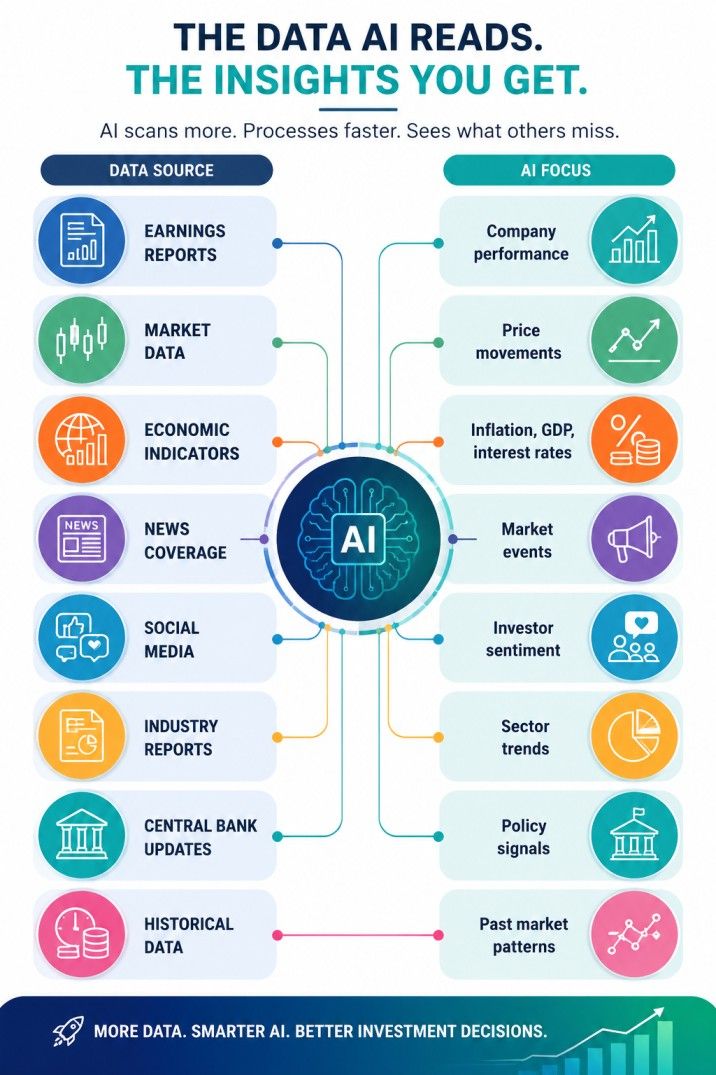
AI isn't managing every mutual fund independently. Instead, fund houses use it to improve research, portfolio management, and risk monitoring.
AI Application |
Primary Role |
Investor Benefit |
| Portfolio Construction | Selects and balances investments | Better diversification |
| Sentiment Analysis | Tracks market mood | Faster insights |
| Risk Monitoring | Flags unusual exposures | Early risk detection |
| Fund Recommendation Engines | Matches funds to investor profiles | More relevant fund choices |
The biggest advantage of AI isn't necessarily better predictions. It's scale. An Artificial Intelligence system can look at hundreds of companies and economic indicators and market signals in the time it takes an analyst to look at a few stocks.
But Artificial Intelligence has limits. It learns from what happened in the past which means big changes in the market can be hard for it to understand even if it is a good model. When things are really uncertain or the economy changes fast, people still need to make decisions about investments.
How Mutual Funds Artificial Intelligence Improves Investment Decisions. To be successful with investments, you need to make decisions. That is where Mutual Funds Artificial Intelligence helps. The big advantage is that it can look at a lot of information.
There is much information about financial markets all the time. A person can only look at a bit of it but an Artificial Intelligence system can look at a lot of information all the time and find patterns really fast. Mutual Funds Artificial Intelligence is really good, at this.
Do read: Top Artificial Intelligence Applications Across Industries
Free Courses
Investment success depends on making informed decisions. That's where mutual funds artificial intelligence creates value. The biggest advantage is scale.
Financial markets generate enormous amounts of information every second. Human analysts can only review a fraction of it, while AI systems can process large datasets continuously and identify patterns much faster.
AI Capability |
What It Does |
Benefit |
| Research & Screening | Analyzes stocks and market data at scale | Faster investment research |
| Trend Detection | Identifies emerging opportunities | Better stock selection |
| Risk Monitoring | Tracks exposure and market risks | Early warning signals |
| Portfolio Analysis | Monitors diversification and concentration | Improved portfolio balance |
| Decision Support | Uses data-driven models | Reduced emotional bias |
| Continuous Tracking | Monitors markets in real time | Faster response to changes |
For investors, these improvements can contribute to stronger research quality and more disciplined portfolio management.
Do read: Types of AI: From Narrow to Super Intelligence with Examples
AI Courses to upskill
Explore Artificial Intelligence Courses for Career Progression
Not all mutual funds use AI in the same way. There are now distinct categories worth understanding.
These funds rely on AI and machine learning models to drive investment decisions. Human involvement is minimal. The algorithm sets the strategy, rebalances the portfolio, and manages risk.
In India, DSP Quant Fund and Nippon India Quant Fund are examples. They're not magic. They perform well in trending markets and can underperform when market behavior is erratic or driven by events the model wasn't trained on.
Many large active funds now use AI as a decision-support tool. The fund manager still makes final calls, but AI surfaces insights, identifies correlations, and flags risks faster.
Think of it as giving a pilot a better co-pilot. The human is still flying.
Platforms like Groww, ET Money, and Zerodha Coin use AI-driven recommendation layers. You answer a few questions. The AI maps your risk profile and suggests a fund basket.
It's not deep AI. But it's practical AI. And for most retail investors, it works well enough.
Also read: AI vs ML vs DL: Why These Terms Are Everywhere
Let's be direct about where AI actually has an edge.
Area |
Traditional Approach |
AI Approach |
| Data volume | Limited by analyst bandwidth | Processes massive datasets instantly |
| Speed | Hours to days | Milliseconds to seconds |
| Emotion | Human bias present | No fear or greed in the model |
| Pattern detection | Based on known trends | Identifies non-obvious correlations |
| Rebalancing | Periodic, manual | Continuous, automated |
| Cost | High (large research teams) | Lower over time with scale |
The biggest advantage isn't data. It's consistency. AI doesn't panic during a market dip. It doesn't overreact to short-term noise. It just follows the logic of its training.
But here's the catch. If the model's logic is flawed, it follows that flawed logic consistently. A human manager might notice something's off. But the model won't be able to identify the flaw.
Also read: Exploring the 6 Different Types of Sentiment Analysis and Their Applications
People often assume AI-managed funds are automatically safer or smarter. That's not quite right.
A few things worth keeping in mind:
Limitation |
What It Means |
Impact |
| Overfitting | Relies too heavily on past data | Weaker performance in new market conditions |
| Lack of Transparency | AI models aren't fully disclosed | Limited visibility into decisions |
| Crowding Risk | Multiple funds make similar trades | Higher market volatility |
| Regulatory Gap | Rules still evolving | Less standardized oversight |
None of this means AI in mutual funds is bad. It just means you shouldn't assume "AI-powered" equals "safer." Evaluate the fund's track record the same way you would any other fund.
Must read: Simple Guide to Build Recommendation System Machine Learning
You don't need to understand machine learning to invest in a quant fund. But you should ask a few smart questions before putting money in.
What to Check |
Why It Matters |
| Performance Consistency | Shows results across market cycles |
| Expense Ratio | Helps assess cost efficiency |
| Fund Strategy | Reveals how the AI approach works |
| AUM (Assets Under Management) | Indicates scale and liquidity |
| Benchmark Tracking | Measures true active performance |
Mutual funds artificial intelligence is reshaping investment management by improving research, accelerating data analysis, and strengthening risk monitoring. Fund managers can now process information at a scale that wasn't possible just a few years ago, helping them make faster and more informed decisions.
Technology alone isn't enough, though. Markets remain unpredictable, and human expertise still plays a critical role in interpreting events that data models can't fully anticipate. The future of mutual funds artificial intelligence lies in combining advanced analytics with experienced investment judgment, creating a smarter and more disciplined approach to investing.
Ready to start your journey? Book a free consultation with upGrad today to find the best path for your career.
No. AI can identify patterns, trends, and risk signals from large datasets, but it cannot predict future returns with certainty. Market performance is influenced by economic events, policy changes, and investor behavior that may not follow historical patterns, making perfect prediction impossible.
Not necessarily. AI-based funds excel at processing data quickly and removing emotional bias, while active fund managers bring experience and market judgment. Performance depends more on the investment strategy, market conditions, and execution than whether a fund uses AI or human-led research.
Yes. Several fund houses offer quantitative or data-driven funds that use algorithms and machine learning models in their investment process. Examples include quant-focused schemes where stock selection and portfolio construction rely heavily on systematic models rather than traditional discretionary decisions.
Beginners can invest in AI-driven funds if they understand the fund's objective, risk level, and investment strategy. The presence of AI alone shouldn't be the reason to invest. Investors should focus on whether the fund aligns with their financial goals and investment horizon.
AI can monitor thousands of market signals simultaneously and identify unusual movements faster than manual research teams. While it cannot prevent losses during volatile periods, it can support quicker portfolio adjustments, risk assessment, and decision-making when market conditions change rapidly.
Not always. Quant funds use mathematical and statistical models for investment decisions, while AI mutual funds may use machine learning, predictive analytics, and natural language processing. Many modern quant funds incorporate AI tools, but the two terms aren't completely interchangeable.
AI can lower certain operational and research costs over time by automating data analysis and portfolio monitoring. However, investors shouldn't assume AI-based funds will always be cheaper. Some specialized quantitative funds may still have expense ratios comparable to actively managed funds.
Robo-advisors analyze factors such as age, income, risk appetite, financial goals, and investment duration. Based on these inputs, they suggest suitable mutual fund portfolios. The recommendations are automated, but the underlying fund selection framework varies across platforms.
AI models can make mistakes when market conditions change or when historical data fails to reflect new realities. In most professionally managed funds, risk controls and human oversight help review model outputs, reducing the likelihood of a single algorithmic decision causing major damage.
Some AI-driven strategies perform well in trending markets because patterns are easier to identify and follow. However, performance varies by model design. Certain strategies may struggle during sudden reversals, highly volatile periods, or event-driven markets where historical relationships break down.
Investors don't need coding or machine learning expertise. A basic understanding of mutual funds, risk management, portfolio diversification, asset allocation, and quantitative investing is usually enough. The focus should remain on evaluating fund quality rather than understanding every technical detail behind the model.
972 articles published
We are an online education platform providing industry-relevant programs for professionals, designed and delivered in collaboration with world-class faculty and businesses. Merging the latest technolo...
Speak with AI & ML expert
By submitting, I accept the T&C and
Privacy Policy
Top Resources
Master's Degree
18 Months
Executive Diploma
12 Months
IIIT Bangalore
Executive Programme in Generative AI & Agentic AI for LeadersIndia’s #1 Tech University
Dual Certification
5 Months