Engineering Applications of Artificial Intelligence
By Sriram
Updated on Jun 22, 2026 | 7 min read | 4.52K+ views
Share:

All courses
Certifications
More
By Sriram
Updated on Jun 22, 2026 | 7 min read | 4.52K+ views
Share:
Artificial Intelligence (AI) has evolved from a specialized computer science field into a core technology across engineering disciplines. Today, mechanical, civil, electrical, and aerospace engineers use AI to analyze data, automate complex processes, and solve challenging problems. Instead of relying solely on fixed mathematical models, AI enables data-driven decision-making, helping engineers improve efficiency, accuracy, and innovation in real-world applications.
In this blog, you'll learn how artificial intelligence is used in engineering, the technologies behind these applications, practical industry examples, benefits, limitations, and the future opportunities engineers can expect in the coming years.
Discover upGrad's Artificial Intelligence and Machine Learning programs and learn how to deploy and optimize intelligent systems using technologies
Popular AI Programs
Artificial Intelligence (AI) in Engineering refers to the use of AI technologies for solving engineering problems, improving efficiency, and enabling better decision-making. AI is a tool that engineers use to analyze big data sets, automate repetitive tasks, forecast outcomes and optimize complex systems .
AI helps engineers work faster and find insights that would be hard to get manually as engineering projects become more data-driven. AI is becoming an essential tool in many engineering fields, from product design to infrastructure management.
By intelligently understanding these applications, engineers can build smarter systems, reduce costs, improve safety and increase overall performance.
The picture highlights the relationship between AI technologies and engineering tasks.
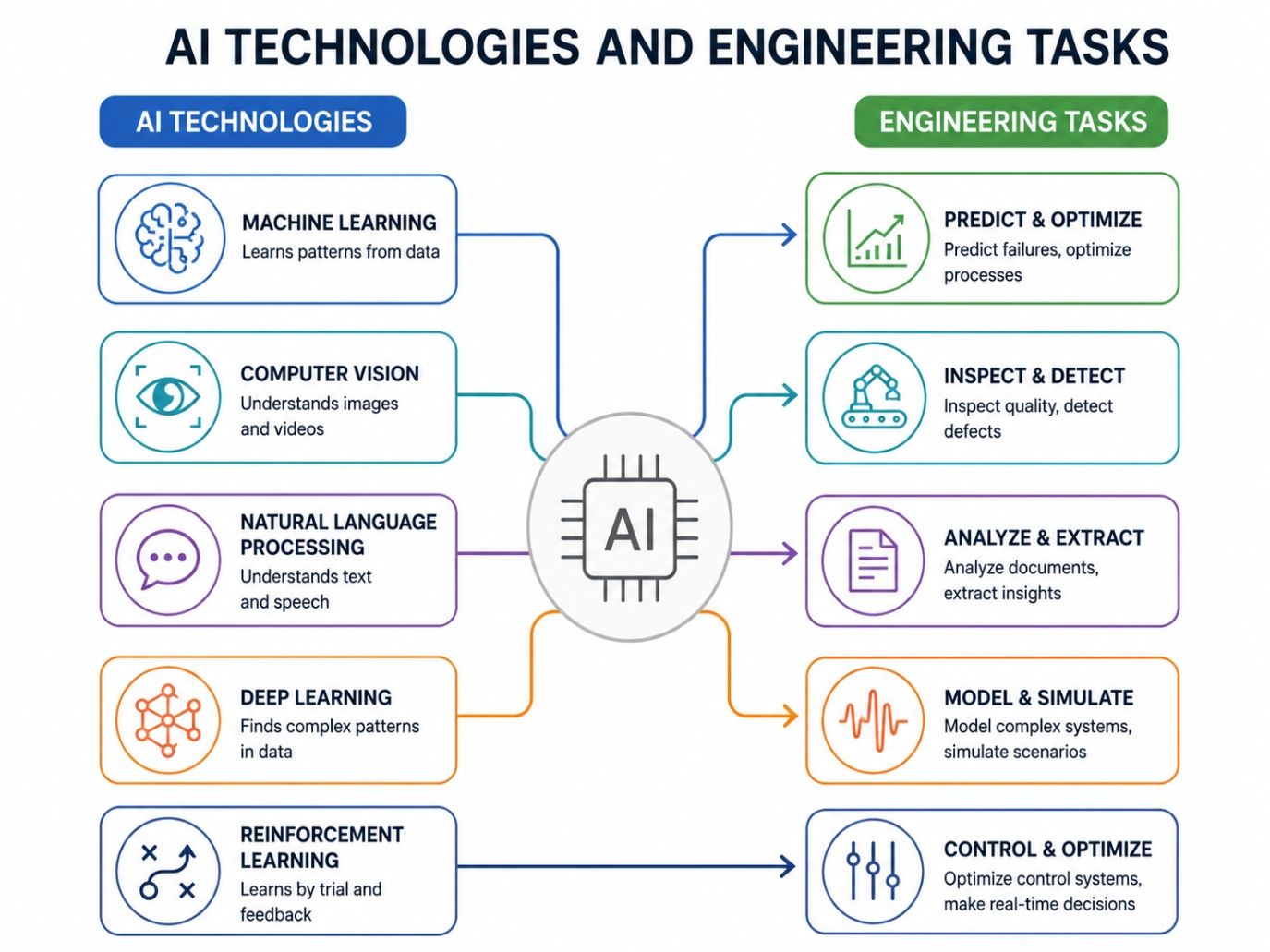
Modern engineering projects generate enormous volumes of data through sensors, simulations, connected devices, and software platforms.
AI helps engineers:
Also read: Applications of Artificial Intelligence and Its Impact
Free Courses
Manufacturing remains one of the most mature areas for engineering applications of artificial intelligence. Factories now use AI to improve efficiency, reduce waste, increase quality, and optimise production processes.
Modern industrial environments generate data from machines, sensors, control systems, and production lines. AI converts this information into actionable insights.
Artificial intelligence helps manufacturers improve production efficiency, maintain product quality, and reduce operational costs. By analyzing machine and production data in real time, AI enables smarter and faster manufacturing processes.
The table below highlights the key applications of AI in manufacturing systems.
AI Application |
How It Is Used in Manufacturing |
Benefit |
| Predictive Maintenance | Monitors machine data to predict failures before they occur | Reduces downtime and maintenance costs |
| Quality Inspection | Uses computer vision to detect defects during production | Improves product quality and consistency |
| Production Planning | Analyzes demand and production capacity | Optimizes schedules and resource allocation |
| Process Optimization | Identifies inefficiencies in manufacturing workflows | Increases productivity and reduces waste |
| Inventory Management | Forecasts inventory requirements using historical data | Prevents stock shortages and overstocking |
| Robotic Automation | Enables robots to perform repetitive assembly tasks | Improves speed, accuracy, and efficiency |
| Demand Forecasting | Predicts future product demand patterns | Supports better production planning |
| Smart Manufacturing | Connects machines and systems for real-time monitoring | Enhances operational visibility and control |
AI helps industrial facilities monitor operations, optimize resource usage, and improve equipment performance. It enables engineers to make data-driven decisions across large-scale industrial environments.
The table below shows major applications of AI in industrial systems.
AI Application |
How It Is Used in Industrial Systems |
Benefit |
| Industrial Process Control | Continuously adjusts operational parameters based on real-time data | Improves efficiency and product output |
| Energy Management | Analyzes energy consumption patterns | Reduces energy costs and waste |
| Asset Monitoring | Tracks equipment performance through sensors and IoT devices | Improves asset reliability |
| Supply Chain Optimization | Optimizes logistics, procurement, and distribution activities | Enhances operational efficiency |
| Safety Monitoring | Detects unsafe conditions and operational risks | Improves workplace safety |
| Anomaly Detection | Identifies unusual system behavior before failures occur | Prevents costly disruptions |
| Smart Decision Support | Provides real-time operational insights to engineers | Enables faster decision-making |
| Resource Optimization | Improves utilization of materials, labor, and equipment | Reduces operational expenses |
Also Read: Best AI Tools for Business: Top Tools & Use Cases
AI Courses to upskill
Explore Artificial Intelligence Courses for Career Progression
Artificial intelligence is helping engineers improve the planning, monitoring, operation, and maintenance of critical infrastructure systems. By analyzing large amounts of data, AI supports better decision-making, enhances safety, and increases operational efficiency across civil, electrical, and infrastructure projects.
AI helps civil engineers design, monitor, and maintain infrastructure more effectively. It can identify potential issues early and improve project planning and execution.
The table below highlights key AI applications in civil engineering.
AI Application |
How It Is Used in Civil Engineering |
Benefit |
| Structural Health Monitoring | Analyzes sensor data from bridges, buildings, and tunnels | Detects damage before major failures occur |
| Construction Project Planning | Optimizes schedules, resources, and workflows | Reduces delays and project costs |
| Site Safety Monitoring | Uses cameras and sensors to identify hazards | Improves worker safety |
| Traffic Management | Analyzes traffic patterns and congestion data | Improves transportation efficiency |
| Surveying and Mapping | Processes drone and satellite imagery | Speeds up land assessment |
| Risk Assessment | Predicts potential project risks using historical data | Supports better decision-making |
| Smart Building Management | Monitors building systems in real time | Improves energy efficiency and maintenance |
| Infrastructure Inspection | Automates inspections using computer vision | Reduces manual inspection effort |
AI enables electrical engineers to manage power systems more efficiently by improving energy distribution, fault detection, and demand forecasting. It helps create reliable and intelligent electrical networks.
The table below shows how AI is used in electrical engineering.
AI Application |
How It Is Used |
Benefit |
| Smart Grid Management | Optimizes electricity generation and distribution | Improves grid reliability |
| Energy Demand Forecasting | Predicts future electricity consumption | Enhances energy planning |
| Fault Detection | Identifies electrical faults in real time | Reduces power outages |
| Renewable Energy Optimization | Balances solar and wind energy generation | Improves energy efficiency |
| Substation Monitoring | Tracks equipment health and performance | Prevents equipment failures |
| Load Balancing | Distributes power efficiently across networks | Improves system stability |
| Predictive Maintenance | Predicts maintenance needs for electrical assets | Reduces downtime |
| Power Quality Monitoring | Detects voltage and frequency issues | Maintains power quality |
AI helps infrastructure engineers monitor, maintain, and optimize large-scale public systems such as roads, utilities, transportation networks, and smart cities. It improves reliability while reducing operational costs.
The table below highlights key AI applications in infrastructure engineering.
AI Application |
How It Is Used in Infrastructure Engineering |
Benefit |
| Infrastructure Maintenance | Predicts maintenance requirements using sensor data | Reduces repair costs |
| Utility Network Monitoring | Monitors water, gas, and utility systems | Improves service reliability |
| Smart City Management | Integrates transportation, utilities, and public services | Enhances urban efficiency |
| Transportation Optimization | Improves traffic flow and route planning | Reduces congestion |
| Asset Management | Tracks infrastructure asset performance | Extends asset lifespan |
| Environmental Monitoring | Analyzes environmental and climate-related data | Supports sustainable planning |
| Disaster Prediction | Identifies potential infrastructure risks from natural events | Improves preparedness |
| Resource Optimization | Improves allocation of infrastructure resources | Increases operational efficiency |
Also Read : Why AI Is The Future & How It Will Change The Future?
Artificial intelligence is becoming a key part of modern engineering, helping organizations build smarter, faster, and more efficient systems. As AI technology advances, its role in design, automation, and decision-making will continue to grow across engineering disciplines.
The following trends are shaping the future of AI in engineering.
Artificial intelligence is transforming engineering by helping professionals design, build, operate, and maintain systems more efficiently. From predictive maintenance and smart manufacturing to infrastructure monitoring and design optimization, AI enables faster analysis and better decision-making.
However, AI works best when combined with human expertise. Engineers remain essential for validating outcomes, ensuring safety, and solving complex challenges. As AI continues to evolve, it will play an even greater role in shaping the future of engineering.
Ready to start your journey? Book a free consultation with upGrad today to find the best path for your career.
Artificial intelligence is widely used in mechanical, electrical, civil, aerospace, industrial, and software engineering. Manufacturing and industrial engineering currently lead adoption because they generate large amounts of operational data. However, civil engineering uses AI for infrastructure monitoring, while electrical engineering applies it to smart grids, energy forecasting, and fault detection.
You do not need to become a data scientist to work with AI. Most engineers benefit from learning:
Understanding how AI models make predictions is often more valuable than building models from scratch.
AI automates repetitive tasks that often consume engineering teams' time. Instead of manually analyzing thousands of data points, engineers can use AI systems to identify patterns, generate insights, and highlight potential issues.
This allows teams to focus on problem-solving, innovation, and design improvements rather than routine analysis.
Yes. AI is no longer limited to large enterprises. Many cloud-based platforms and engineering software solutions now include built-in AI features.
Small firms can use AI for:
The key is starting with a specific business challenge rather than adopting AI for its own sake.
AI supports many real-world engineering applications. Construction companies use it to predict project delays. Manufacturers rely on AI to detect product defects. Utility providers use it to forecast electricity demand.
In many cases, AI works behind the scenes by processing large datasets and providing recommendations that help engineers make faster decisions.
The biggest challenge is often data quality rather than technology. AI systems depend on accurate and consistent data to perform well.
Other common challenges include:
Organizations that address these issues early typically achieve better outcomes.
AI is more likely to change engineering roles than eliminate them. Engineers will continue to make critical decisions, validate designs, and ensure safety standards are met.
As engineering applications of artificial intelligence expand, professionals who understand both engineering principles and AI tools will become increasingly valuable in the workforce.
A digital twin is a virtual representation of a physical asset such as a machine, building, or production line. AI continuously analyzes data from sensors and updates the digital model in real time.
Engineers can use digital twins to test scenarios, monitor performance, and predict failures without disrupting actual operations.
Manufacturing organizations use AI to improve efficiency, reduce downtime, and maintain product quality.
Some practical benefits include:
These improvements help manufacturers increase productivity while minimizing waste.
Yes. AI is becoming a standard technology across engineering disciplines. Future engineers will increasingly work with intelligent systems, automation platforms, and data-driven tools.
Learning how AI supports engineering workflows can help you adapt to industry changes and improve your ability to solve complex technical problems.
The future of engineering applications of artificial intelligence includes smarter digital twins, autonomous systems, advanced robotics, and AI-driven sustainability initiatives. Engineers will use AI not only for automation but also for design optimization, infrastructure management, and predictive decision-making.
Organizations that combine engineering expertise with AI capabilities will be better equipped to handle complex projects, improve efficiency, and develop innovative solutions.
730 articles published
Sriram K is a Senior SEO Executive with a B.Tech in Information Technology from Dr. M.G.R. Educational and Research Institute, Chennai. With over a decade of experience in digital marketing, he specia...
Speak with AI & ML expert
By submitting, I accept the T&C and
Privacy Policy
Top Resources
Master's Degree
18 Months
Executive Diploma
12 Months
IIIT Bangalore
Executive Programme in Generative AI & Agentic AI for LeadersIndia’s #1 Tech University
Dual Certification
5 Months