Portfolio Management Meaning: Types, Process, Strategies & More
By upGrad
Updated on Aug 17, 2026 | 8 min read | 6.99K+ views
Share:

All courses
Certifications
More
By upGrad
Updated on Aug 17, 2026 | 8 min read | 6.99K+ views
Share:
Table of Contents
Key Highlights
Ready to move ahead in your management career? Explore an online MBA for working professionals that help you develop industry-relevant skills, strengthen your business acumen, and prepare for bigger career opportunities.
Popular MBA Programs
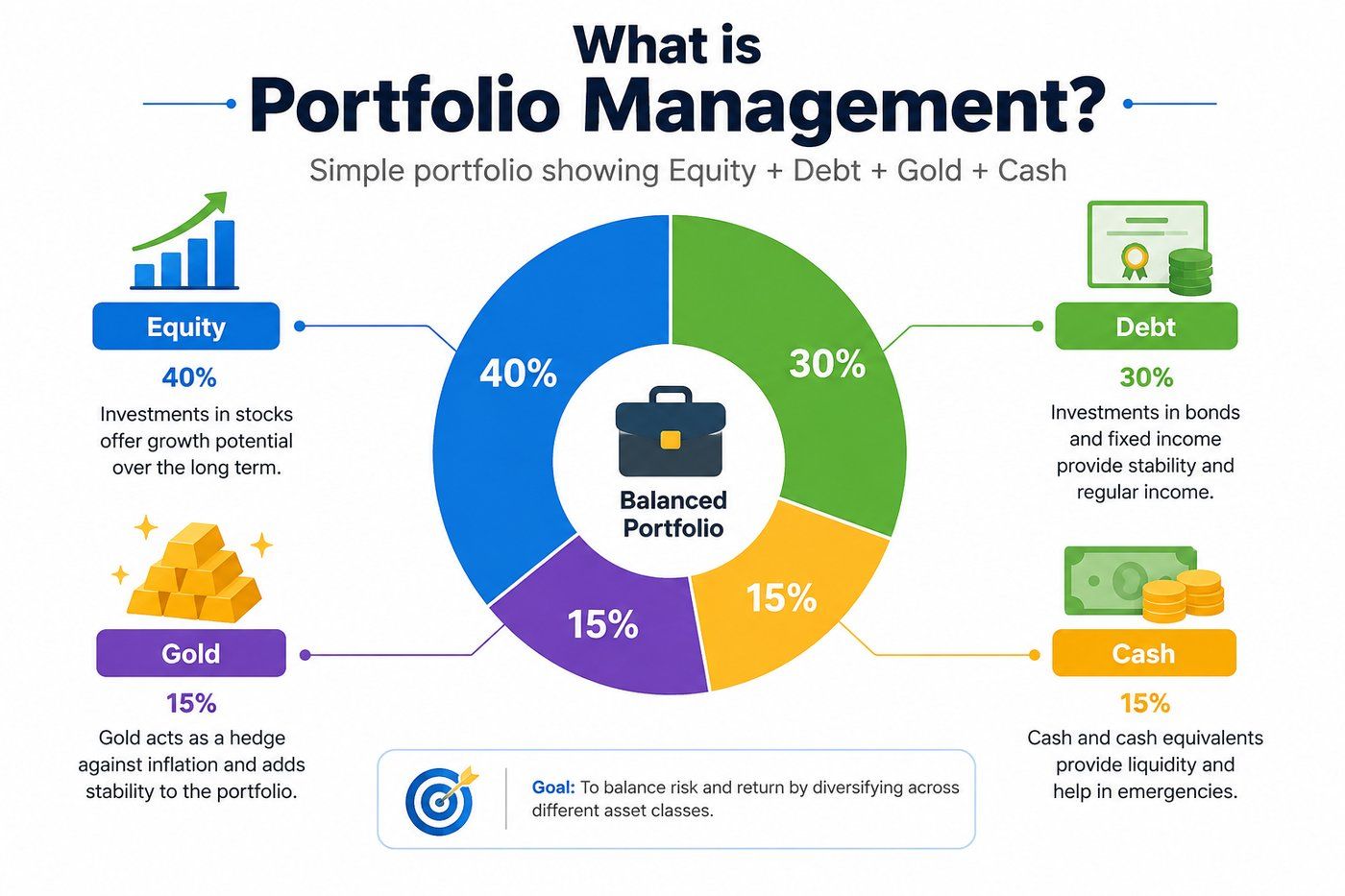
Portfolio management is the process of selecting, organising, monitoring, and adjusting investments to achieve specific financial objectives while managing risk. It can involve stocks, bonds, mutual funds, exchange-traded funds, cash, and other investment assets. The exact mix depends on the investor.
For example, a young investor saving for a goal 15 years away may be comfortable with a larger equity allocation. Someone who needs the money in two years may prefer a more conservative mix.
Portfolio management usually involves several connected decisions.
1. Goal Setting: Knowing why you are investing. The goal could be retirement, buying a house, funding education, or creating long-term wealth.
2. Risk Assessment: Every investor has a different ability and willingness to take risk. A portfolio should reflect both.
3. Asset Allocation: Deciding how much money should go into different asset classes such as equity, debt, gold, or cash.
4. Investment Selection: Once the broad allocation is decided, specific investments can be selected.
5. Portfolio Monitoring: Portfolio needs regular review. Market movements, changes in income, new financial goals, or changes in risk tolerance can affect the original plan.
6. Rebalancing: Over time, some investments may grow faster than others. This can change the portfolio's original allocation. Rebalancing brings it back toward the intended mix.
Also read: Investment Management: Strategies, Process & Real-World Use
Free Courses
The objectives of portfolio management can differ from one investor to another. A person saving for retirement may prioritise long-term wealth creation, while someone approaching retirement may give greater importance to capital preservation.
The main objectives include the following.
The portfolio can include growth-oriented investments that have the potential to appreciate in value. The investor's time horizon is important here because long-term goals may allow more room to handle short-term market fluctuations.
Wealth creation does not mean chasing the highest possible return. The return should be considered alongside the amount of risk being taken.
A portfolio can spread exposure across different assets, sectors, securities, and investment styles. The objective is to avoid allowing one investment or one type of risk to dominate the entire portfolio.
Risk management also involves selecting an asset mix that matches the investor's financial situation.
Some investors are more concerned about protecting the money they already have.
This can become particularly important when an investor is close to a major financial goal. Taking excessive risk shortly before the money is required can create problems if markets decline.
In such cases, portfolio decisions may focus more heavily on stability and liquidity.
Depending on the investor's needs, this could come from sources such as interest, dividends, or other income-producing investments.
For example, a retired investor may need the portfolio to support regular expenses rather than focus only on long-term capital appreciation.
An investor may want to build ₹1 crore for retirement, fund a child's education, purchase a home, or create a financial cushion.
Portfolio management connects investment decisions with those goals. The investment strategy can then be evaluated based on whether it is helping the investor move toward the required target.
Also read: Must-Know Risk Management Strategies for Every Leader!
MBA Courses to upskill
Explore MBA Courses for Career Progression
O.P.Jindal Global University
MBA (with Career Acceleration Program by upGrad)Become interview ready with Career Services
PSB MBA + IIML Certification
MBA from Paris School of Business with Certification from IIM LucknowConsider an investor named Rahul who has ₹10 lakh to invest.
He wants to use the money for long-term wealth creation. His investment horizon is 10 years, and he is comfortable taking moderate risk.
Instead of putting the entire ₹10 lakh into one investment, Rahul first defines what he wants the money to achieve.
After assessing his risk tolerance and time horizon, he decides on a hypothetical allocation:
| Asset class | Allocation | Amount |
| Equity | 60% | ₹6 lakh |
| Debt | 25% | ₹2.5 lakh |
| Gold | 10% | ₹1 lakh |
| Cash | 5% | ₹50,000 |
| Total | 100% | ₹10 lakh |
The next step is investment selection.
The ₹6 lakh equity allocation could be spread across suitable investments instead of one company. Debt may provide stability, gold can add diversification, and cash can meet short-term needs.
If equity performs strongly, its share could rise from 60% to 68%, increasing the portfolio's risk. Rahul can then rebalance it toward the original allocation.
This shows the essence of portfolio management: build around a goal, monitor performance, and adjust when circumstances or risk levels change.
Also read: Explore the Core Functions of Financial Management
The portfolio management process is a structured sequence of decisions used to build and maintain an investment portfolio. It starts before an investment is selected and continues after the money has been invested.
A typical portfolio management process includes seven important steps.
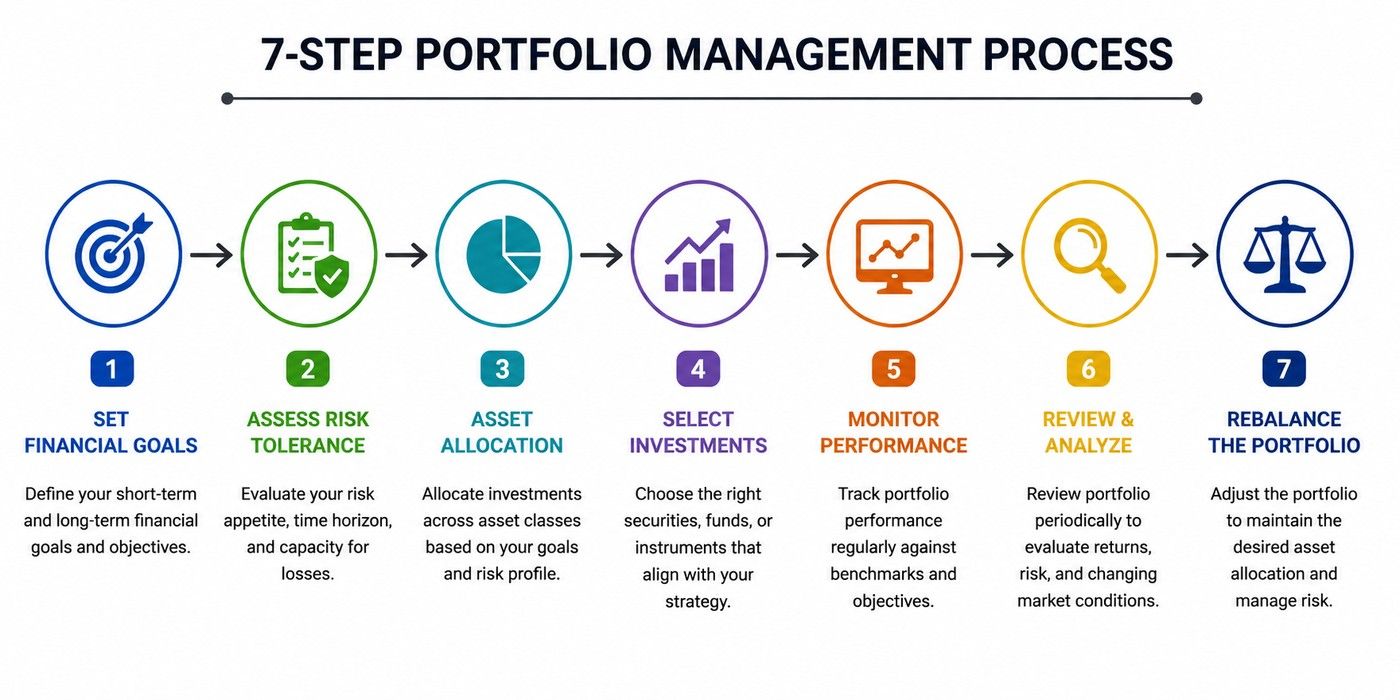
An investor may have one goal or several. These could include retirement planning, buying a house, creating an emergency fund, or building long-term wealth.
Instead of saying, “I want good returns,” an investor could define:
Risk tolerance has two sides.
These two factors may not always match.
An investor might financially be able to handle a market decline but still feel uncomfortable seeing a large drop in the portfolio. A suitable portfolio should consider both factors.
Other factors that can influence risk assessment include:
Once the goals and risk profile are understood, the investor can decide how much money should be allocated to different asset classes. This is called asset allocation.
For example, a moderate-risk portfolio might have exposure to equity, debt, gold, and cash. The exact percentages depend on the investor's circumstances.
For equity exposure, this might involve selecting individual stocks, equity mutual funds, or exchange-traded funds. For debt exposure, an investor may consider bonds, debt funds, or other suitable instruments.
Investment selection requires looking at factors such as:
A strong portfolio is not necessarily the one with the largest number of investments. Adding more investments without a clear purpose can make a portfolio difficult to understand and manage.
Portfolio construction means deciding how the selected investments will work as a group.
Suppose an investor selects ten stocks. Simply owning ten stocks does not automatically create a well-designed portfolio. The investor also needs to consider how much money is allocated to each stock and whether the holdings are concentrated in the same sector or exposed to similar risks.
The portfolio should therefore have a clear structure. Each investment should have a reason for being included.
The investor needs to review whether the portfolio is performing as expected and whether its risk remains appropriate. Monitoring does not mean checking prices every few minutes. Instead, it can involve periodic reviews of:
An investment may also need to be reviewed if its fundamentals change or if it no longer fits the original investment strategy.
Market movements can change the portfolio's original allocation.
Suppose an investor initially allocates 60% to equity and 40% to other assets. If equity performs strongly, it may eventually represent 70% of the portfolio.
Nothing is necessarily wrong with the equity investments. However, the portfolio has become riskier than originally planned. Rebalancing involves making appropriate changes to move the portfolio closer to its intended allocation.
It can also be triggered by changes in personal circumstances, such as:
Therefore, portfolio management is a continuous process rather than a one-time investment decision.
Also read: Best Financial Management Courses 2025 | Learn Online
The major types include active, passive, discretionary, and non-discretionary portfolio management. In detail information about the types are as follows:nf
Active portfolio management involves making investment decisions with the aim of achieving better returns than a selected benchmark or market index.
The portfolio manager may buy or sell investments based on factors such as company performance, valuation, economic conditions, industry trends, or market expectations.
For example, a manager may believe that a particular sector has stronger growth potential than the broader market. The portfolio may therefore have a higher allocation to that sector.
Passive portfolio management takes a different approach.
Instead of trying to regularly outperform the market, the objective is generally to replicate the performance of a particular market index or benchmark.
Passive management generally involves:
This approach can suit investors who prefer a simpler, long-term strategy and do not want investment decisions to depend heavily on a manager's market forecasts.
In discretionary portfolio management, the portfolio manager is given authority to make investment decisions on behalf of the client within the agreed investment mandate.
The client provides information about their:
The manager then makes suitable investment decisions within the agreed framework.
In India, discretionary portfolio management services operate under a regulated framework. Investors should understand the terms, fees, risks, and responsibilities involved before using such services.
Non-discretionary portfolio management gives the investor greater control.
The portfolio manager provides recommendations based on the client's objectives and risk profile. However, the investor generally makes the final investment decision.
For example, a manager may recommend reducing exposure to a particular stock or increasing allocation to another asset class. The client can then decide whether to act on that recommendation.
This approach can suit investors who want professional research and guidance but still want to retain control over their investment decisions.
The key difference is simple:
The manager recommends. The investor decides.
The two approaches can be compared quickly:
| Factor | Active Management | Passive Management |
| Main objective | Try to outperform a benchmark | Track a benchmark |
| Investment decisions | More frequent | Generally fewer |
| Research requirement | High | Relatively lower |
| Trading | More frequent | Usually limited |
| Flexibility | Higher | Lower |
| Cost | Can be higher | Often lower |
| Dependence on manager decisions | Higher | Lower |
The key difference is who makes the final investment decision.
This distinction is particularly useful when understanding portfolio management services meaning, because different service arrangements can give investors different levels of control.
Don’t let the next wave of AI leadership pass you by. Build the skills to lead data and AI transformation with the IIIT-B & IIMU Chief Data and AI Officer Programme Online.
Some commonly used portfolio management strategies include the following.
The buy-and-hold strategy involves purchasing investments and keeping them for a long period instead of frequently buying and selling.
The idea is simple. If an investor believes an asset has long-term potential, short-term market fluctuations may not be a reason to exit the investment.
For example, an investor may purchase shares of fundamentally strong companies and hold them for several years.
Value investing focuses on finding investments that appear to be priced below their underlying or estimated value. The investor studies factors such as:
The expectation is that the market may eventually recognise the investment's value.
However, a low share price does not automatically mean that a stock is undervalued. Sometimes a company is cheap because its business is facing serious problems.
Growth investing focuses on companies or assets that are expected to grow faster than the broader market or their industry. Growth-oriented companies may have characteristics such as:
Investors following this approach generally accept greater uncertainty in exchange for the possibility of higher future growth. The risk is that expectations may not materialise. If a company's growth slows, its valuation can fall sharply.
Income investing focuses on generating regular cash flows from investments. Depending on the portfolio, income can come from sources such as interest payments or dividends.
For example, a person approaching retirement may have different income requirements from a young investor focused primarily on long-term capital growth.
Strategic asset allocation involves setting a long-term target allocation across different asset classes. The allocation is based mainly on factors such as:
The portfolio is then periodically rebalanced when market movements cause the actual allocation to move significantly away from the target.
Here, the investor or portfolio manager temporarily changes the portfolio's asset allocation based on market conditions, valuations, economic expectations, or other factors.
For example, if an investor believes that equity valuations have become unusually attractive, they may temporarily increase equity exposure.
Similarly, exposure may be reduced if the investor believes the risk has increased substantially.
The key difference is that strategic allocation focuses on the long-term target, while tactical allocation allows shorter-term deviations from that target.
Also read: How to Become an Investment Banker in India? Complete Guide for 2026
Creating a portfolio is only one part of the job. Investors also need to determine whether it is delivering appropriate results.
Looking only at the amount of money earned can be misleading.
For example, Portfolio A may earn 12% while Portfolio B earns 10%. At first glance, Portfolio A appears better. But if Portfolio A took substantially more risk to generate that additional return, the comparison becomes less straightforward.
This is why investors use several measures to evaluate portfolio performance.
Absolute return measures how much an investment has gained or lost over a particular period.
For example, if an investment of ₹1 lakh becomes ₹1.20 lakh, the absolute gain is ₹20,000, or 20%.
The basic calculation is:
Absolute Return = (Final Value − Initial Value) / Initial Value × 100
It is easy to understand, but it does not consider how long the investment was held.
A 20% return over one year is very different from a 20% return over five years.
CAGR stands for Compound Annual Growth Rate.
It shows the annualised growth rate of an investment over a period, assuming the investment grew at a steady compounded rate.
The formula is:
CAGR = (Final Value / Initial Value)^(1/n) − 1
Here, n represents the number of years.
For example, suppose ₹1 lakh grows to ₹1.61 lakh over five years. CAGR provides a more useful way to understand the annualised growth than simply saying that the investment gained 61%.
CAGR is particularly useful when comparing investments held for different periods.
A portfolio's return becomes more meaningful when compared with an appropriate benchmark.
Suppose a portfolio generates a 10% return during a year. That may sound reasonable.
But what if its benchmark generated 14% during the same period?
The portfolio has produced a positive return but has still underperformed its benchmark.
The Sharpe ratio considers returns in relation to the risk taken to generate those returns.
A higher Sharpe ratio generally indicates better risk-adjusted performance, assuming the portfolios are being compared appropriately.
For example, imagine two portfolios both generated 12% returns. If one experienced much larger fluctuations than the other, the less volatile portfolio may have a more attractive risk-adjusted result.
Volatility measures how much an investment or portfolio's value fluctuates over time. Higher volatility means larger price movements. Lower volatility means relatively smaller fluctuations.
Consider two investments:
Both may eventually produce similar long-term returns, but Investment B has experienced much greater volatility.
Volatility does not automatically mean permanent loss. However, it helps investors understand how unstable the portfolio's value can be.
Maximum drawdown measures the largest decline from a portfolio's peak value to a subsequent low during a specific period.
For example, suppose a portfolio grows from ₹10 lakh to ₹14 lakh and later falls to ₹11 lakh.
The decline from the ₹14 lakh peak to ₹11 lakh is ₹3 lakh, or approximately 21.4%.
Maximum drawdown helps investors understand how severe a historical decline has been.
Risk-adjusted returns evaluate performance while considering the amount of risk involved.
This is important because two portfolios can generate the same return while exposing investors to very different levels of uncertainty.
Measures such as the Sharpe ratio help make this comparison.
When evaluating performance, investors should therefore consider more than just the final return. A useful assessment can combine:
The best portfolio is not necessarily the one with the highest return. It is one whose performance is appropriate for the investor's objective and the risk taken to achieve it.
Also read: Achieve Career Success: Master 10 Type of Management Style
These three terms sound similar, but they refer to different things. Understanding the distinction makes the broader concept of portfolio management meaning easier to grasp.
| Term | Meaning | Simple example |
| Portfolio | A collection of investments owned by an investor | Stocks, bonds, mutual funds and gold held together |
| Portfolio Investment | Money invested in financial assets rather than directly owning or managing a business | Buying shares or bonds |
| Portfolio Management | The process of selecting, monitoring and adjusting investments | Deciding what to buy, how much to invest and when to rebalance |
Think of it this way:
Portfolio = What you own
Portfolio investment = Where you put your money
Portfolio management = How you manage what you own
For example, suppose Priya owns stocks, debt funds and gold. These investments together form her portfolio.
The money she puts into these financial assets represents portfolio investment.
If she regularly reviews the allocation, evaluates performance, changes investments and rebalances the portfolio according to her financial goals, she is practising portfolio management.
This distinction is useful because simply having multiple investments does not mean that a portfolio is being actively managed.
Also read: Financial Analyst Job Description: Key Roles and Skills
These concepts are particularly useful for finance students, investment professionals, and investors who want to understand the logic behind portfolio construction.
Modern Portfolio Theory (MPT), developed by Harry Markowitz, focuses on how investments work together rather than evaluating each asset separately. Its goal is to create a portfolio with a suitable balance between expected return and risk.
Key idea:
The efficient frontier represents portfolios that offer the highest expected return for a given level of risk or the lowest risk for a specific expected return. It helps investors understand the trade-off between risk and return.
Correlation shows how investments move in relation to each other. Assets with low or negative correlation may behave differently during market movements, which can help reduce the impact of a sharp movement in one investment.
Risk-adjusted returns consider the return earned in relation to the risk taken. Two portfolios may generate similar returns but experience different levels of volatility. Measures such as the Sharpe ratio help investors make this comparison.
Portfolio optimisation involves finding an investment mix that balances objectives such as return, risk, liquidity, and allocation limits.
It may consider:
Mathematical models can support these decisions, but their results depend on the assumptions and data used.
A benchmark provides a standard for comparing portfolio performance. Tracking error measures how closely a portfolio's returns follow its benchmark. This is particularly useful for portfolios designed to replicate an index or follow a specific investment strategy.
Also read: Scope of Financial Management Shaping Careers in 2025
There is no universal answer.
Some investors prefer managing their own investments. Others use professional portfolio management services because they want expert support or do not have enough time to handle their portfolios.
Managing a portfolio yourself gives you direct control over investment decisions.
You can decide:
The main advantage is control. You can also avoid paying certain professional management fees.
Professional management can be useful when an investor wants expert assistance with portfolio decisions. A professional may help with:
This can be particularly useful for investors with complex financial goals or limited time. However, professional management comes with costs, and using a professional does not guarantee higher returns.
Also read: Top Highest Paying Finance Jobs in India 2026 Revealed!
Portfolio management is about more than buying and selling investments. It is a structured approach to connecting investments with financial goals. The process starts with defining objectives and understanding risk. It then moves through asset allocation, investment selection, portfolio construction, monitoring, and rebalancing. Different approaches give investors different ways to manage their money.
Understanding portfolio management also means looking beyond returns. Risk, volatility, benchmarks, drawdowns, and the investor's financial goals all matter.
Take the next step in your career? Book a consultation call with upGrad to explore the right learning programme for your goals.
Yes. Beginners can use portfolio management principles to organise investments according to their goals and risk tolerance. They can start with basic asset classes, clear objectives, and periodic reviews without needing advanced financial or investment knowledge.
There is no fixed minimum amount for managing a personal portfolio. The required amount depends on the investment products and financial goals. Even small amounts can be invested systematically after covering essential expenses and emergency needs.
A portfolio should be reviewed periodically rather than monitored constantly. Reviews become particularly important when financial goals, income, risk tolerance, or investment circumstances change. Checking too frequently can also encourage emotional reactions to short-term market movements.
No. Portfolio management cannot guarantee profits or eliminate investment losses. It provides a structured way to balance financial goals and risk. Market conditions, economic events, and individual investment performance can still cause portfolio values to decline.
Inflation reduces the purchasing power of money over time. Therefore, investors should consider whether their investments have the potential to grow faster than inflation. Otherwise, even a growing portfolio may not provide enough purchasing power for future expenses.
Portfolio management can help control certain risks but cannot completely prevent losses. Appropriate asset allocation, diversification, investment selection, and regular reviews can reduce excessive exposure to specific risks. However, broad market declines can still affect portfolio values.
When financial goals change, the portfolio may need to be reassessed. A new goal, changed timeline, or additional financial responsibility can affect the required risk level and liquidity. Investment allocations may then need adjustment to remain suitable.
It depends on the investor's needs. Professional management may be useful for people with limited time or investment knowledge. However, fees reduce overall returns, so investors should compare the services, costs, investment approach, and potential benefits carefully.
Yes, but different goals may require different investment approaches. They can have separate timelines, risk levels, and liquidity requirements. Organising investments according to individual goals can make tracking easier and reduce the risk of using money meant for one purpose elsewhere.
Taxation can affect the actual return earned from investments. Tax treatment may vary based on the investment type, holding period, and income generated. Investors should therefore consider post-tax returns when comparing investment choices rather than focusing only on stated returns.
Common mistakes include investing without clear goals, taking excessive risk, concentrating investments, reacting emotionally to market movements, and ignoring costs. Investors should also review their portfolios when circumstances change instead of continuing with an unsuitable strategy.
1008 articles published
We are an online education platform providing industry-relevant programs for professionals, designed and delivered in collaboration with world-class faculty and businesses. Merging the latest technolo...
Speak with MBA expert
By submitting, I accept the T&C and
Privacy Policy
From MBA to Dream Job - Explore Our Alumni Success Stories
Top Resources
Master's Degree
12 Months
Master's Degree
15 Months
Master's Degree
13 Months