Go-To-Market Strategy Framework: Meaning, Process, Template & Benefits
By upGrad
Updated on Aug 30, 2026 | 9 min read | 3.52K+ views
Share:

All courses
Certifications
More
By upGrad
Updated on Aug 30, 2026 | 9 min read | 3.52K+ views
Share:
Table of Contents
Key Highlights
Looking to strengthen your leadership skills? Explore our management training programs and take the next step in your career.
Popular Management Programs
A go-to-market strategy, also known as the GTM strategy, is a plan to launch a new product and sell it into the right market to the right audience. The strategy includes understanding your audience, your current positioning in the market, pricing, and the sales approach.
A go-to-market strategy covers these few situations.
Once the GTM strategy is fixed, the next step is to put the strategy into the framework. This framework is divided into four parts, and each part should answer the questions a solid plan needs. A strong GTM strategy framework should answer these four points:
Also read: Secrets to Crafting an Unbeatable Digital Marketing Strategy
Free Courses
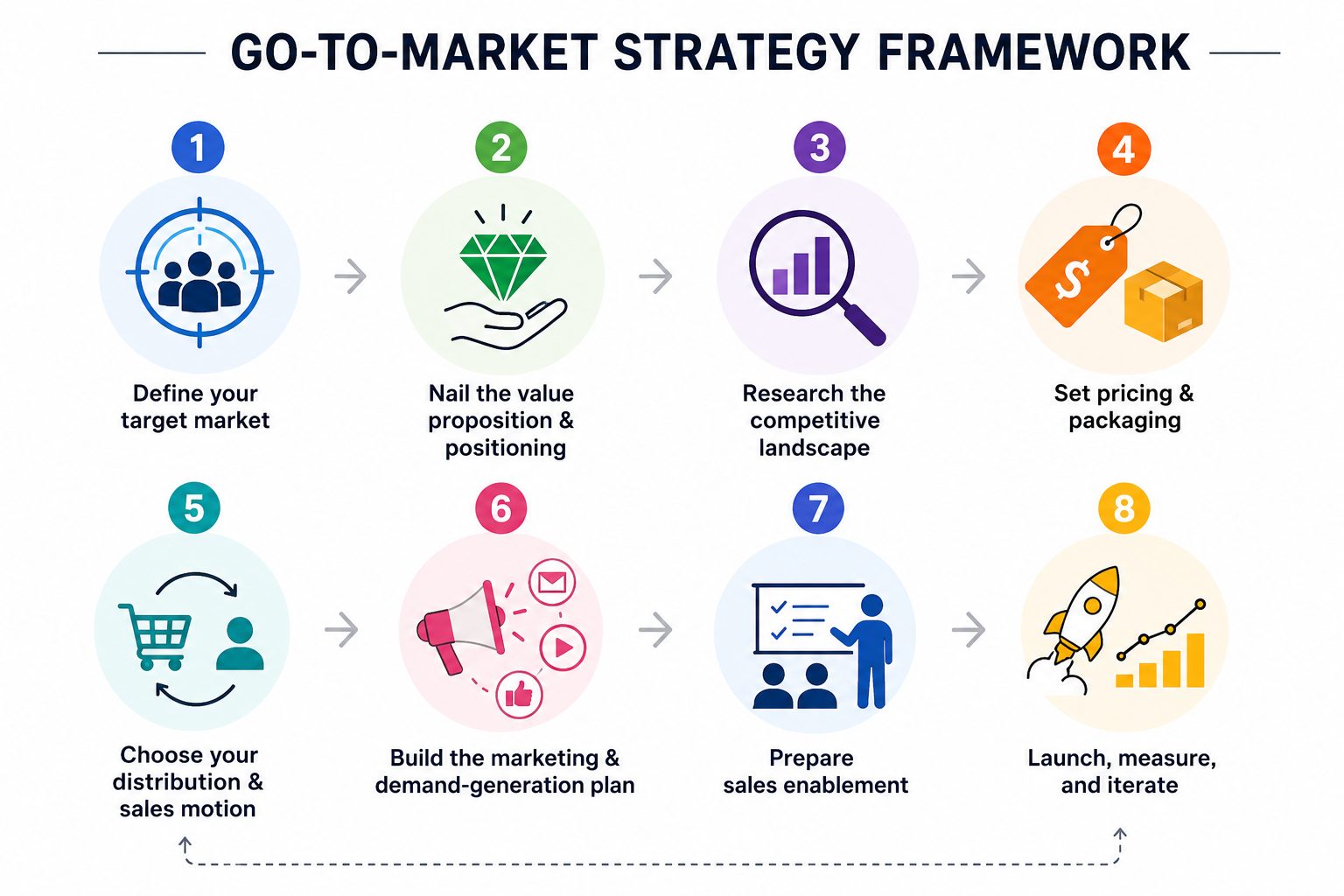
Go to market strategy framework has 8 steps, so looking at all steps at once can be confusing, so we breakdown each step.
Let’s check how to go from an idea to real execution.
Be specific, do not just write selling to “small businesses.” If possible, write “targeting business owners with 2-3 shops in different locations, who still track their inventory on spread sheet”.
For the strategy, write down all the information you have to understand your target audience. Based on the details, write a message that actually connects with the audience and find the exact channels where the audience is spending their time.
Do not make your strategy narrow or too broad. If you do so, then the strategy ends up talking to nobody in particular.
Value proposition is the promise you make to your customers, not just showing a list of features, because nobody buys features. They buy the outcome that feature gives them.
A strong value proposition answers three things:
Positioning is closely related to value propositions. It’s about how people think about your product as compared to your competitors or everyone else. It could be related to price, usage, or made for a specific audience that competitors ignored.
A few common angles brands take:
Try to write a value proposition in one or two sentences. If you’re writing it in a paragraph, it will be difficult to understand, and the chances are nobody will read it. A simple test to check whether you write it correctly or not, is to say your message aloud, if the other person understood it immediately, you’re good to go. If they didn’t understand, or asking what that means then you should rewrite your message.
Check in the market if someone else is also trying to solve the same problem. They are your competitor even if their solution is completely different from yours. These are your direct competitors, and indirect ones are spreadsheets, manual processes, or the free tools.
Look at these things while doing research and competitors analysis.
To set pricing, look at what customers are already paying and what are your costs? Also, check how much value you are delivering as compared to the alternatives customers have.
You've basically got a few options to pick from. You could go with a flat one-time fee, keep it simple. Or set up tiers based on features or how much someone uses the product. A lot of companies just go with a subscription, billed monthly or yearly. And then there's usage-based pricing, where people only pay for what they use.
Packaging is just as important as the price tag itself. Look closely at what you're including at each level of pricing and what your different customers really need. If your price is too high, people back out before even giving you a shot. Price too low, and some will assume there's a catch, or that the product just isn't very good.
This step is about figuring out how your product actually gets to the customer. Not every product sells the same way, so it helps to think about how your audience already prefers to buy.
A few common approaches:
Which one fits depends on how much your customer needs explained before they trust you enough to hand over money, and how they're already used to buying similar things.
Even if you created the really best product, but didn’t market it well, nobody will buy it. Create awareness among your ideal customers even before launching your product. Once you get the attention you can launch your product, or even if your products are already in a market, marketing is must for your business.
Which marketing channel you will choose, depends on actually where most of your ideal audience hang out. That could be:
Do not try to be on every marketing platform. Pick max two or three options and aware people about your product or service. You can do both organic and paid marketing.
If your sales process is done by human, then give them right tools to close deals. These tools can be:
Launching the product is not an end, once the product gets launched check the actual results with your desired results. Check if people are buying, where they are dropping in the customer journey, or they are just leaving the product in few seconds.
Analyze the problem and tweak the strategy by changing the pricing a little, giving more clear messages, switching the market channel, etc. A go to market strategy is something that you must fix as per the real numbers for better outcomes.
Ready to lead growth from strategy to execution? The Chief Revenue & Growth Officer Programme from IIM Kozhikode helps professionals strengthen their revenue and growth leadership skills.
Management Courses to upskill
Explore Management Courses for Career Progression
IIIT-B & IIM, Udaipur
Chief Technology Officer & AI Leadership ProgrammeIIM Kozhikode
PCP in AI for Business ProfessionalsA solid GTM strategy does more than just get a product out the door. Here's what else it can do for your business.
Because of going to market strategy, you understand your audience, channels of marketing, sharing clear messages about your vision, and much more. This helps a lot, especially for industries where competition is moving too fast. Having an option where people can come into can beat the best product.
For example, a fitness app uses AI to share personalized workout plans. Usually their target audience is on social media, so they collaborate with social media influencers to promote the app.
Putting a GTM strategy together means researching what customers want instead of guessing. It makes the current launch land better, and it gives you something to build on for every product decision and marketing to move down the road.
An eco-friendly cleaning brand could be a good example. As per their research, their target audience spent a lot of time reading sustainability blogs and forums. So instead of guessing where to advertise, they went straight to those communities. That decision-built trust early, and it turned into strong word-of-mouth growth without much extra spending.
While building a go to market strategy, you have to take hard decisions related to your resources. Instead of putting a thin budget to cover everything, you will find where to actually put effort into. And where the chances for customer conversion are higher.
A small startup building a project management tool for remote teams ran into this problem directly. Working with a tight budget, they skipped broad advertising entirely and focused only on platforms remote teams were already using. That narrower approach stretched their money further and brought in a stronger conversion rate than trying to be everywhere at once would have.
A clear GTM strategy will help you understand how different you are from others. Based on this, you create your messaging instead of blending in with others. This will decide whether you will get picked or passed.
A GTM strategy can help you stand out by:
A new beverage brand entering an already crowded market used this approach well. Instead of focusing on everything, they created their message around their unique flavor and health benefits. Something that nobody is offering.
Also read: Project Management Applications: Features, Benefits & Tools
A go to market strategy is a must to create, whether you are launching a new product, entering a new market, bringing something familiar to new customers, or something else. Having a clear strategy will help you sell better.
Businesses that treat the go-to-market strategy framework as a real plan, and not just a document, are the ones who stay ahead of others. Analyzing the framework and making changes is also another important step. Check each step and you will get more clarity related from planning the launch to actually launching the product.
The five approaches are self-serve, sales-led, partner-led, product-led, and channel-led. Each fits differently depending on price point and how much explanation a product needs before someone trusts it enough to buy. Most businesses pick one primary motion and adjust as they grow.
A GTM template covers nine areas: target market, market landscape, value proposition, positioning, pricing, distribution, marketing channels, sales enablement, and success metrics. Filling in each section for your specific product turns a general framework into a plan you can actually execute and act on.
There's no single best strategy, it depends on your product and audience. A low-cost app often works with self-serve, product-led growth. An expensive B2B tool usually needs sales-led selling. The right approach fits your specific customer instead of copying what worked elsewhere.
Start by defining your target customer and their pain points, then build out your value proposition, pricing, and distribution approach. Add a marketing plan and sales enablement, then set clear metrics to track after launch so you can adjust as real numbers come in.
The process moves through research, planning, and execution: understand your market and customer, define your positioning and pricing, choose how you'll sell and reach people, then launch while tracking results closely. It's less a straight line and more a loop you keep refining.
Marketing strategy is ongoing and focuses on ads, content, and brand building. A go-to-market strategy is tied to a specific launch or market entry, and covers more ground, including pricing, distribution, and sales enablement, not just how you promote the product.
Follow the same core steps as any GTM plan, but expect a longer sales cycle and more decision-makers involved. Focus on the buyer's role and pain points, lean toward sales-led or partner-led selling, and invest in case studies since B2B buyers need more convincing.
A solid checklist covers target market, value proposition, competitor research, pricing, distribution channels, marketing plan, sales enablement, and post-launch metrics. Working through each item before launch helps catch gaps early instead of discovering them after the product is already live.
Without one, it's easy to target the wrong audience, price incorrectly, or enter an already crowded market. A GTM strategy forces you to think through customers, competition, pricing, and channels before spending real money, stacking the odds in your favor instead of guessing.
A fitness app using AI for personalized workout plans is one example. Before launch, the team knew their audience was active on social media, so they lined up influencer partnerships early. That groundwork led to fast user growth right after going live.
It varies, but most teams spend a few weeks to a couple of months. Simpler products with a clear, well-understood audience move faster. Entering a brand-new market or launching something unproven usually takes longer, since more research and testing are needed upfront.
1141 articles published
We are an online education platform providing industry-relevant programs for professionals, designed and delivered in collaboration with world-class faculty and businesses. Merging the latest technolo...
Get Free Consultation
By submitting, I accept the T&C and
Privacy Policy
Top Resources
Certification
3 Months
Certification
6 Months
O.P. Jindal Global University
Masters in International Accounting and Finance (Accredited by ACCA, UK)Master's Degree
12 Months