15 Types of Pricing Strategies with Examples
By upGrad
Updated on Aug 27, 2026 | 7 min read | 2.36K+ views
Share:

All courses
Certifications
More
By upGrad
Updated on Aug 27, 2026 | 7 min read | 2.36K+ views
Share:
Key Highlights
Looking to strengthen your leadership skills? Explore our management training programs and take the next step in your career.
Popular Management Programs
A pricing strategy cannot fit into all decisions; it depends on your market, cost, positioning, goals, and more. Some of the key factors to check before you decide the strategy:
1. Costs
2. Customer Value & Willingness to Pay
3. Where You Stand Against Competitors
4. Your Bigger Business Goals
5. Different Customers, Different Stages
6. How Demand Reacts and What Rules Apply
Also read: What is Product Development? Everything You Need to Know About
Free Courses
There is no one correct approach for pricing strategy. The strategy you’ll choose completely depends on your costs, your targeted customers, and the stage of your business. Below are different pricing strategies. Understand each one to know which works best for you.
This method is used by everyone from small retailers to manufacturers. If you want a simple, and predictable way to set prices without deep research on the market, this strategy is best for you.
You take your product price and add a fixed markup. For example, if the product costs you ₹20 and you want a 50% markup, you will sell your product for ₹30.
This is the formula for calculating cost-plus pricing: Price = Cost + (Cost x Markup %).
Why Businesses Use Cost-Plus Pricing:
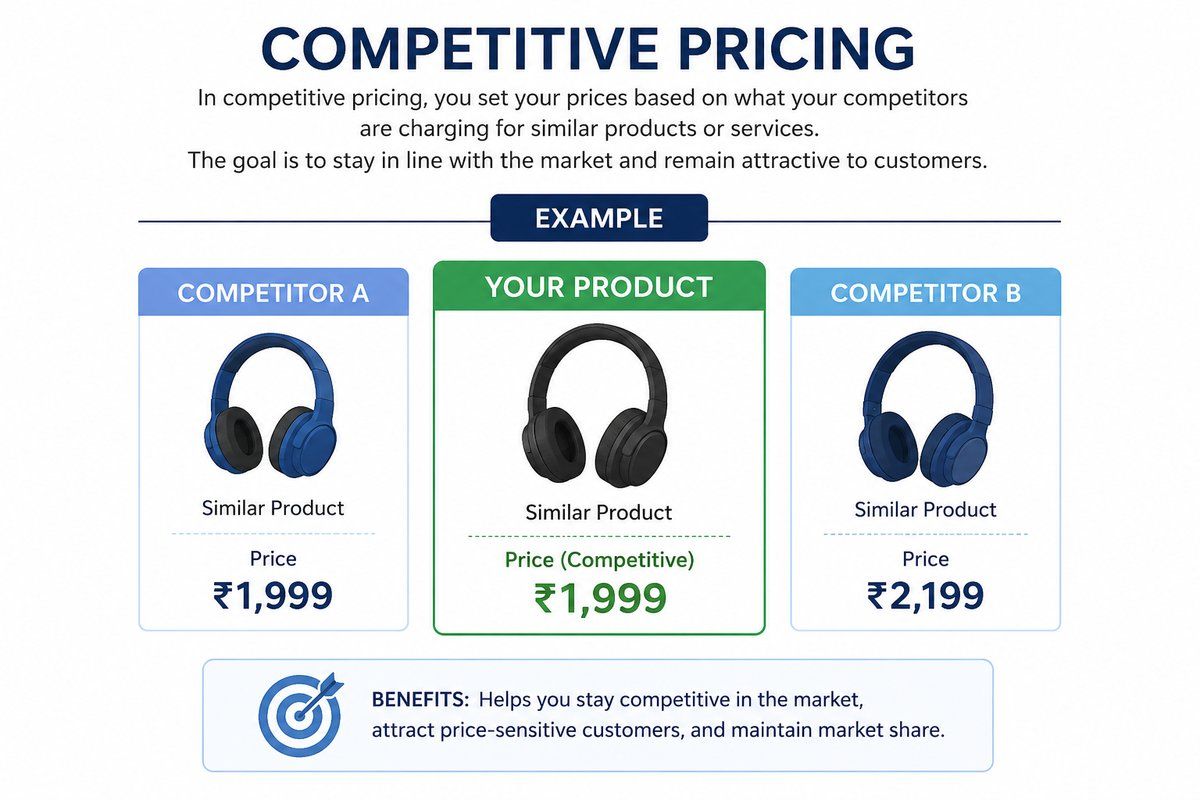
Competitive pricing means you check the price other businesses are charging in your space. Then set your product price around that same range instead of calculating it from your own costs. You have three basic options:
The reason this works is that customers already have an expected price range in their head for your type of product, so staying within that range keeps you from looking either overpriced or suspiciously cheap.
This is the classic "come in cheap and win people over" move. You launch at a low price, sometimes barely breaking even, to pull in as many customers as possible. The bet is that once people are using your product and it becomes part of their routine, they won't leave just because the price increases later.
Companies follow this strategy for these reasons:
The tricky part is sustaining it. Pricing this low usually means running on thin margins or even a loss for a while, so you need enough money in the bank to survive that stretch. And raising prices later is delicate; some customers will feel like they got tricked into sticking around, and you risk losing exactly the people you worked so hard to win.
You'll see this most with new apps and subscription services trying to build a user base quickly, think of food delivery apps or streaming platforms in their early days.
In price skimming, you launch high, then bring the price down gradually over time. It works because some customers genuinely don't mind paying more to be first, whether that's the newest phone, a limited gadget, or anything with a bit of hype behind it.
The logic here is to squeeze the most value out of people willing to pay a premium before opening things up to the more price-conscious crowd. It's also a handy way to recover whatever you spent developing the product, since those early sales come in at a much higher margin.
The downside is that a high price is basically an invitation for competitors to jump in, since it signals there's real money to be made. And the people who bought early at full price might feel a bit burned if the price drops sharply just a few months later. This approach can fail if the early buyers are not ready to pay more in the first place.
In this strategy, you don't start with what something costs you to build, you start with what it's actually worth to the person buying it. If your product saves someone hours every week or fixes a problem, that's quietly costing them money. And that value is what sets your price, not your production cost.
For this, you have to sit with your customers, understand what they're struggling with, what they'd happily pay to make that struggle go away, and how they judge whether something was worth it. That usually means interviews, surveys, and testing different price points to see what sticks.
When it works, the payoff is bigger margins than almost any other approach can offer, since you're not boxed into "cost plus a little extra."
In psychological pricing, your product price doesn't change with its worth. It changes whether the buyer feels that the price is right at that moment or not. So, businesses use some common tricks in setting the prices, and these are as follows:
Here the high price isn't a byproduct of high costs. Charging more on purpose sends a signal of quality, exclusivity, status, and a certain kind of customer; that signal is exactly what they're paying for.
Companies which use this strategy make sure everything related to the package backs up the pricing, like packaging, service, store, and the way it's marketed.
Get it right and you're looking at strong margins along with a kind of loyalty that's hard to shake, because people aren't just buying the product anymore; they're buying into what it says about them. The tradeoff is a much smaller pool of potential customers; plenty of people will never buy at this price, full stop. And if the quality doesn't live up to the hype, customers will call it out loud.
Luxury goods live, high-end electronics too, basically any brand that's staked its whole identity on being the elevated choice in its space to use this strategy.
This one runs in the opposite direction, cut everything that isn't essential and price as low as the business can survive on. No fancy packaging, no big marketing spend folded into the cost, just the product at the leanest price possible.
A low enough price pulls in shoppers who'd otherwise skip the category entirely, and it can work really well if being the cheapest option is your whole pitch. The catch is that margins per sale are razor thin, so you need serious volume to make the math work, and there's not much room to build loyalty around price alone since someone else can always go lower.
Generic supermarket brands, no-frills airlines, and budget retailers, places where customers are shopping on price first and thinking about everything else second.
Dynamic pricing means the price changes in real time based on what's happening at that exact moment, demand, time of day, or how much supply is left. Cab fares surging during rush hour, or flight tickets getting pricier the closer you get to departure, are both classic examples.
Software tracks signals like current demand, competitor pricing, remaining inventory, and sometimes external factors like weather, then adjusts the price automatically.
In this pricing, you group two or more products together and sell them as a single package. It would cost the buyer less if buying everything separately. In a meal combo, a burger alone is ₹150, but the meal with fries and a drink is ₹220. That's bundle pricing.
Why Bundle Pricing works:
This strategy can backfire if the bundle price is too low, and you lose money from people who'd have bought the popular item alone anyway. If the price is too high, the deal stops feeling like one.
Fast-food combos, spa packages, and software suites—every business uses this.
The oldest trick in the book cuts the price for a limited time to push sales. Festival sales, "flat 30% off," clearance racks, all the same idea.
It works because:
In this strategy, brands give discounts too often, so the real price stops feeling real. So, customers wait for the next sale. Examples are Big Billion Days and Diwali Dhamaka Sales.
Same product, different price, depending on where you live. A software subscription might cost less in India than in the US.
Why? Purchasing power, local competition, and taxes all shift from place to place. A single global price means overcharging people in cheaper markets and undercharging in expensive markets.
While purchasing digital products, people can check prices in other countries. If they find out they're paying more than a customer elsewhere for the exact same product, it can feel unfair, and it can turn into customer frustration. This pricing is followed in software subscriptions, airline fares, and global brands that sell online.
Free to start, paid to go further, that's basically the whole pitch of freemium pricing. The core product costs nothing, but anything extra, more storage, advanced features, premium tools, sits behind a paywall.
It works because there's zero risk in trying it. No credit card, no commitment, just sign up and start using it. That pulls in a much bigger crowd than asking people to pay upfront ever would.
The tricky part is that only a small percentage of free users ever end up paying, so this only really works if you have a huge number of people using the free version to begin with. There's also a balancing act involved. Make the free plan too generous and nobody feels a reason to upgrade. Make it too restrictive and people leave before they even get attached to the product.
You see this everywhere, note-taking apps, cloud storage services, and most productivity tools people use every day.
Pay monthly or yearly, keep access as long as you pay. No one-time purchase, no ownership, just ongoing use. Why subscription pricing is good for businesses:
Also, it is risky because the moment someone feels shortchanged, they cancel. One click, no strings attached, unlike a purchase that's already locked in.
You already live inside this model, streaming platforms, gym memberships, SaaS tools, and subscription boxes.
Sell one thing at a loss on purpose, just to get people in the door. A supermarket selling milk dirt cheap, betting you'll fill the rest of your cart at full price, is the textbook example.
Why it works: The loss on one item gets covered by everything else the customer buys alongside it, especially for things people need to restock often.
Where it fails: If shoppers only ever buy the discounted item and leave, it's just a straight loss. It's also risky online, where someone can grab the cheap item from you and buy everything else from a competitor.
Common in supermarkets, retail stores, and software with a free core tool that leads to paid add-ons.
Management Courses to upskill
Explore Management Courses for Career Progression
IIIT-B & IIM, Udaipur
Chief Technology Officer & AI Leadership ProgrammeNo single pricing strategy fits every business. A new app might use penetration or freemium pricing to build users, a luxury brand goes premium, a supermarket competes on economy pricing, and a software company might do best with value-based pricing. What matters more than getting it right on day one is understanding the trade-offs and staying open to change as costs, competitors, and customers shift.
Before settling a strategy, check out the basics: it should cover costs with a healthy margin, reflect what customers actually value, and hold up against competitors. Get that right, and your strategy has a real shot at working.
Take the first step toward becoming a future leader. Book a free consultation with upGrad today to find the best path for your career.
Yeah, actually most businesses do. A company might use freemium pricing for its core product but switch to value-based pricing for premium add-ons, or run occasional discount pricing on top of its regular competitive pricing. It's rare that one strategy covers everything.
There's no fixed rule, but it's worth checking in at least once or twice a year, or whenever something major shifts, like a new competitor entering the market, costs going up, or customer demand changing. Sticking to the same price for years without reviewing it can leave money on the table or push customers away.
Beyond just thin margins, pricing too low can actually make customers question the quality of what you're selling. It also makes raising prices later a lot harder, since customers get anchored to that low number and feel cheated if it goes up.
It can, yeah. Online businesses have more room to experiment with things like dynamic pricing or geographical pricing since it's easier to change prices instantly. Physical stores usually stick to more fixed pricing since changing price tags constantly isn't practical.
It really depends on how badly they need to build a user base fast versus how much they want to capture from early adopters willing to pay more. Penetration works better in crowded markets where you need volume fast, while skimming suits products with genuine hype or limited early competition.
It's a bit of a grey area, honestly. Some people see it as just smart marketing, since the product's actual value doesn't change. Others feel tricks like charm pricing or fake anchoring can mislead customers about how much they're really saving.
It usually shows up pretty fast, either sales drop, margins get squeezed too thin, or customers start comparing you unfavorably to competitors. The good news is pricing isn't usually permanent, so businesses can adjust once they see it's not working.
Small businesses can use it, but it takes some infrastructure, like software that can track demand and adjust prices automatically. Without that, manually changing prices constantly gets impractical fast, so a lot of small businesses skip it in favor of simpler strategies.
If loyalty is the priority, businesses often lean toward subscription pricing or premium pricing, since both are built around long-term relationships rather than one-off purchases. Strategies like discount pricing can actually hurt loyalty if used too often, since customers start waiting for sales instead of buying at full price.
Yeah, depends on the country and industry. Some places have rules against predatory pricing, price fixing, or misleading discount claims. It's worth checking local regulations before leaning too heavily into something like aggressive penetration pricing or psychological discount tactics.
Probably copying a competitor's pricing without actually understanding their cost structure or customer base. What works for one business, especially a bigger, better-funded one, doesn't always translate well to a smaller or different kind of business.
950 articles published
We are an online education platform providing industry-relevant programs for professionals, designed and delivered in collaboration with world-class faculty and businesses. Merging the latest technolo...
Get Free Consultation
By submitting, I accept the T&C and
Privacy Policy
Top Resources
Certification
3 Months
Certification
6 Months
O.P. Jindal Global University
Masters in International Accounting and Finance (Accredited by ACCA, UK)Master's Degree
12 Months