Digital Marketing Platforms: The Complete Guide
By upGrad
Updated on Jun 04, 2026 | 8 min read | 1.72K+ views
Share:

All courses
Certifications
More
By upGrad
Updated on Jun 04, 2026 | 8 min read | 1.72K+ views
Share:
Table of Contents
Digital marketing platforms are the tools and channels businesses use to reach their audience online. Whether you're running paid ads, sending email campaigns, or publishing content on social media, you're using a Digital marketing platform.
This blog covers everything you need to know, what these platforms actually do, which ones are worth your time, how to pick the right mix for your goals, and what real beginners often get wrong. By the end, you'll know exactly where to start.
Explore upGrad's Digital Marketing programs to learn how to measure campaign performance, optimize conversions, analyze marketing data, and develop skills in SEO, PPC, and marketing analytics.
Digital marketing platforms are software solutions that help businesses plan, execute, manage, and measure online marketing activities. They bring different marketing functions into one place, making campaigns easier to manage and optimise. Instead of handling SEO, advertising, email campaigns, and analytics separately, marketers can use digital marketing platforms to organize and track everything more efficiently.
Here's what makes them matter: people spend 6+ hours online every day. They search for products, scroll through feeds, watch videos, and read emails. If your business isn't showing up in those moments, someone else is. Digital marketing platforms are how you show up.
They also give you something traditional marketing never could: data. You can see who clicked, who ignored you, who came back, and who converted. That feedback loop changes how you make decisions.
Consider an online retailer running a sale. Without a platform, the team would manually manage email campaigns, social media posts, ad campaigns, and reporting. With the right system, much of this work becomes centralized, saving time while providing better visibility into results. Here are reasons why businesses need digital marketing platforms.
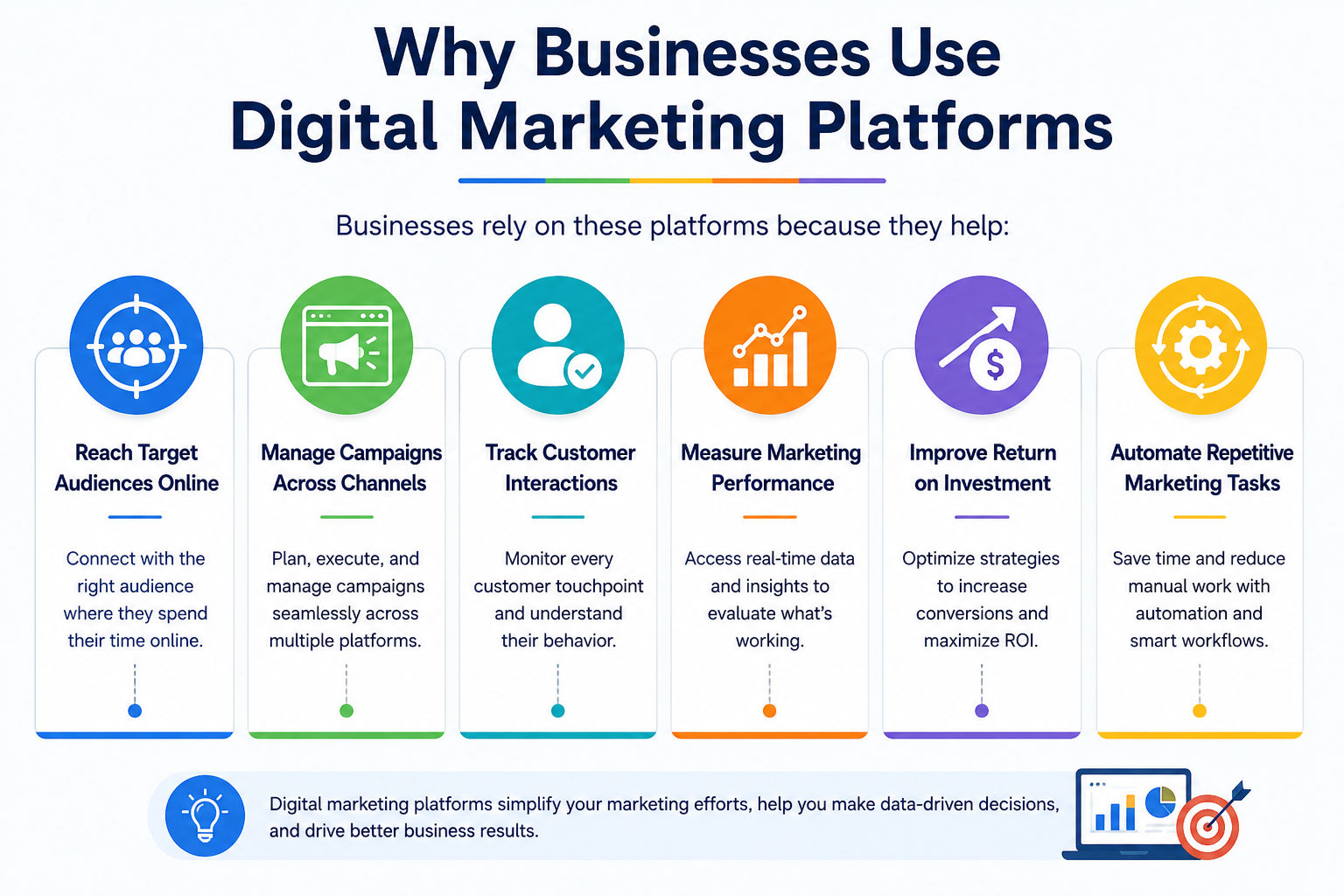
One important thing to understand here is that not every platform works for every business. A B2B software company doesn't need TikTok. A fashion brand probably doesn't need LinkedIn. The goal is to market in relevant places, not just anywhere.
Do read: 10 Significant Advantages of Digital Marketing You Must Know
Free Courses
There are many platforms. There's the right platform for your audience, your budget, and your goals.
That said, these are the platforms with the widest use and proven results across industries.
Platform |
Category |
Best For |
Budget Level |
Learning Curve |
| Google Ads | Search Advertising | High-intent search traffic and lead generation | Medium to High | Moderate |
| Google Search Console | SEO Analytics | Tracking organic visibility and website performance | Free | Easy |
| Meta Ads (Facebook & Instagram) | Social Media Marketing | Audience targeting, brand awareness, and conversions | Low to High | Moderate |
| Semrush | SEO Platform | Keyword research, competitor analysis, and content planning | Medium | Moderate |
| Ahrefs | SEO Platform | Backlink analysis, SEO audits, and keyword tracking | Medium to High | Moderate |
| Moz | SEO Platform | Beginner-friendly SEO research and site optimization | Medium | Easy to Moderate |
| Mailchimp | Email Marketing | Email campaigns, newsletters, and customer retention | Low | Easy |
| HubSpot | Email Marketing & CRM | Marketing automation, lead nurturing, and CRM management | Medium to High | Moderate |
| Klaviyo | Email Marketing | E-commerce email marketing and customer segmentation | Medium | Moderate |
| YouTube Ads | Video Marketing | Brand awareness, product education, and broad audience reach | Medium | Moderate |
| TikTok Ads | Video Marketing | Product discovery and engagement among younger audiences | Low to Medium | Easy to Moderate |
Must read: Digital Marketing Objectives: Full Guide with Types and Examples [2026]
Digital Marketing Courses to upskill
Explore Digital Marketing Courses for Career Progression
MICA Executive Alumni Status
The biggest mistake beginners make is trying to be everywhere at once. It doesn't work. You spread yourself thin, produce mediocre content, and can't measure what's working.
Ask yourself these questions first:
If you're a new e-commerce store, start with Meta Ads for top-of-funnel awareness and Klaviyo for email follow-ups. That combination covers acquisition and retention without overcomplicating things.
If you're a service business, Google Ads and Search Console make more sense. People searching "digital marketing agency in Mumbai" are ready to hire. You want to be there.
Budget reality check
Most platforms don't require huge spends to test. Meta Ads can start at Rs. 500-1000 per day. Google Ads can start around the same range. Email platforms like Mailchimp are free up to 500 contacts. SEO tools usually run $100-$200/month for serious use.
Don't confuse cheap entry with cheap results. Getting value out of any platform takes time, testing, and iteration.
Must read: What is PPC in Digital Marketing, and How to Use It?
Even experienced marketers make these. Knowing them upfront saves you time and money.
Must read: Top 10 Email Marketing Tools Successful Email Marketing Experts Use
Digital marketing platforms help businesses manage online marketing activities more efficiently, track performance accurately, and improve campaign outcomes. From SEO and email marketing to advertising and analytics, these tools support every stage of the customer journey.
The best digital marketing platforms aren't necessarily the most expensive or feature-packed. They're the ones that align with your goals, fit your workflow, and provide the insights needed to make better marketing decisions. As digital channels continue to grow, choosing the right platform becomes a critical part of building a successful marketing strategy.
Ready to start your journey? Book a free consultation with upGrad today to find the best path for your career.
Most small businesses don't need more than two or three platforms initially. A local service business might combine Google Ads, Google Search Console, and email marketing, while an e-commerce brand could start with Meta Ads and Klaviyo. Adding too many platforms early often creates confusion rather than growth.
Paid advertising platforms such as Google Ads and Meta Ads usually deliver the fastest results because they can generate traffic immediately after launch. Organic channels like SEO and content marketing take longer, but they often provide more sustainable traffic over time without ongoing ad spend.
Free tools can be surprisingly effective when you're starting out. Google Search Console, Google Analytics, Canva, and Mailchimp's free plan can help you learn core marketing skills without spending money. The need for paid tools typically arises when you require deeper insights, automation, or larger-scale campaign management.
A marketing channel is where customers interact with your brand, such as search engines, email, or social media. A digital marketing platform is the tool used to manage those activities. For example, email is a channel, while Mailchimp is the platform used to run email campaigns.
For most B2B businesses, Google Ads, LinkedIn Ads, and SEO platforms are often the strongest options. Decision-makers actively search for solutions online before making purchases. Combining search visibility with lead nurturing through email marketing generally produces better results than relying on a single channel.
The answer depends on goals and industry competition. Many small businesses start testing with ₹10,000 to ₹30,000 per month across advertising and software tools. It's usually smarter to invest consistently in a few channels than spread a limited budget across multiple platforms.
Yes, and that's often where the strongest results come from. Someone may discover your business through a Meta ad, visit your website through Google Search, and later convert after receiving an email. The best digital marketing platforms work together to support different stages of the customer journey.
Results vary by platform. Paid advertising can generate clicks and leads within days, while SEO and content marketing may require several months before showing significant growth. Businesses that combine short-term and long-term channels often create a more balanced marketing strategy.
Most marketers benefit from understanding analytics, audience targeting, content creation, campaign optimization, and basic SEO principles. Platform knowledge matters, but success usually comes from understanding customer behavior and interpreting performance data rather than simply knowing how a tool works.
Yes. Many modern platforms now include AI-powered features such as audience targeting, content recommendations, bidding automation, predictive analytics, and campaign optimization. While AI can improve efficiency, marketers still need to provide strategy, creative direction, and business context for meaningful results.
Look at business outcomes rather than platform activity. If your chosen channels consistently generate qualified traffic, leads, sales, or customer engagement at an acceptable cost, they're likely a good fit. High impressions or clicks alone don't necessarily indicate success if they aren't contributing to business goals.
965 articles published
We are an online education platform providing industry-relevant programs for professionals, designed and delivered in collaboration with world-class faculty and businesses. Merging the latest technolo...
Get Free Consultation
By submitting, I accept the T&C and
Privacy Policy
Level Up Your Digital Marketing Career Today!
Top Resources
MICA
Advanced Certificate in AI-Powered Digital Marketing & Communication from MICAMICA Executive Alumni Status
Certification
5 Specialisation
Classroom
4 Months
Certification
2 Months