ITSM vs ITIL: Which One Your Organization Needs
By upGrad
Updated on Jul 05, 2026 | 5 min read | 1.7K+ views
Share:

All courses
Certifications
More
By upGrad
Updated on Jul 05, 2026 | 5 min read | 1.7K+ views
Share:
Table of Contents
Key takeaways
This blog breaks down what each term actually means, how they relate to one another, and how to decide what your organization actually needs.
Explore upGrad's MBA programs to strengthen your leadership and business management skills for today's technology-driven organizations. Learn operations management, business strategy, analytics, digital transformation, and project management through hands-on projects and real-world business case studies.
Popular MBA Programs
Although ITSM vs ITIL are closely related, they are not interchangeable. IT Service Management (ITSM) is the broader discipline of designing, delivering, managing, and improving IT services, while ITIL is one of the most widely adopted frameworks that provides best practices for implementing ITSM effectively.
The table below highlights their key differences to help you understand when and how each applies.
Aspect |
ITSM |
ITIL |
| Purpose | Ensures IT services align with business needs and customer expectations. | Provides standardized guidance for delivering effective IT services. |
| Scope | Broad, covering all aspects of IT service management. | Focused on structured practices and recommendations for ITSM. |
| Nature | A management approach or philosophy. | A documented framework with established best practices. |
| Implementation | Can be customized to suit organizational needs. | Follows ITIL guidance, with flexibility introduced in ITIL 4. |
| Processes & Practices | Organizations define their own service management processes. | Provides predefined practices such as Incident, Change, and Problem Management. |
| Flexibility | Highly flexible and methodology-independent. | Structured but adaptable, especially with ITIL 4. |
| Certification | No universal certification for ITSM. | Formal certification paths are available. |
| Adoption | Used by organizations of all sizes. | Common among organizations seeking standardized service management. |
| Origin | Evolved as a service management discipline. | Developed by the UK government as the IT Infrastructure Library. |
| Best Suited For | Organizations needing a customized service management approach. | Organizations seeking a proven, standardized framework. |
| Example | Building a custom service desk workflow. | Implementing ITIL Incident Management and Change Enablement practices. |
ITIL is a framework within the broader discipline of ITSM, providing best practices to help organizations manage IT services effectively. However, ITSM does not require ITIL. Organizations can implement ITSM using other frameworks, such as COBIT or ISO/IEC 20000, or by developing their own service management processes. While ITIL is one of the most widely adopted approaches, it is optional, not mandatory.
Also read: MBA vs FRM: Which Should You Choose?
ITSM Function |
Corresponding ITIL 4 Practice |
| Ticket handling & user support | Service Desk |
| Outage resolution | Incident Management |
| Root cause analysis | Problem Management |
| Rolling out system updates | Change Enablement |
| Managing IT assets | IT Asset Management |
| Tracking SLAs | Service Level Management |
Do read: Top 55+ ITIL Interview Questions and Answers That Will Help You Stand Out
Free Courses
IT Service Management (ITSM) is the approach organizations use to design, deliver, manage, and improve IT services. It isn't a specific tool or certification. Instead, it helps IT teams provide reliable, efficient, and business-focused services through well-defined processes and continuous improvement.
Here are the core components explained in the following image:

Benefit |
How It Helps Organizations |
| Improved Service Consistency | Standardizes processes for reliable service delivery. |
| Reduced Downtime | Speeds up issue resolution through structured incident and problem management. |
| Better Business Alignment | Ensures IT services support organizational goals. |
| Greater Accountability | Clearly defines roles and responsibilities across IT teams. |
| Higher User Satisfaction | Delivers faster, more reliable services and a better user experience. |
Must read: How to Become an IT Project Manager: Certifications & Career Path
MBA Courses to upskill
Explore MBA Courses for Career Progression
O.P.Jindal Global University
MBA (with Career Acceleration Program by upGrad)Become interview ready with Career Services
PSB MBA + IIML Certification
MBA from Paris School of Business with Certification from IIM LucknowITIL (Information Technology Infrastructure Library) is a globally recognized framework that provides best practices for implementing IT Service Management (ITSM). Developed by the UK government in the 1980s, it helps organizations deliver consistent, efficient, and high-quality IT services through standardized guidance.
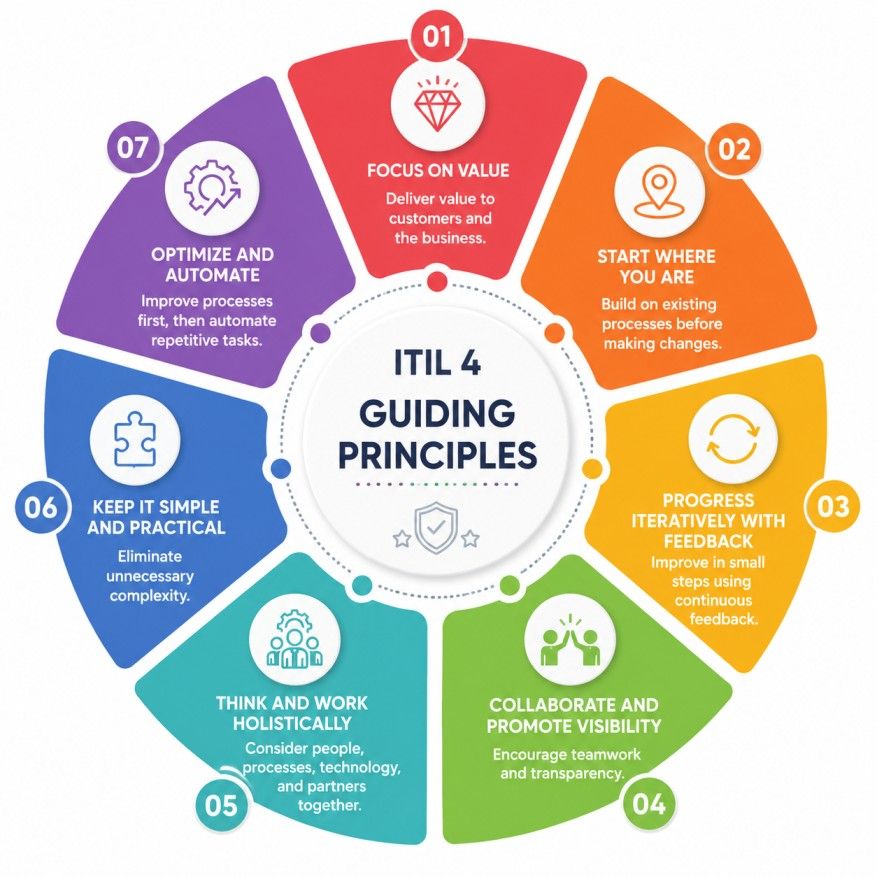
ITIL 4, released in 2019, introduced a more flexible and value-driven approach built around the Service Value System (SVS) and 34 management practices. It also incorporates Agile, DevOps, and Lean principles, making it suitable for modern IT environments.
Here are the Guiding Principles explained in the following image:
Benefit |
How It Helps Organizations |
| Standardized Best Practices | Provides a proven framework for managing IT services. |
| Improved Consistency | Creates common processes across teams and locations. |
| Supports Compliance | Helps meet governance and audit requirements. |
| Professional Certifications | Offers globally recognized certification paths for IT professionals. |
| Better Vendor Collaboration | Improves communication through standardized terminology and practices. |
Explore the MBA Career Acceleration Program from O.P. Jindal Global University to build leadership, strategic thinking, and business management skills. Learn operations, project management, business analytics, digital transformation, and organizational strategy through industry-focused learning and real-world business case studies.
Although ITSM vs ITIL are different concepts, they work closely together to help organizations deliver high-quality IT services. Both focus on improving service delivery, increasing efficiency, and ensuring IT supports business objectives. The table below highlights their key similarities.
Similarity |
ITSM vs ITIL |
| Common Goal | Both aim to deliver reliable, high-quality IT services that support business objectives. |
| Customer Focus | Both prioritize creating value and improving the customer or end-user experience. |
| Service Improvement | Both encourage continuous evaluation and improvement of IT services. |
| Process-Oriented | Both rely on structured processes and clearly defined workflows. |
| Business Alignment | Both ensure IT services align with organizational goals and business needs. |
| Incident Resolution | Both emphasize resolving incidents efficiently to minimize service disruptions. |
| Change Management | Both promote controlled and well-planned implementation of IT changes. |
| Collaboration | Both encourage coordination among IT teams, stakeholders, and service providers. |
| Performance Measurement | Both use metrics, KPIs, and SLAs to monitor and improve service quality. |
| Value Delivery | Both focus on delivering measurable value through effective IT service management. |
You may think, is ITIL a Part of ITSM? Yes. ITIL is a framework that supports the broader discipline of ITSM. While ITSM focuses on managing IT services, ITIL provides best practices for implementing it effectively.
Does ITSM Require ITIL? No. Organizations can practice ITSM without ITIL by using frameworks like COBIT or ISO/IEC 20000, or by creating their own processes. Although ITIL is widely adopted, it is optional, not mandatory.
Must read: MBA Syllabus : Subject, Courses and Specializations
Implementing ITIL within an ITSM strategy helps organizations standardize service management, improve operational efficiency, and deliver more consistent IT services. The table below highlights the key ways ITIL strengthens ITSM and the business benefits it provides.
How ITIL Improves ITSM |
Organizational Benefit |
| Pre-validated Best Practices | Reduces guesswork by providing proven service management guidance. |
| Standardized Terminology | Speeds up onboarding and improves communication across IT teams. |
| Defined Escalation Paths | Improves incident resolution through structured workflows. |
| Governance Support | Strengthens compliance and audit readiness. |
| Operational Consistency | Ensures consistent service delivery across teams and locations. |
| Shared Frameworks | Improves collaboration with vendors and external partners. |
| Business Alignment | Helps align IT investments with business goals. |
| Scalability | Makes it easier to expand IT operations as the organization grows. |
Also read: Service Delivery Manager: Job Description, Skills Required, Salary Trends
Yes, absolutely. If you want to know how ITIL supports ITSM, you should know that ITSM is the goal and ITIL is just one path to get there.
Approach / Scenario |
When It Fits Best |
| COBIT | Best for organizations focused on IT governance, risk management, and compliance. |
| ISO/IEC 20000 | Suitable for organizations seeking an internationally recognized IT service management standard. |
| Agile Service Management | Ideal for teams that want to apply Agile principles to service delivery. |
| Custom or Hybrid Frameworks | Works well for startups and mid-sized organizations needing flexible, lightweight processes. |
| Adopt ITIL | Recommended for large or complex IT environments, regulated industries, organizations pursuing service management maturity, or teams that benefit from standardized terminology. |
| Skip Formal ITIL Adoption | Suitable for small teams, Agile/DevOps-native organizations, or businesses where ITIL's overhead outweighs its benefits. |
Do read: What Is Total Productive Maintenance? A Practical Guide
Many organizations confuse ITSM vs ITIL, leading to misconceptions about their purpose and adoption. The table below clarifies these myths and illustrates how ITSM vs ITIL are applied in real-world scenarios.
Myth |
Reality |
Example |
| ITSM vs ITIL are the same. | ITSM is the overall approach, while ITIL is a framework that supports it. | A help desk follows ITSM; using ITIL's Service Desk and Incident Management practices means it's also applying ITIL. |
| ITIL is mandatory for ITSM. | Organizations can manage IT services effectively without adopting ITIL. | A SaaS company uses Agile and DevOps practices instead of ITIL. |
| ITIL is only for large enterprises. | Organizations of any size can adopt ITIL practices based on their needs. | A startup may use selected ITIL practices, while a large enterprise may implement the full framework. |
| ITIL only focuses on Incident Management. | ITIL covers many areas beyond incidents, including change, risk, and continual improvement. | An enterprise uses ITIL for change management, governance, and supplier management in addition to incident resolution. |
Do read: 9 Common MBA in Digital Finance & Banking Interview Questions [For Freshers & Experienced]
Choosing between ITSM and ITIL depends on your organization's size, goals, compliance needs, and the level of process standardization required. While ITSM provides the flexibility to design service management processes that fit your business, ITIL offers a structured framework for organizations seeking consistent, scalable, and best-practice-driven service delivery. The table below can help you determine which approach is the better fit.
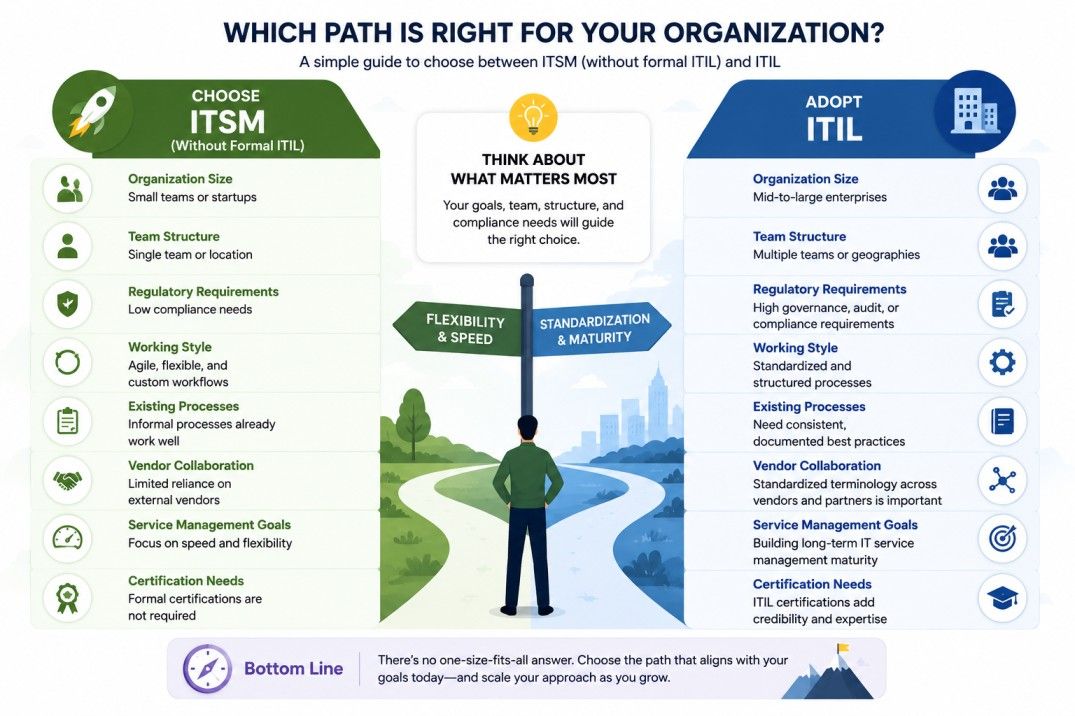
ITSM vs ITIL work together, not against each other. ITSM is the overall approach to managing IT services, while ITIL is a widely used framework that helps organizations implement ITSM using proven best practices and standardized processes.
The right choice depends on your organization's size, business goals, compliance needs, and how structured your IT operations need to be. Understanding the difference between ITSM vs ITIL helps you choose the approach that best supports your IT service management goals.
Ready to start your journey? Book a free consultation with upGrad today to find the best path for your career.
No. ITSM (IT Service Management) is the overall approach to managing IT services, while ITIL (Information Technology Infrastructure Library) is a framework that provides best practices for implementing ITSM. Organizations can practice ITSM with or without adopting ITIL.
The main difference is that ITSM is the discipline of managing IT services, whereas ITIL is a framework that provides structured guidance and best practices for implementing ITSM. In simple terms, ITSM defines the goal, while ITIL offers one way to achieve it.
No. Organizations can implement ITSM without ITIL by using other frameworks such as COBIT or ISO/IEC 20000, or by developing their own service management processes. ITIL is one of the most popular frameworks, but it is not mandatory.
Yes. Many startups, small businesses, and Agile organizations successfully manage IT services without formally adopting ITIL. They often use lightweight processes, Agile practices, or customized workflows that suit their business needs.
ITIL 4 is the latest version of the ITIL framework, released in 2019. It introduced a more flexible approach based on the Service Value System (SVS) and 34 management practices, while incorporating Agile, DevOps, and Lean principles.
ITIL practices are standardized recommendations that help organizations manage IT services effectively. ITIL 4 includes 34 management practices covering areas such as incident management, change enablement, service desk, knowledge management, and continual improvement.
Yes. Small businesses can adopt only the ITIL practices that meet their needs rather than implementing the entire framework. This allows them to improve service quality and consistency while maintaining flexibility and avoiding unnecessary complexity.
ITIL helps improve ITSM by providing proven best practices, standardized processes, and clear guidance for managing IT services. This can lead to better service quality, faster issue resolution, improved collaboration, and stronger governance.
Enterprise Service Management (ESM) extends ITSM principles beyond the IT department to teams such as HR, finance, legal, and facilities. It uses similar workflows, self-service portals, and service requests to improve service delivery across the organization.
ITSM vs ITIL are not competing approaches. ITSM is the overall service management approach, while ITIL is a framework that helps organizations implement it. The right choice depends on your organization's goals, complexity, compliance requirements, and service management maturity.
Organizations should adopt ITIL when they need standardized processes, compliance support, or consistent service management across multiple teams or locations. If flexibility and speed are the priority, organizations can practice ITSM using custom processes or alternative frameworks without formally implementing ITIL.
1141 articles published
We are an online education platform providing industry-relevant programs for professionals, designed and delivered in collaboration with world-class faculty and businesses. Merging the latest technolo...
Speak with MBA expert
By submitting, I accept the T&C and
Privacy Policy
From MBA to Dream Job - Explore Our Alumni Success Stories
Top Resources
Master's Degree
13 Months
Master's Degree
12 Months
O.P.Jindal Global University
MBA (with Career Acceleration Program by upGrad)Become interview ready with Career Services
Master's Degree
12 Months