What Is Total Productive Maintenance? A Practical Guide
By upGrad
Updated on Jul 01, 2026 | 5 min read | 1.65K+ views
Share:

All courses
Certifications
More
By upGrad
Updated on Jul 01, 2026 | 5 min read | 1.65K+ views
Share:
Table of Contents
Total productive maintenance (TPM) is a maintenance approach that focuses on preventing equipment failures by involving everyone in the organization. Instead of leaving maintenance only to technicians, machine operators perform routine care such as cleaning, inspecting, and identifying early signs of wear. Maintenance specialists then focus on more technical tasks and long-term reliability improvements.
The concept began in Japan during the 1970s and later became one of the foundations of Lean Manufacturing. Today, companies across manufacturing, healthcare, logistics, food processing, automotive, and pharmaceuticals use TPM to improve equipment performance and reduce operational waste.
This blog walks you through what total productive maintenance actually means, its eight core pillars, the real benefits companies see, and the practical steps to roll it out on your own floor.
Explore upGrad's MBA programs to develop the business, operations, and leadership skills needed to improve organizational performance. Learn operations management, supply chain, quality management, business strategy, finance, and data-driven decision-making through real-world case studies, hands-on projects, and industry-focused learning.
Popular MBA Programs
Total productive maintenance (TPM) is a maintenance approach where machine operators, not just maintenance technicians, help take care of the equipment they use every day. This includes simple tasks like cleaning, inspecting, lubricating, and reporting small problems before they become major breakdowns.
TPM began in Japan in the 1970s and is based on a simple idea. Machines perform better and last longer when they receive regular care from the people who use them daily.
In traditional maintenance, operators only run the machine while the maintenance team fixes it after something goes wrong. TPM changes this approach. Operators carry out basic maintenance, while technicians focus on more complex repairs and preventive maintenance. Why is this important?
Because unexpected machine breakdowns can stop production, increase repair costs, and delay deliveries. Finding and fixing small issues early helps avoid these problems.
TPM isn't something you implement once and forget. It requires regular training, teamwork, and management support. Many companies find it difficult to maintain because people gradually return to old habits or lose focus over time.
TPM is a key part of Lean Manufacturing. While Lean focuses on reducing waste across processes, TPM reduces waste caused by equipment failures, downtime, and quality defects. Together, they help improve productivity and operational efficiency.
What Total Productive Maintenance (TPM) Is Not |
Explanation |
| It's not just about fixing machines faster | TPM focuses on preventing equipment failures, not simply speeding up repairs. |
| It's not a maintenance department initiative alone | TPM involves operators, maintenance teams, managers, and other departments in equipment care. |
| It's not a checklist you complete once and forget | TPM is a continuous improvement process that requires regular monitoring and ongoing participation. |
Done right, total productive maintenance becomes part of daily routine, not a separate task bolted onto the workday.
Do read: What Is Task Management? 14 Key Tools and Strategies for Success
Free Courses
Before TPM can succeed, the workplace needs to be clean and organized. That's where the 5S method comes in. It creates a work environment where equipment is easier to inspect, maintain, and operate safely.
5S Principle |
Purpose |
| Sort | Remove unnecessary items. |
| Set in Order | Keep tools and equipment organized. |
| Shine | Clean machines regularly. |
| Standardize | Follow the same maintenance practices. |
| Sustain | Make these habits part of daily work. |
A clean workplace makes it easier to spot leaks, loose parts, and other equipment issues before they become serious problems.
Also read: How to Improve Productivity? Top 10 Ways You Can Implement Today
MBA Courses to upskill
Explore MBA Courses for Career Progression
O.P.Jindal Global University
MBA (with Career Acceleration Program by upGrad)Become interview ready with Career Services
PSB MBA + IIML Certification
MBA from Paris School of Business with Certification from IIM LucknowTPM rests on eight pillars. Skip one, and the whole structure gets shaky.
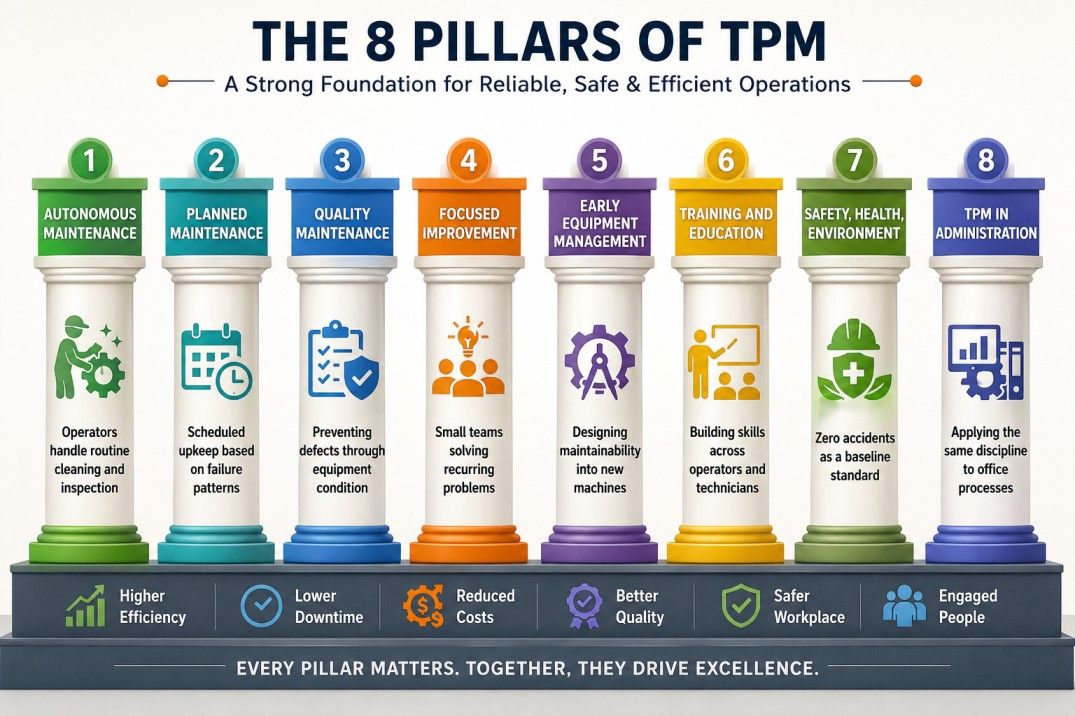
This is the pillar most companies start with. Operators learn to clean, lubricate, and inspect their own machines on a set schedule. It sounds basic. It's not. Getting operators to actually do this consistently, without supervision breathing down their necks, takes real training and trust.
Instead of waiting for something to break, teams schedule maintenance based on historical failure data. A pump that tends to fail every 8,000 hours gets serviced at 7,000. Simple logic, but it requires good record keeping, which many plants still don't have.
Small cross-functional teams tackle one recurring problem at a time. Maybe it's a machine that jams every Tuesday. Maybe it's a bottleneck nobody's bothered to fix. These teams dig into root causes instead of applying quick patches.
Also read: Difference Between Management and Administration
Quality maintenance focuses on keeping equipment in the right condition to prevent product defects. Regular calibration and inspections help maintain consistent output.
Must read: What Is Operations Management? Why It’s So Important for Companies
This pillar considers maintenance during the design and installation of new equipment. Machines that are easy to inspect and repair usually cost less to maintain over time.
Employees need the right skills to identify equipment problems and carry out maintenance tasks correctly. Regular training helps improve equipment reliability.
TPM promotes safe working conditions by reducing equipment failures that could cause accidents or environmental risks.
TPM also improves office processes such as maintenance planning, inventory management, purchasing, and documentation, helping maintenance teams work more efficiently.
Explore upGrad's MBA from Liverpool Business School to develop the strategic, leadership, and operational skills needed to drive business growth. Learn business strategy, operations management, finance, marketing, analytics, and decision-making through global case studies, hands-on projects, and an industry-relevant curriculum designed for working professionals.
Companies that stick with TPM long enough tend to see measurable gains. Not overnight, but over quarters and years.
Benefit |
Impact |
| Lower Unplanned Downtime | Reduces downtime by 30% to 50% in mature TPM programs. |
| Fewer Product Defects | Improves output consistency and reduces defects. |
| Longer Equipment Lifespan | Extends machine life and delays replacements. |
| Higher OEE | Boosts availability, performance, and quality. |
| Better Employee Morale | Builds ownership and improves teamwork. |
There's a catch though. These gains take time. A plant that starts TPM this month won't see dramatic downtime reduction by next quarter. It's a gradual curve, and companies expecting instant results often abandon the program too early.
One manufacturer I've seen referenced in case studies took nearly two years to move OEE from 65 percent to 85 percent. That's not a failure. That's how TPM actually works.
Also read: What is Production Management? Definition, Functions, Importance, and Scope
Tracking the right metrics helps measure the success of a TPM program.
Metric |
Measures |
| OEE | Overall equipment performance |
| MTBF | Time between equipment failures |
| MTTR | Average repair time |
| Downtime | Lost production time |
| Defect Rate | Product quality consistency |
Reviewing these metrics regularly helps teams identify recurring issues and improve maintenance planning.
Must read: What is Six Sigma? 5 Steps of Six Sigma
Rolling out total productive maintenance isn't a single project with a start and end date. It's closer to building a habit across an entire organization, and habits take repetition.
Don't skip the pilot phase. Plants that try to implement TPM plant-wide from day one usually end up with confused operators and inconsistent execution.
Operators sometimes resist taking on maintenance tasks, viewing it as extra work without extra pay. That's a fair concern, and it's worth addressing directly rather than dismissing it. Training budgets get cut when quarterly numbers look tight. Maintenance teams occasionally feel threatened, worried that autonomous maintenance means their jobs are at risk. None of these are dealbreakers, but they're real, and pretending otherwise sets programs up to fail.
Equipment reliability plays a big role in keeping production smooth and meeting customer expectations. Waiting until a machine breaks down often results in higher repair costs, production delays, and lower efficiency.
Total productive maintenance (TPM) helps prevent these issues by making equipment care everyone's responsibility. Regular inspections, planned maintenance, and operator involvement help reduce downtime, improve product quality, increase workplace safety, and extend the life of machines.
Whether you run a small workshop or a large manufacturing plant, TPM can help improve equipment performance, reduce unexpected breakdowns, and support consistent business operations.
Ready to start your journey? Book a free consultation with upGrad today to find the best path for your career.
Total productive maintenance (TPM) is a maintenance strategy that involves operators, maintenance teams, and managers in keeping equipment in good condition. Instead of waiting for breakdowns, TPM focuses on preventing them through routine care, improving equipment reliability, reducing downtime, and supporting consistent production quality.
The eight pillars of TPM are Autonomous Maintenance, Planned Maintenance, Focused Improvement, Quality Maintenance, Early Equipment Management, Training and Education, Safety, Health and Environment, and Office TPM. Together, these pillars improve equipment performance while creating a culture of shared responsibility across the organization.
The 12 steps of TPM provide a structured implementation roadmap. They usually begin with management commitment and awareness training, followed by establishing TPM teams, setting goals, introducing autonomous and planned maintenance, measuring performance, and continuously improving equipment effectiveness. Organizations may adapt these steps based on their operational needs.
TPM itself doesn't have a single mathematical formula. Its performance is commonly measured using Overall Equipment Effectiveness (OEE), calculated as Availability × Performance × Quality. A higher OEE score indicates better equipment utilization and reflects how successfully TPM practices are reducing production losses.
Organizations typically measure TPM performance using OEE. First, calculate Availability, Performance, and Quality individually. Then multiply these three values to obtain the OEE percentage. Tracking this metric regularly helps identify production losses, monitor equipment reliability, and evaluate the impact of maintenance improvements.
The 5S foundation includes Sort, Set in Order, Shine, Standardize, and Sustain. These workplace organization practices make equipment easier to inspect, clean, and maintain. A well-organized work area also helps operators detect leaks, wear, and abnormalities before they develop into costly equipment failures.
The four commonly used maintenance strategies are reactive maintenance, preventive maintenance, predictive maintenance, and total productive maintenance. Each serves a different purpose, but TPM stands out by combining preventive practices with operator involvement and continuous improvement to maximize equipment effectiveness.
Many learners search for the "five types" of TPM, but TPM is officially built around eight pillars, not five. However, some organizations group its activities into broader categories such as autonomous maintenance, planned maintenance, quality maintenance, focused improvement, and training when introducing TPM to new teams.
The six big losses are breakdowns, setup and adjustment losses, minor stops, reduced speed, startup rejects, and production defects. These losses reduce Overall Equipment Effectiveness (OEE). One of TPM's primary goals is to identify and eliminate these losses through preventive maintenance and continuous improvement.
Yes. Small manufacturers can successfully implement total productive maintenance by starting with one critical machine or production line. Simple practices such as daily inspections, cleaning routines, and planned maintenance often deliver noticeable improvements without requiring major investments in equipment or software.
TPM and Lean Manufacturing work together but have different priorities. Lean focuses on eliminating waste throughout business processes, while TPM concentrates on improving equipment reliability and reducing machine-related losses. Combining both approaches helps organizations increase productivity, improve quality, and reduce operational costs.
1141 articles published
We are an online education platform providing industry-relevant programs for professionals, designed and delivered in collaboration with world-class faculty and businesses. Merging the latest technolo...
Speak with MBA expert
By submitting, I accept the T&C and
Privacy Policy
From MBA to Dream Job - Explore Our Alumni Success Stories
Top Resources
Master's Degree
13 Months
Master's Degree
12 Months
O.P.Jindal Global University
MBA (with Career Acceleration Program by upGrad)Become interview ready with Career Services
Master's Degree
12 Months