Build AI Agent From Scratch: A Practical Step-by-Step Guide
By upGrad
Updated on Oct 21, 2026 | 11 min read | 7.33K+ views
Share:

All courses
Certifications
More
By upGrad
Updated on Oct 21, 2026 | 11 min read | 7.33K+ views
Share:
Table of Contents
The first step to building an AI agent from scratch is to build a system with a Large Language Model (LLM) at its core decision making engine. The model knows about goals, processes information, and makes decisions about what actions need to be taken to complete a task.
To operate effectively, the agent must leverage the LLM, memory, system instructions and external tools. It has the ability to recall context, adhere to specified rules, retrieve information, and take autonomous actions, making it capable of executing multi-step tasks with little human input.
In this blog, you will learn the main steps to create an AI agent from scratch: its architecture, the necessary tools, how to implement it, typical problems, and best practices for building reliable task-oriented AI agents.
Want to build AI agents that can reason, use tools, and complete tasks autonomously? Explore generative AI and agentic AI courses to develop practical skills in LLMs, AI agent architecture, and intelligent automation for real-world applications.
Agentic AI Courses to upskill
Explore Agentic AI Courses for Career Progression
IIIT Bangalore
EPGP in Applied AI and Agentic AIIIIT Bangalore
Executive Diploma in Machine Learning and AI360° Career Support
Before writing code, it helps to understand what makes an AI agent different from a standard AI application.
Most AI agents contain several building blocks that work together to complete tasks.
The Five Core Components of an AI Agent
| Component | Purpose |
| LLM | Reasoning and decision-making |
| Memory | Stores context and past interactions |
| Tools | Allows interaction with external systems |
| Planning Module | Breaks goals into smaller tasks |
| Execution Layer | Performs actions and returns results |
Imagine building a travel assistant
Without these components working together, the system behaves more like a chatbot than an autonomous agent.
Want to learn how to design and build AI agents using LLMs, memory, tools, and planning modules? Explore the Executive Post Graduate Programme in Applied AI and Agentic AI to develop practical skills in AI agent development, intelligent automation, and real-world AI applications.
Many beginners only concentrate on the language model.
In fact, the success of ai agents relies on:
The model is intelligent, but whether the agent can solve real problems is determined by its surrounding architecture.
Also read: A Complete Guide on Agent Systems
Once you understand the core architecture, building an AI agent becomes a step-by-step process. The diagram below illustrates the key stages involved, from defining the agent's goal to deploying and improving it for real-world use.
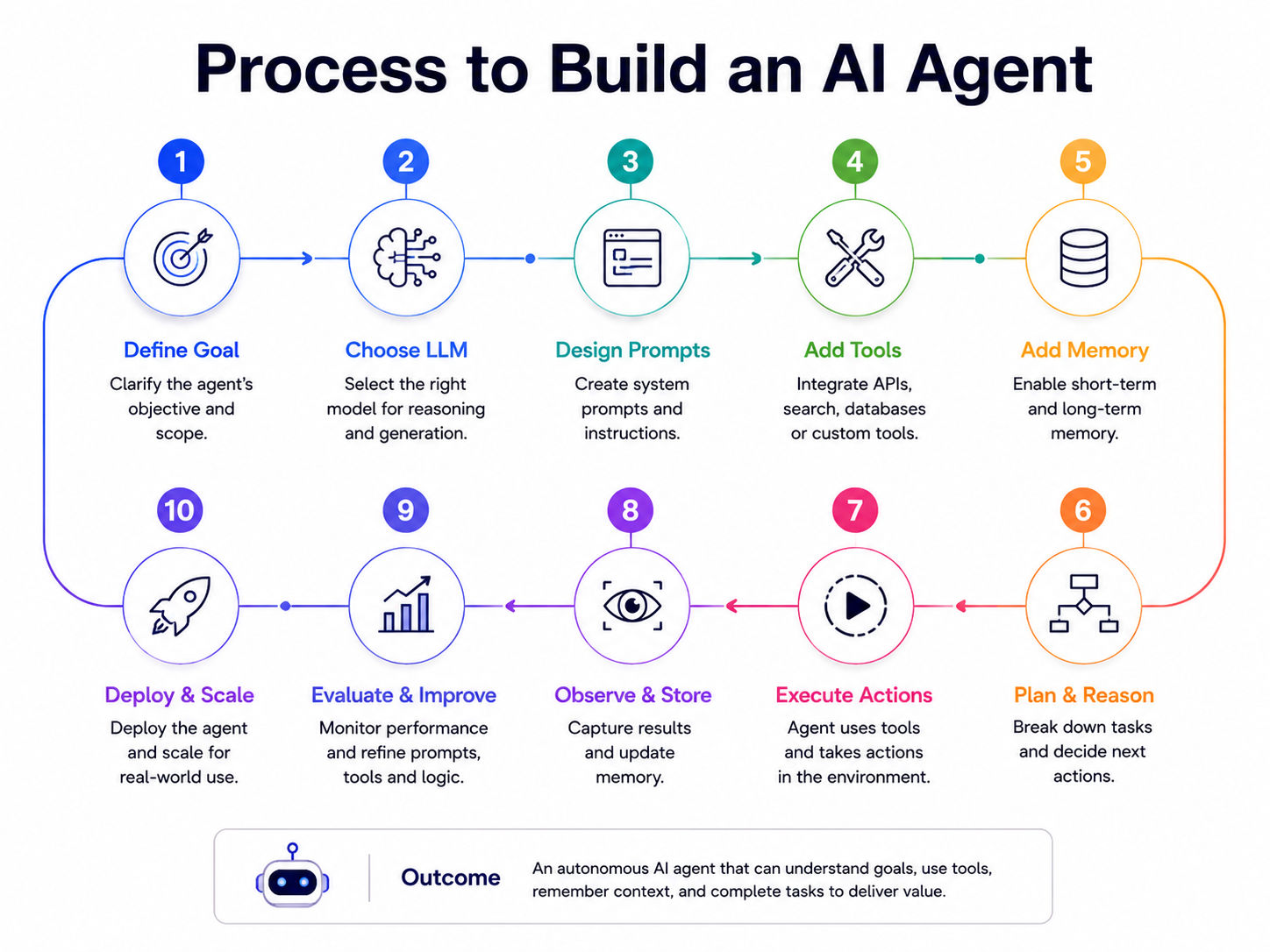
A structure helps you avoid unnecessary complexity and it makes debugging easier.
Begin with a limited objective.
Examples are as follows:
Many projects fail because developers try to solve too many problems at once.
A focused goal leads to better performance and simpler workflows.
Your LLM acts as the reasoning engine.
Common options include:
When selecting a model, consider:
A highly capable model may increase costs significantly during production.
Agent behavior depends heavily on system instructions.
Strong prompts define:
For example, a customer support agent should know when to answer directly and when to escalate an issue.
Tools transform a conversational AI into an actionable agent.
Common tools include:
Without tools, the agent can only generate text.
With tools, it can interact with real-world systems.
Memory allows the agent to maintain context across interactions.
Memory systems often store:
This improves personalization and decision-making.
The execution layer connects planning and action.
A typical workflow looks like:
This process forms the foundation of most autonomous AI systems.
Do read : Types of Agents in AI: A Complete Guide to How Intelligent Agents Work
The technology ecosystem around AI agents continues to grow rapidly.
Fortunately, developers do not need to build every component manually.
Popular Agent Frameworks
| Framework | Best For |
| LangChain | Agent workflows |
| LangGraph | Stateful agents |
| CrewAI | Multi-agent collaboration |
| AutoGen | Conversational agents |
| Semantic Kernel | Enterprise applications |
These frameworks reduce development time and provide reusable patterns.
The majority of modern agents rely on Retrieval-Augmented Generation (RAG).
Some of the popular vector databases are:
These systems help agents retrieve relevant information instead of relying solely on model memory.
The behaviour of an agent may become non-deterministic.
Observability platforms support:
Typical options are:
This phase is often overlooked in favour of development but is critical in production environments.
Also read : Top 10 Agentic AI Frameworks to Build Intelligent AI Agents in 2026
To understand how to build an AI agent in practice, consider a sales research assistant.
The goal is to help sales teams prepare for prospect meetings.
User Request
"Prepare a summary about Company X before tomorrow's meeting."
Agent Workflow
The agent:
Several systems work together behind the scenes.
The language model reasons about the task.
External APIs gather information.
Memory stores account history.
The agent combines everything into a single response.
This workflow illustrates why agents are more powerful than standalone chat interfaces.
They connect reasoning with action.
Even simple agents encounter challenges such as:
Testing these scenarios early improves reliability significantly.
Must read : Latest AI News and Updates - Stay Ahead in the AI Revolution
Building an AI agent involves more than connecting models and tools. As agents become more autonomous, developers often face challenges related to accuracy, memory management, cost, reliability, and handling unexpected situations.
Language models can confidently produce false information.
Ways to reduce hallucinations include:
Every agent action uses resources.
Costs increase by:
Many organisations optimise workflow before scaling deployments.
Too little memory creates poor user experiences.
Too much memory increases complexity and costs.
Developers must decide:
Sometimes agents:
The risks are mitigated by guardrails and monitoring systems.
Strong ai agent development is not just about capability, but also reliability.
If you are learning how to build an ai agent, focus on building reliable systems, not on building very complex ones.
Here are some practical suggestions:
A lot of successful production agents do a small set of things really well, as opposed to trying to solve every problem.
A focused design will often yield better results than an overly ambitious architecture.
Learning how to build an AI agent from scratch is more than just connecting a language model to an interface. Good agents combine reasoning, planning, memory, tools, and execution into a coherent system that can perform meaningful tasks. Developers can build AI agents that offer real-world value by understanding agent architecture, picking the right frameworks, implementing memory and retrieval systems, and tackling reliability challenges.
Want personalized guidance on AI and upskilling? Speak with an expert for a free 1:1 counselling session today.
A personal productivity assistant is often the best starting point. You can create an agent that manages tasks, summarizes notes, or answers questions from your documents. This type of project introduces core concepts such as prompting, memory, and tool usage without requiring a complex architecture or multiple integrations.
Yes. You can build an AI agent from scratch using direct API calls, custom logic, and your own workflow management. This approach gives you more control and helps you understand how agents work internally. Frameworks mainly speed up development and reduce the amount of boilerplate code.
The amount depends on the project's complexity. A simple agent may require only basic Python skills and API integration. More advanced systems need experience with databases, cloud services, workflow orchestration, and software engineering practices. Coding remains an essential part of creating reliable AI agents.
Most developers can build and test AI agents on a standard laptop because cloud-based models handle the heavy computation. If you plan to run open-source models locally, hardware requirements increase significantly. For learning and prototyping, a typical development machine is usually sufficient.
AI agents use prompts, available context, memory, and tool outputs to determine their next action. The language model evaluates the goal, selects relevant information, and decides whether to answer directly or use a tool. Decision quality often depends on the workflow design rather than the model alone.
Start with a single agent whenever possible. It is easier to develop, test, and maintain. Multi-agent systems become useful when different tasks require specialized expertise, such as research, analysis, and validation. Adding multiple agents too early can increase complexity without improving outcomes.
Teams usually create evaluation datasets that simulate real user interactions. They measure factors such as task completion, response quality, tool accuracy, and failure rates. Many organizations also run agents in limited environments before full deployment to identify weaknesses and unexpected behaviors.
Yes. Many organizations connect agents to internal knowledge bases, databases, and document repositories. Access controls and permission systems help ensure that agents only retrieve information authorized for a specific user. Security planning becomes important when handling sensitive business information.
Once you complete a basic project, focus on retrieval systems, vector databases, monitoring tools, and deployment workflows. Learning how to evaluate agent performance is equally valuable. These skills help transform a prototype into a system that can operate reliably in production environments.
An AI copilot primarily assists users by providing suggestions and recommendations. An AI agent can take actions independently based on a goal. For example, a copilot may suggest an email response, while an agent can draft the email, gather supporting information, and send it through connected tools.
Employers often value practical experience more than theoretical knowledge. They look for developers who can integrate models with tools, manage workflows, handle errors, and deploy reliable systems. A portfolio containing real-world AI agent projects usually demonstrates these capabilities more effectively than certifications alone.
1180 articles published
We are an online education platform providing industry-relevant programs for professionals, designed and delivered in collaboration with world-class faculty and businesses. Merging the latest technolo...
Speak with AI & ML expert
By submitting, I accept the T&C and
Privacy Policy