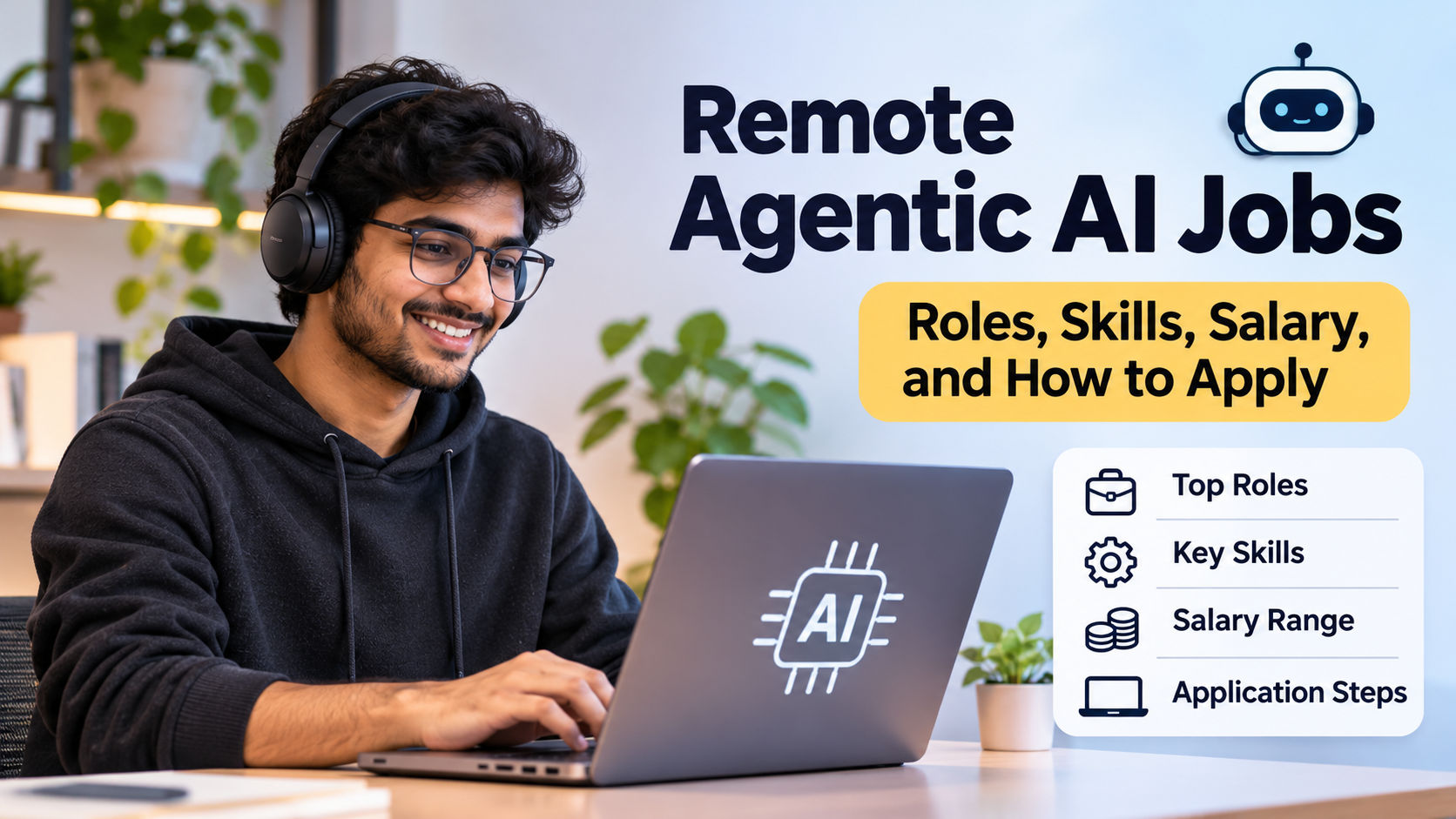
Remote Agentic AI Jobs: Roles, Skills, Salary, and How to Apply
By upGrad
Updated on Oct 27, 2026 | 6 min read | 1.44K+ views
Share:

All courses
Certifications
More
By upGrad
Updated on Oct 27, 2026 | 6 min read | 1.44K+ views
Share:
Table of Contents
Key Highlights
Ready to build a career in AI? Explore upGrad’s Generative AI and Agentic AI Courses Online to develop relevant skills and learn how AI agents can automate tasks, solve problems, and improve workflows.
Agentic AI Courses to upskill
Explore Agentic AI Courses for Career Progression
IIIT Bangalore
EPGP in Applied AI and Agentic AIIIIT Bangalore
Executive Diploma in Machine Learning and AI360° Career Support
With AI chatbots automating work in every industry, the demand for Agentic AI Jobs is on the rise. And companies do not look for state or country boundaries as long as their work is getting done. Hence, a lot of these jobs can be done remotely.
Here are some of the top remote Agentic AI Jobs:
The Agentic AI Engineer designs and builds AI agents. These created AI agents then perform multi-stage complex tasks with very little human input. These AI agents have the ability to utilize tools, think, plan, and even control their memory. The Agentic AI Engineer selects the model to be used, determines the tools the AI agent can use, controls the memory, and decides when a human takes action. Frameworks like LangGraph, CrewAI, and the OpenAI Agents SDK are used.
It's the broadest role on this list and usually needs solid Python.
An AI Agent Developer builds agents for specific tasks. For example, an agent is built to do sales research, or a code review agent is built to review code.
The AI Agent Developer writes prompts, connects APIs, and tests how the agent handles messy real inputs. This work involves less architecture and more hands-on building.
An AI Automation Engineer connects artificial intelligence to business process management. The typical job of such a professional is the transformation of a currently manual invoice process into something that would be replicated with the help of n8n, Zapier, or Make and language models for processing documentation. It can vary from low-code to full-on Python coding.
The Generative AI Engineer handles retrieval, fine-tuning, and prompt design. This role also covers text, image, and code generation. Agents are only one part of it.
AI Workflow Engineer
An AI Workflow Engineer designs sequences of tasks that combine AI models, APIs, business rules, and external tools.
They decide where a model step belongs, then build the retries, error handling, and logging around it. It's where most agents break in production.
The AI Integration Engineer plugs agents into software a company already uses, like Salesforce, Slack, or an internal database. API design and authentication knowledge matter a lot here. Security reviews are part of the daily routine.
This Multi-Agent Systems Engineer builds setups where several agents work together. One plans, one researches, and one checks the output. It's the most advanced role here, and debugging is painful because agents can disagree or loop forever. Fewer remote openings exist, and most ask for prior experience.
Want to strengthen your data science and AI skills? Explore upGrad’s Data Science and Generative AI Certification from IIIT Bangalore to build practical knowledge and prepare for opportunities in the evolving AI field.
Employers look for people who can build AI applications and understand their limitations. Knowing how to write prompts is useful, but technical roles usually require deeper skills.
Here are the skills required for remote Agentic AI Jobs:
Skill |
What it looks like on the job |
Common tools |
Writing agent logic and handling errors |
Python, FastAPI |
|
LLM APIs |
Calling models and managing context |
OpenAI, Anthropic, Gemini APIs |
Planning, tool use, memory |
LangGraph, CrewAI, AutoGen |
|
Retrieval |
Giving agents access to company data |
Pinecone, Chroma, pgvector |
Evaluation |
Testing whether agents behave |
LangSmith, custom test sets |
Automation platforms |
Connecting apps without heavy code |
n8n, Zapier, Make |
APIs and authentication |
Plugging into business software |
REST, OAuth, webhooks |
Skills people overlook
Must read: Build AI Agent From Scratch: A Practical Step-by-Step Guide
As the demand for automation is on the rise, there are many companies that hire remotely
Here are they:
Company Category |
Examples |
Types of Opportunities |
What to Expect |
| AI-native startups | Hugging Face, Cohere, and early-stage AI startups | AI agent development, LLM applications, and agent product engineering | Fast-paced work, varied responsibilities, and potentially lower salary with equity. Job stability can be less predictable. |
| Remote-first software companies | GitLab, Zapier, Automattic | AI feature development, workflow automation, and AI product engineering | Distributed teams, asynchronous communication, and opportunities to work on AI-powered products. |
| Staffing and talent platforms | Turing, Toptal, Upwork | Freelance AI development, contract-based agent building, and client projects | Project-based work, screening requirements, and opportunities to build a portfolio. |
| Consultancies and agencies | AI automation agencies and software consultancies | Custom AI agents, business process automation, and AI integrations | Hands-on client projects, varied technical challenges, and opportunities for freelancers and contractors. |
Must read: 10+ Real Agentic AI Examples Across Industries (2026 Guide)
Their salaries depend on the complexity of work and experience. Though, larger companies pay more. Freelancers get paid differently. Beginners often start around $25 to $50 per hour on client projects. Experienced builders with a track record can charge $100 or more.
Someone with domain knowledge in Finance, healthcare, and legal also gets paid more. Some companies also pay according to global rate
Here are the salaries:
S. No. |
Job Role |
Average Annual Salary in India |
1 |
Agentic AI Engineer |
₹14 LPA |
2 |
AI Automation Engineer |
₹8 LPA |
3 |
AI Agent Developer |
₹15.3LPA |
4 |
AI Integration Engineer |
₹11 LPA |
5 |
AI Workflow Engineer |
₹22.5 LPA |
6 |
Multi-Agent Systems Engineer |
₹16.3 LPA |
Source: Ambitionbox & Glassdoor
Must Read: Agentic AI Jobs in India: Roles, Salary, Skills, and Career Opportunities
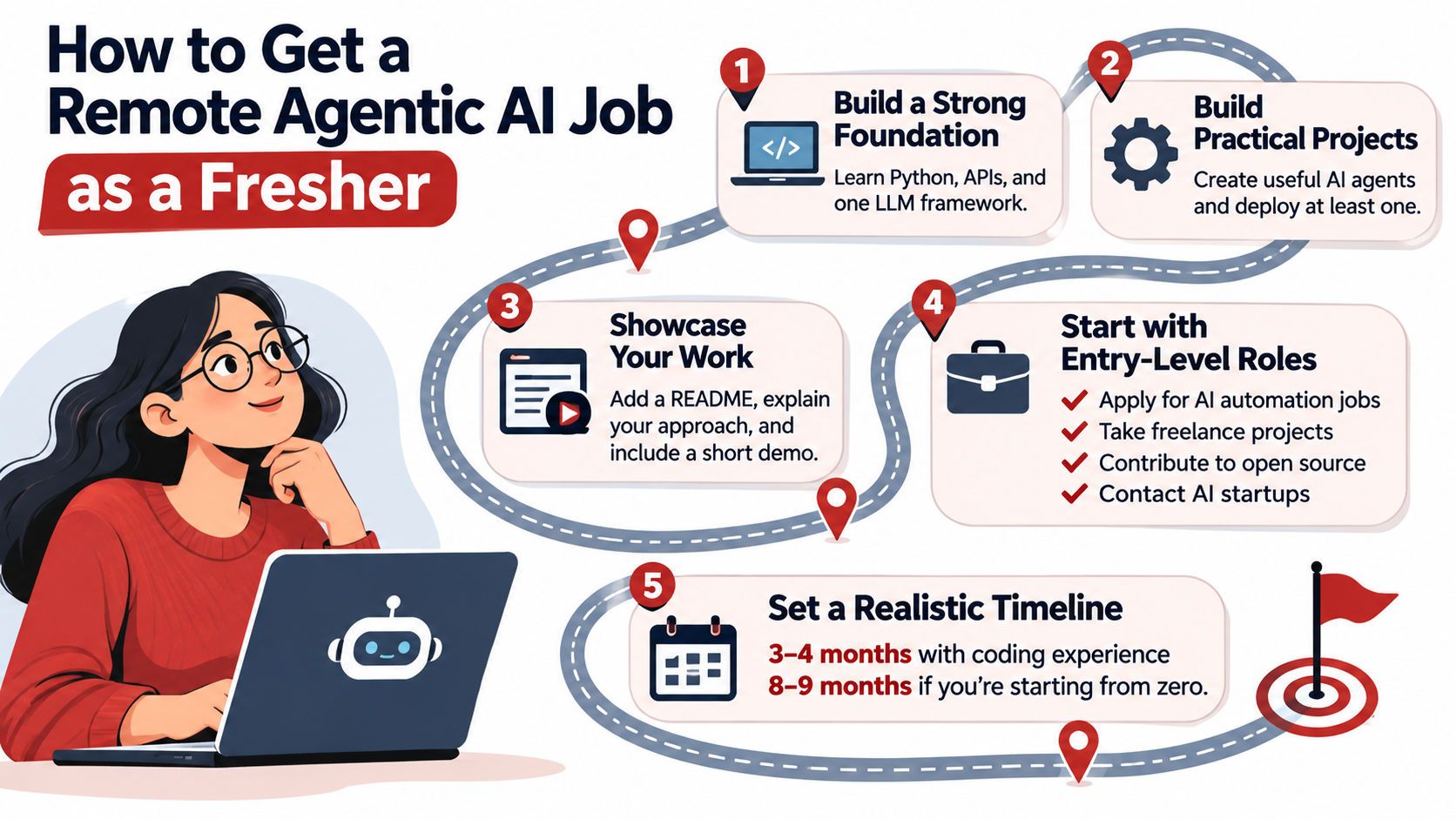
Fresher roles are present. But getting a remote Agentic AI Job will be difficult for freshers. Though freelance gigs and internships are possible. So check for these kinds of roles.
Here are the steps to get a remote Agentic AI Job as a fresher:
Must read: Agentic AI Jobs for Freshers in India: Roles, Skills, and Salary
Nowadays it has become a very common scam when searching for remote jobs.Since the roles sound exciting, demand is real, and many applicants are eager. So scammers make them their easy targets. Though the fake agentic AI remote job listings will have some patterns. You have to be vigilant enough to catch them.
One important fact to be remembered is that you should never give your ID, bank information, or passport copy until you sign a validated contract. Legitimate employers will get such information only once an offer is made to you through official channels. Moreover, if any project is assigned to you without payment to create something for the organization’s product, consider it as unpaid labor.
However, if the project is small and falls into specific categories, then the assessment can be treated as a regular procedure. But if you are asked to do production then it isn't normal. If something rings a bell to you, then don't doubt yourself and ask questions, as a professional recruiter would be answering you normally, whereas a scammer would urge you to rush.
Here are the warning signs that you should be aware of:
Verify the company
Enter the company's name with either "scam" or "reviews." See if the career page has the position. Search the recruiter's LinkedIn profile to see if he works for that company. Verify the job posting using the company's official website instead of the link provided.
You may want to check the domain age with a WHOIS search too. The claim of the company having ten years of history when its website was registered last month doesn't make sense.
Ready to start your journey? Book a free consultation with upGrad today to find the best path for your career.
Not necessarily. Startups do not value educational certificates as much as a good GitHub repository or deployed project, or even a freelancing customer. But large companies and jobs that require more research and development still want a computer science degree, so that depends on the company.
Python is the safest option to start learning. Most agent frameworks like LangGraph and CrewAI are Python based. The second one is TypeScript and it is mostly used in web-based agent frameworks. Start with Python, and if you need to work with JavaScript or front-end, learn TypeScript as well.
Yes, with some limitations. Lots of international companies hire remote developers from India in automation and engineering positions. There can be some restrictions about hiring people from certain countries due to tax or payroll policies. You have to check the location in each job posting.
A chatbot can answer the question posed during the course of dialogue. An AI agent performs the actions, for example, searches the database, sends emails, updates information in the CRM system, plans, utilizes tools and evaluates the results. This ability to perform actions is precisely what clients are paying for.
Yes, it is quite common. SMBs purchase research lead generation agents, support automation, and document processing services. Upwork and direct outreach channels are effective. You start by performing fixed price projects, and then you switch to retainers after gaining enough clients' trust.
If you have a programming background, then it will take two to four months of consistent practicing to develop several strong projects. If you do not have any experience, it will take six to nine months since you will need to learn Python and API first.
It is a decent choice; however, no one can guarantee the development of the market. The need for people capable of creating an agent has increased since many businesses have started experimenting with automation. This is quite a dynamic area in which you will constantly have to learn something new.
You should start with programming languages (Python), OpenAI/Anthropic API, and one framework like LangGraph. Additionally, you will require vector databases like Pinecone or Chroma for retrieving and n8n for immediate results. Do not try to learn all these technologies at once; deep knowledge in a couple of them is better than shallow knowledge in many.
Very few agent positions require understanding of machine learning mathematics. You will be calling the model, not training it yourself. The important thing is basic awareness of language model properties, including their weaknesses such as hallucinations and context windows.
Show them a concrete project that can be tested. Put together a functional agent, create a two-minute video with the demonstration, and write a brief README explaining mistakes and fixes. Companies need someone who will be able to solve problems and will show how they do that.
Not likely anytime soon. The agents are still prone to errors and looping, so it is necessary for businesses to have humans design guardrails and monitor their output. There will be some automation of coding tasks, but humans will still be required to fix the agents.
1320 articles published
We are an online education platform providing industry-relevant programs for professionals, designed and delivered in collaboration with world-class faculty and businesses. Merging the latest technolo...
Speak with AI & ML expert
By submitting, I accept the T&C and
Privacy Policy