Revenue Cycle Management: Process, Benefits, and Challenges
By Sriram
Updated on Aug 17, 2026 | 5 min read | 2.35K+ views
Share:

All courses
Certifications
More
By Sriram
Updated on Aug 17, 2026 | 5 min read | 2.35K+ views
Share:
Table of Contents
Key Highlights
Want to strengthen your business and management expertise? Explore industry-recognized online MBA for working professionals.
Popular MBA Programs
Revenue cycle management (RCM) is the process of tracking and managing the revenue generated from healthcare services. It combines patient registration, insurance verification, clinical documentation, coding, billing, claims management, payment collection, and reporting into one continuous workflow.
Main objective of RCM is to maximize reimbursements while reducing billing errors, payment delays, and claim denials.
An effective revenue cycle management process helps healthcare organizations:
Think of RCM as the financial backbone of a healthcare organization. While doctors focus on patient care, revenue cycle management ensures the organization remains financially healthy.
Also read: Key Insights into the Nature and Scope of Management
Understanding the difference makes it easier to see why revenue cycle management covers much more than billing alone.
Feature |
Revenue Cycle Management |
Medical Billing |
Medical Coding |
| Scope | Complete financial lifecycle of patient care | Claim submission and payment collection | Converts clinical records into standardized codes |
| Starts | Patient appointment scheduling | After coding is completed | After clinical documentation |
| Ends | Final payment collection and reporting | Payment is received or claim is resolved | Accurate diagnosis and procedure codes are assigned |
| Primary Goal | Improve financial performance | Secure reimbursements | Ensure coding accuracy and compliance |
| Teams Involved | Front desk, clinicians, coders, billers, finance teams | Billing specialists | Medical coders |
Here's an easy way to understand the relationship:
Example, imagine a patient visits a hospital for knee surgery. The front desk registers the patient, insurance is verified, the doctor documents the treatment, a medical coder assigns CPT and ICD codes, the billing team submits the insurance claim, and the finance team tracks payments until the account is settled. All these activities together make up the revenue cycle.
Modern revenue cycle management healthcare platforms bring these processes into one system. Improves collaboration, reduces manual work, and gives hospitals real-time visibility into their financial performance.
Free Courses
A successful RCM process starts long before a patient receives treatment and continues until every payment is collected. Each step depends on the one before it. Even a small mistake, such as an incorrect insurance ID or missing documentation, can delay reimbursements or result in claim denials.
Most healthcare organizations follow the 13 steps to ensure accurate billing, faster payments, and better financial performance. Here's how the process works.
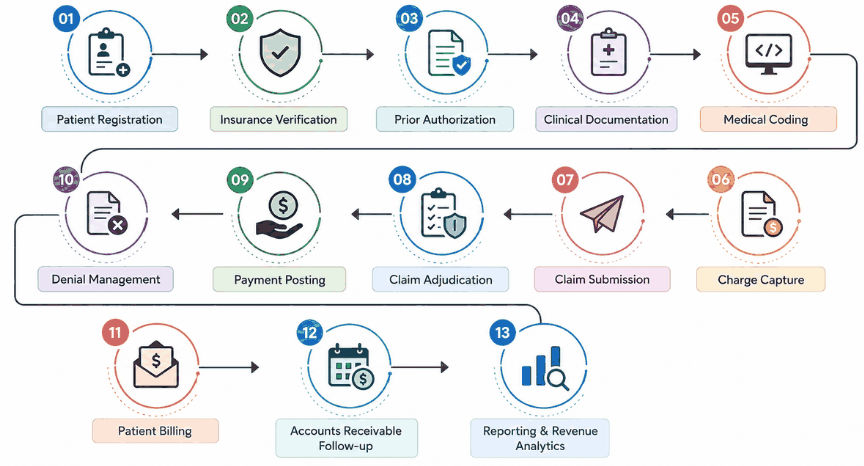
The revenue cycle begins when a patient schedules an appointment. During registration, the healthcare provider collects essential information such as the patient's name, date of birth, contact details, insurance information, and medical history.
Accurate registration is critical because errors at this stage often lead to rejected claims later. Even a small typo in the patient's insurance ID can delay payments.
Best practices include
Before treatment begins, providers verify whether the patient's insurance policy is active and what services are covered. Helps estimate out-of-pocket expenses and prevents unexpected billing issues.
Insurance verification typically checks policy validity, coverage limits, copay and deductible amounts, network eligibility, and preauthorization requirements. Many healthcare providers now automate this step to reduce manual work and improve accuracy.
Some treatments, surgeries, medications, and diagnostic tests require approval from the insurance company before they can be performed. If prior authorization is missed, insurers may reject the claim even if the treatment was medically necessary.
To avoid delays, providers submit supporting medical records, track authorization requests, and follow up with insurers before treatment.
After providing care, physicians document the patient's diagnosis, procedures performed, medications prescribed, and treatment plan.
Clear documentation serves two purposes:
Incomplete or inaccurate documentation is one of the leading causes of claim denials.
Medical coders translate clinical documentation into standardized codes using systems such as ICD-10, CPT, and HCPCS.
These codes tell insurance companies:
Once services are coded, every billable service, procedure, medication, and medical supply is recorded. This process is called charge capture.
Missing charges can directly reduce revenue, while duplicate charges may lead to claim rejections or compliance issues. Many hospitals use automated charge capture tools to improve billing accuracy.
The billing team prepares insurance claims using patient information, medical codes, and treatment details.
Before submission, claims are checked for missing information, coding errors, insurance eligibility, and compliance requirements. Clean claims are then submitted electronically to insurance providers for processing.
Once the insurer receives the claim, it reviews the information to determine reimbursement.
During adjudication, the insurer may:
After reimbursement is received, payments are recorded in the provider's financial system.
The billing team compares the amount paid with the expected reimbursement to identify as underpayments, overpayments, and outstanding balances. Accurate payment posting helps maintain reliable financial records.
Not every claim gets approved on the first attempt. Some are denied because of coding errors, missing documentation, expired insurance coverage, or authorization issues.
An effective denial management process involves:
After insurance processing is complete, patients receive bills for any remaining balance, including deductibles, copayments, or uncovered services.
Many healthcare organizations now offer online payment portals, digital invoices, flexible payment plans, and multiple payment options to simplify the billing process. It makes payment easier for patients.
Not every payment is received immediately. The accounts receivable (AR) team follows up on unpaid claims and outstanding patient balances.
Common activities include contacting insurance companies, sending payment reminders, resolving claim disputes, and following up on overdue balances. Reducing AR days improves cash flow and strengthens financial stability.
The final step focuses on measuring financial performance.
Healthcare organizations analyze key metrics such as claim approval rates, denial rates, reimbursement timelines, and revenue trends.
These insights help administrators:
Modern RCM software provides real-time dashboards and analytics, enabling hospitals and clinics to monitor performance continuously instead of waiting for monthly reports.
By regularly reviewing these metrics, healthcare providers can optimize every stage of the revenue cycle and ensure long-term financial sustainability.
Also read: Management process: Defination, Features & function
MBA Courses to upskill
Explore MBA Courses for Career Progression
O.P.Jindal Global University
MBA (with Career Acceleration Program by upGrad)Become interview ready with Career Services
PSB MBA + IIML Certification
MBA from Paris School of Business with Certification from IIM LucknowHere are the key benefits of an effective revenue cycle management process.
Even the most efficient healthcare organizations face challenges in managing their revenue cycle. Errors in billing, documentation, or insurance verification can delay payments and increase administrative costs. Identifying these issues early helps providers improve efficiency and maintain a steady cash flow.
Challenge |
Solution |
| Coding errors | Conduct regular coding audits, provide staff training, and use AI-assisted coding tools. |
| Missing patient information | Verify patient demographics and insurance details during registration. |
| Claim denials | Review claims before submission and analyze denial trends to address root causes. |
| Prior authorization delays | Automate authorization requests and track approval status in real time. |
| Staffing shortages | Automate repetitive tasks and outsource RCM functions when needed. |
| Compliance issues | Perform regular compliance audits and keep staff updated on regulatory changes. |
| Slow reimbursements | Submit clean claims promptly and strengthen accounts receivable (AR) follow-up. |
Want to move into leadership roles? The Certificate Programme in General Management for Young Leaders (YLP) from IIM Bangalore equips you with essential management, business strategy, and decision-making skills to prepare for today's dynamic business environment.
Managing the revenue cycle requires expertise, technology, and continuous monitoring. While some healthcare organizations handle these tasks internally, others partner with specialized revenue cycle management services providers to improve efficiency and reduce administrative workload.
Choosing the right model depends on factors such as the organization's size, budget, and operational needs.
In an in-house RCM model, the healthcare organization manages the entire revenue cycle using its own staff, processes, and technology. Internal teams handle patient registration, insurance verification, medical coding, billing, claim submission, denial management, payment posting, and accounts receivable follow-up.
Advantages of In-house RCM
Challenges of In-house RCM
With outsourced medical revenue cycle management services, a third-party provider manages key revenue cycle functions such as medical coding, billing, claim submission, denial management, payment posting, and accounts receivable follow-up. Outsourcing gives healthcare organizations access to experienced RCM professionals, advanced technology, and industry best practices.
Advantages of Outsourced RCM
Challenges of Outsourced RCM
The right choice depends on your organization's goals and resources.
Feature |
In-house RCM |
Outsourced RCM |
| Cost | Higher operational costs | Lower upfront investment |
| Control | Full control | Shared control |
| Expertise | Internal team | Dedicated RCM specialists |
| Scalability | Limited | High |
| Best For | Large hospitals | Small and mid-sized healthcare practices |
Large hospitals with dedicated billing teams often prefer an in-house approach. Smaller hospitals, clinics, and physician practices may benefit more from outsourcing, as it reduces administrative burden and provides access to specialized expertise.
Also read: Production & Operations Management: Meaning & Type
Subscribe to upGrad's Newsletter
Join thousands of learners who receive useful tips
Some widely used revenue cycle management software platforms include:
Epic is a comprehensive healthcare platform widely used by large hospitals and health systems. It combines clinical and financial workflows in a single system.
Key features:
Best for: Large hospitals and multi-hospital health systems.
Oracle Health (formerly Cerner) offers enterprise-level RCM solutions that streamline both clinical and financial operations.
Key features:
Best for: Large hospitals and enterprise healthcare organizations.
athenahealth is a cloud-based platform designed for clinics, physician practices, and outpatient care centers. It simplifies billing and improves reimbursement efficiency.
Key features:
Best for: Small to mid-sized clinics and physician practices.
Waystar focuses on improving reimbursement rates by reducing claim errors and simplifying payer interactions.
Key features:
Best for: Organizations looking to reduce claim denials and improve collections.
Availity connects healthcare providers with insurance payers through a single digital platform, making payer communication faster and more efficient.
Key features:
Best for: Healthcare providers that work with multiple insurance companies.
NextGen Healthcare combines EHR, practice management, and revenue cycle management into one integrated solution.
Key features:
Best for: Ambulatory care centers and specialty practices.
Also read: 10+ Essential Management Skills for a Successful Manager
Artificial intelligence (AI) is transforming how healthcare organizations manage their revenue cycle. Instead of relying on manual processes, providers can automate repetitive tasks, reduce errors, and improve reimbursement rates. From patient registration to denial management, AI helps make the revenue cycle faster and more accurate.
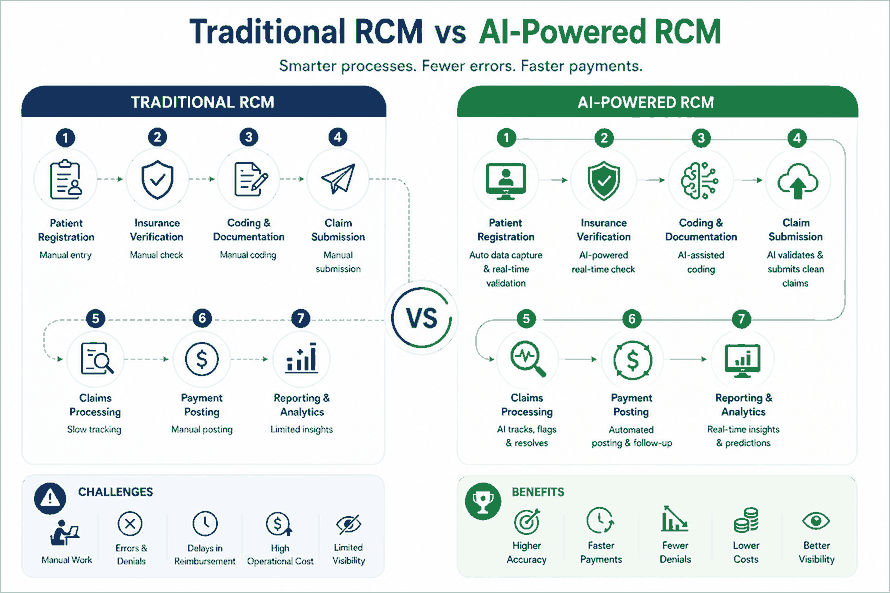
1. AI-Assisted Coding
AI-powered coding tools analyze clinical documentation and suggest accurate ICD, CPT, and HCPCS codes. This reduces manual effort, improves coding accuracy, and minimizes claim denials.
2. Predictive Denial Management
AI analyzes historical claim data to identify claims that are likely to be denied. Billing teams can correct potential issues before submission, increasing first-pass claim acceptance.
3. Robotic Process Automation (RPA)
RPA automates repetitive administrative tasks, including:
This allows staff to focus on higher-value tasks while improving productivity.
4. NLP for Documentation
Natural Language Processing (NLP) converts unstructured clinical notes into structured data. This helps improve documentation quality, supports accurate coding, and speeds up billing workflows.
5. Automated Eligibility Verification
AI can verify a patient's insurance coverage in real time before treatment. This reduces manual verification efforts, prevents billing errors, and improves the patient experience.
6. Generative AI
Generative AI assists healthcare teams by:
As AI technology evolves, it is becoming an essential part of modern revenue cycle management healthcare systems, helping providers improve efficiency while reducing operational costs.
Also read: How to Improve Task Management: Tips, Roles, Skills, and Tools for Success
Tracking the right Key Performance Indicators (KPIs) helps healthcare organizations measure the effectiveness of their revenue cycle. These metrics highlight bottlenecks, improve collections, and support data-driven decisions.
KPI |
What It Measures |
Why It Matters |
| Clean Claim Rate | Percentage of claims submitted without errors | Higher rates improve first-pass reimbursements |
| Days in Accounts Receivable (AR) | Average time taken to collect payments | Lower AR days indicate better cash flow |
| Net Collection Rate | Revenue collected after contractual adjustments | Measures overall collection efficiency |
| Gross Collection Rate | Total collections before adjustments | Evaluates billing performance |
| Denial Rate | Percentage of claims denied by payers | Helps identify billing and coding issues |
| First Pass Resolution Rate | Claims paid on the first submission | Indicates claim quality and process efficiency |
| Cost to Collect | Cost incurred to collect payments | Lower costs improve profitability |
| Charge Lag | Time between service delivery and claim submission | Shorter lag leads to faster reimbursements |
Monitoring these KPIs regularly helps healthcare providers identify revenue leaks, optimize workflows, and strengthen financial performance.
Revenue cycle management is the foundation of a healthcare organization's financial health. From patient registration and insurance verification to claim submission and payment collection, every step plays a role in ensuring timely reimbursements and a better patient experience.
Modern revenue cycle management services and AI-powered technologies help providers reduce claim denials, improve cash flow, and automate time-consuming tasks. Whether you manage a large hospital or a small clinic, investing in the right processes and revenue cycle management software can improve operational efficiency and support long-term growth.
Take the first step toward becoming a future leader. Book a free consultation with upGrad today to find the best path for your career.
A revenue cycle manager oversees the financial processes involved in patient care. Their responsibilities include managing billing, claims, reimbursements, denial resolution, compliance, and financial reporting to ensure the healthcare organization maintains a healthy cash flow and minimizes revenue loss.
Revenue cycle management is used by hospitals, clinics, physician practices, diagnostic centers, laboratories, ambulatory surgery centers, and other healthcare providers. Any organization that bills patients or insurance companies can benefit from an efficient RCM process.
Revenue leakage refers to income lost due to billing mistakes, coding errors, missed charges, claim denials, or delayed collections. Regular audits, accurate documentation, and automated billing processes help healthcare organizations identify and prevent revenue leakage.
A clean claim contains complete and accurate information, allowing insurers to process it without corrections. Clean claims reduce payment delays, improve first-pass approval rates, lower administrative costs, and help healthcare providers receive reimbursements faster.
Payment delays are commonly caused by incomplete patient information, incorrect medical coding, missing documentation, claim denials, prior authorization issues, and slow insurance processing. Identifying these problems early helps speed up reimbursements and improve cash flow.
Yes. Small clinics can use revenue cycle management software or outsource RCM services to automate billing, improve claim accuracy, reduce administrative workload, and accelerate payment collection without maintaining a large in-house billing team.
Healthcare organizations should review key revenue cycle processes regularly. Many perform quarterly audits, while larger hospitals may monitor billing accuracy, coding quality, and claim performance every month to detect issues before they affect revenue.
Yes. Revenue cycle management offers career opportunities in medical billing, coding, healthcare finance, compliance, and operations. Growing digital transformation and increasing healthcare demand continue to create strong opportunities for skilled RCM professionals.
Cloud-based RCM software offers remote access, automatic updates, lower infrastructure costs, and easy scalability. It also enables healthcare providers to access billing information securely, collaborate across teams, and manage financial operations more efficiently.
Professionals need knowledge of medical billing, coding, insurance claims, healthcare regulations, financial reporting, and RCM software. Strong analytical, communication, and problem-solving skills are also essential for improving reimbursement and operational efficiency.
The future of revenue cycle management will be driven by AI, automation, predictive analytics, cloud technology, and digital payments. These innovations will reduce manual work, improve billing accuracy, accelerate reimbursements, and help healthcare providers make smarter financial decisions.
730 articles published
Sriram K is a Senior SEO Executive with a B.Tech in Information Technology from Dr. M.G.R. Educational and Research Institute, Chennai. With over a decade of experience in digital marketing, he specia...
Speak with MBA expert
By submitting, I accept the T&C and
Privacy Policy
From MBA to Dream Job - Explore Our Alumni Success Stories
Top Resources
Master's Degree
13 Months
Master's Degree
12 Months
Master's Degree
15 Months