Importance of Time Management: Benefits, Challenges, and Effective Strategies
By Sriram
Updated on Aug 10, 2026 | 4 min read | 1.37K+ views
Share:

All courses
Certifications
More
By Sriram
Updated on Aug 10, 2026 | 4 min read | 1.37K+ views
Share:
Table of Contents
Key Highlights
Want to build stronger planning and leadership skills? Explore management certification courses and learn practical strategies to succeed in academics and your future career.
Popular Management Programs
Time is one resource you cannot get back. Every person gets the same 24 hours in a day, but how you use those hours makes a big difference. Good time management helps you stay organized, meet deadlines, and make room for activities you enjoy.
Without a proper plan, even simple tasks can pile up quickly. You may end up studying late at night, missing assignment deadlines, or sacrificing your personal time. Managing your time well helps you avoid these situations and makes student life more balanced.
Let's explore the biggest reasons why time management matters.
Students attend classes, complete assignments, prepare for exams, participate in extracurricular activities, and spend time with family and friends. Balancing everything can feel challenging without a schedule.
Time management helps you divide your day wisely. Instead of spending hours on one subject, you can create dedicated time slots for studying, relaxation, exercise, and hobbies. This prevents burnout and keeps your routine healthy.
For example, imagine you have a chemistry assignment due tomorrow and a football practice in the evening. If you start working on the assignment a few days earlier, you won't have to skip practice or stay awake until midnight.
A balanced routine also gives you time to:
Treat your study time and personal time as equally important. A balanced schedule is easier to maintain than one that only focuses on academics.
Many students postpone studying until the exam week. This often leads to long study hours, poor sleep, and increased anxiety. Good time management helps you prepare gradually. Studying for one hour every day is often more effective than studying for eight hours the night before an exam.
A planned revision schedule also improves information retention. Instead of trying to memorize everything at once, you revise concepts regularly and build confidence over time.
Here's a simple comparison:
Without Time Management |
With Time Management |
| Last-minute cramming | Daily revision |
| Poor sleep before exams | Better sleep schedule |
| High stress | Lower anxiety |
| Panic during exams | Better confidence |
Even small daily study sessions can make a big difference when exams arrive.
Students who follow a study schedule usually have enough time to revise, ask questions, and practice difficult topics. This leads to stronger subject knowledge and better exam performance.
For example, if you divide your mathematics revision over two weeks instead of two days, you'll have more opportunities to solve practice questions and identify weak areas.
Here's how effective time management improves academic performance:
Without Time Management |
With Time Management |
| Missed deadlines | Assignments submitted on time |
| Irregular study routine | Consistent learning |
| Less revision | Regular practice |
| Lower confidence | Better preparation |
| More mistakes | Improved accuracy |
Remember, studying longer doesn't always mean studying better. Consistency is far more important than spending endless hours with your books.
Every day, students make dozens of decisions. Should you study first or scroll through social media? Should you complete your assignment today or postpone it until tomorrow? Time management helps you make smarter choices because your priorities are already clear.
When you know what needs to be done first, you waste less time deciding what to do next. You also become better at identifying urgent tasks and avoiding distractions.
For instance, if you have an assignment due tomorrow and a quiz next week, you'll naturally finish the assignment first. Planning ahead removes confusion and helps you stay focused.
Over time, these small decisions build productive habits that benefit both your academic and personal life.
Following a daily routine teaches you to stay committed even when you don't feel motivated. Whether it's attending classes on time, completing assignments before the deadline, or revising regularly, every habit strengthens your self-discipline.
Time management also makes you more responsible. Instead of blaming deadlines or lack of time, you begin taking ownership of your schedule.
A disciplined student is more likely to:
These habits not only improve academic performance but also prepare you for responsibilities beyond college.
Almost every profession requires employees to manage deadlines, attend meetings, handle multiple projects, and work with teams. Students who learn these habits early find it easier to adapt to professional life.
For example, a software developer may have to deliver a project within a deadline. A marketing executive may handle multiple campaigns at the same time. A doctor must balance patient care with administrative work. In every role, managing time is essential.
Learning this skill during your student years helps you:
Employers value candidates who can organize their work and manage their time effectively. Developing this habit now can give you an advantage throughout your career.
Also read: How to Improve Task Management in 2025: Tips, Roles, Skills, and Tools for Success
Free Courses
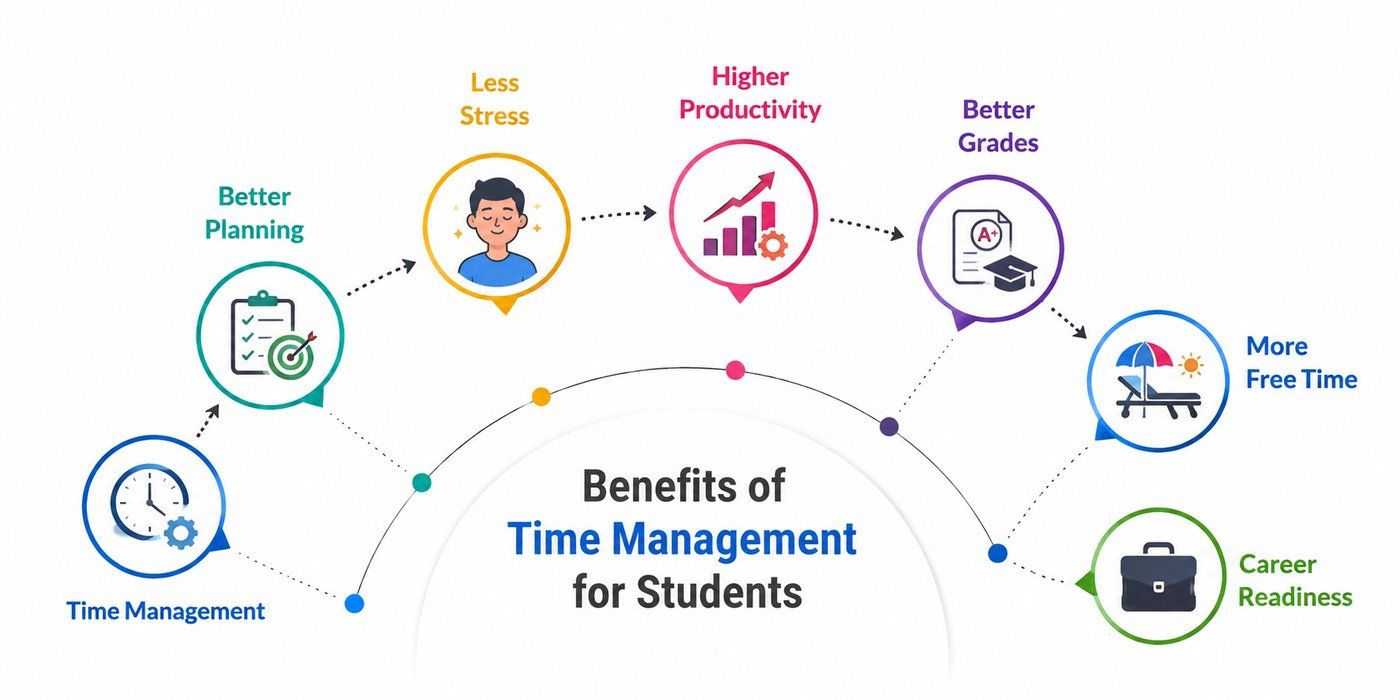
Good time management does more than help you meet deadlines. It changes the way you study, work, and learn. When you use your time wisely, you can stay focused, reduce stress, and enjoy a better balance between academics and personal life.
Let's look at the biggest benefits of time management for students.
Instead of studying for three hours without concentration, try studying for shorter, focused sessions. Even one hour of distraction-free study can be more productive than several hours of unfocused reading.
For example, if you plan to spend 45 minutes solving maths problems, you'll naturally stay committed until the session ends.
Here are a few ways to improve focus:
Tip for Students: Write down one goal before every study session. For example, "Complete Chapter 5" or "Solve 20 practice questions." A clear target keeps you motivated.
By planning your day, you can complete tasks before deadlines and avoid last-minute pressure.
Imagine you have a project due next Friday. Instead of working on it the night before, you divide it into smaller tasks over five days. This approach makes the workload feel lighter and gives you enough time to review your work.
Students who plan ahead often:
Here's a quick comparison.
Without Time Management |
With Time Management |
| Last-minute submissions | Early submissions |
| More errors | Better quality work |
| Constant stress | Better planning |
| Limited revision | Time for improvements |
Small, consistent efforts always produce better results than rushed work.
When you manage your time well, you don't have to choose between academics and extracurricular activities. You can make time for both.
For example, if you complete your homework after school, you'll still have time to attend football practice or learn a new skill in the evening.
Participating in extracurricular activities helps you:
A balanced schedule helps you enjoy college life without falling behind in your studies.
Quick Checklist
Ask yourself these questions every Sunday:
If the answer is yes to most of these, you're creating a healthy weekly routine.
As you complete one task after another, you start believing in your ability to handle bigger challenges. For example, imagine you finish all your weekly assignments by Friday. Instead of worrying over the weekend, you can relax or revise at your own pace. This creates a positive learning experience.
Confidence grows when you:
Remember, motivation comes and goes. Good habits last much longer.
A well-planned schedule helps you maintain a healthy routine. You get enough sleep, eat on time, exercise regularly, and still make progress in your studies. Good time management also reduces anxiety. Knowing that you've completed your work gives you peace of mind and helps you stay calm during exams.
Here's how it makes a difference.
Poor Time Management |
Good Time Management |
| Irregular sleep | Healthy sleep schedule |
| Missed meals | Balanced daily routine |
| High stress | Better emotional well-being |
| Burnout | Consistent energy levels |
| Poor concentration | Improved focus |
Even simple habits can improve your well-being.
Looking to future-proof your career? Enroll in the IIMK AI for Business Professionals Certificate Program to develop in-demand AI and business skills.
Management Courses to upskill
Explore Management Courses for Career Progression
IIIT-B & IIM, Udaipur
Chief Technology Officer & AI Leadership ProgrammeThe benefits of time management go beyond academics. It supports your overall development and prepares you for future challenges.
Area |
How Time Management Helps |
| Academics | Better grades and regular revision |
| Personal Life | More time for family and hobbies |
| Mental Health | Less stress and anxiety |
| Physical Health | Better sleep and healthier routines |
| Career Preparation | Strong planning and organizational skills |
The more consistently you follow a schedule, the easier these habits become. Over time, you'll spend less time worrying about deadlines and more time learning, growing, and enjoying your student life.
Also read: Top 5 Project Management Tools in 2026
Let's look at the biggest time management problems students face and how to deal with them.
Procrastination is one of the biggest reasons students fall behind. It means delaying important tasks even when you know they need to be completed.
Students procrastinate for many reasons, such as:
The longer you delay a task, the more stressful it becomes. This often leads to last-minute cramming and lower-quality work.
How to Overcome Procrastination
Instead of thinking about completing an entire project, focus on one small step at a time. Breaking large tasks into smaller goals makes them feel easier to start.
Problem |
Solution |
| Delaying assignments | Break them into smaller tasks |
| Feeling overwhelmed | Focus on one task at a time |
| Waiting for motivation | Create a fixed study routine |
Phones, social media, and gaming are some of the biggest distractions for students today.
A quick look at Instagram or YouTube can easily turn into an hour of scrolling. Constant notifications also interrupt your concentration, making it harder to return to studying.
Even short distractions reduce productivity because your brain needs time to regain focus.
Common digital distractions include:
How to Reduce Digital Distractions
You don't have to stop using your phone completely. Instead, create boundaries.
Try these simple habits:
Most students don't study just one subject. They may have mathematics, science, English, social studies, projects, practical work, and extracurricular activities to manage at the same time.
Without a plan, it's easy to spend too much time on your favorite subject while ignoring the difficult ones.
A balanced schedule ensures every subject gets enough attention.
How to Manage Multiple Subjects
Start by listing all your subjects.
Then identify:
Next, divide your study time throughout the week instead of trying to cover everything in one day.
Here's an example.
Day |
Main Subject |
Revision |
| Monday | Mathematics | Science |
| Tuesday | English | History |
| Wednesday | Science | Mathematics |
| Thursday | Social Studies | English |
| Friday | Practice Tests | Weekly Revision |
Rotating subjects keeps your study sessions interesting and prevents mental fatigue.
Learning to prioritize helps you focus on work that has the biggest impact. For example, preparing for tomorrow's exam should come before organizing your study notes or watching educational videos.
How to Prioritize Tasks
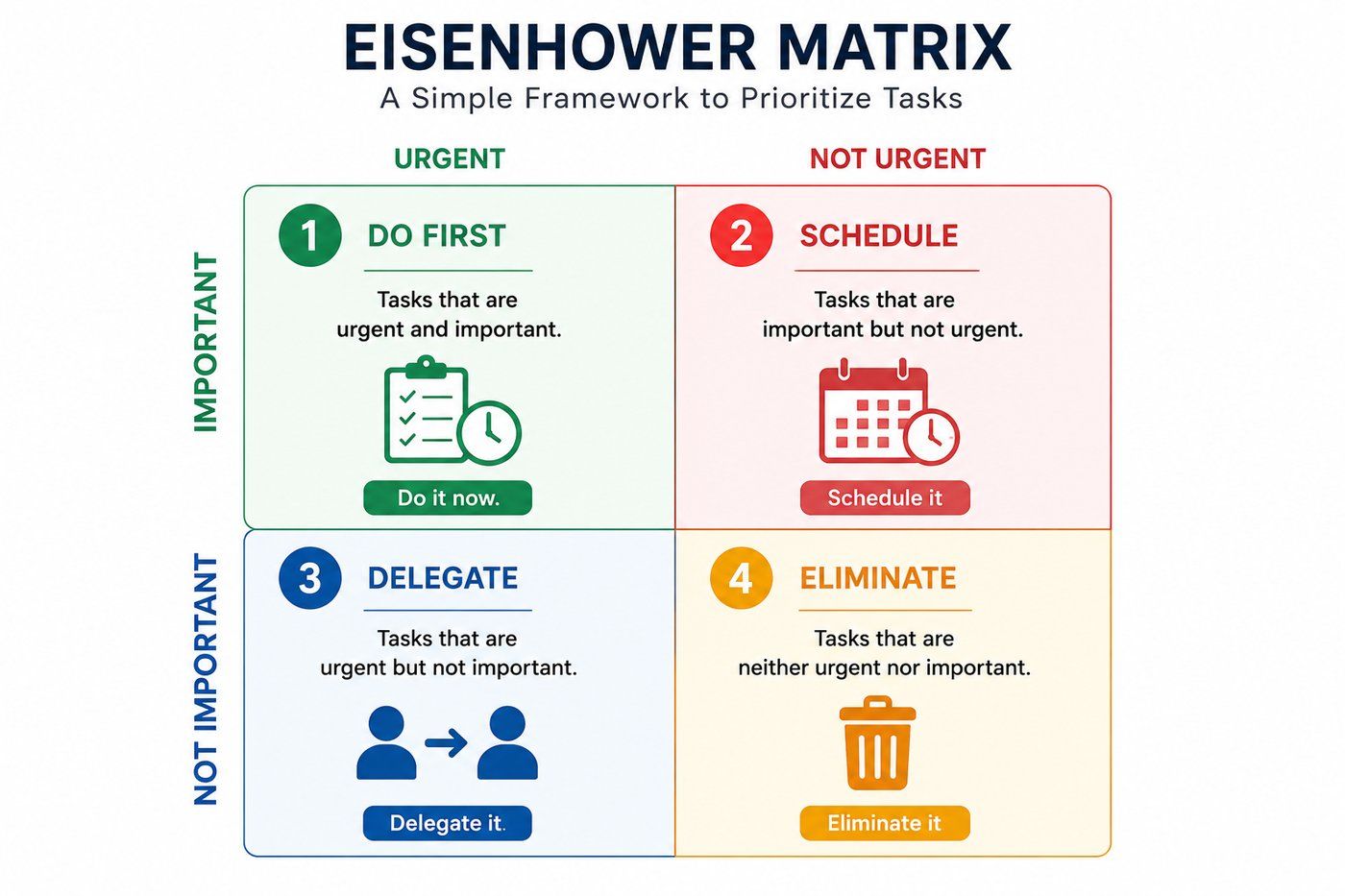
A simple method is to divide your work into four categories.
Priority |
What to Do |
| Urgent and Important | Complete immediately |
| Important but Not Urgent | Schedule it |
| Urgent but Less Important | Finish quickly if possible |
| Neither Urgent nor Important | Avoid or postpone |
Many students create ambitious study schedules that are impossible to follow.
For example, planning to study for 10 hours every day may sound impressive, but it usually leads to frustration and burnout.
A realistic timetable is much easier to maintain.
Instead of creating the perfect schedule, create one that fits your daily routine.
Here's a comparison.
Unrealistic Plan |
Practical Plan |
| Study 10 hours every day | Study 3-4 focused hours |
| No breaks | Take a 10-minute break after each session |
| Finish five chapters in one day | Complete one chapter well |
| Revise everything before exams | Revise a little every day |
Remember, consistency matters more than intensity.
Tips for Creating a Realistic Study Plan
A flexible timetable is easier to follow than a rigid one.
Common Challenge |
Simple Solution |
| Procrastination | Break tasks into smaller steps |
| Social media distractions | Use Focus Mode and study without your phone |
| Managing multiple subjects | Follow a weekly study schedule |
| Poor prioritization | Complete important tasks first |
| Unrealistic study plans | Set achievable daily goals |
Every student faces time management challenges at some point. The difference lies in how you respond to them. Small changes, such as planning your day, reducing distractions, and setting realistic goals, can make studying much easier.
Also read: Top 10 Simple Ways to Improve Your Time Management Skills | upGrad blog
There is no one-size-fits-all approach to time management. The best technique depends on your study habits, workload, and goals. Some methods improve focus, while others help you organize tasks or plan your week.
Let's look at five effective time management techniques for students.
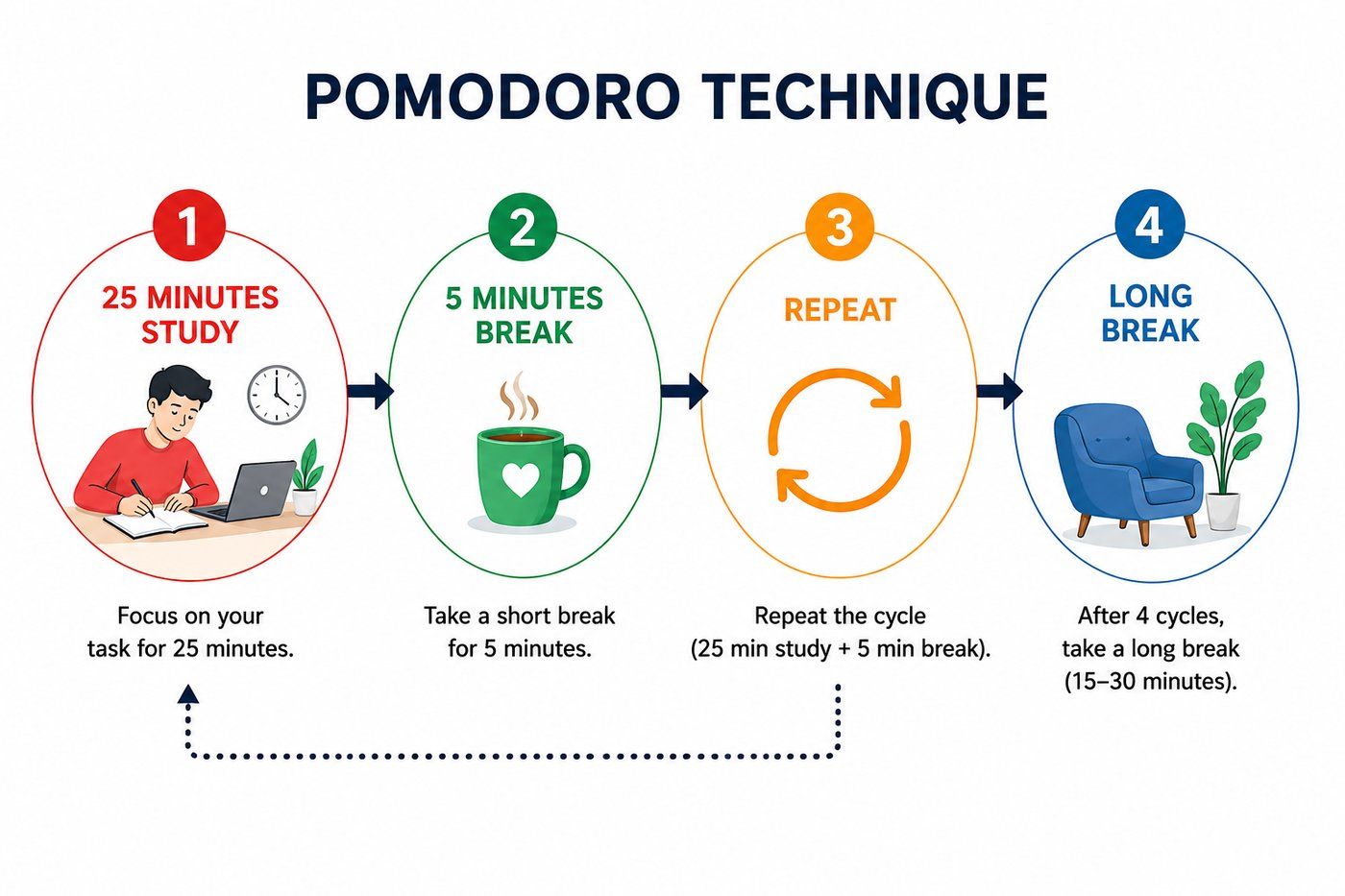
The Pomodoro Technique helps you stay focused by breaking study time into short sessions. Study for 25 minutes, take a 5-minute break, and repeat. After four sessions, take a longer break.
This method prevents mental fatigue and makes long study hours easier to manage.
Best for:
Time Blocking means assigning specific time slots to different tasks. Instead of deciding what to study throughout the day, you follow a fixed schedule.
For example, study mathematics from 9 AM to 10 AM and science from 10:30 AM to 11:30 AM.
This technique helps you stay organized and avoid wasting time.
Best for:
When you have several tasks, it's important to know what to do first. The Eisenhower Matrix helps you prioritize work based on urgency and importance.
SMART goals help you create clear and realistic study targets.
Letter |
Meaning |
| S | Specific |
| M | Measurable |
| A | Achievable |
| R | Relevant |
| T | Time-bound |
For example, instead of saying, "I'll study chemistry," set a goal like, "Complete Chapter 4 and solve 20 questions before 6 PM."
SMART goals make it easier to stay motivated and track your progress.
A weekly planner helps you organize subjects, assignments, and revision in advance. It also prevents last-minute stress.
Day |
Main Task |
| Monday | Mathematics |
| Tuesday | English |
| Wednesday | Science |
| Thursday | Social Studies |
| Friday | Revision |
| Saturday | Mock Test |
| Sunday | Plan Next Week |
Review your planner every week and adjust it when priorities change.
The right technique depends on your learning style, study habits, and daily schedule.
For example, if you often lose focus, you need a method that improves concentration. If you're preparing for exams, a structured study plan may work better.
The good news is that you don't have to stick to one technique forever. Try different methods and see which one helps you stay productive.
Study Situation |
Recommended Technique |
Why It Works |
| Easily distracted | Pomodoro Technique | Short study sessions improve focus and reduce distractions. |
| Preparing for exams | Time Blocking | Dedicated revision slots help cover the syllabus on time. |
| Managing multiple assignments | Eisenhower Matrix | Helps prioritize urgent and important tasks. |
| Building daily study habits | SMART Goal Planning | Creates clear, realistic, and measurable goals. |
| Working on long-term projects | Weekly Study Planner | Tracks progress and prevents last-minute work. |
Keep these points in mind before selecting a method:
Also read: Top Productivity Hacks to Boost Efficiency and Success
Instead of spending time creating study plans manually, you can use these tools to simplify your routine and improve productivity.
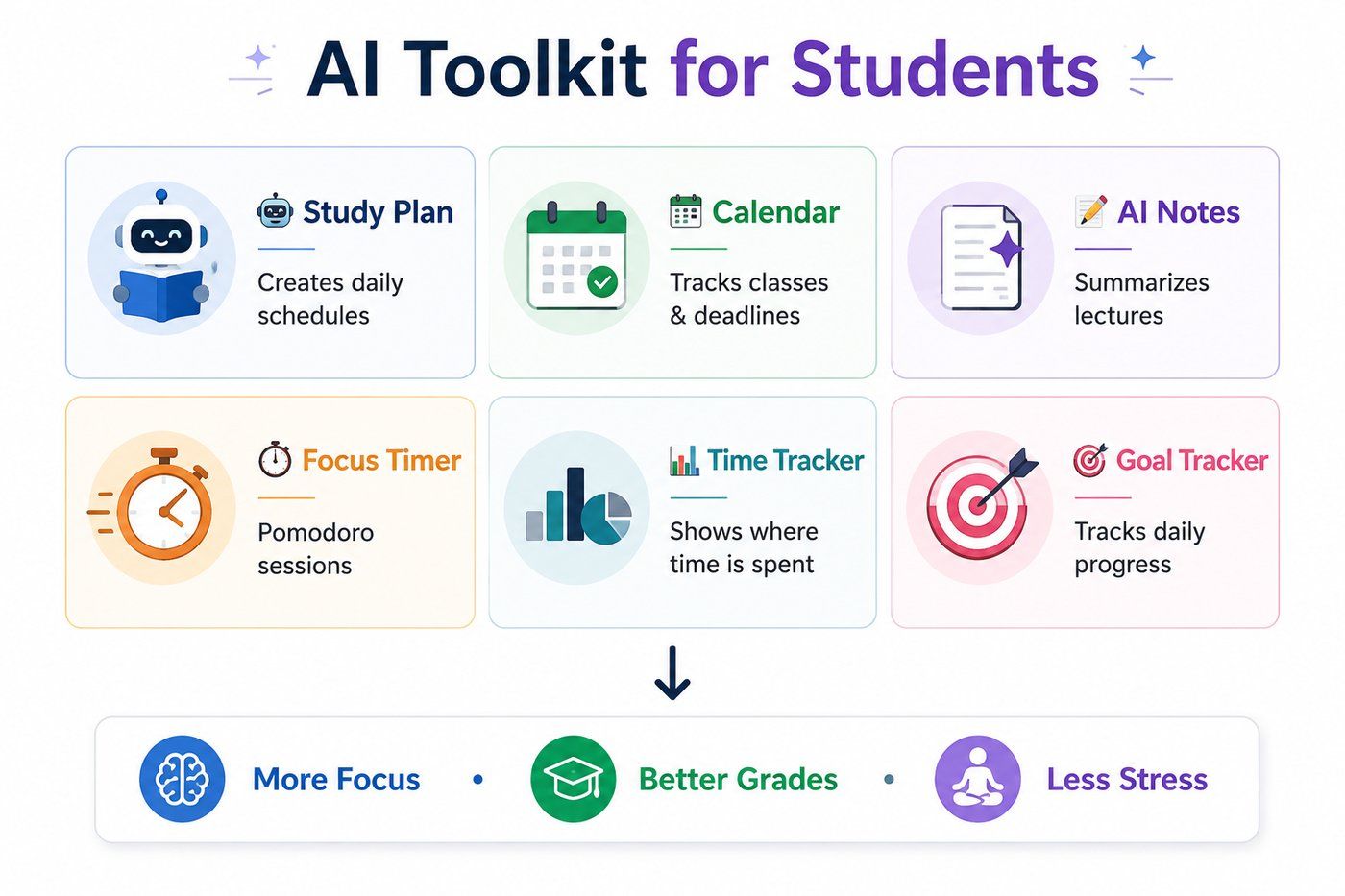
AI study planners can create personalized schedules based on your goals, deadlines, and available study time. They also help you break large tasks into smaller, manageable steps.
Some popular tools include:
Tool |
Best For |
Key Feature |
| ChatGPT | Study planning | Creates personalized study schedules and explains concepts. |
| Notion AI | Task management | Organizes notes, assignments, and study plans. |
| Motion | Automatic scheduling | Prioritizes tasks and adjusts your calendar automatically. |
These tools are especially useful during exam season when you have multiple subjects to manage.
Missing deadlines often happens because students forget important dates. Calendar and reminder apps solve this problem by sending timely notifications.
Popular options include:
You can use these apps to:
A digital calendar gives you a clear view of your week, making it easier to manage your time.
Reviewing long lecture notes can take hours. AI note-taking tools save time by summarizing key points and organizing information.
Popular tools include:
Tool |
Best Use |
| NotebookLM | Summarizing study material |
| ChatGPT | Simplifying difficult concepts |
| Otter.ai | Converting lectures into notes |
These tools help you revise faster, but always review the original material to ensure accuracy.
Knowing where your time goes can help you improve your study habits. Focus and time-tracking apps reduce distractions and show how you spend your day.
App |
Purpose |
Best For |
| Forest | Focus timer | Avoiding phone distractions |
| Focus To-Do | Pomodoro timer | Managing study sessions |
| RescueTime | Time tracking | Monitoring productivity |
These apps can help you identify habits that reduce productivity and encourage more focused study sessions.
Also read: 15 Ways to Improve Your Time Management Skills [With Actionable Tips]
Managing your time well is one of the most valuable skills you can develop as a student. It helps you stay organized, complete tasks on time, and reduce the stress of last-minute deadlines. More importantly, it creates a healthy balance between academics, extracurricular activities, and personal life.
The key is to start small. Choose one time management technique, set realistic goals, and follow a routine you can maintain. As your study habits improve, you can combine different strategies and use AI tools to plan your schedule, stay focused, and track your progress.
Take the first step toward becoming a future leader. Book a free consultation with upGrad today to find the best path for your career.
The golden rule of time management is to focus on your priorities. Start with the most important and urgent tasks instead of the easiest ones. Planning your day in advance and avoiding distractions helps you stay productive, reduce stress, and complete your work on time.
The 5 P's stand for Proper Planning Prevents Poor Performance. This principle highlights the importance of planning your tasks before you begin. A well-organized schedule helps students meet deadlines, avoid last-minute pressure, and use their time more effectively throughout the day.
The 3-3-3 rule encourages you to complete three major tasks, three smaller tasks, and three quick maintenance activities each day. This approach keeps your workload balanced, improves productivity, and prevents you from feeling overwhelmed by a long to-do list.
There is no fixed number because every student has different learning needs. Most students benefit from 2 to 4 hours of focused self-study outside class. The goal should be consistent, distraction-free learning rather than studying for long hours without concentration.
Students can avoid procrastination by breaking large tasks into smaller goals, creating a realistic study schedule, and removing distractions like social media. Starting with just a small task often builds momentum, making it easier to stay focused and complete the remaining work.
Create a revision timetable several weeks before your exams and study a little each day. Prioritize difficult subjects, practice mock tests, and schedule short breaks to stay refreshed. Avoid last-minute cramming, as it increases stress and reduces information retention.
A balanced routine includes dedicated time for studying, exercise, hobbies, family, and rest. Planning your week in advance helps you manage academic responsibilities without sacrificing personal time. This balance improves motivation, reduces burnout, and supports better physical and mental well-being.
Yes. Effective time management allows students to attend classes regularly, complete assignments before deadlines, and revise consistently. These habits improve understanding, reduce exam stress, and increase confidence, which often leads to better academic performance and higher grades over time.
Both options are useful. Digital planners offer reminders, syncing across devices, and easy schedule updates. Paper planners are simple, distraction-free, and help many students remember tasks by writing them down. Choose the option that best matches your study habits and preferences.
The biggest mistake is delaying important tasks until the last minute. This creates unnecessary stress, reduces the quality of work, and leaves little time for revision. Planning ahead and setting realistic daily goals can help students avoid this common problem.
Yes. AI tools can create personalized study schedules, summarize notes, organize assignments, and send reminders for deadlines. They also help students track their progress and save time on routine tasks, allowing them to focus more on learning and exam preparation.
730 articles published
Sriram K is a Senior SEO Executive with a B.Tech in Information Technology from Dr. M.G.R. Educational and Research Institute, Chennai. With over a decade of experience in digital marketing, he specia...
Get Free Consultation
By submitting, I accept the T&C and
Privacy Policy
Top Resources
Certification
3 Months
Certification
6 Months
O.P. Jindal Global University
Masters in International Accounting and Finance (Accredited by ACCA, UK)Master's Degree
12 Months