Token Management: Meaning, Work Process, Benefits, and Popular Tools
By upGrad
Updated on Aug 10, 2026 | 147 views
Share:

All courses
Certifications
More
By upGrad
Updated on Aug 10, 2026 | 147 views
Share:
Table of Contents
Key Highlights
Looking to strengthen your leadership skills? Explore our management training programs and take the next step in your career.
Popular Management Programs
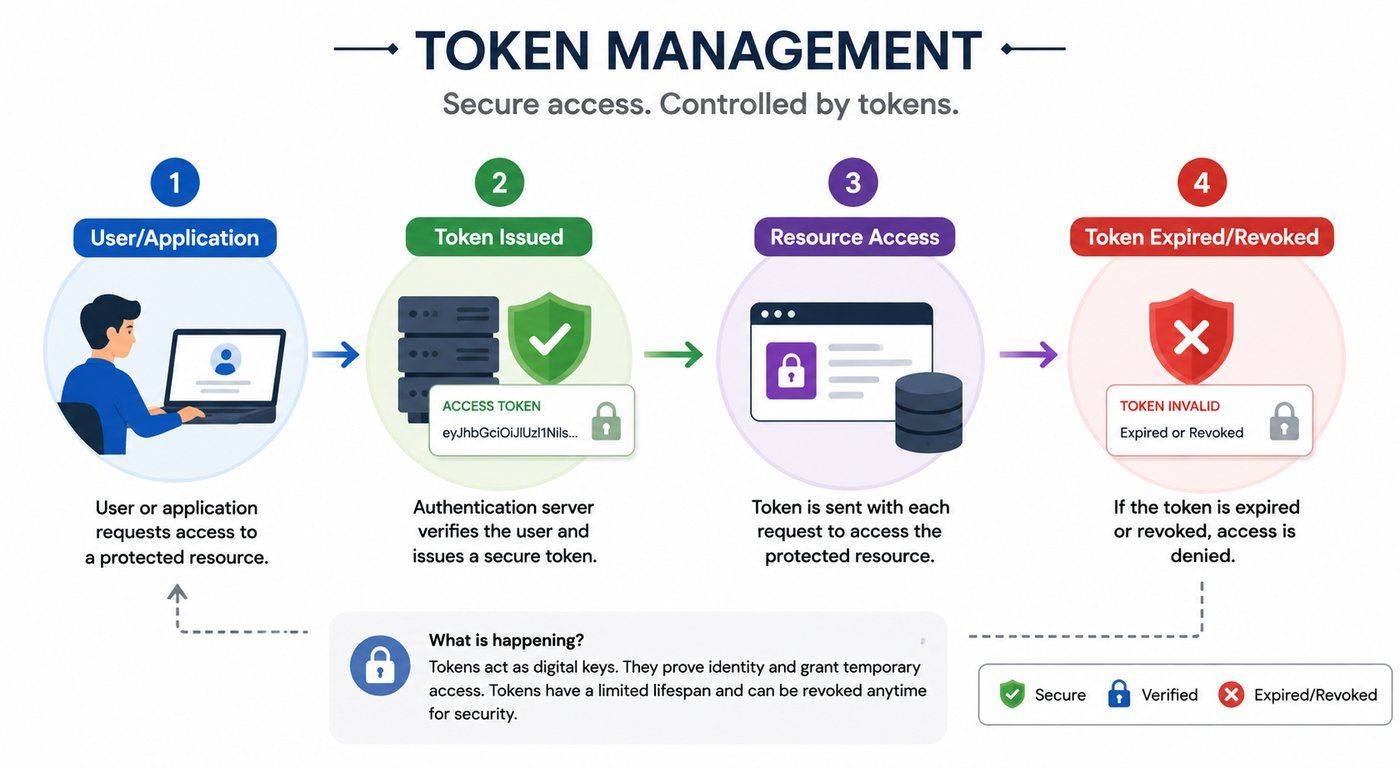
Token management is the process of creating, storing, validating, using, rotating, renewing, and revoking digital tokens throughout their lifecycle. Now you must be wondering what tokens are?
A token is a digital credential used to prove that a user, application, or device has permission to access a resource.
Think of it like a temporary access pass. A system issues the pass after successful authentication. It then checks the pass whenever access is requested. When the pass expires or is no longer trusted, the system removes its access.
You will find token-based access across many digital environments, such as:
The way tokens are handled depends on the application. A payment system may use tokens to represent sensitive card information, while an API may use an access token to authorize a request.
Free Courses
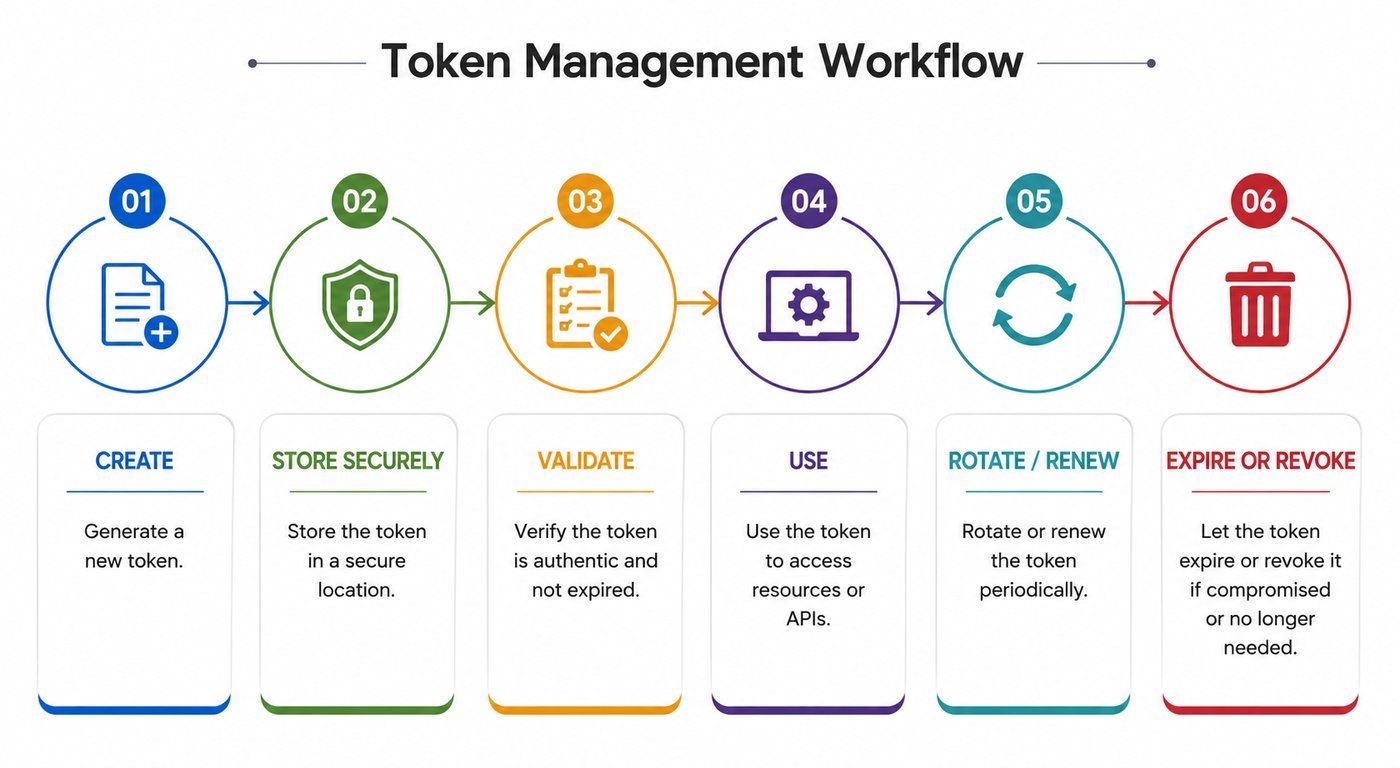
A token follows a lifecycle from the moment it is created until it expires or gets revoked. This process is commonly called token lifecycle management.
The exact workflow varies between systems, but the main stages usually remain the same. Below a complete process is explained:
The process begins after a user or application successfully completes authentication. The system generates a token and assigns it the required permissions and validity period.
For instance, a user signs in to an application with valid credentials. The authentication server verifies the details and issues an access token. The application can then use that token when requesting protected resources.
The token should provide only the access required for its intended purpose. Giving every token broad permissions creates unnecessary security risks.
A token must be protected after it has been created. If an attacker gains access to a valid token, they may be able to use it until the token expires or is revoked.
For this reason, applications use secure storage methods and access controls. Encryption can protect stored token data, while permission policies can restrict which users or services are allowed to retrieve it.
The storage method also depends on where the token is being used. Web applications, mobile applications, APIs, and enterprise systems may require different approaches.
A token cannot simply be accepted because it exists. The receiving system needs to verify that it is valid and authorized for the requested action.
During validation, the system may check:
If the checks pass, access is granted. If something fails, the request is rejected.
After validation, the token is used to access the approved resource.
Consider an API that provides customer information. An application sends a request with an access token. The API checks the token and its permissions before returning the requested data.
The token therefore acts as a bridge between authentication and access. It tells the receiving system that the request has the required authorization.
Tokens should not remain active forever. Rotation replaces an existing token with a new one, while renewal extends access through a new or refreshed token.
This is especially useful for long-running applications and sensitive systems. If an old token is compromised, limiting its lifetime reduces the period during which it can be misused.
Automated rotation is also an important feature of token lifecycle management because manually replacing large numbers of tokens can become difficult and error-prone.
Every token should have a clear endpoint.
For example, if an employee leaves an organization, the company may revoke tokens associated with their access immediately. The same approach can be used when a device is lost or suspicious activity is detected.
Also read: Tokenization in Natural Language Processing
Management Courses to upskill
Explore Management Courses for Career Progression
IIIT-B & IIM, Udaipur
Chief Technology Officer & AI Leadership ProgrammeThe following features help businesses manage access securely across applications, APIs, and digital services.
Also read: Data Preprocessing in Machine Learning: 11 Essential Steps
Imagine an application with thousands of active users. Every user, API, and connected service may have credentials that need to be controlled. Managing those credentials manually quickly becomes difficult.
This is where token management becomes useful. It gives businesses a structured way to control access while reducing the amount of manual work involved.
A token can provide access without exposing the original credentials every time. Businesses can also limit its permissions and lifespan.
If a token is compromised, expiration and revocation controls can help reduce the window of unauthorized access.
Not every authenticated user needs access to everything. Token permissions can restrict what a user or application can do.
For instance, an application may have permission to read customer information but cannot delete customer records. This limits the damage caused by stolen or misused credentials.
Users do not need to repeatedly share their original login credentials with every connected service. Once authentication is completed, a valid token can handle subsequent access requests.
This makes authentication smoother across websites, mobile apps, APIs, and connected services.
Security teams need more than authentication. They also need to know who accessed what and when.
Token management can support these requirements through:
These controls can be especially important for industries handling financial, healthcare, or personal data.
Consider an organization managing thousands of API credentials. Rotating each one manually would take considerable time.
Automated token rotation, renewal, expiration, and revocation can handle much of this work. Security teams can then spend more time on monitoring and risk management.
Security does not have to mean adding more steps for users. Token-based authentication can keep users signed in and allow connected services to communicate without repeatedly requesting credentials.
The result is a smoother experience across applications and devices.
APIs often connect several applications behind the scenes. A token gives these systems a controlled way to authenticate requests.
Cloud applications can use the same approach to restrict access between services. This becomes increasingly important as businesses add more cloud platforms and connected applications.
Ready to bring AI into your business skill set? Explore the IIMK AI for Business Professionals Certificate Program to build practical AI skills and stay ahead in your career.
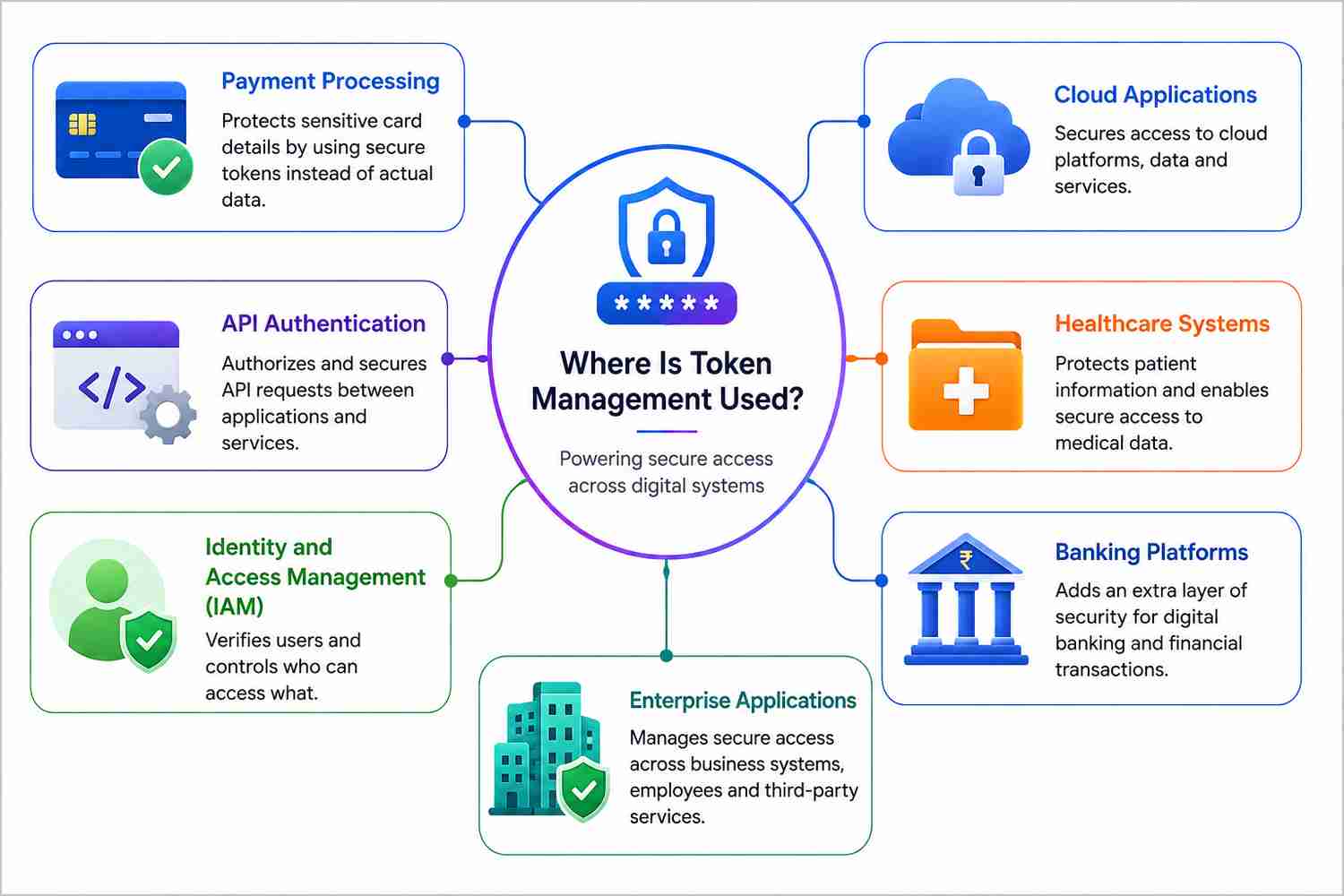
Token management appears in places most users never see. When a payment goes through, an API returns data, or an employee opens a company application, tokens may be working in the background.
The use case determines how the token is created, what access it provides, and how long it remains valid.
Think about a customer saving a card for future purchases. The payment system needs a way to process that card without repeatedly exposing the actual card details.
Tokenization can replace sensitive payment information with a token. The business can then use that token for future transactions while the original payment data remains protected.
This is common in:
APIs need to know whether an incoming request is authorized. An access token provides that proof.
Suppose an ecommerce application requests order information from its backend API. The application sends an access token with the request. The API checks the token and its permissions before returning the data.
Tokens can also expire, which limits how long a compromised credential remains useful.
IAM systems use tokens to manage access across users, applications, and services.
An employee logging into a company application may receive a token after authentication. That token can then be used to access approved resources based on the employee's role.
This makes token management an important part of enterprise identity and access control.
Cloud environments rarely operate as one isolated system. Applications, databases, storage services, and APIs constantly communicate with each other.
Tokens help establish trust between these services. A cloud application can present a token when requesting access to another service, while permissions determine what it can actually access.
Healthcare platforms handle highly sensitive information, so access needs to be carefully controlled.
A hospital application, for example, may use tokens when requesting patient records from another healthcare system. The token can identify the requesting application and carry the permissions required for that request.
Short-lived tokens and strict access policies can further reduce unnecessary exposure.
Banking systems handle transactions, account information, payment data, and other sensitive resources. Token-based access can help control how users and applications interact with these systems.
A banking application may use tokens to authenticate API requests, authorize transactions, or maintain a user's authenticated session.
Here, expiration, monitoring, and revocation become especially important because a compromised credential can have serious consequences.
A large company may use separate systems for HR, finance, CRM, communication, analytics, and operations. These applications still need to exchange information.
Token management provides a controlled way for them to communicate.
For example, an HR application could use a token to request employee information from an internal API. The API checks the token's permissions before providing the requested data.
As the number of connected applications grows, centralized token controls become increasingly valuable.
Also read: 15+ Top Natural Language Processing Techniques
Choosing among token management tools can be confusing because these platforms solve different problems. A company managing API credentials has different requirements from a payment company protecting card data. An enterprise managing employee access needs another type of solution.
The table below gives a quick view of 10 commonly used platforms before looking at where each one fits.
| Tool | Best For | Key Strength |
| HashiCorp Vault | Secrets management | Credential storage and rotation |
| Auth0 | Application identity | OAuth and token handling |
| Okta | Enterprise IAM | Identity and access control |
| CyberSource | Payment systems | Payment tokenization |
| Keycloak | Open-source IAM | Authentication and authorization |
| AWS Secrets Manager | AWS applications | Secret storage and rotation |
| Azure Key Vault | Azure environments | Keys, secrets, and certificates |
| Google Secret Manager | Google Cloud | Centralized secret management |
| Akeyless | Multi-cloud environments | Centralized credential management |
| Doppler | Development teams | Application secrets management |
HashiCorp Vault is useful when an organization has sensitive credentials spread across multiple applications and environments. It brings these secrets into a centralized system and controls how applications access them.
Key capabilities include:
Good fit: Enterprise secrets and infrastructure credentials.
Application developers often need authentication without building an identity system from scratch. Auth0 provides authentication and authorization features for applications and APIs.
It supports OAuth-based workflows and token handling. Its Token Vault capability can also manage refresh tokens when an application needs to access third-party services on behalf of users.
Good fit: Web applications, APIs, and OAuth workflows.
For large organizations, token management often sits within a broader identity strategy. Okta provides centralized identity and access management across applications and services.
It is useful for organizations that need to manage:
Good fit: Enterprise IAM and centralized identity management.
Payment systems require a different approach to token management. CyberSource focuses on payment processing and payment data protection.
Businesses can replace sensitive card information with payment tokens and use those tokens during transactions. This reduces the need to repeatedly handle raw payment details.
Good fit: Payment processing and payment tokenization.
Keycloak gives organizations an open-source option for identity and access management. It supports authentication, authorization, single sign-on, and token-based access.
Its self-hosted model gives development teams greater control over deployment and customization.
Good fit: Open-source and self-managed IAM.
Teams already using AWS can manage application credentials through AWS Secrets Manager. It stores sensitive information such as API keys, database credentials, and OAuth tokens.
One useful feature is automatic rotation. Supported credentials can be replaced according to a defined schedule, reducing manual maintenance.
Good fit: AWS applications and automated credential management.
Azure Key Vault is designed for applications running in the Microsoft ecosystem. It stores and controls access to secrets, encryption keys, and certificates.
It also supports features such as:
Good fit: Azure applications and Microsoft-based enterprises.
A Google Cloud application may need API keys, passwords, certificates, or other sensitive values. Google Secret Manager provides a central location for storing and controlling access to them.
Its integration with Google Cloud IAM allows teams to define which users or services can access individual secrets. Versioning and audit capabilities also help track changes.
Good fit: Google Cloud applications.
Managing credentials across several cloud environments can become complicated. Akeyless takes a centralized approach to secrets and credential management.
It can bring credentials from different environments under common access policies. This makes it useful for organizations working across multiple cloud platforms.
Good fit: Multi-cloud secrets management.
Developers work with API keys, database credentials, environment variables, and service tokens across development and production environments. Doppler provides a centralized way to manage these application secrets.
Its developer-focused approach makes it easier to keep sensitive configuration separate from application code and distribute it across environments.
Good fit: Development teams and application secrets.
There is no single best option among these token management tools. The right choice depends on what you are trying to protect.
When comparing token management software, check security controls, integrations, automation, scalability, compliance support, and cost. This gives you a more practical basis for selecting a tool than simply following a top 10 token management tools list.
Also read: NLP Models Guide: Types, Working and Real-World Applications
Choosing a token management system comes down to how your business uses tokens and what you need to protect. A solution that works for a small application may not be enough for a large enterprise.
Here are the main things to check:
Also read: Types of Natural Language Processing (NLP) Explained
Token management helps businesses control digital credentials throughout their lifecycle, from creation and storage to validation, rotation, and revocation. It strengthens security, simplifies access, and protects APIs, applications, and sensitive data.
Choosing the right solution depends on your security needs, integrations, scalability, compliance requirements, and budget.
Ready to build stronger management skills? Book a free consultation with upGrad to explore the right learning path for your career.
No. A password is usually a long-term credential used to authenticate a user, while a token is generally issued after authentication and can provide temporary access to specific resources. Tokens can also have limited permissions and expiration periods, making them useful for applications and APIs.
A stolen token can potentially be used to access resources available to it. The impact depends on its permissions and validity period. Short-lived tokens, limited permissions, monitoring, and quick revocation can reduce the potential damage caused by a compromised token.
Yes. Many token-related activities can be automated, including token creation, renewal, rotation, expiration, and revocation. Automation becomes particularly useful for organizations managing large numbers of credentials across applications, APIs, cloud services, and other connected systems.
There is no universal duration. The appropriate lifetime depends on the sensitivity of the resource, application type, and security requirements. Sensitive systems generally benefit from shorter-lived tokens, while longer sessions may use refresh mechanisms to maintain access without repeatedly authenticating the user.
An access token is used to access protected resources and is typically short-lived. A refresh token is used to obtain a new access token after the original expires. Keeping these roles separate can help applications maintain user sessions without requiring repeated login credentials.
Token-based authentication allows a system to verify access using a token rather than repeatedly sending the user's original credentials. After authentication, the application receives a token and presents it when accessing protected resources. The receiving system then checks whether the token is valid.
Yes. Mobile applications commonly use tokens to maintain authenticated sessions and communicate with APIs. However, tokens need to be stored carefully because mobile devices can be lost, compromised, or accessed by unauthorized users. Appropriate expiration, storage, and revocation controls are therefore important.
Once an access token reaches its expiration time, the receiving system should reject it. If the application supports refresh tokens, it can request a new access token without requiring the user to log in again. Otherwise, the user may need to authenticate again.
Payment tokenization replaces sensitive payment information with a non-sensitive token. The token can represent the original card details during approved transactions without exposing those details repeatedly. This approach is commonly used in online payments, subscriptions, saved cards, and digital wallets.
It depends on the number of applications, APIs, users, and credentials involved. A small application may not need a dedicated platform initially. However, as integrations and digital services grow, centralized token controls can make credential management easier and reduce security risks.
The first step is to revoke the compromised token so it can no longer be used. The business should then investigate how it was exposed, review related activity, rotate affected credentials, and check whether other tokens or systems may also have been compromised.
987 articles published
We are an online education platform providing industry-relevant programs for professionals, designed and delivered in collaboration with world-class faculty and businesses. Merging the latest technolo...
Get Free Consultation
By submitting, I accept the T&C and
Privacy Policy
Top Resources
Certification
3 Months
Certification
6 Months
O.P. Jindal Global University
Masters in International Accounting and Finance (Accredited by ACCA, UK)Master's Degree
12 Months