Minimum Viable Product: Meaning, Process, Examples and Benefits
By Sriram
Updated on Aug 13, 2026 | 15 min read | 4.34K+ views
Share:

All courses
Certifications
More
By Sriram
Updated on Aug 13, 2026 | 15 min read | 4.34K+ views
Share:
Table of Contents
Key Highlights
Advance your business career with upGrad’s MBA Certification Courses Online and build practical skills for today’s competitive workplace.
Popular MBA Programs
A minimum viable product is an early version of a product with enough core functionality to solve a specific customer problem and gather real user feedback. It isn't a finished product. It focuses on testing whether the main idea provides value.
The minimum viable product meaning becomes clearer by breaking down the term. “Minimum” means focused scope, “viable” means useful to users, and “product” means a working solution that people can actually use.
To define minimum viable product simply, it's the smallest usable version of a product that delivers its core value and helps a team test an important assumption.
For example, a meal-planning app might begin with meal selection, weekly planning, and a shopping list instead of building every planned feature. This lets the team test whether users find the core service useful.
Free Courses
A good MVP is tightly focused. It is focused on a single critical customer problem and has enough functionality to let users experience the proposed solution.
The characteristics of a minimum viable product also help teams avoid a common error. Minimal doesn't mean minimally functional.
An effective MVP usually has these characteristics
Characteristic |
What it means |
| Clear problem | It addresses a specific customer need |
| Focused scope | It avoids unnecessary functionality |
| Core value | Users receive a useful outcome |
| Usability | Customers can complete the main task |
| Testability | The team can measure meaningful behaviour |
| Real users | Feedback comes from the intended audience |
| Clear hypothesis | The team knows what it wants to learn |
The product doesn’t have to look perfect. It does need to be good enough for users to rate it's core value.
That’s an important distinction, because bad usability can generate misleading feedback. Users might reject a good idea simply because the first version was too difficult to use.
A practical MVP is a trade-off between two things. It remains small enough to build and test quickly, but useful enough to provide reliable evidence.
Read: Product lifecycle management
Teams often spend too much time building before they start learning. They create extensive feature lists, develop complex workflows, and make assumptions about customers without testing them.
A minimum viable product changes that sequence. Instead of asking users what they might want in the future, teams can put a focused solution in their hands and observe what happens.
The approach can help teams
The MVP approach also helps teams recognise when an idea needs to change. If users don't behave as expected, the team can investigate why before investing heavily in a larger product.
Build future-ready product skills with upGrad’s Executive Post Graduate Certificate in AI-Native Software Engineering.
MBA Courses to upskill
Explore MBA Courses for Career Progression
O.P.Jindal Global University
MBA (with Career Acceleration Program by upGrad)Become interview ready with Career Services
PSB MBA + IIML Certification
MBA from Paris School of Business with Certification from IIM LucknowA minimum viable product follows a cycle of build, launch, observe and learn. The team starts with a customer problem, identifies an assumption to test, develops a lean solution, and tests it with users.
Users engage with the product. The team observes their behaviour, takes feedback, measures relevant behaviour, and decides what needs to change.
The cycle usually looks like this
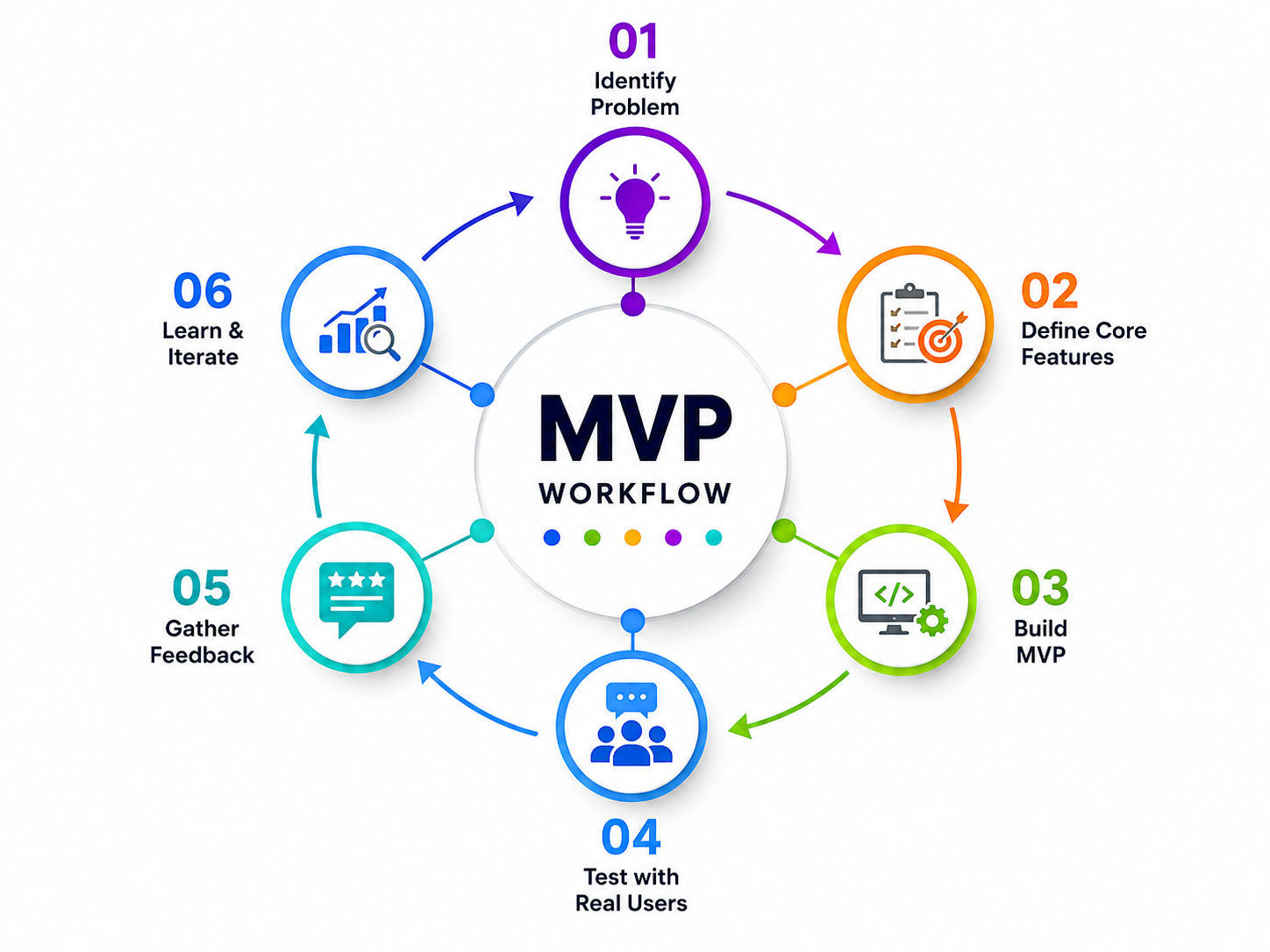
Read: Top 10 Online Product Management Courses to Level Up Your Skills in 2026
The minimum viable product development process usually includes these stages
A better approach starts with a clear customer need. Once the problem is understood, the team can decide what the product must do to address it.
The development process isn't finished when the product launches. Feedback after launch helps determine what should happen next.
Also Read: Complete Guide to Product Management Career: Skills and Opportunities for Growth
Not every MVP has the same universal feature list. Different functionality will be needed for a mobile application, a physical device, a SaaS product, and a service business.
The features of a minimum viable product should support one core user outcome. If a feature doesn’t get users to that outcome or help the team test its primary assumption, it probably doesn’t belong in the first release.
Consider a simple ride-booking service. The initial product might require
It doesn't necessarily need loyalty points, advanced vehicle preferences, multiple subscription plans, or sophisticated recommendations.
Start by describing what the customer needs to accomplish. Don't begin with a feature list.
For example, "help people find affordable home-cooked meals nearby" describes a customer problem. "Build a food marketplace with ten filters" describes a solution before the problem has been validated.
Once the problem is clear, map the basic user journey.
Ask
This approach keeps the product focused.
Prioritise features based on customer value and learning value. A feature that looks impressive but doesn't help test the core idea shouldn't automatically receive development time.
Feature type |
Priority |
| Core problem-solving feature | High |
| Essential user workflow | High |
| Feature needed for validation | High |
| Convenience feature | Lower |
| Cosmetic enhancement | Lower |
| Future use case | Later |
You don't need every feature users might eventually request.You need the features that let them experience the core value and give you useful evidence.
Read: Complete Guide to Product Management Career: Skills and Opportunities for Growth
Examples make the idea easier to understand because they show how successful products started with a narrower scope than their current versions.
The example shows that MVP testing doesn't always begin with a fully developed system. The right approach depends on what assumption needs to be tested.
Example |
Early focus |
Main lesson |
| Amazon | Online book buying | Start with a focused market |
| Uber | Basic ride booking | Test the core service |
| Airbnb | Short-term stays | Validate marketplace demand |
| Dropbox | File synchronisation | Test interest before full development |
These examples show why the mvp minimum viable product concept isn't tied to one industry or technology.
Read: Future Scope of Management: Scope, Salary, Career Opportunities
A prototype helps a team explore how a product could work. It might be a wireframe, clickable interface, physical model, or interactive mock-up.
An MVP goes further. It gives real users enough working functionality to experience the proposed value and provide evidence.
Factor |
MVP |
Prototype |
| Main purpose | Validate product value | Explore the solution |
| Functionality | Core working features | May be incomplete |
| Real users | Usually involved | Not always |
| Market feedback | Central | Limited |
| Main question | Will users find value? | How could the solution work? |
If the main uncertainty is usability, a prototype might be the right first step. If the team needs evidence about actual customer behaviour, an MVP is more appropriate.
A proof of concept answers a technical question. An MVP focuses on whether customers find value in a usable product.
For example, an AI startup might build a proof of concept to determine whether its system can accurately classify documents. That doesn't prove customers want the service.
The MVP would put a usable version in front of the intended audience and test how people respond.
Factor |
MVP |
Proof of Concept |
| Main question | Will users find value? | Can the technology work? |
| Focus | Product and customers | Technical feasibility |
| Real customers | Usually involved | Usually not required |
| Market validation | Possible | Not the main goal |
| Output | Usable product version | Technical evidence |
The two approaches can work together. A proof of concept can reduce technical uncertainty before a team builds its MVP.
That sequence can save time when the technology itself is the biggest unknown.
Read: 8 Crucial Business Management Skills Every Manager Should Have
Validation starts with a hypothesis. You need to know what you're trying to learn before deciding what to build or measure.
Don't ask only whether people like your idea. People can be enthusiastic during an interview and still never use the product.
A team might validate whether
Look for evidence that helps you make a decision. If users consistently experience value, continue developing the product. If they struggle with the core workflow, investigate the problem and improve the experience.
If the evidence remains weak, the team might need to change the audience, revise the solution, or stop development.
A good MVP doesn't protect an idea from criticism. It exposes the idea to evidence.
Read: Importance of Management in Every Organisation – [A Complete Guide]
MVP success depends on the hypothesis being tested. There isn't one metric that works for every product.
A productivity app might care about repeat usage. A marketplace might track completed transactions. A subscription product might focus on activation and retention.
Useful measures include:
Metric |
What it can reveal |
| Activation | Whether users reach the core value |
| Feature usage | Which functions matter |
| Task completion | Whether the main workflow works |
| Retention | Whether users continue finding value |
| Conversion | Whether users take the desired action |
| Feedback | Why users behave as they do |
Avoid tracking numbers simply because they're easy to collect.A thousand sign-ups sound impressive. But if only a handful of users complete the core action, the product may have a deeper problem.
The right metric tells you something useful about the product hypothesis.
Read: Online Product Management Courses to Kickstart your Career
An MVP can fail because of execution, not just because the underlying idea is weak.
One common problem is feature creep. Teams keep adding functions until the supposedly small first release becomes a complex product that takes months to build.
Another problem is testing with the wrong audience. Feedback from people who don't experience the target problem won't tell you much.
Watch for these mistakes
Create a feature cutoff before development starts. For every proposed feature, ask whether it's essential to the core user journey or the validation hypothesis. If it isn't, move it to a later roadmap.
That doesn't mean the feature is useless.It means you don't have enough evidence to priorities it yet.
After launching an MVP, teams analyse user feedback and product data to decide the next step.
The goal is to turn MVP results into clear product decisions. An MVP is a starting point for learning, not the final product.
A minimum viable product gives teams a practical way to learn before committing to a complete product. It focuses on a real customer problem, delivers the core value, and creates an opportunity to observe actual behaviour.
The strongest MVP isn't the one with the fewest features. It's the one that tests an important assumption without wasting effort on functionality that hasn't earned its place yet.
Define the problem clearly. Build the smallest useful solution. Test it with the right users. Measure meaningful behaviour. Then let the evidence guide what you build next.
Ready to start your journey? Book a free consultation with upGrad today to find the best path for your career.
A classic MVP example is Zappos, which tested online shoe demand without maintaining inventory. The founder photographed shoes in local stores, posted them online, and bought the shoes only after receiving orders. This tested customer demand before investing in a full e-commerce operation
A PoC answers whether a technical idea is feasible, while an MVP tests whether customers find a working solution valuable. A PoC can therefore come before an MVP when technology is the biggest uncertainty, helping teams avoid building around an unproven technical assumption.
MVP refers to the minimum viable product, while KPI means key performance indicator. An MVP is the product being tested, whereas KPIs are measurable indicators used to evaluate its performance. The right KPIs depend on what the team wants to learn from the product experiment.
Start by identifying one customer problem and the main assumption you need to test. Then decide what the smallest usable solution should contain, build it, release it to suitable users, and use their behaviour and feedback to guide the next version.
An MVP tests whether the core product idea provides value, while a beta version is usually a more developed product released to a limited audience for broader testing. A beta may focus more on finding bugs, improving usability, and preparing for wider release.
Common MVP types include landing-page MVPs, concierge MVPs, Wizard of Oz MVPs, single-feature MVPs, and explainer-video MVPs. The right format depends on the assumption being tested. A startup doesn't always need fully developed software to learn whether customers want its proposed solution.
Yes, an MVP doesn't always require traditional software development. No-code tools, landing pages, spreadsheets, manual services, clickable interfaces, or simple automation can test certain assumptions. The method should match the learning goal rather than automatically starting with a full technical build.
There isn't a fixed number that works for every MVP. The required audience depends on the product, target market, research goal, and type of evidence needed. Early testing should focus on relevant users who actually experience the problem being investigated
MVP costs vary widely based on product complexity, technology, team size, development method, and required integrations. A manually delivered service or landing page can cost far less than a product requiring custom software, complex infrastructure, security controls, or specialised technology.
No. Established companies can use MVPs when testing new products, services, features, or customer experiences. The approach can help larger organisations test an uncertain idea on a limited scale before committing significant development resources, even when they already have an established customer base.
An MVP has enough functionality when users can complete the core task and the team can collect meaningful evidence about its main assumption. Adding another feature isn't automatically useful. The better question is whether removing it would prevent users from experiencing the product's central value.
724 articles published
Sriram K is a Senior SEO Executive with a B.Tech in Information Technology from Dr. M.G.R. Educational and Research Institute, Chennai. With over a decade of experience in digital marketing, he specia...
Speak with MBA expert
By submitting, I accept the T&C and
Privacy Policy
From MBA to Dream Job - Explore Our Alumni Success Stories
Top Resources
Master's Degree
13 Months
Master's Degree
12 Months
O.P.Jindal Global University
MBA (with Career Acceleration Program by upGrad)Become interview ready with Career Services
Master's Degree
12 Months