Sustainability Reporting: Meaning, Importance, Process and Examples
Updated on Aug 16, 2026 | 12 min read | 7.04K+ views
Share:

All courses
Certifications
More
Updated on Aug 16, 2026 | 12 min read | 7.04K+ views
Share:
Table of Contents
Key Highlights
Ready to take your business expertise further? Explore upGrad’s DBA Online programme to deepen your understanding of business strategy, leadership, and data-driven decision-making while building skills for senior management roles.
Popular upGrad Programs
Sustainability reporting is the process of sharing information about an organisation’s environmental, social, and governance performance.
It covers areas such as emissions, energy use, employee safety, diversity, waste, governance, and progress toward sustainability goals.
In simple terms, it helps stakeholders understand what a company is doing, measure its progress, and assess its wider impact. The scope of a sustainability report varies based on the organisation, industry, stakeholders, and applicable requirements.
Reporting on sustainability helps stakeholders see how a firm is performing on environmental, social and governance issues.
It also helps businesses identify risks, measure progress, improve operations, set measurable goals and make informed decisions.
Measuring areas like energy use, waste, emissions and employe safety on a regular basis can help companies identify areas of inefficiency and improve their sustainability performance over time.
Free Courses
A sustainability reporting framework provides companies with a clear structure for determining what sustainability information to collect and disclose.
It’s like a map. It provides organisations with the means to identify relevant subjects, select appropriate metrics, organise data, and communicate their results effectively.
Different frameworks have different purposes. Some look at a company’s environmental and social impacts, while others look more at sustainability-related risks and opportunities.
The right framework depends on the goals of the company, industry, stakeholders, location and reporting requirements. The framework should facilitate reporting, not create unnecessary data work.
Sustainability reporting requirements vary by a company’s location, industry, size, listing status, and applicable regulations or standards.
Some disclosures are mandatory, while others are voluntary.
Mandatory reporting |
Voluntary reporting |
| Required by applicable laws or regulations | Chosen by the organisation |
| Specific disclosures may be required | Scope can be more flexible |
| Focuses on compliance | Often driven by stakeholder expectations |
Companies also need to know which parts of their business fall within the reporting boundary, including subsidiaries, facilities, or parts of the value chain.
Requirements can change, so businesses should review current rules before preparing each sustainability report. In India, applicable listed entities may also have BRSR-related reporting obligations.
Also Read: Top 10 Career Opportunities in India after PhD in 2026
Recommended Courses to upskill
Explore Our Popular Courses for Career Progression
IIIT Bangalore
Executive Diploma in Machine Learning and AI360° Career Support
O.P.Jindal Global University
MBA from O.P.Jindal Global UniversityLive Case Studies and Projects
A sustainability report usually covers three main areas: environmental, social, and governance performance. The exact information varies by industry, company goals, and reporting requirements.
Area |
Common information |
Example metric |
| Environmental | Energy, emissions, water, waste | GHG emissions |
| Social | Employees, safety, diversity | Injury rate |
| Governance | Ethics, oversight, compliance | Compliance incidents |
A report can also include sustainability targets and progress against hem. For example, a manufacturer might share its emissions, energy use, workplace safety data, and progress toward reducing waste.
Good reporting also explains the reporting period, measurement approach, and any major changes in performance. That context helps readers understand what the numbers actually mean.
Also Read: Best PhD Courses in India in 2026: Which One Should You Choose?
Good sustainability reporting isn't about sharing as much data as possible. The information should be accurate, clear, balanced, and useful to the people reading it.
Key principles include
These principles should guide the entire process, from collecting data to publishing the final report. A credible report doesn't need perfect results. It needs honest, understandable, and well-supported information.
Build relevant technical expertise with upGrad’s Executive Post Graduate Certificate in AI-Native Software Engineering and learn how AI can support modern business and technology functions.
ESG metrics turn sustainability goals into measurable results. They help companies track whether their environmental, social, and governance efforts are actually making progress.
For example, saying a company wants to reduce emissions isn't enough. It needs a baseline, a target, a reporting period, and actual performance data.
ESG area |
Example metrics |
| Environmental | GHG emissions, energy use, water consumption |
| Social | Employee safety, turnover, workforce diversity |
| Governance | Compliance incidents, ethics, board oversight |
The right metrics depend on the company and its material topics. A hospital won't measure sustainability in exactly the same way as a manufacturer.
Metrics also need context. A figure becomes more useful when the report explains what it measures, the period covered, and how it compares with previous performance.
Also read: What is the DBA Degree Format - Coursework, Research, Dissertation
First, the organization identifies its reporting requirements, stakeholders, material topics, and reporting objectives. It then selects an appropriate reporting approach and determines which metrics need to be tracked.
A practical workflow looks like this:
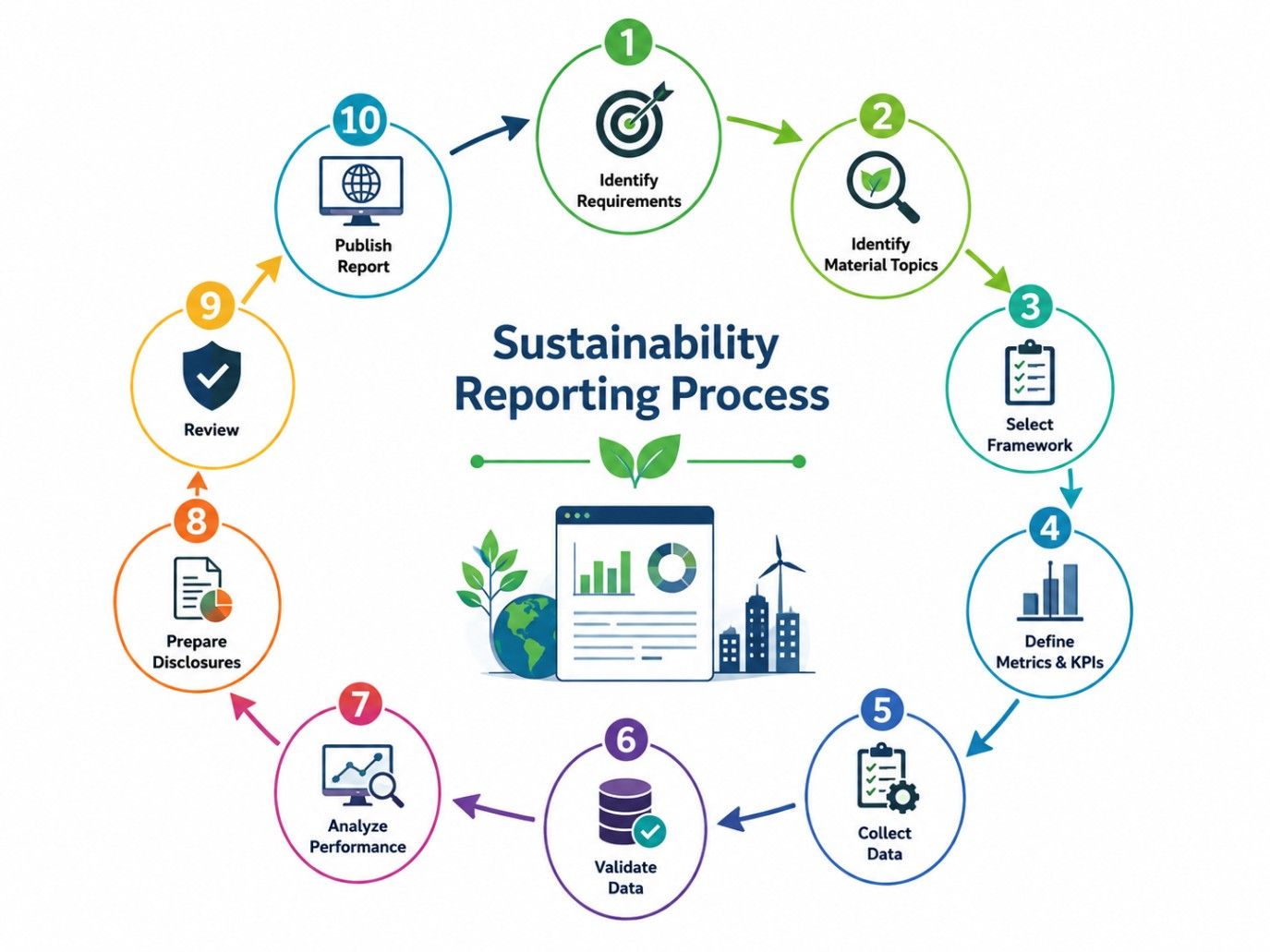
Sustainability reporting usually refers to broader disclosure about an organization's environmental, social, and governance performance, impacts, goals, and progress.
ESG reporting focuses on environmental, social, and governance factors and is frequently used when discussing how these factors relate to business performance, risks, opportunities, and stakeholder or investor decision-making.
The distinction isn't always consistent across organizations.
Sustainability reporting |
ESG reporting |
| Can cover broad sustainability impacts and performance | Focuses on environmental, social, and governance factors |
| Can address a wide stakeholder audience | Often used in investor and business contexts |
| Can include goals, impacts, policies, and performance | Often emphasizes measurable ESG factors |
| Scope depends on the reporting approach | Scope depends on the framework and reporting purpose |
So, which term should a company use? That depends on the purpose and reporting approach. The important thing is to define the scope clearly rather than assuming the labels mean exactly the same thing.
A company can also communicate both sustainability and ESG information within its wider reporting activities.
Read: List of Doctorate Degrees You Can Pursue at upGrad
A sustainability report example shows how a company can present its sustainability goals, metrics, targets, and progress in a clear format.
Consider a food manufacturing company tracking energy use, emissions, and workplace safety. Its report could look like this:
Topic |
Baseline |
Target |
Current result |
| Energy use | 1,000 units |
Reduce by 15% |
940 units |
| Emissions | 10,000 tonnes |
Reduce by 20% |
8,900 tonnes |
| Workplace safety | 18 incidents |
Reduce incidents |
11 incidents |
The report can also cover social areas such as employee training, workforce diversity, and workplace safety. Governance disclosures may include board oversight, ethics policies, and compliance practices.
A useful sustainability report example connects four things: topic, measurement, target, and result. It should also mention the reporting period and measurement method so readers can understand the figures properly.
Read: Doctorate for Working Professionals: Eligibility, Career Benefits, and Growth Opportunities
A good sustainability report presents clear, reliable, and measurable information. It should explain what was measured, why it matters, what changed, and whether targets were achieved.
Key elements include:
Avoid vague claims. For example, reporting an 8% reduction in energy use is more useful than simply saying the company is becoming greener.
Sustainability reporting helps organizations communicate their environmental, social, and governance performance clearly and honestly. A sustainability report can cover key impacts, targets, ESG metrics, and progress across different areas of the business.
With the right framework, reliable data, clear metrics, and a structured process, organizations can create reports that are useful to stakeholders and support better decisions.
For companies starting their reporting journey, the best approach is simple. Begin with material topics, use reliable data, set measurable goals, and improve the process with each reporting cycle.
Ready to start your journey? Book a free consultation with upGrad today to find the best path for your career.
There isn't one universal set of seven principles across all reporting standards. Different frameworks define their own principles. For example, GRI uses eight principles, while TCFD identifies seven principles for effective climate-related disclosures. The exact principles therefore depend on the framework being followed.
The five Cs aren't a universal sustainability reporting standard. Different sources use different versions, including Clean, Community, Culture, Care, and Corporate Governance. Other sustainability models use different terms, so companies shouldn't treat the five Cs as a formal reporting requirement.
ESG reporting focuses specifically on environmental, social, and governance factors, while sustainability reporting can cover a broader view of an organisation's impacts, performance, risks, goals, and progress. The terms overlap considerably, but their scope and purpose can vary depending on the reporting approach used.
The purpose is to give stakeholders useful information about an organisation's sustainability-related impacts, risks, opportunities, and performance. It can also help management track progress and connect sustainability information with business planning, strategy, and decision-making rather than treating reporting as a standalone exercise.
There isn't one universally accepted set of five pillars. One commonly used model identifies human, cultural, environmental, social, and economic sustainability. Other organisations use different models depending on their goals, so the meaning of the five pillars should always be checked against the framework being referenced.
In sustainability disclosure, the four pillars commonly refer to governance, strategy, risk management, and metrics and targets. This structure originated with TCFD and was carried into the IFRS sustainability disclosure approach. These pillars describe key disclosure areas rather than four universal pillars of sustainability itself.
Double materiality considers both how an organisation affects people and the environment and how sustainability-related matters can affect its financial position, performance, or prospects. It can therefore influence which topics receive attention and how their significance is assessed during the reporting process.
Financial reporting primarily communicates financial performance and position, while sustainability reporting covers relevant environmental, social, and governance information. The two can complement each other because sustainability-related risks and opportunities can affect business performance, strategy, and future prospects.
Companies typically consider material topics, stakeholder information needs, industry characteristics, applicable requirements, and the reporting framework they follow. The aim isn't to report every possible sustainability issue, but to identify information that is relevant and useful for the intended audience.
Assurance provides an independent assessment of selected sustainability information against defined criteria. It can increase confidence in reported data by checking aspects such as evidence, calculations, processes, and controls. The scope and level of assurance can differ depending on the engagement and applicable requirements.
Sustainability reporting can reveal patterns that aren't obvious from isolated operational data. Tracking emissions, energy use, workforce issues, or resource consumption can help management identify risks, set priorities, allocate resources, and connect sustainability performance with wider business planning.
Get Free Consultation
By submitting, I accept the T&C and
Privacy Policy
Top Resources
Certification
3 Months
Certification
6 Months
O.P. Jindal Global University
Masters in International Accounting and Finance (Accredited by ACCA, UK)Master's Degree
12 Months