Organizational Citizenship Behaviour: Meaning, Dimensions, Benefits, Examples and Measurement
By upGrad
Updated on Aug 12, 2026 | 8 min read | 3.52K+ views
Share:

All courses
Certifications
More
By upGrad
Updated on Aug 12, 2026 | 8 min read | 3.52K+ views
Share:
Table of Contents
Key Highlights
Looking to build advanced business expertise? Explore an online DBA online program designed for working professionals and take the next step in your leadership journey.
Organizational citizenship behaviour is the voluntary effort employees make beyond what their formal job requires. It includes actions that support colleagues, improve teamwork, or contribute to the organization.
For example, helping a coworker complete an urgent task even though it is not their responsibility. Another employee may voluntarily share useful information with a new team member. These actions are not necessarily mentioned in their job description, but they can make everyday work easier.
The concept of organizational citizenship behaviour in simple terms can be understood as:
Formal responsibilities + voluntary contributions = stronger workplace functioning
Voluntary contribution should not become an unofficial requirement. If employees are pressured to constantly take on extra work, it can lead to stress and burnout.
Also read: The 5 Best Ways for Employee Engagement
The dimensions describe the different forms that these voluntary actions can take. A commonly used framework identifies five major dimensions.
Altruism means voluntarily helping another employee with a work-related problem.
Example, helping a colleague complete a difficult task, explain a process to a new team member, or provide assistance when another employee has an unusually heavy workload.
Common examples include:
Courtesy involves considering how your actions may affect other employees and taking steps to prevent unnecessary problems. It can include,
Conscientiousness involves going beyond the minimum level of responsibility expected from an employee. Like preparing for meetings, follow workplace procedures consistently, or make an effort to maintain high standards even when no one is directly monitoring them.
Sportsmanship means maintaining a constructive attitude when facing workplace difficulties instead of making unnecessary complaints about minor problems.
Workplaces rarely operate perfectly. Employees may encounter delays, changes in procedures, or temporary difficulties.
Civic virtue refers to taking an active interest in the organization's affairs and participating responsibly in its activities.
Examples:
Also read: 4 Inspiring Ways You Can Improve Your Employee Development Methods
DBA Courses to upskill
Explore DBA Courses for Career Progression
IIIT-B & IIM, Udaipur
Chief Technology Officer & AI Leadership ProgrammeOCB can also be divided according to who benefits from the behaviour. The two commonly discussed types are OCB-I and OCB-O.
OCB-I refers to voluntary behaviour that primarily benefits another person at work.
For example, helping a colleague understand a new software system or guide a new team member through an unfamiliar process.
For example, an employee may help a colleague understand a new software system, guide a new team member, or assist a coworker with a difficult task. The immediate beneficiary is usually another employee.
OCB-O includes voluntary actions that directly support the organization's functioning, goals, or resources. Examples:
Also read: How to Develop Time Management Skills of Employees?
The organizational citizenship behavior model explains how voluntary employee actions can influence coworkers, teams, and the organization. It helps connect employee attitudes and workplace conditions with behaviours that go beyond formal job duties.
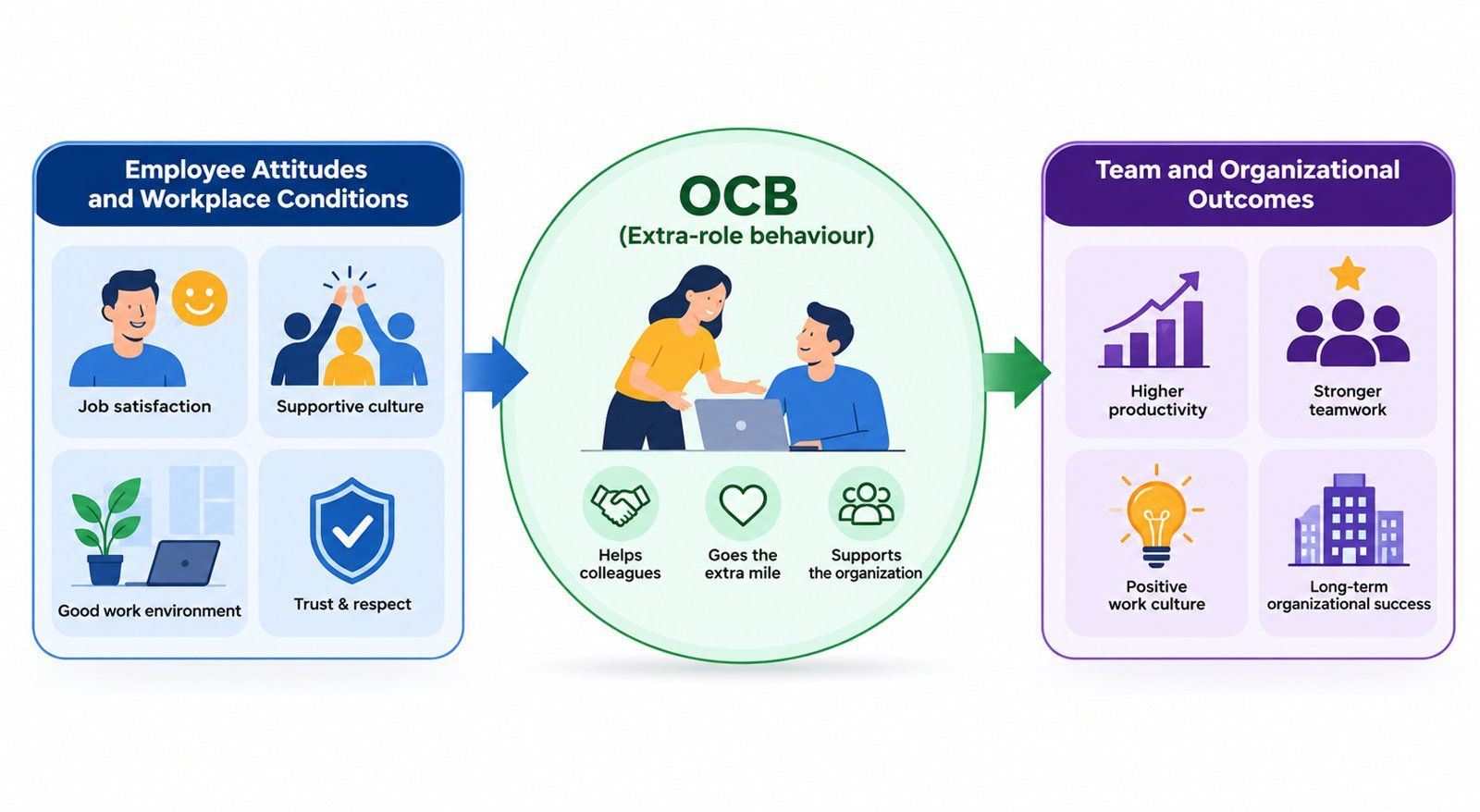
Several factors commonly appear in discussions of OCB:
Imagine a team where employees trust their manager and feel that their contributions are valued.
One employee notices that a colleague is struggling with a project. They voluntarily offer assistance. Another employee shares a useful resource with the team. Someone else participates in an optional meeting and suggests a way to improve a process.
When similar behaviours occur across a team, they can make coordination easier. Employees may spend less time dealing with avoidable problems and more time working toward shared goals.
Also read: How to Create an Effective Employee Development Plan
The benefits of organizational citizenship behaviour can be seen at the employee, team, and organizational levels. OCB does not replace good systems or effective management, but it can complement them.
When people willingly help each other, new employees may find it easier to adjust. Team members can also access knowledge and support without always going through formal channels.
Some potential benefits:
OCB can also improve team morale. Employees who regularly experience helpful behaviour from their coworkers may feel more connected to the team.
Employees who voluntarily share information, participate in organizational activities, or suggest improvements can contribute beyond their immediate responsibilities.
Potential organizational benefits:
Research on OCB has also examined its relationship with individual and organizational performance.
Also read: Difference Between Training and Development: Key Concepts Explained
A good organizational citizenship behavior example is usually voluntary, useful, and connected to helping people or the organization.
OCB can look different depending on the employee's role and workplace.
An employee notices that a teammate has a tight deadline. After completing their own priority work, they offer to help organize some information or review the work.
The employee was not required to do this. They chose to help.
Other examples helping a coworker solve a technical issue, explaining a difficult process, assisting a teammate during a busy period, offering guidance to someone who is learning a new task, etc.
Suppose an employee discovers a useful report template that can save the team time. Instead of keeping it to themselves, they share it with colleagues.
Other examples:
Starting a new job can be difficult. New employees need to understand systems, processes, workplace norms, and team expectations.
An existing employee who voluntarily helps them settle in is demonstrating OCB.
For example, they may explain how internal tools work, introduce the new employee to other team members, explain common workplace processes, share useful documents, and answer questions about everyday work.
Employees may also demonstrate OCB by voluntarily participating in activities that support their team or organization. Employees may choose to participate in an optional company activity, support an internal project, or contribute to an organizational initiative without being formally required to do so.
If an organization expects employees to repeatedly perform unpaid or unrecognized additional work, it can create role overload. That situation moves away from the positive idea of voluntary citizenship behaviour.
Ready to turn your understanding of workplace behaviour into stronger business leadership? Explore Executive Doctor of Business Administration from SSBM and develop advanced skills in leadership, strategy, and organizational decision-making.
A common question is how do you measure organizational citizenship behaviour when the behaviour is voluntary and may not appear in formal performance records?
Organizations can use several methods. The choice depends on the purpose of measurement and the workplace context.
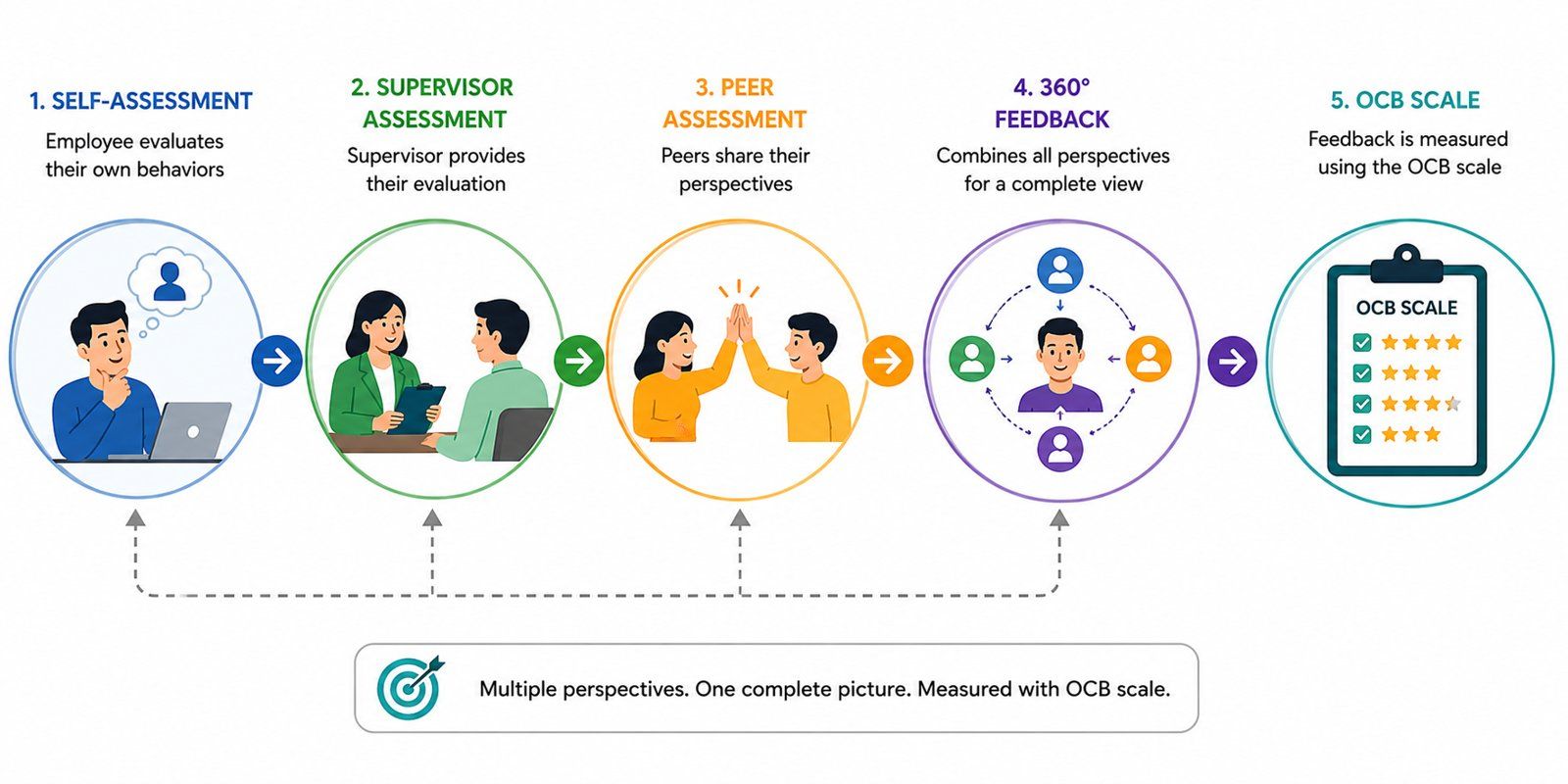
Researchers and organizations can use questionnaires that ask employees, supervisors, or peers to rate behaviours such as helping colleagues, following workplace standards, showing consideration, and participating in organizational activities.
A scale may include statements related to:
Organizations can measure OCB through several approaches.
1. Employee self-assessment
Employees report how frequently they demonstrate specific behaviours. This can provide insight into behaviours that managers may not always observe.
2. Supervisor assessment
Managers rate employees based on behaviours they have observed. This can be useful because supervisors often see how employees interact with their teams.
3. Peer assessment
Coworkers evaluate each other's behaviour. This can be particularly useful for OCB because colleagues may directly experience helping, cooperation, and knowledge sharing.
4. 360-degree feedback
Feedback is collected from multiple sources, such as managers, peers, and sometimes direct reports. This provides a broader view of an employee's workplace behaviour.
5. Behavioural observation
Organizations can look for specific behaviours rather than asking general questions. For example, they may track participation in voluntary activities or instances of peer support.
Also read: 12 Essential Time Management Tips for Employees
Organizations create conditions that make employees more willing to support one another and contribute beyond their formal responsibilities. The following are the ways to encourage this behaviour.
A supportive workplace provides clear communication, fair treatment, reasonable workloads, and opportunities for employees to share their concerns. Managers should also make it clear that asking for help is acceptable.
A supportive environment can strengthen trust between employees. Over time, that trust can make voluntary cooperation more natural.
Managers can acknowledge employees who help teammates, share knowledge, or contribute constructively to organizational activities. Recognition can be as simple as thanking someone during a team meeting or mentioning their contribution in a performance discussion.
The purpose is not to reward every small act. It is to communicate that cooperation and responsible workplace behaviour are valued.
Teams should have opportunities to work together and exchange knowledge.
Organizations can support this through:
If employees are already dealing with excessive workloads, asking them to continually take on additional responsibilities can have the opposite effect. They may become tired, frustrated, or less willing to help others.
Organizations should therefore maintain reasonable workloads and respect employees' boundaries.
Also read: Training and Development in HRM – Types, Purpose and Methods
Workplaces have changed considerably because of remote work, digital collaboration, artificial intelligence, and greater attention to employee wellbeing. These changes are also influencing how employees demonstrate citizenship behaviour.
Employees working remotely cannot always help coworkers in the same way as employees sitting in the same office.
Instead, citizenship behaviour may appear through digital interactions.
Remote OCB includes:
A team member may answer a question in a shared channel so that others can benefit from the information. Someone may create a short guide explaining how to use an internal platform. Another employee may voluntarily organize information in a shared workspace.
These actions can make digital collaboration easier.
Helping others can strengthen relationships and give employees a sense that their work is meaningful. But excessive help can also consume time and energy.
This has shifted attention toward sustainable OCB.
The question is no longer simply whether employees are willing to go beyond their formal roles. Organizations also need to consider whether employees can do so without harming their wellbeing or core job performance.
Also read: How to Increase the Productivity of your Employees?
OCB same behaviour that helps a team can become problematic when employees feel pressured to keep doing more. The following are some of the disadvantages of the model.
An employee who regularly assists coworkers because they are one of the most experienced people on the team. At first, the behaviour may feel rewarding. Over time, however, colleagues may start depending on them for almost everything.
The employee now has less time for their own responsibilities.
If this continues, they may experience:
So, organizations should not treat helpful employees as unlimited resources.
For example, an employee may initially volunteer to help with company events. If management later expects them to organize every event without adjusting their workload, the activity is no longer truly voluntary.
This can create role overload.
Compulsory OCB can also affect employee satisfaction. Employees may feel that they must constantly demonstrate extra commitment to receive recognition or avoid negative judgments.
A healthy workplace should therefore distinguish between:
Voluntary contribution: "I want to help."
and
Compulsory extra work: "I have to do this even though it is not part of my role."
That distinction is essential when organizations try to build a culture of citizenship behaviour.
Also read: Human Resource Management Process: Meaning, Importance, Steps and Tools
Organizational citizenship behaviour shows that employee contribution is not limited to what appears in a job description. Helping coworkers, sharing knowledge, supporting organizational activities, and maintaining a constructive attitude can all contribute to a better workplace.
Understanding the different dimensions and types of OCB helps organizations recognize these behaviours without confusing them with formal job performance. A healthy approach to OCB is therefore about balance. Employees should have opportunities to support their colleagues and organization while still having reasonable workloads, clear responsibilities, and enough space to protect their wellbeing.
Ready to advance your career? Book a consultation call with upGrad today.
The concept of organizational citizenship behaviour is strongly associated with researcher Dennis Organ, who helped establish OCB as an important area of organizational research. His work focused on discretionary employee behaviours that support organizational functioning, helping researchers distinguish these contributions from formally defined job responsibilities.
No. Employee engagement describes an employee's psychological connection, enthusiasm, and involvement with their work. OCB focuses on specific voluntary behaviours that support colleagues or the organization. An engaged employee may demonstrate OCB, but engagement does not automatically mean they will consistently perform citizenship behaviours.
OCB may influence how managers perceive an employee's contribution, particularly when teamwork and cooperation are valued. However, promotion decisions should not depend only on extra-role behaviour. Organizations should also consider formal performance, skills, results, experience, and role requirements to maintain a fair evaluation process.
Employees can develop behaviours associated with OCB through mentoring, teamwork, communication training, leadership development, and positive workplace experiences. However, organizations cannot simply teach employees to be helpful through training alone. Workplace culture, leadership, trust, and employee motivation also influence whether these behaviours appear naturally.
HR can support OCB by developing fair policies, encouraging employee development, improving communication, training managers, and creating recognition systems. HR can also monitor workload and employee wellbeing. This helps ensure that voluntary contributions remain positive rather than becoming an informal expectation placed on employees.
Managers can look for consistent voluntary actions that support coworkers or organizational functioning without being directly required. Feedback from multiple colleagues can provide additional context. However, managers should avoid judging employees based on visibility alone because some valuable contributions happen informally and may not be immediately noticed.
Yes. A culture based on trust, fairness, cooperation, and mutual respect can make employees more comfortable supporting one another. In contrast, a highly competitive or unfair environment may discourage voluntary cooperation. Employees often observe how colleagues and managers are treated before deciding how much they contribute.
OCB can indirectly support customer service when employees voluntarily share information, assist coworkers, solve problems, or cooperate during busy periods. Better internal coordination can make it easier for employees to respond to customer needs. However, customer service also depends on training, processes, resources, and management.
Yes. The form of OCB can vary according to workplace requirements and employee interactions. In healthcare, it may involve supporting colleagues during busy periods. In education, it may involve sharing resources. In technology, it could involve helping teammates solve technical problems or sharing expertise.
Organizations can consider relevant citizenship behaviours during performance discussions, but they should use caution. Making OCB a strict requirement can reduce its voluntary nature and create pressure. Performance evaluations should clearly distinguish formal responsibilities from optional contributions and consider objective evidence wherever possible.
OCB helps researchers understand workplace contributions that traditional performance measures may overlook. Studying these behaviours provides insight into how employee attitudes, relationships, leadership, and workplace conditions connect with organizational functioning. It also helps explain why employees sometimes contribute beyond what their formal roles require.
1141 articles published
We are an online education platform providing industry-relevant programs for professionals, designed and delivered in collaboration with world-class faculty and businesses. Merging the latest technolo...
Speak with DBA expert
By submitting, I accept the T&C and
Privacy Policy