What Is a Circular Economy? Meaning, Principles, Examples and Benefits
By upGrad
Updated on Aug 10, 2026 | 153 views
Share:

All courses
Certifications
More
By upGrad
Updated on Aug 10, 2026 | 153 views
Share:
Table of Contents
Key Highlights
Take the next step in your career with a DBA online degree designed to build advanced business knowledge, strategic thinking, and leadership skills.
The circular economy is a system of production and consumption that aims to eliminate waste, extend the life of products, and keep materials in use for as long as possible. To understand the circular economy definition, start with one simple question:
What happens to a product after we stop using it?
In a traditional system, the answer is often "it becomes waste." But in a circular system, the answer can be very different. The product may be:
The choice depends on the condition of the product and the value of its materials.
For example, imagine a laptop that no longer works properly. The entire laptop does not necessarily need to be thrown away. Its battery may be replaced. Its storage can be upgraded. If it cannot be repaired, some of its components may still be useful.
The easiest way to understand the concept is to compare it with a linear economy. A linear economy follows a simple path:
Take → Make → Use → Dispose
Resources are extracted from nature. Products are manufactured. Consumers use them. Once they are no longer wanted or useful, they are discarded.
A circular economy tries to create loops:
Design → Make → Use → Reuse → Repair → Refurbish → Remanufacture → Recycle
The objective is to keep products and materials moving through the economy instead of sending them quickly to landfill or disposal.
Consider a simple example.
You buy a pair of jeans. After wearing them for several years, the fabric develops a small tear. In a linear system, you might throw them away and buy another pair.
In a circular system, you could repair the jeans. If you no longer want them, someone else could buy them. When the jeans can no longer be worn, the material may be reused or recycled.
The product has therefore remained useful through several stages.
A Simple Circular Economy Diagram
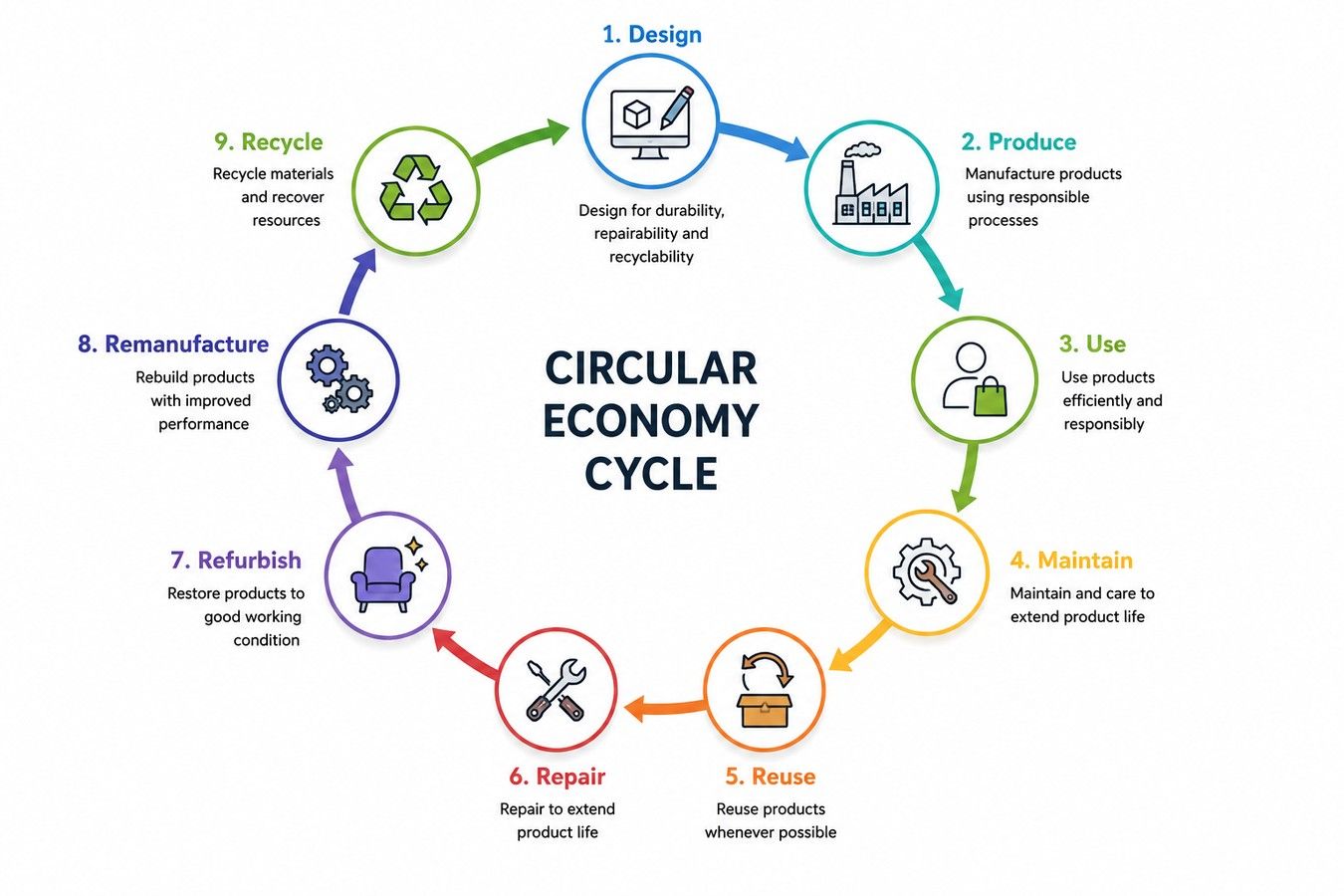
The circular economy principles explain how businesses, governments, and consumers can move away from a waste-heavy economic system. It has three core principles and these are as follows:
The first principle is simple, do not create unnecessary waste in the first place.
Traditional waste management often focuses on what happens after waste has been produced. Circular thinking starts earlier. It asks, can we design the product differently so less waste is created?
Imagine two products.
The second product starts with a circular advantage.
The same idea applies to manufacturing. A factory can redesign its processes to reduce material waste. It can use resources more efficiently. It can also find ways to prevent harmful pollutants from entering the environment.
This is why product design is so important.
If a product is difficult to repair or disassemble, it may become waste sooner. If it is designed with replaceable parts, its useful life can be much longer.
So, one of the key circular economy concepts is prevention. Instead of asking only how to manage waste, we should ask why the waste was created and whether it could have been avoided.
The second principle focuses on extending the useful life of products and materials.
Think about a smartphone. You may stop using it because you want a newer model. But that does not mean the phone has no value. Someone else may buy it. A repair shop may replace its battery. A company may refurbish it and sell it again. The phone can therefore continue serving a purpose.
The same applies to furniture, clothes, appliances, vehicles, machinery, and many other products.
Businesses can support this principle by offering:
Materials can also stay in circulation. The idea is to avoid treating useful materials as waste too early.
The third principle focuses on natural systems.
A circular economy should not only reduce damage. It should also support the regeneration of nature where possible. Agriculture gives us useful examples. Food production depends on healthy soil. If farming practices continuously degrade soil, future productivity can suffer.
Circular approaches can return organic material to the soil through composting. Farmers can also use practices that improve soil health and reduce the need for unnecessary inputs.
Food waste provides another example.
Instead of sending all organic waste to landfill, it can be processed into compost or other useful outputs. This creates a biological cycle. Materials that come from nature can return to natural systems safely and support future production.
DBA Courses to upskill
Explore DBA Courses for Career Progression
IIIT-B & IIM, Udaipur
Chief Technology Officer & AI Leadership ProgrammeA circular economy model changes how products are designed, used, maintained, and recovered. Instead of becoming waste after use, products and materials stay in circulation through several stages.
Circularity begins at the design stage.
This is important because many decisions that determine a product's environmental impact are made before the product reaches the customer.
A company can design products that are:
Take a laptop as an example.
If its battery is permanently sealed and cannot be replaced easily, a battery problem could shorten the laptop's life.
Now imagine a laptop with a replaceable battery. The user can replace that component instead of replacing the entire device.
The same idea can be applied to many products.
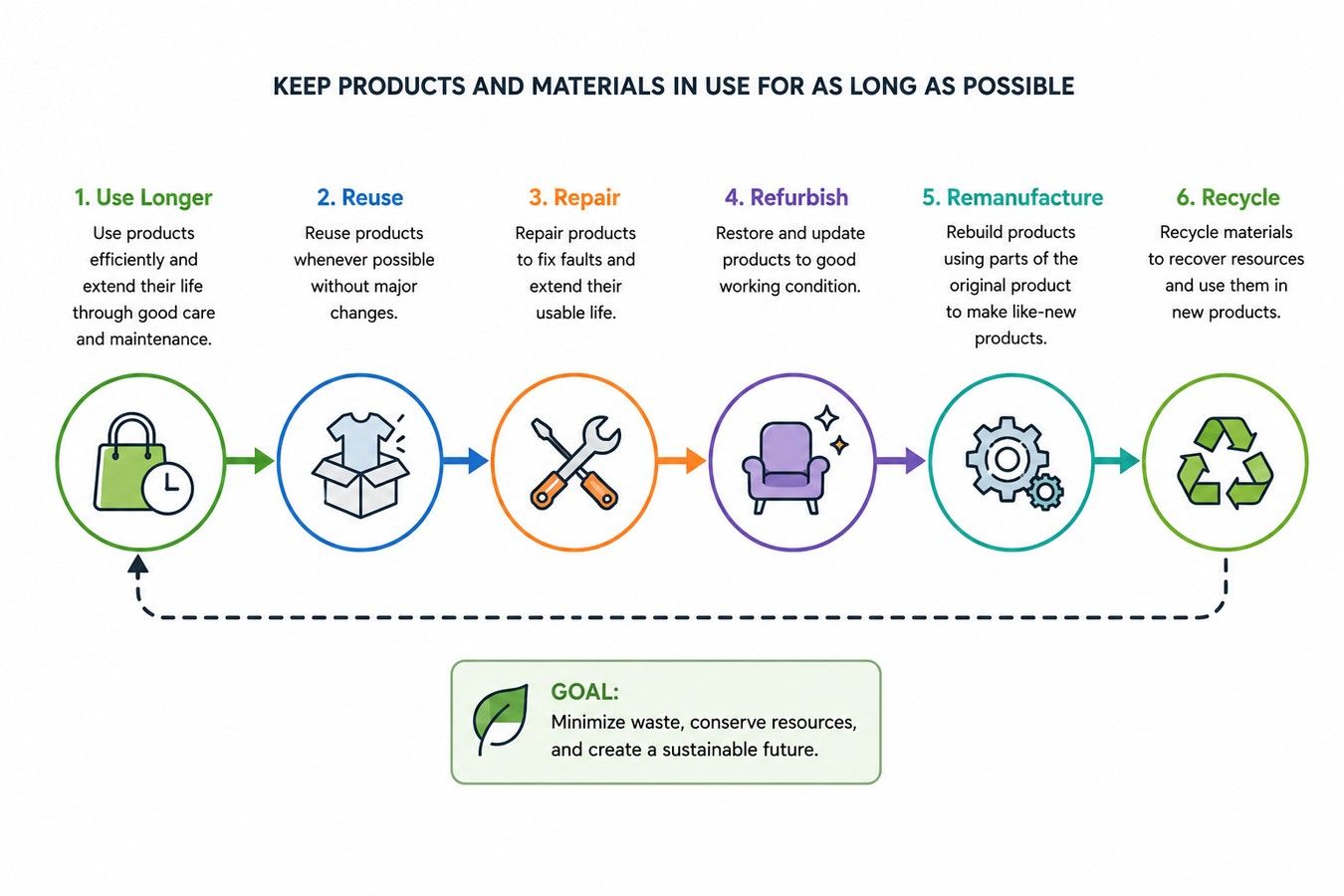
A product does not always need to be changed or processed before another person can use it.
A student can buy a second-hand desk. A family can pass clothes to another family member. A company can sell old office furniture instead of throwing it away.
Repair adds another layer.
A damaged product can often be fixed with a small intervention. A broken screen can be replaced. A damaged zipper can be repaired. A machine component can be changed.
Refurbishment is slightly different.
A refurbished product is generally restored so it can be used again. The product may be inspected, cleaned, repaired, and tested before being sold or returned to service.
Some products cannot be effectively repaired or reused. This is where remanufacturing and recycling become important.
It involves restoring used products or components to a specified condition so they can perform again. It is common in areas such as automotive, industrial equipment, and machinery.
It takes a different approach. The product is processed to recover materials. These materials can then become inputs for new products. Paper, metals, glass, and certain plastics can be recycled through different processes.
This is especially useful when the original product can no longer perform its intended function.
However, recycling should not always be considered the first choice. If a product can still be repaired or reused, keeping it intact may preserve more value.
Also read: What is Supply Chain Management? Learn Its Impact on Business
A circular economy also changes how businesses create value. Instead of selling a product once, companies can earn through rental, repair, resale, maintenance, or refurbishment.
In a traditional model, customers buy a product and own it. In a Product-as-a-Service model, customers pay for access or use.
For example, a business may pay to use industrial equipment instead of purchasing it. The manufacturer remains responsible for maintaining the equipment.
This can encourage companies to make durable products. A longer-lasting product can generate value for a longer period.
Sharing allows several people to use the same product. Car-sharing is one example.
Rental works in a similar way. Customers use a product for a limited period and return it. Clothing, furniture, tools, vehicles, and equipment can all follow this model.
Resale also keeps products in circulation. A phone that is no longer needed by one person can be sold to another instead of becoming waste.
These models help increase the use of products that already exist.
Products can often remain useful with proper maintenance and repair.
Companies can extend product life by providing:
Take-back programmes provide another option. Customers return old products to a company or collection centre. The product can then be repaired, refurbished, reused, or dismantled for material recovery. This creates a reverse flow in the supply chain.
There are many circular economy examples across different industries.
These examples show that circularity can work differently in each industry.
Build expertise with a DBA in Emerging Technologies in Gen AI and Agentic AI from GGU, specialising in Generative and Agentic AI, and lead innovation in the AI-driven business landscape.
Moving towards a circular economy requires changes in infrastructure, business models, supply chains, and consumer behaviour.
Circular systems need facilities for collection, repair, sorting, refurbishment, and recycling.
Many regions still lack enough infrastructure for these activities.
Supply chains can also become more complicated. Used products need to move back from customers to businesses. This requires collection systems and reverse logistics.
There is also a challenge with recycled materials. Businesses may want to use recovered materials, but the supply may not always be consistent in quality or quantity.
Circular practices can require investment.
Companies may need to redesign products, build repair facilities, establish collection systems, or train employees.
Some customers may also prefer new products over refurbished ones. Businesses therefore need to build trust around quality, warranties, and reliability.
Companies may also need to change their revenue models. Instead of depending only on new product sales, they can earn through repair, rental, maintenance, subscriptions, and resale.
Consumers play an important role.
A take-back programme will not work effectively if people do not return their old products. Similarly, resale and repair models need customers who are willing to use them.
Convenience matters too. If repairing or recycling a product is difficult, people may choose disposal instead.
Education can help consumers understand the value of repairing, reusing, and buying second-hand products.
It is difficult to measure whether a company is truly circular.
Recycling rates alone are not enough. Businesses should also consider product lifespan, repair rates, reuse, material recovery, and waste generation.
Useful measures include:
These measures help businesses identify where they need to improve.
Also read: How To Start A Business With a Supply Chain Management System
India has significant opportunities to adopt circular practices.
A growing population, rising consumption, and increasing waste make better resource management important. Circular models can also create new businesses and employment in areas such as repair, recycling, refurbishment, resale, and resource recovery.
India can benefit from circular practices in several sectors.
These opportunities show that how can we create a circular economy depends on the sector. Different industries need different solutions.
Government policies can help create the infrastructure needed for circular systems.
Extended Producer Responsibility, or EPR, is one important approach. It gives producers greater responsibility for managing certain products and their waste after use.
Industries can also support circularity through take-back programmes, recycled materials, repair services, and resource recovery.
However, government action alone is not enough. Businesses, consumers, local authorities, and waste-management organisations all need to participate.
Circular practices already exist in many parts of India.
Used electronics can enter repair and refurbishment markets. Old clothes can be reused or resold. Organic waste can be converted into compost. Materials from discarded products can also be recovered and processed.
Even simple activities such as repairing a product instead of replacing it can support circularity.
This shows that a circular economy does not always require advanced technology. Sometimes, a simple change in how we use a product can prevent waste.
It is also important not to confuse the circular flow of the economy with the circular economy.
The circular flow of income in two sector economy explains the movement of money, goods, services, and resources between households and firms.
These are concepts from economics. They are different from the circular economy, which focuses on keeping physical products and materials in use and reducing waste.
Also read: What is Consumer Behaviour in Marketing? Patterns, Types and Segmentation
A circular economy moves beyond the traditional take, make, use, and dispose model by keeping products and materials useful for longer. It focuses on better design, reuse, repair, refurbishment, and recovery. Businesses and consumers both play a role.
For India, it offers opportunities across electronics, textiles, agriculture, construction, packaging, and waste management while connecting economics with sustainability.
Ready to take the next step? Book a consultation call with upGrad today.
A circular economy can help businesses reduce material costs, create new revenue streams, improve resource efficiency, and build stronger customer relationships. Models such as rental, repair, resale, and refurbishment can also open new markets while reducing dependence on continuously producing new products.
Yes. A circular economy can create jobs in areas such as product repair, refurbishment, recycling, maintenance, resale, waste management, and resource recovery. It can also create demand for designers, engineers, supply chain professionals, and sustainability specialists who understand circular business practices.
Technology can help businesses track products, manage materials, predict maintenance needs, and improve recycling processes. Digital product passports, data systems, artificial intelligence, and IoT devices can make it easier to understand where products are, how they are used, and what happens after use.
Small businesses can start with simple changes. They can reduce packaging, repair products, reuse materials, sell refurbished items, source recycled inputs, or introduce return schemes. They do not need to transform their entire business immediately. Starting with one product or process can make adoption easier.
Not necessarily. It changes how production happens. Businesses can continue producing goods while using resources more efficiently and extending product lifespans. The focus shifts from constantly selling new products towards creating longer-term value through services, maintenance, reuse, upgrades, and recovery.
The effect on prices can vary. Durable or repairable products may cost more initially because of better materials or design. However, longer product life can reduce the total cost of ownership. Rental, resale, and refurbished options can also make products more affordable for some consumers.
Useful skills include sustainability knowledge, product design, supply chain management, data analysis, waste management, business strategy, and lifecycle assessment. Technical skills can also be valuable in areas such as recycling, refurbishment, renewable materials, manufacturing, and resource recovery.
Zero waste mainly focuses on preventing materials from becoming waste. Circular economy has a broader focus. It considers product design, business models, resource use, product life, and material recovery. Zero waste can therefore be part of a wider circular strategy.
Yes. Developing countries can adopt circular practices based on their local needs and resources. Repair, reuse, resale, and informal recovery systems may already exist in many places. Improving these systems through better infrastructure, safety standards, technology, and formal business models can increase their impact.
Governments can support circularity through regulations, financial incentives, recycling infrastructure, public procurement, producer-responsibility policies, and standards for sustainable product design. They can also encourage research and innovation while educating consumers and businesses about responsible resource use.
Students can begin by understanding resource use, waste management, sustainable production, and circular business models. Studying real companies and industry examples can make the concepts easier to understand. Projects involving product redesign, waste audits, or circular business ideas can provide practical learning.
987 articles published
We are an online education platform providing industry-relevant programs for professionals, designed and delivered in collaboration with world-class faculty and businesses. Merging the latest technolo...
Speak with DBA expert
By submitting, I accept the T&C and
Privacy Policy