Learn What Is an OKR? Meaning, Examples & Benefits
By upGrad
Updated on Oct 14, 2026 | 5 min read | 1.32K+ views
Share:

All courses
Certifications
More
By upGrad
Updated on Oct 14, 2026 | 5 min read | 1.32K+ views
Share:
Table of Contents
Key Highlights:
Want to build a career in management? Explore our Management Programs from top institutes, you can build strong skills and learn from experienced faculty and certified project managers.
Popular Management Programs
An OKR is a way of setting objectives and key results. It's a way of setting goals and tracking progress. It helps a team to understand what they're trying to achieve and how they will measure that achievement.
OKR full form is Objectives and Key Results.
Objective: What you want to achieve.
Key Result: How you measure progress towards that goal.
OKRs were developed at Intel by Andy Grove. John Doerr introduced OKRs to Google in 1999. His book 'Measure What Matters' in 2018 went on to help a lot of other businesses to understand the method.
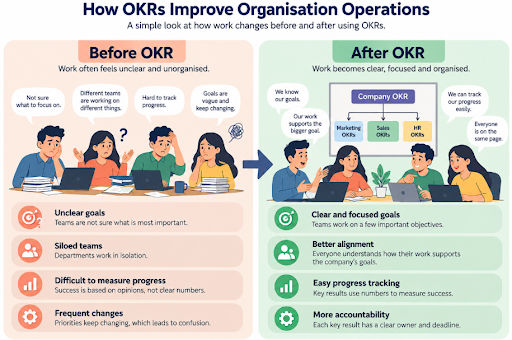
Businesses use OKRs to set clear objectives and track progress. The top level of the organisation may set annual objectives, with the various teams setting their own quarterly objectives which will support those.
This helps different teams to be working towards the same objectives rather than just focusing on their own individual tasks.
Google, Spotify, Adobe and Deloitte are all companies that are very well known for the effective use of OKRs.
Explore the Certificate Programme in General Management for Young Leaders (YLP) from IIMB to build skills in leadership, strategy, people management, and business decision-making.
Free Courses
The OKR framework is all about setting goals, measuring progress and reviewing the results. It has three key stages.
An objective is a clear statement of what you want to achieve. It should give the team a clear goal and a timeframe.
Companies normally set their primary objectives first and then teams set their own objectives to support those. It's best to focus on a small number of objectives at any one time so that the teams can properly work towards them.
Key results are the indicators of whether or not you're making progress towards an objective. They need to be specific, measurable and time-bound.
For example:
Task: Publish 20 articles.
Key result: Increase monthly website leads from 120 to 300.
The task shows what the team does, the key result shows the outcome. That's what enables the team to focus on the result rather than just the task.
Helpful Guide: Risk Management Tools and how they work
At the end of the OKR cycle the teams look at their results and check how much progress they've actually made. They go through what has and hasn't worked, what they've learned and what they can improve on before they go on to set their goals for the next cycle.
Teams should be checking their progress regularly (e.g. every week or every two weeks). That way they can spot problems and make the necessary changes.
Also Read: Everything You Need to Know About Performance Marketing
Management Courses to upskill
Explore Management Courses for Career Progression
IIIT-B & IIM, Udaipur
Chief Technology Officer & AI Leadership ProgrammeOKRs are all about setting clear objectives and then measuring progress against them. Here are some examples for Marketing, Sales and HR.
Objective: Build trust with the customer.
These are the key results to find leads, traffic and sign ups data.
Goal: Win larger deals faster.
Objective: To get people on board quicker and improve their joining experience.
Explore More: Top HR Courses Online with Certification (2026)
OKR's help a business to set clear objectives, keep the team focused and track results. Here are four of the key benefits.
Also Read: Performance Management: Definition, Process, Benefits & Best Practices (2026 Guide)
An OKR helps a team work towards a goal, a KPI is a measure of how well something is performing. Both are often used by businesses to track performance and drive improvement.
OKR (Objectives and Key Results) is used to help teams set their goals and then measure progress against those goals.
KPI (Key Performance Indicator) is a measure of the performance of an activity that is currently on going (e.g. monthly revenue, customer satisfaction).
OKRs: Track progress towards a specific goal over a set period (usually a quarter).
KPIs: Monitor performance of a target over time.
A KPI can also be a key result in an OKR. If the monthly customer loss rate is 5% for example then a team might have an OKR to get that down to 3%.
Use OKRs when you're setting out to achieve a new goal or improve something. Use KPIs to monitor how your business is performing. You can also use both of them to track your regular performance as you work towards new goals.
Factor |
OKRs |
KPIs |
| Purpose | Achieve a specific goal or change | Track ongoing performance |
| Time frame | Usually a set period, such as a quarter | Ongoing |
| Target | Often aims for challenging results | Usually tracks performance against a set target |
| Example | Enter a new market this quarter | Track monthly revenue |
For more detailed information, read: OKRs vs KPIs
Final Thoughts
OKRs are all about setting clear goals and then tracking progress. Start with one or two key objectives and for each of those set three measurable key results. Check in on progress every week or two and then review the results at the end of the quarter.
Treat the first cycle as a learning exercise.
And use these lessons to set better OKRs for the next cycle.
Want to start your management career journey? Book a free consultation with upGrad today to find the best path for your career.
An OKR cycle is the period in which a team sets its goals, tracks progress, and reviews results. It usually lasts a quarter. At the end of the cycle, the team checks what it achieved and uses those lessons to set goals for the next cycle.
Yes individuals can use OKRs to work towards personal goals (e.g. learning a new skill, getting fit etc).
For example, if your goal is to improve your writing skills, you can:
Yes small businesses and start-ups can use OKRs without it being a complicated process. They can get started with a few clear goals and simply review progress.
They should:
No. SMART goals are about writing clear goals, OKRs are about linking goals to measurable outcomes.
SMART goals: Ensure the goal is Specific, Measurable, Achievable, Relevant and Time-bound.
OKRs: Link an objective to key results in order to measure progress towards that objective.
Yes OKRs can change if the business needs or priorities change. Teams shouldn't be changing them simply because a goal is proving difficult to achieve.
Before making changes, teams should:
OKRs should not be the sole measure of an employee's performance. There will be some objectives which are simply impossible to achieve even if the individual is doing a great job.
Managers should also consider:
Both the team members and the managers have a part to play in tracking the OKRs.
Businesses can use simple spreadsheets, project management tools, or special OKR software.
The right tool depends on the team's size and needs.
Missing an OKR gives a team a chance to understand what went wrong and improve.
The team can:
A company can use OKRs well by keeping goals clear and checking progress regularly.
Some useful steps are:
1038 articles published
We are an online education platform providing industry-relevant programs for professionals, designed and delivered in collaboration with world-class faculty and businesses. Merging the latest technolo...
Get Free Consultation
By submitting, I accept the T&C and
Privacy Policy
Top Resources
Certification
3 Months
Certification
6 Months
O.P. Jindal Global University
Masters in International Accounting and Finance (Accredited by ACCA, UK)Master's Degree
12 Months