Production and Operations Management: Functions, Objectives, Types, and Process
By upGrad
Updated on Aug 04, 2026 | 9 min read | 2.41K+ views
Share:

All courses
Certifications
More
By upGrad
Updated on Aug 04, 2026 | 9 min read | 2.41K+ views
Share:
Table of Contents
Ready to move into leadership roles? upGrad's Management Courses equip you with practical skills top companies look for in future managers.
Popular Management Programs
Production and Operations Management (POM) are the ways of managing the steps that are used to make things and provide services. It is about bringing people, materials, tools, machines and information so that products and services are made in a good way at a low cost and in a way that meets what customers want.
Production management is mainly about making items while operations management is about both making things and providing services. Together they help businesses work well and keep things good, productive, and profitable.
Free Courses
The main goal of production and operations management is to make the item or service in the right amount at the right time with the right quality and for the lowest possible cost. Ultimately, production and operations management make sure that the company uses its resources well to get the most out of them with the least waste.
Its major purposes include:
Difference Between Production and Operations management:
Basis |
Production Management |
Operations Management |
| Meaning | Focuses on manufacturing physical goods | Focuses on managing both goods and services |
| Scope | Limited to production activities | Covers the entire operational process |
| Industry | Manufacturing | Manufacturing and service industries |
| Output | Tangible products | Products and services |
| Objective | Efficient production | Overall operational efficiency |
Read: Comprehensive Guide to Product Design in Operations Management
Management Courses to upskill
Explore Management Courses for Career Progression
IIIT-B & IIM, Udaipur
Chief Technology Officer & AI Leadership Programme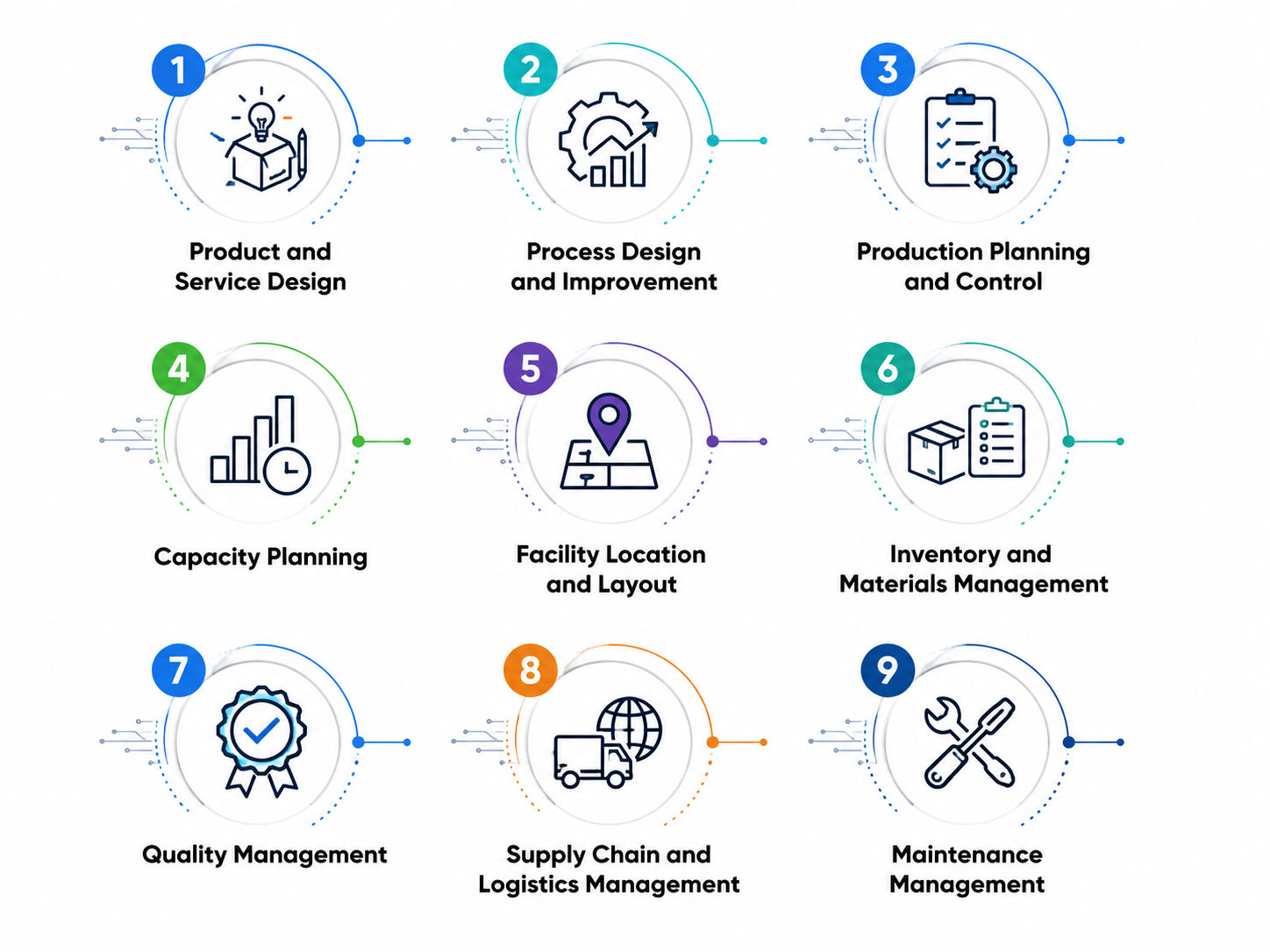
The scope of Production and Operations Management (POM) includes all activities that are involved in planning, organizing, controlling, and improving the processes that turn inputs into goods and services. It goes beyond manufacturing to include service industries like healthcare, banking, retail, hospitality, and information technology.
The scope of POM covers every part of the production and service delivery process starting from product design and resource planning all the way to quality assurance and distribution.
Production and operations management starts with creating products and services that meet what customers want while being affordable and easy to make. This includes finding out what customers need, choosing materials, making samples, and improving designs to get quality and better performance.
Key activities include:
Process design is about figuring out ways to make goods or deliver services. It involves choosing production methods, creating workflows, setting up ways to do things, and always looking for ways to make operations better to increase productivity.
Key activities include:
Production planning makes sure that products are made in the amount at the right time and with the right quality. Production control checks the production work to make sure that schedules are followed, and that resources are used in the way possible.
Key activities include:
Capacity planning finds out how much production is needed to meet what customers want without using much or too little resources. It looks at labor, machines, buildings, and technology to make sure everything runs smoothly.
Key activities include:
Picking the place for a facility and designing the layout of a plant has a big effect on costs and how well things run. A good layout makes it easier to move materials cut down on time spent moving things and makes the workplace safer.
Key activities include:
Keeping track of inventory and materials makes sure that the things needed like raw materials, items being made and finished products are available when they are needed while keeping storage costs and waste as low as possible.
Key activities include:
Quality management makes sure that products and services are always what customers want and meet industry standards. It focuses on stopping problems before they happen making processes better and keeping the quality of outputs.
Key activities include:
Production and operations management handle the movement of materials, information, and products in the supply chain. Good supply chain management makes sure that things are bought on time moved efficiently and delivered reliably.
Key activities include:
Maintenance management makes sure that machines, equipment and buildings are working the best they can to reduce time when things stop working and to make production better.
Key activities include:
Read: What is Production Management? Definition, Functions, Importance, and Scope
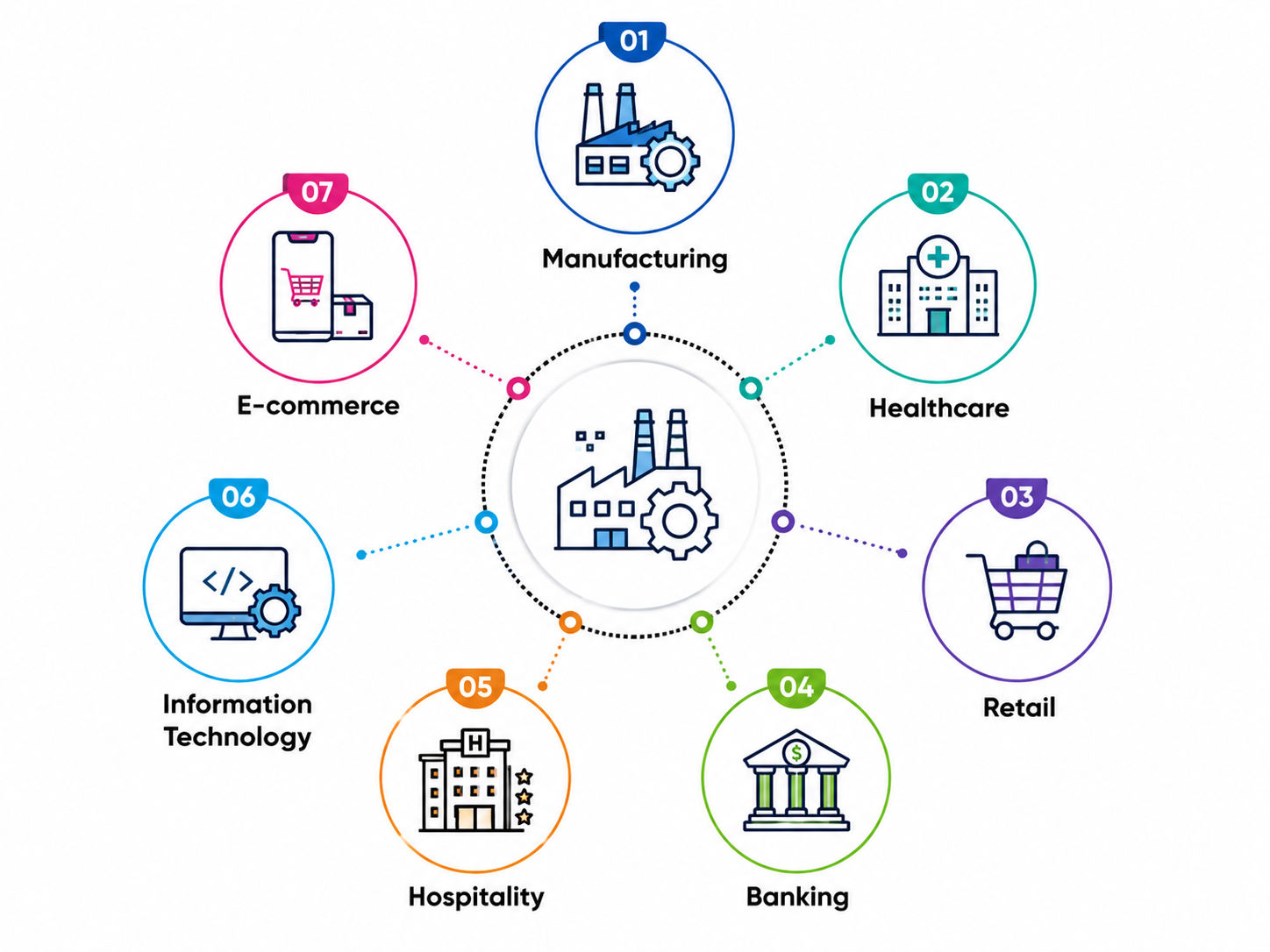
Production and operations management is applicable across almost every industry.
Manufacturing
Healthcare
Retail
Banking
Hospitality
Information Technology
E-commerce
Read: Top 6 Concepts to Learn During an MBA in Operations Management
The main goal of production and operations management is to make the organization run smoothly while providing products and services that customers want.
Here are the main objectives of production and operations management:
Productivity is about how resources are used to make things. When productivity is high, the organization makes money and can compete better.
To improve productivity organizations:
Quality is very important for making customers happy and for the long-term success of the business. When products are high-quality, customers are satisfied and do not return.
Some quality objectives include:
Resources like people, machines, materials, and money should be used in a way that makes sense. When resources are used properly, the organization saves money.
This involves:
One of the goals is to keep production costs low without making products that are not good. When costs are low, the organization improves profit margins.
Some ways to reduce costs include:
Organizations need to make products and services to meet customer demand without making too much. When customer demand is met on time, customers are happy.
This requires:
Reducing waste makes the organization run better and is good for the environment. Using lean production techniques helps get rid of these wastes.
Some common types of waste include:
Markets change quickly. Being flexible makes the organization more competitive.
Organizations should be able to:
Production and operations management help the organization grow in a way that is good for the environment and society.
Sustainable practices include
Read: Comprehensive Guide to Scope of MBA in Operations Management: Key Insights and Opportunities
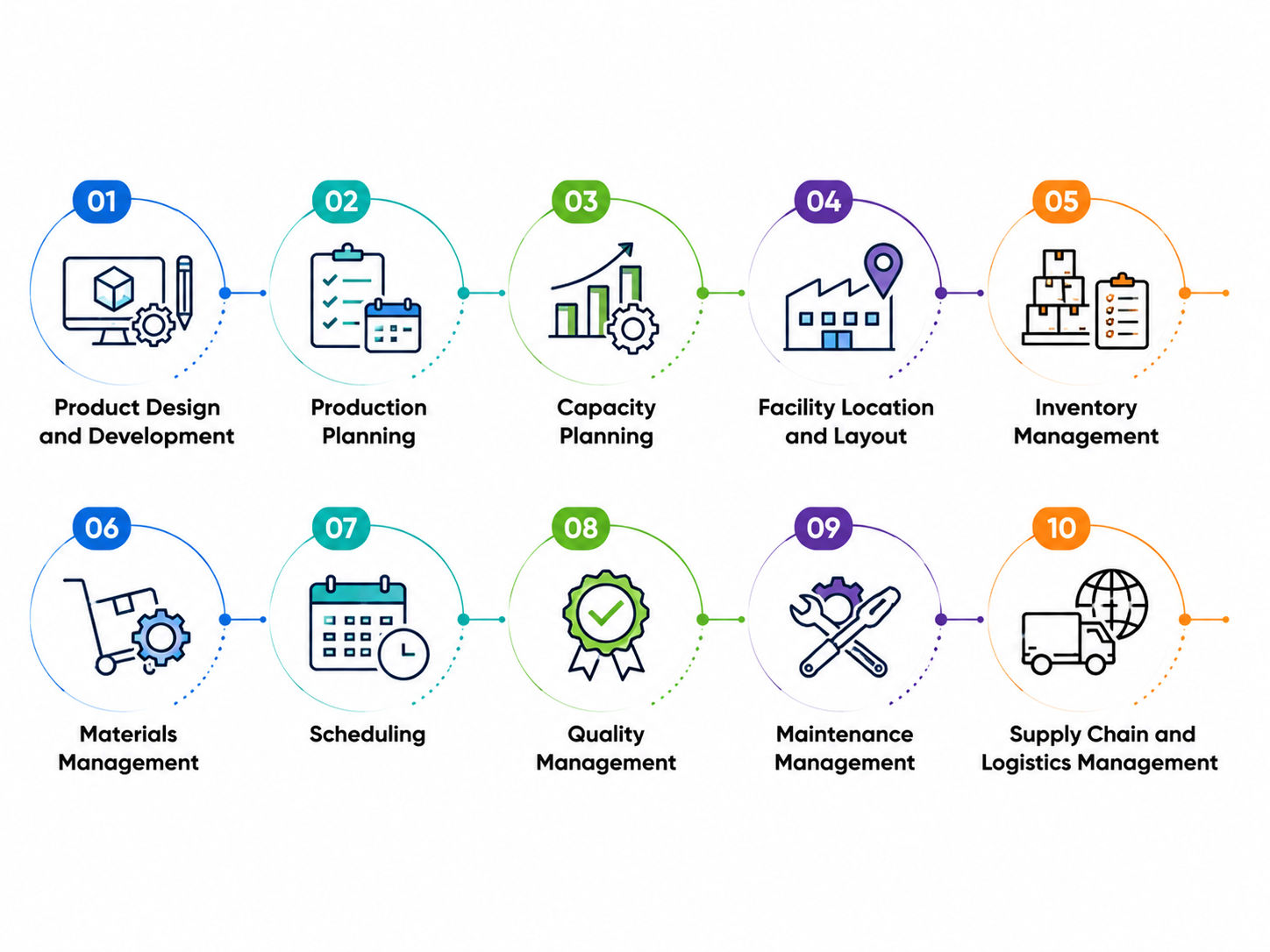
Production and operations management include many connected functions that help make production and service delivery run smoothly.
Product design determines what the product will be like its quality and how it will be made. Well-designed products reduce production costs and make customers happy.
Activities include:
Production planning determines and helps balance demand with production capacity:
Capacity planning makes sure that production facilities have resources to meet demand. Proper capacity planning prevents underutilization and overloading.
It involves:
Choosing the production location reduces transportation costs and improves efficiency. A good layout reduces production delays.
Facility layout is about arranging things like:
Inventory management makes sure that raw materials, work-in-progress, and finished goods are available when needed. Popular inventory techniques include Economic Order Quantity (EOQ), Just-in-Time (JIT), and ABC analysis.
Objectives include:
Materials management involves planning, purchasing, storing, and controlling materials needed for production. Effective materials management ensures that production runs smoothly.
Key responsibilities include:
Efficient scheduling reduces time and improves productivity.
Scheduling determines:
Quality management ensures that products and services meet customer expectations. Techniques like Six Sigma, Total Quality Management, and Statistical Process Control help improve quality.
Activities include:
Equipment maintenance reduces production downtime. Extends the life of machinery. Regular maintenance improves reliability and productivity.
Types of maintenance include:
When we talk about Supply Chain and Logistics Management, we talk about getting things from one place to another. Supply Chain and Logistics Management is about making sure materials and products get from suppliers to customers.
Here are some things that Supply Chain and Logistics Management does:
The production and operations management process consists of a sequence of activities that transform inputs into finished products or services while ensuring efficiency, quality, and customer satisfaction.
The process begins with estimating future customer demand.
Demand forecasting uses:
Accurate forecasting helps businesses avoid shortages and excess inventory.
After forecasting demand, organizations determine the resources required.
This includes planning for:
Proper resource planning ensures smooth operation.
The next step is to acquire the necessary materials from reliable suppliers.
Key procurement activities include:
Timely procurement prevents production delays.
Production scheduling allocates jobs to machines, employees, and production lines.
Scheduling determines:
Efficient scheduling increases productivity and minimizes idle time.
This stage involves converting inputs into finished products or delivering services.
Manufacturing activities may include:
For service organizations, this stage focuses on delivering customer experiences efficiently and consistently.
Quality inspection verifies that products or services meet established standards.
Inspection activities include:
Continuous quality inspection reduces defects and enhances customer satisfaction.
Finished products are stored, packaged, transported, and delivered to customers through appropriate distribution channels.
Distribution activities involve:
Efficient distribution ensures timely deliveries and improves customer experience.
The final stage involves assessing operational performance to identify opportunities for improvement. Performance evaluation supports continuous improvement by identifying inefficiencies, measuring outcomes against goals, and implementing corrective actions.
Key performance indicators (KPIs) include:
Enroll now in the CTO & AI Certification Program, master strategic leadership, AI innovation, and technology governance to accelerate your executive career today!
Production systems refer to the methods and processes organizations use to manufacture goods or deliver services. The choice of a production system depends on factors such as product type, production volume, customer requirements, production costs, and available resources.
The four primary types of production systems are job production, batch production, mass production, and continuous production. Each system offers distinct advantages and is suitable for different business needs.
Comparison Table: Types of Production Systems:
Production System |
Characteristics |
Best Suited For |
| Job Production | Customized products, low volume, high flexibility, skilled labor | Construction, custom furniture, bespoke clothing, shipbuilding |
| Batch Production | Products manufactured in batches, moderate volume, flexible scheduling | Bakeries, pharmaceuticals, printing, garments, cosmetics |
| Mass Production | Standardized products, assembly lines, high automation, large volumes | Automobiles, electronics, packaged foods, household appliances |
| Continuous Production | Continuous operation, highly automated, extremely high volume | Oil refineries, chemical plants, steel manufacturing, power generation |
Job production involves manufacturing a single product or completing one project at a time according to specific customer requirements. Every product is unique, and production begins only after receiving a customer order.
This production system emphasizes customization, skilled labor, and close interaction with customers.
Characteristics
Advantages
Disadvantages
Batch production involves manufacturing products in groups or batches rather than individually or continuously. Once one batch is completed, production equipment is adjusted for the next batch.
This system provides a balance between customization and production efficiency.
Characteristics
Advantages
Disadvantages
Mass production focuses on manufacturing standardized products in very large quantities using assembly lines and automation.
Products are identical, allowing organizations to achieve economies of scale.
Characteristics
Advantages
Disadvantages
Continuous production operates without interruption, producing products continuously 24 hours a day. It is mainly used in industries where production processes cannot be stopped.
Automation and process control systems play a significant role in continuous production.
Characteristics
Advantages
Disadvantages
Production and Operations Management consists of several interrelated components that ensure efficient production, optimal resource utilization, and high customer satisfaction. These components work together to improve productivity, reduce costs, and maintain quality standards.
Product design involves creating products that satisfy customer needs while remaining cost-effective and easy to manufacture. A well-designed product improves quality, functionality, and market competitiveness.
Key activities include:
Benefits
Process design focuses on determining the most efficient method of producing goods or delivering services. It defines the sequence of activities, technologies, workflows, and equipment needed to transform inputs into outputs.
Major activities include:
Benefits
Capacity planning ensures that an organization has sufficient resources—such as labor, machinery, facilities, and equipment to meet current and future demand without overloading or underutilizing its operations.
Capacity planning includes:
Benefits
Facility management involves planning, organizing, and maintaining production facilities to ensure smooth operations and a safe working environment.
It includes:
Benefits
Inventory control ensures that the right quantity of raw materials, work-in-progress items, and finished goods is available at the right time while minimizing storage costs.
Inventory management techniques include:
Benefits
Supply Chain Management (SCM) coordinates the movement of materials, information, and products from suppliers to manufacturers, distributors, retailers, and customers. It aims to optimize the entire supply chain to reduce costs, improve delivery speed, and enhance customer satisfaction.
Core activities include:
Benefits
Quality assurance (QA) focuses on preventing defects by establishing standards, monitoring processes, and continuously improving production systems. Unlike quality control, which detects defects after production, QA emphasizes building quality into every stage of the process.
Quality assurance activities include:
Benefits
Lean manufacturing is a production philosophy that aims to maximize customer value while minimizing waste. It focuses on eliminating activities that do not add value, improving workflow efficiency, and continuously optimizing processes.
Common lean principles include:
Types of waste targeted by lean manufacturing:
Benefits
MBA Production and Operations Management focuses on planning, managing, and optimizing the processes involved in producing goods and delivering services. It equips students with skills in supply chain, inventory, quality, and operations management to improve efficiency, reduce costs, and enhance customer satisfaction across industries such as manufacturing, healthcare, logistics, retail, and technology.
The primary objectives of this MBA specialization include:
The curriculum typically includes a combination of management, analytical, and technical subjects.
This subject covers production scheduling, forecasting, capacity planning, workflow management, and production monitoring to ensure smooth manufacturing operations.
Students learn how to manage day-to-day business operations, improve operational efficiency, and coordinate resources effectively in manufacturing and service organizations.
This subject focuses on procurement, supplier management, transportation, warehousing, distribution, logistics, and supply chain optimization.
Students study inventory control techniques such as Economic Order Quantity (EOQ), Just-in-Time (JIT), ABC analysis, and inventory forecasting to reduce costs and improve material availability.
Quality management covers Total Quality Management (TQM), Six Sigma, Statistical Process Control (SPC), ISO standards, and continuous improvement methodologies to ensure product and service excellence.
Lean principles help students identify and eliminate waste, improve productivity, reduce lead times, and enhance customer value through efficient production processes.
Students learn project planning, scheduling, budgeting, risk management, and resource allocation to manage projects successfully.
This subject introduces mathematical models and optimization techniques used for solving complex business and production problems.
Students use data analysis, forecasting, and business intelligence tools to support operational decision-making and improve organizational performance.
An MBA in Production and Operations Management helps students develop technical, analytical, and managerial skills required for leadership roles.
Key skills include:
Production and Operations Management (POM) is essential because it enables organizations to transform resources into high-quality goods and services efficiently. Effective POM not only supports day-to-day operations but also contributes to long-term business growth and competitiveness.
POM streamlines production processes by optimizing workflows, eliminating bottlenecks, and ensuring the effective use of labor, machinery, and materials. Efficient operations reduce delays and increase output without requiring additional resources.
Benefits:
Consistent quality is achieved through standardized processes, quality assurance programs, and continuous monitoring. POM helps organizations meet customer expectations while reducing defects and rework.
Benefits:
Efficient production planning, inventory control, and waste reduction lower manufacturing and operational expenses. By optimizing resources and minimizing inefficiencies, businesses can improve profitability.
Benefits
Meeting customer demand on time with quality products enhances customer experience and loyalty. POM ensures timely production, accurate order fulfillment, and consistent service delivery.
Benefits:
When organizations improve productivity, reduce costs, and satisfy customers, they generate higher revenues and better profit margins. Efficient operations also help businesses remain competitive in pricing.
Benefits:
Effective production and operations management creates standardized systems that allow businesses to expand production or services as demand grows. Scalable operations make it easier to enter new markets and introduce new products.
Benefits:
Organizations with efficient production systems can deliver superior quality, lower prices, and faster service than competitors. Continuous improvement and innovation further strengthen their market position.
Benefits:
Although the terms are often used together, production management and operations management differ in scope and focus. Production management primarily deals with manufacturing goods, whereas operations management encompasses both manufacturing and service operations.
Comparison Table: Production Management vs Operations Management
Feature |
Production Management |
Operations Management |
| Scope | Focuses on manufacturing processes | Covers manufacturing and service operations |
| Focus | Producing physical goods efficiently | Managing all operational activities for goods and services |
| Industries | Manufacturing industries | Manufacturing, healthcare, banking, retail, hospitality, IT, and more |
| Output | Tangible products | Tangible products and intangible services |
| Decision-making | Production planning, scheduling, machinery, and quality control | Resource allocation, process improvement, supply chain, customer service, and overall operational strategy |
Organizations face several challenges that can affect productivity, cost, quality, and customer satisfaction. Successfully addressing these challenges is essential for maintaining efficient and resilient operations.
Global events, natural disasters, transportation delays, supplier failures, and geopolitical issues can interrupt the flow of raw materials and finished goods.
Impact:
Solutions:
Customer demand often changes due to seasonality, economic conditions, and market trends. Inaccurate forecasts can lead to overproduction or stock shortages.
Impact:
Solutions:
Increasing prices of raw materials, labor, energy, and transportation can significantly affect profitability.
Impact:
Solutions:
Maintaining consistent quality becomes more challenging as production volumes increase or products become more complex.
Impact:
Solutions:
Adopting new technologies such as automation, robotics, AI, and IoT requires investment and organizational change. Integrating these technologies with existing systems can be complex.
Impact:
Solutions:
Managing a skilled workforce involves recruitment, training, scheduling, motivation, and retention. Labor shortages and changing workforce expectations add further complexity.
Impact:
Solutions:
Governments, customers, and investors increasingly expect businesses to reduce their environmental impact and adopt sustainable practices.
Impact:
Solutions:
Adopting proven best practices enables organizations to improve efficiency, reduce costs, maintain quality, and respond effectively to changing market conditions.
Lean manufacturing focuses on eliminating non-value-added activities and continuously improving processes.
Best practices include:
Benefits:
Automation and Artificial Intelligence (AI) enhance operational efficiency by reducing manual work, improving accuracy, and enabling predictive decision-making.
Applications include:
Benefits:
Effective inventory management ensures that materials are available when needed while minimizing excess stock and carrying costs.
Best practices include:
Benefits:
Modern production systems generate large amounts of operational data that can be analyzed to improve performance and support strategic decisions.
Best practices include:
Benefits:
Continuous improvement involves regularly evaluating processes, identifying inefficiencies, and implementing incremental changes to enhance performance over time.
Common approaches include:
Benefits:
Strong supplier relationships are essential for maintaining a reliable supply chain, controlling costs, and ensuring consistent product quality. Rather than viewing suppliers as transactional vendors, organizations should build long-term partnerships based on trust, transparency, and mutual benefit.
Key strategies to strengthen supplier relationships include:
Benefits of strong supplier relationships
By treating suppliers as strategic partners, organizations can create a more responsive, efficient, and resilient supply chain that supports long-term operational success and competitive advantage.
Production and Operations Management (POM) is applied across a wide range of industries to improve efficiency, optimize resources, maintain quality, and deliver products or services that meet customer expectations. Although the processes vary by industry, the fundamental principles of planning, organizing, controlling, and continuous improvement remain the same.
Manufacturing companies rely heavily on production and operations management to convert raw materials into finished goods efficiently. POM helps manage production planning, inventory, machinery, workforce, quality control, and supply chain activities.
Manufacturers use forecasting to estimate customer demand, schedule production, and ensure sufficient raw materials are available. Quality management techniques such as Total Quality Management (TQM), Six Sigma, and Lean Manufacturing help reduce defects and improve productivity. Preventive maintenance minimizes machine downtime and keeps production running smoothly.
How manufacturing applies POM principles:
E-commerce businesses use production and operations management to manage order processing, inventory, warehousing, logistics, and customer service. Since customers expect fast deliveries and accurate orders, operational efficiency is essential.
Demand forecasting helps maintain appropriate inventory levels, while warehouse management systems and automation improve picking, packing, and shipping efficiency. Real-time inventory tracking prevents stock shortages and overselling.
How e-commerce applies POM principles:
Hospitals and healthcare organizations apply production and operations management to deliver high-quality patient care while efficiently utilizing medical staff, equipment, facilities, and supplies.
Healthcare operations include patient scheduling, emergency response planning, inventory management for medicines and medical equipment, quality assurance, and capacity planning for hospital beds and staff. Efficient operations improve patient outcomes while reducing waiting times and operational costs.
How healthcare applies POM principles:
Hotels, restaurants, and tourism businesses use production and operations management to provide consistent customer experiences and efficient service delivery.
Operations managers coordinate staffing, room availability, food preparation, housekeeping, procurement, and customer service. Forecasting occupancy levels helps optimize staffing and inventory, reducing waste while maintaining excellent service quality.
How hospitality applies POM principles:
The automobile industry is one of the most advanced users of production and operations management. Manufacturers use highly automated assembly lines, robotics, Lean Manufacturing, and Just-in-Time (JIT) inventory systems to produce vehicles efficiently.
Operations managers coordinate thousands of suppliers, monitor production quality, schedule manufacturing activities, and ensure timely delivery of vehicles. Continuous improvement initiatives help reduce production costs while maintaining high safety and quality standards.
How the automobile industry applies POM principles:
Production and Operations Management is the foundation of efficient business operations across manufacturing and service industries. By optimizing resources, improving quality, reducing costs, and meeting customer expectations, POM enhances organizational performance and competitiveness. Adopting modern technologies, lean practices, and continuous improvement enables businesses to achieve sustainable growth, operational excellence, and long-term success in an increasingly competitive global marketplace.
Production and Operations Management is the process of planning, organizing, and controlling resources to produce goods and deliver services efficiently. It focuses on optimizing productivity, maintaining quality, minimizing costs, and ensuring customer satisfaction through effective management of production and operational activities.
The objectives of Production and Operations Management include improving productivity, ensuring product and service quality, optimizing resource utilization, reducing production costs, minimizing waste, meeting customer demand efficiently, increasing operational flexibility, and supporting sustainable business growth through efficient operational processes.
Key functions include product design, production planning, capacity planning, facility layout, inventory management, materials management, scheduling, quality management, maintenance management, and supply chain coordination. Together, these functions ensure smooth operations, efficient resource utilization, and timely delivery of quality products and services.
Production management focuses on manufacturing physical goods and managing production activities. Operations management has a broader scope, covering both manufacturing and service operations, including process improvement, resource management, quality assurance, supply chain management, and customer service across various industries.
The four main production systems are job production, batch production, mass production, and continuous production. Each system differs in production volume, customization, flexibility, and automation level, making them suitable for different products, industries, and customer requirements.
Production and Operations Management improves efficiency, reduces operational costs, enhances product quality, increases customer satisfaction, supports business scalability, and strengthens competitive advantage. It enables organizations to utilize resources effectively while delivering products and services that meet market demand consistently.
Major challenges include supply chain disruptions, fluctuating customer demand, rising production costs, maintaining quality standards, integrating advanced technologies, managing workforce productivity, and meeting sustainability requirements. Overcoming these challenges helps organizations maintain efficient, resilient, and competitive operations.
Production and Operations Management is widely used in manufacturing, automobile, healthcare, retail, e-commerce, banking, hospitality, logistics, construction, food processing, aviation, telecommunications, and information technology industries to improve operational efficiency, quality, and customer satisfaction.
Professionals need analytical thinking, problem-solving, communication, leadership, project management, decision-making, inventory management, quality control, supply chain knowledge, data analysis, and proficiency with enterprise systems such as ERP software, along with adaptability to evolving technologies and business environments.
Technology enhances Production and Operations Management through automation, artificial intelligence, robotics, IoT, cloud computing, predictive analytics, and real-time monitoring. These technologies improve forecasting accuracy, optimize resource utilization, reduce errors, increase productivity, strengthen quality control, and support faster, data-driven decision-making.
Production and Operations Management (POM) is the process of planning, organizing, and controlling resources and activities to produce goods and deliver services efficiently. It focuses on improving productivity, maintaining quality, reducing costs, optimizing resources, and meeting customer requirements while achieving organizational goals.
Production and Operations Management is the branch of management that plans, organizes, coordinates, and controls processes for producing goods and delivering services. It ensures efficient resource utilization, high-quality output, cost control, and timely delivery while meeting customer needs and organizational objectives.
The difference between production and operations management is that production management focuses on manufacturing physical goods by managing production processes. Operations management has a broader scope, overseeing both manufacturing and service operations, including resource planning, process improvement, quality management, and supply chain activities to enhance overall organizational efficiency.
You can find Production and Operations Management PDFs through university websites, online learning platforms, digital libraries, and educational publishers. Many institutions also provide lecture notes, study materials, and e-books covering POM concepts, functions, objectives, processes, and real-world applications.
972 articles published
We are an online education platform providing industry-relevant programs for professionals, designed and delivered in collaboration with world-class faculty and businesses. Merging the latest technolo...
Get Free Consultation
By submitting, I accept the T&C and
Privacy Policy
Top Resources
Certification
3 Months
Certification
6 Months
O.P. Jindal Global University
Masters in International Accounting and Finance (Accredited by ACCA, UK)Master's Degree
12 Months