Scope of Management Accounting: Nature, Functions, Objectives and Limitations
By Sriram
Updated on Oct 16, 2026 | 9 min read | 4.34K+ views
Share:

All courses
Certifications
More
By Sriram
Updated on Oct 16, 2026 | 9 min read | 4.34K+ views
Share:
Table of Contents
Key Highlights
Explore upGrad’s online management programs to strengthen your strategic planning, leadership, and decision-making skills. Learn to align business goals with financial insights, optimise resources, and make informed decisions that support organisational growth.
Popular Management Programs
The scope of management accounting covers collecting, analysing, and interpreting financial and operational information to support planning, cost control, budgeting, forecasting, and decision-making.
It helps managers answer practical questions such as why costs increased, which products are profitable, and whether a new investment makes sense. Unlike financial accounting, it mainly serves internal decision-making and can be tailored to management needs.
Financial statement analysis helps managers understand the financial position and performance of the business.
It involves examining revenue, expenses, profits, assets, liabilities, and other financial information to identify meaningful trends and changes.
Managers can use this analysis to assess:
For example, a company might see that revenue increased by 12%, yet profit barely changed. Analysis can help management investigate whether rising production costs, operating expenses, or pricing decisions caused the gap.
Cost accounting is an important part of the scope of management accounting because managers need to know where money is being spent.
It involves classifying, analysing, and monitoring costs associated with products, services, departments, or projects.
Managers can use cost information to:
A manufacturer, for instance, might discover that material costs are rising faster than sales. Management can investigate suppliers, wastage, production methods, or product design before the problem affects margins further.
Budgeting is the process of converting business plans into financial objectives. Budgetary control then compares actual performance against these targets.
The process generally includes preparing budgets, tracking actual results, identifying major variances, and investigating why those variances occurred.
A budget is not useful simply because it is prepared on time. When actual results begin to deviate from expectations, managers need to review it.
Financial planning looks ahead. It helps managers estimate future revenue, expenses, profits, cash requirements, and resource needs.
Forecasting supports this process by estimating what might happen under current or changing conditions.
Common forecasting areas include:
Forecasts aren't promises. They're estimates based on available information and assumptions, so managers need to revisit them when business conditions change.
Decision support sits at the heart of management accounting.
Managers may need financial information before choosing whether to launch a product, change a price, outsource production, invest in equipment, or discontinue an activity.
Common decisions include:
Consider a company deciding whether to manufacture a component internally or buy it from a supplier. The manager needs relevant costs, available capacity, supplier pricing, and other financial implications before choosing an option.
Management needs to know whether the plans are working as expected. That feedback comes from performance measurement.
They may measure departments, products, projects or business units with revenue, profit, costs, margins, productivity and key performance indicators.
Variance analysis can also be used to identify where actual performance is significantly different from planned performance.
Responsibility accounting goes further by relating financial performance to the managers responsible for specific areas.
Also Read: What is Customer Relationship Management? A Complete Guide
Management reports translate accounting information into something managers can act on. Reports may contain sales trends, departmental expenses, product margins, budget variances, cash positions or other metrics that are relevant to a particular decision.
Good reports don’t require all the numbers that are out there. They need the right numbers at the right moment.
Risk has also become relevant to management accounting because financial decisions involve uncertainty.
Management accountants can contribute by analysing potential financial effects, evaluating scenarios, monitoring cost exposure, and providing information for risk-based decisions.
For example, before entering a new market, management may assess expected investment, operating costs, revenue assumptions, and possible financial losses.
Management accounting isn't limited to short-term operational decisions. It can support longer-term planning as well.
Managers can use cost information, profitability analysis, forecasts, and performance trends when considering expansion, new products, competitive positioning, and resource allocation.
Strategic decisions usually involve more uncertainty than routine operating decisions. That's why management needs information from several sources rather than relying on one financial measure.
Scope at a Glance
Area |
What it covers |
Main purpose |
| Cost accounting | Cost analysis and control | Manage costs |
| Budgeting | Financial targets | Control resources |
| Forecasting | Future estimates | Support planning |
| Financial analysis | Financial performance | Improve decisions |
| Performance measurement | KPIs and variances | Evaluate results |
| Decision support | Business alternatives | Improve choices |
| Risk management | Financial and business risks | Assess uncertainty |
| Strategic management | Long-term decisions | Support growth |
Read: What is Logistics Management? Understanding Its Types, Functions, Processes, and More
Free Courses
The nature and scope of management accounting are closely connected. Its nature describes how management accounting works, while its scope describes the areas where it is applied.
Management accounting isn't governed by one rigid reporting format. Its information is prepared according to what managers need to understand, plan, control, or decide.
Management accounting exists to support managerial action.A report has limited value if nobody can use it to understand a problem or make a decision.
Historical information matters, but managers also need to think ahead.Budgets, forecasts, scenarios, and investment analysis help managers estimate possible future outcomes and prepare their plans accordingly.
Managers don't need every number available in the accounting system. They need information that is relevant to the question at hand. Analysis helps separate useful signals from information that doesn't affect the decision.
The primary users are people inside the organisation.
Reports can be designed for department heads, finance managers, operations teams, or senior executives depending on what they need to know.
Management accounting reports can be prepared monthly, weekly, daily, or whenever a specific decision requires analysis.
The format can also change. A production manager and a chief executive won't necessarily need the same report.
Management accounting connects with finance, operations, marketing, economics, statistics, and business strategy.
A pricing decision, for example, may require cost data as well as information about demand, competitors, and production capacity.
Planning establishes what the business expects to achieve. Control helps management compare actual results with those expectations and respond to significant differences.
That's why the nature and scope of management accounting are closely tied to managerial planning and control.
Prepare to lead technology-driven business transformation with the CTO and AI Officer Programme from IIM Udaipur and IIIT Bangalore. Develop expertise in AI strategy, technology leadership, and digital transformation to leverage data-driven insights and improve business decision-making.
Management Courses to upskill
Explore Management Courses for Career Progression
IIIT-B & IIM, Udaipur
Chief Technology Officer & AI Leadership ProgrammeIIM Kozhikode
PCP in AI for Business ProfessionalsThe objectives and scope of management accounting work together. The scope identifies the areas covered, while the objectives explain what managers want to achieve through the information generated from those areas.
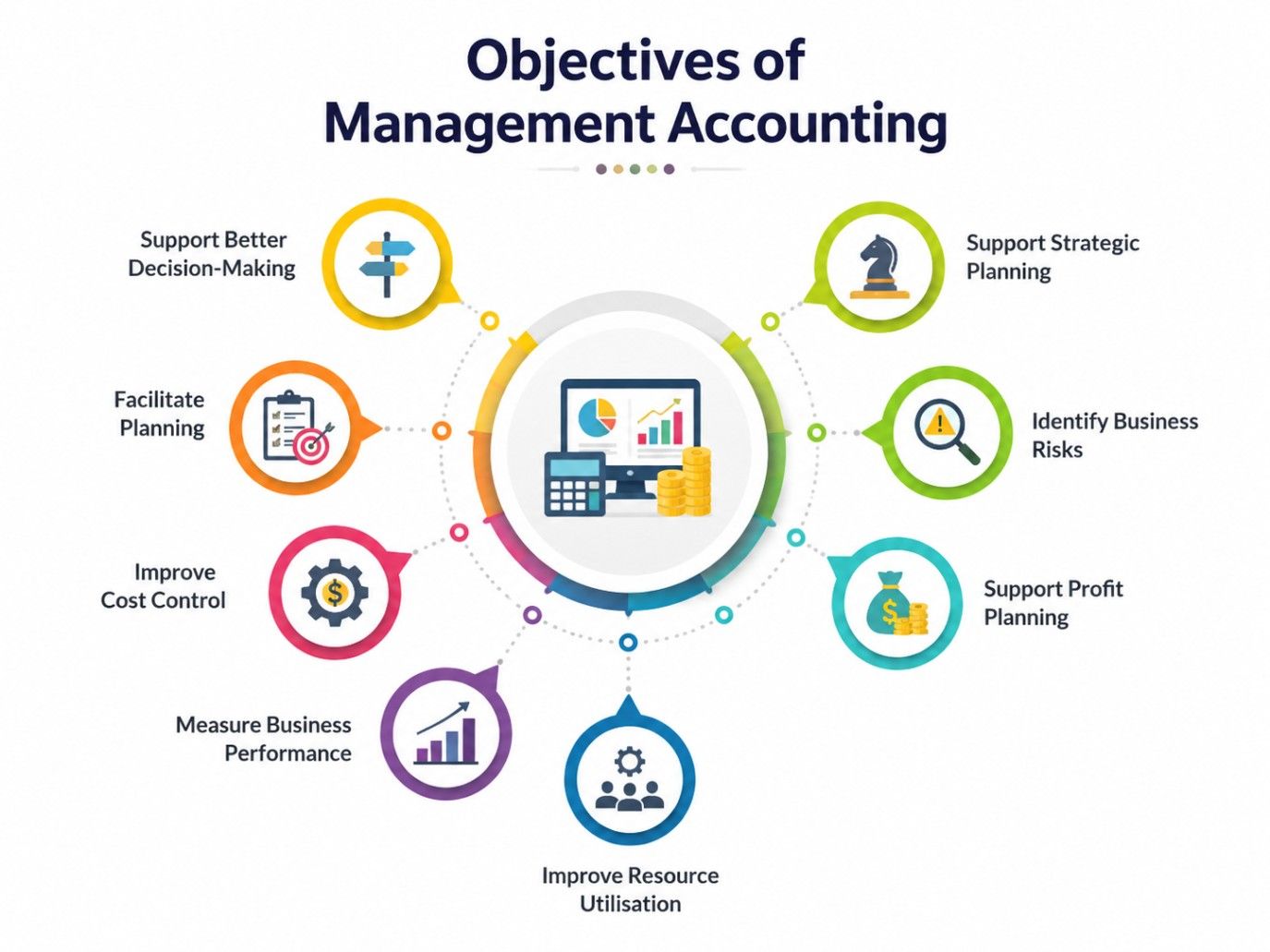
The central objective is to help managers make informed decisions. Other objectives support that goal by improving planning, controlling costs, measuring performance, and allocating resources.
Managers face choices with different financial consequences.
Management accounting provides relevant information that helps compare alternatives and assess their likely impact before resources are committed.
Planning requires estimates of revenue, expenses, resources and future needs.
Budgets and forecasts provide managers with a financial basis for setting targets and deciding on resource allocation.
Managers need to know when costs are moving away from expected levels.
Cost analysis and variance analysis can highlight problem areas that require investigation.
Performance information helps managers decide whether departments, products, projects, or business units are meeting expectations.
It also provides a basis for reviewing what worked well and where the results fell short.
Resources are limited in every business.
Management accounting can help compare the expected financial outcomes of different uses of money, labour, equipment, and capacity.
Profit is determined by a variety of factors, including sales volume, revenue, pricing and costs. Management accounting pulls these together, so managers can see how different decisions might impact on profitability.
Financial analysis can highlight exposure to rising costs, weak margins, declining sales, or uncertain investment returns.
Managers can then consider possible responses before a financial issue becomes larger.
Long-term plans require information about costs, profitability, resources, investment requirements, and expected returns.
The objectives and scope of management accounting therefore extend beyond routine reporting and into strategic decision support.
Read: Distributor and Consumer Management System for Modern Businesses
The scope and functions of management accounting are related, but they aren't the same thing. Scope describes the areas covered by management accounting, while functions describe the activities performed to support management.
The functions connect information with action.
Management accountants gather relevant financial information and analyse it to identify patterns, changes, costs, and performance issues.
They may also combine accounting information with operational data when financial figures alone don't tell the complete story.
Reports give managers a structured view of relevant information.
The content depends on the user. A production manager may need unit costs, while senior management may need profitability trends and investment information.
Management accountants help prepare budgets and develop forecasts that support business planning.
Actual results can then be compared with expectations to identify significant differences.
Cost information helps managers understand where resources are being consumed.
The objective isn't simply to cut spending. Managers need to distinguish between necessary spending and avoidable costs.
Variance analysis identifies differences between actual and planned results.
A significant variance isn't automatically a problem. It may reflect a change in demand, supplier prices, production volume, or another business condition that requires investigation.
Managers can use financial and non-financial measures to evaluate business performance.
This may include profitability, revenue, costs, productivity, efficiency, and department-level performance.
Management accountants can provide analysis for decisions involving pricing, product mix, investment, outsourcing, resource allocation, and other business choices.
The information doesn't make the decision for management. It gives managers a stronger basis for making it.
Management accounting information can support longer-term choices by showing expected costs, profitability, resource requirements, and financial outcomes.
Its role becomes especially useful when managers need to compare different strategic options.
Read: 6 Types of Supply Chain Models To Know
The scope of management accounting covers key activities that help managers plan, control costs, evaluate performance, and make decisions.
The table below highlights the major areas with simple business examples.
Scope Area |
What It Covers |
Example |
| Financial Statement Analysis | Analysing financial performance and trends | Reviewing falling profit margins |
| Cost Accounting | Analysing and controlling business costs | Identifying rising material costs |
| Budgeting | Planning and monitoring business spending | Comparing actual expenses with the budget |
| Financial Planning and Forecasting | Estimating future revenue, costs, and cash flow | Forecasting next year's sales |
| Decision-Making | Comparing financial alternatives | Deciding whether to make or buy a component |
| Performance Measurement | Evaluating business or department performance | Comparing regional sales performance |
| Management Reporting | Preparing internal business reports | Reporting monthly sales and expenses |
| Risk Management | Assessing financial risks and outcomes | Evaluating risks before market expansion |
| Strategic Management | Supporting long-term business decisions | Assessing the cost of expanding production |
| Investment Appraisal | Evaluating potential investments | Assessing returns from new machinery |
Also Read: Guide to Product Data Management: Features, Tools, Challenges, and Career Opportunities
Management accounting gives managers useful information for planning, controlling operations, and making business decisions. It helps connect financial data with practical actions.
Also Read: Basic Components of Supply Chain Management
Management accounting supports better decisions, but its effectiveness depends on data quality, assumptions, and professional judgement.
Management accounting now uses technology, analytics, and real-time reporting alongside traditional budgeting and cost analysis. The core purpose remains the same, but the tools have expanded.
The scope of management accounting extends beyond preparing financial reports. It covers cost control, budgeting, forecasting, financial analysis, performance evaluation, risk management, and decision-making.
Its real value lies in turning business data into useful insights. When managers understand costs, performance, and future financial needs, they can make better decisions, allocate resources wisely, and plan for sustainable business growth.
Ready to start your journey? Book a free consultation with upGrad today to find the best path for your career.
There isn't one universally accepted list of five scopes of management. Depending on the textbook, the areas may include planning, organising, staffing, directing, and controlling. These describe management functions rather than management accounting, so they shouldn't be treated as fixed categories of accounting scope
Accounting doesn't have one standard set of five scopes. Its wider field can include recording transactions, financial reporting, analysis, taxation, auditing, and management accounting. The exact grouping varies by academic source, so a five-part classification is best treated as a study framework rather than a universal rule.
The scope of management covers activities involved in achieving organisational goals through people and resources. Common functions include planning, organising, staffing, directing, and controlling. Management accounting supports these activities by supplying financial and operational information, but it doesn't replace the broader responsibilities of management.
The scope of accounting extends from recording and classifying transactions to preparing reports, analysing financial information, and supporting financial control. Its importance comes from giving stakeholders a structured view of an organisation's financial activities, which helps with accountability, planning, evaluation, and informed business decisions.
The scope of accounting covers the processes used to identify, record, classify, summarise, analyse, and communicate financial information. It also includes specialised areas such as financial accounting, management accounting, cost accounting, taxation, and auditing, depending on how the accounting profession is classified.
There isn't a single universally accepted list of seven accounting types. Common classifications include financial, management, cost, tax, auditing, forensic, and government or nonprofit accounting. Some sources use different categories, so students should follow the classification prescribed by their course or examination syllabus.
Management accounting information is mainly used by internal decision-makers. Department managers, finance teams, operations leaders, and senior executives may use different reports depending on their responsibilities. The information can be tailored to a specific business question rather than prepared in one fixed format for every user.
Management accounting isn't a single mandatory reporting package that every business must prepare in the same way. Its use depends on an organisation's size, complexity, and management needs. Smaller businesses may rely on simpler budgets and cost reports, while larger organisations often need more detailed internal analysis.
Cost accounting focuses more closely on measuring, classifying, and analysing costs related to products, services, processes, or activities. Management accounting uses cost information along with other financial and operational data to support wider planning, control, performance, and managerial decisions.
Management accountants may need information from sales, operations, procurement, production, human resources, and finance teams. Sales data can support forecasts, production data can explain costs, and procurement data can clarify price changes. Combining these inputs helps management accounting reflect how the business actually operates.
Yes. Management accounting can support decisions that aren't based on financial figures alone. Managers may consider capacity, production time, quality, customer demand, employee availability, or operational constraints alongside costs and revenues, giving them a broader basis for evaluating business alternatives.
724 articles published
Sriram K is a Senior SEO Executive with a B.Tech in Information Technology from Dr. M.G.R. Educational and Research Institute, Chennai. With over a decade of experience in digital marketing, he specia...
Get Free Consultation
By submitting, I accept the T&C and
Privacy Policy
Top Resources
Certification
3 Months
Certification
6 Months
O.P. Jindal Global University
Masters in International Accounting and Finance (Accredited by ACCA, UK)Master's Degree
12 Months