Types of Blockchain: Meaning, Examples and Comparison
By Sriram
Updated on Jul 09, 2026 | 11 min read | 3.59K+ views
Share:

All courses
Certifications
More
By Sriram
Updated on Jul 09, 2026 | 11 min read | 3.59K+ views
Share:
Table of Contents
Quick Overview: Types of Blockchain
In this blog, you will learn about the main types of blockchain, how they differ, and which one is best suited to which use case. We will cover public, private, consortium, and hybrid blockchains in detail, including real examples, a comparison table, and answers to common questions about blockchain types.
If you're curious about how technologies like blockchain connect to data-driven fields, upGrad's Data Science courses can help you build the skills to work with real-world data, from analytics to machine learning, and open doors across industries adopting these technologies.
Popular Data Science Programs
Different types of blockchains vary in access, control, and use cases. Each blockchain is designed to meet specific business and security requirements. There are four main types of blockchain technology:
Each type of blockchain controls who can join the network, and who gets to validate transactions. That single difference changes everything else about how the blockchain behaves, from speed to security to cost.
Also Read: Understanding the Basics of Blockchain: A Comprehensive Guide
Type |
Access |
Control |
Example |
| Public | Open to all | Fully decentralized | Bitcoin, Ethereum |
| Private | Restricted | Single organisation | Internal enterprise ledgers |
| Consortium | Restricted to members | Group of organizations | Banking networks, supply chain groups |
| Hybrid | Selectively open | Mixed | Combination of public and private nodes |
Free Courses
Before we look at the four types of blockchains individually, it is important to understand how blockchains are classified as permissionless or permissioned.
Permissioned and permissionless describe the access rule. Public, private, consortium, and hybrid describe how that rule is applied in practice. The four types we cover below all fall under one of these two categories.
Related Read: A Complete Guide to Distributed Ledger Technology
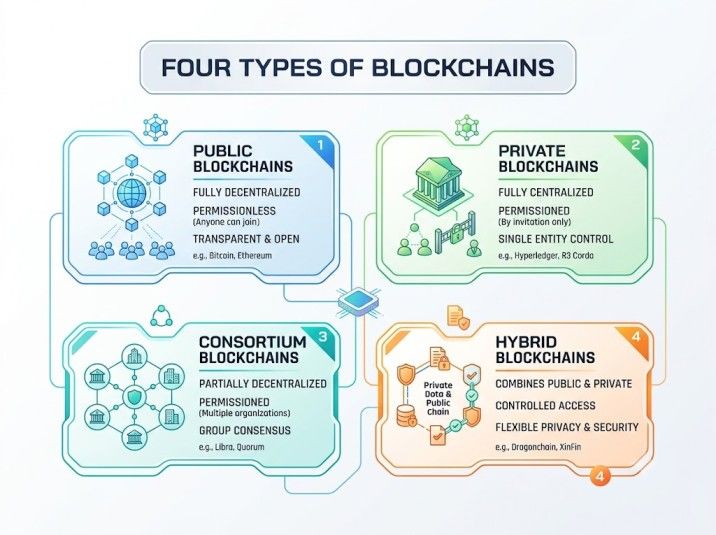
Source: Four Types of Blockchains
Data Science Courses to upskill
Explore Data Science Courses for Career Progression
IIIT Bangalore
Executive Post Graduate Certificate in Data Science & AIPlacement Assistance
Blockchain networks can be designed in different ways depending on who can join, who can validate, and how much control is shared.
The four main types of blockchains are public, private, consortium, and hybrid, each suited to different use cases.
A public blockchain is a network anyone can join without requiring permission. Anyone can view transactions, send transactions, and help validate the network by running a node.
Bitcoin is a classic example of a public blockchain. Anyone in the world can download the Bitcoin software, join the network, and start validating transactions. There is no single company or central authority controlling it.
Ethereum works the same way as Bitcoin. Both are open, permissionless, and fully decentralised, which is why they are often used as the textbook example when people ask about types of blockchain technology.
Public blockchains offer unmatched transparency and decentralization but also face challenges like slower performance and higher energy consumption.
| Advantages | Limitations |
| No central point of failure. | Slower transaction speed at scale. |
| Strong security due to wide network participation. | High energy use in proof-of-work systems. |
| Full transparency builds trust among users. | Not suitable for businesses that need to keep data private. |
A private blockchain restricts access. Only approved members can join, view data, or validate transactions. A single organisation usually controls the entire network.
A private blockchain is a strong fit for enterprise business use because companies often need to keep records internal while still gaining the benefits of a shared, tamper-resistant ledger. Banks, insurance companies, and large manufacturers use private blockchain to track internal processes such as inventory, claims, or compliance records without exposing that data publicly.
While a private blockchain keeps data controlled, it does raise some private blockchain security concerns worth knowing:
These concerns do not make a private blockchain unsafe. They simply mean the security model is different from a public blockchain, and organisations need strong internal controls to manage it well.
A consortium blockchain sits between public and private. Instead of one organisation controlling the network, a group of organisations shares control.
In a consortium blockchain, a set of pre-selected organisations act as validators. No single member has full control. Decisions about network rules usually need agreement from most or all members. This setup works well when multiple companies need to share data, but none of them want to hand over full control to a single party.
Consortium blockchain gives businesses shared trust without full public exposure. It is often the preferred structure when competitors or partners need to collaborate on the same data without one party holding all the power.
A hybrid blockchain combines elements of both public and private blockchains. Some parts of the network remain open, while others remain restricted.
In a hybrid setup, an organisation can keep sensitive data on a private chain while still using a public chain layer for transparency or verification. This gives businesses flexibility. They can choose exactly what stays private and what becomes publicly visible.
Hybrid blockchain use case solutions are common in industries that need both privacy and public trust at the same time:
This flexibility is why hybrid blockchain is growing in industries where full transparency is not required for every piece of data, but some level of public trust still matters.
Also Read: Blockchain Tutorial for Beginners: Learn Blockchain Basic Concepts.
upGrad's Executive Post Graduate Certificate Programme in Data Science & AI from IIITB helps you build these in-demand skills, from data analytics to machine learning and AI, backed by IIIT Bangalore's academic rigor and industry-relevant curriculum. Explore the programme and take the next step toward a career in Data Science & AI.
Blockchain Protocols are the foundational rules and mechanisms that define how a blockchain network operates, allowing participants to securely validate transactions, reach consensus, and maintain a shared ledger without a central authority.
Different blockchain types often run on different protocols, and it helps to know a few names when researching types of blockchain technology.
Protocol |
Common Type |
Known For |
| Ethereum | Public | Smart contracts, open network |
| Hyperledger Fabric | Private/Consortium | Enterprise use, modular design |
| Corda | Consortium | Financial industry use |
| Quorum | Hybrid/Consortium | Built on Ethereum, enterprise-focused |
Also Read: Top Features of Hyperledger Fabric You Should Know
A Blockchain node is a system or device that runs the software of a specific blockchain. Blockchain Nodes are usually computers that make up Blockchain networks. The fundamental function of a blockchain node is to validate the legality of each subsequent batch of network transactions, known as a block.
Every blockchain type relies on nodes to keep the network running. The main types of blockchain nodes include:
The number and type of Blockchain nodes a network allows depend heavily on whether it is public, private, or consortium-based.
Blockchain Blocks are digital records that group verified transactions together, with each Blockchain block securely linked to the previous one, forming a chronological and tamper-resistant chain.
A blockchain is literally made of blocks linked together. The main types of Blockchain blocks include:
Understanding blockchain blocks and nodes helps explain why some blockchain types process transactions faster than others. Fewer nodes and simpler block validation usually mean quicker transaction times.

Source: Blockchain Protocols, Nodes, and Blocks by Type
Different types of blockchain offer different trade-offs in transparency, scalability, control, and security. Each type of blockchain is designed to balance decentralization, privacy, and performance differently. Understanding the differences among types of blockchain helps you choose the right network for your application.
When you compare different types of blockchain side by side, the differences become clearer.
Feature |
Public |
Private |
Consortium |
Hybrid |
| Access | Open to all | Restricted | Restricted to members | Mixed |
| Control | Decentralised | Single organisation | Group of organizations | Mixed |
| Speed | Slower | Fast | Fast | Moderate |
| Transparency | Very high | Low | Moderate | Selective |
| Best for | Cryptocurrency, open networks |
Internal enterprise use | Multi-party business collaboration | Flexible privacy needs |
Public blockchain trades speed for openness. Private blockchain trades openness for speed and control. If your priority is trust without a central authority, public wins. If your priority is data control and faster processing, private wins.
Public blockchain is permissionless by nature. Permissioned blockchain, which includes private and consortium types, requires approval to join. The core difference comes down to who is allowed to participate.
Both are permissioned, but consortium blockchain is controlled by multiple organisations while private blockchain is controlled by just one. Consortium works better when trust needs to be shared across partners.
Public blockchain has no private layer at all. Hybrid blockchain lets you choose what stays private and what goes public, giving more control without giving up all transparency.
Choosing the right type of blockchain depends on what your business or project actually needs.
Public blockchain is generally considered the most secure against outside attacks because it has thousands of nodes validating transactions, making it very hard to alter data. However, private and consortium blockchains can be more secure against internal misuse since access is tightly controlled. Security depends on what threat you are protecting against.
For most enterprise needs, private or consortium blockchain works best. They offer faster transactions, controlled access, and the ability to keep sensitive business data internal. Public blockchain scalability problems, like slow transaction speed and rising costs during high network use, make it less practical for large-scale enterprise operations that need speed and predictability.
If your business needs to meet strict data privacy compliance rules, private or consortium blockchain is usually the safer choice. These types let you control exactly who accesses data, which makes it easier to meet regulations that public blockchain cannot fully support due to its open nature.
Topic for Related Reading: Top 10 Blockchain Applications and Use Cases
Blockchain is not a single technology with one fixed structure. The types of blockchain, public, private, consortium, and hybrid, each solve a different problem. Public blockchain gives you full transparency and decentralisation. Private blockchain gives you speed and control. Consortium blockchain gives multiple organisations a way to collaborate without losing independence. Hybrid blockchain gives you the flexibility to mix privacy with transparency where it matters most.
There is no single best type. The right choice depends on what you are building, who needs access, and how much control you are willing to share. Once you understand these differences, choosing the right blockchain type for your project or business becomes a much easier decision.
Want personalized guidance on Data Science and upskilling? Speak with an expert for a free 1:1 counselling session today.
Blockchain is a digital ledger that records transactions across a network of computers in a way that cannot be easily altered. It has four main types: public, private, consortium, and hybrid. Each type differs in who can access the network and who controls it, which changes how transactions are validated and shared.
The four types of blockchain are public, private, consortium, and hybrid. Public blockchain is open to everyone, private blockchain is restricted to one organisation, consortium blockchain is shared among a group of organisations, and hybrid blockchain combines features of both public and private systems.
Blockchain networks are classified by access level and control structure. Public networks allow anyone to join and validate. Private networks restrict access to one entity. Consortium networks are governed by multiple approved organisations. Hybrid networks mix open and restricted access within a single system.
There are only four widely recognised types of blockchain, but the number of actual blockchain networks running today is in the thousands. Bitcoin, Ethereum, Solana, and Cardano are just a few examples. Each one falls under one of the four main blockchain types, most commonly public.
Some of the most widely used blockchain networks include Bitcoin, Ethereum, BNB Chain, Solana, and Cardano. Most of these operate as public blockchains, meaning anyone can join, view transactions, and participate in validating the network without needing special permission.
New blockchain networks and upgrades launch frequently as developers work on faster and more scalable systems. Regardless of how new a blockchain is, it still fits into one of the four core types, public, private, consortium, or hybrid, based on its access rules and governance model.
A private blockchain is a restricted network controlled by a single organisation. Only approved members can join, view data, or validate transactions. It offers faster processing and more privacy than public blockchain, making it a common choice for internal enterprise systems and controlled data environments.
A consortium blockchain is managed by a group of organisations rather than a single company. Members share control over validating transactions and setting network rules. It is often used in banking, supply chain, and healthcare, where multiple parties need shared trust without full public exposure.
Blockchain is the underlying technology, a digital ledger system that records data across a network. Bitcoin is one application built on top of blockchain technology, specifically a public blockchain used for cryptocurrency transactions. Many other systems, both public and private, also use blockchain technology beyond Bitcoin.
Blockchain applications vary by industry and include areas like supply chain tracking, banking and finance, healthcare record sharing, identity verification, and cryptocurrency. The specific type of blockchain used, public, private, consortium, or hybrid, depends on how much privacy and control each application requires.
Most cryptocurrencies run on public blockchain, since decentralisation and open participation are central to how they work. Bitcoin and Ethereum are prime examples. However, some crypto-adjacent enterprise systems use private or consortium blockchain when they need more control over participants and data.
724 articles published
Sriram K is a Senior SEO Executive with a B.Tech in Information Technology from Dr. M.G.R. Educational and Research Institute, Chennai. With over a decade of experience in digital marketing, he specia...
Speak with Data Science Expert
By submitting, I accept the T&C and
Privacy Policy
Start Your Career in Data Science Today
Top Resources
Executive Diploma
12 Months
Master's Degree
18 Months
Bootcamp
6 Months