Law of Demand: Meaning, Examples, Assumptions, and Importance
By upGrad
Updated on Jun 18, 2026 | 7 min read | 2.33K+ views
Share:

All courses
Certifications
More
By upGrad
Updated on Jun 18, 2026 | 7 min read | 2.33K+ views
Share:
Table of Contents
The law of demand is a fundamental concept in economics. It tells us how consumer purchase when prices went up or down. When you are buying food, picking a phone or buying flight tickets the law of demand affects what you do every day. Knowing the law of demand helps us understand why companies change their prices and how the market works.
In this blog, you’ll learn what the law of demand is, how it works, what it assumes, and where it does not apply. You will also explore examples of the law of demand from daily life and why it is still one of the important ideas in economics and in taking business decisions.
Explore Doctor of Business Administration (DBA) from upGrad and master the Law of Demand and Other Core Economic Principles.
Popular upGrad Programs
The law of demand in economics is about how the price of a product affects people’s purchasing habits. When a products price goes up, people usually buy less of it.
On the hand, when the price of a product falls, people tend to buy more of that product. This happens when all other things stay the same. The law of demand shows this relationship.
The products price and demand are connected in this way. This inverse relationship forms the foundation of consumer behavior analysis.
Also Read: How To Do Market Research – [Ultimate Guide]
The law of demand definition can be stated as:
The law of demand is stated: When everything else stays the same, people want more of something if its price goes down and they want less of it if the price goes up.
Economists say "ceteris paribus" which means all other things are equal. They use this phrase to explain the law of demand. Where it explains considering price and demand, demand rises when price falls and demand fall when price rises.
Let's take an example of a coffee shop that sells a cup of coffee for ₹200.
When the price decrease to ₹150:
But when the price goes up to ₹300:
This is a way to explain the law of demand, practically
Also Read: Difference between Individual Demand and Market Demand
Free Courses
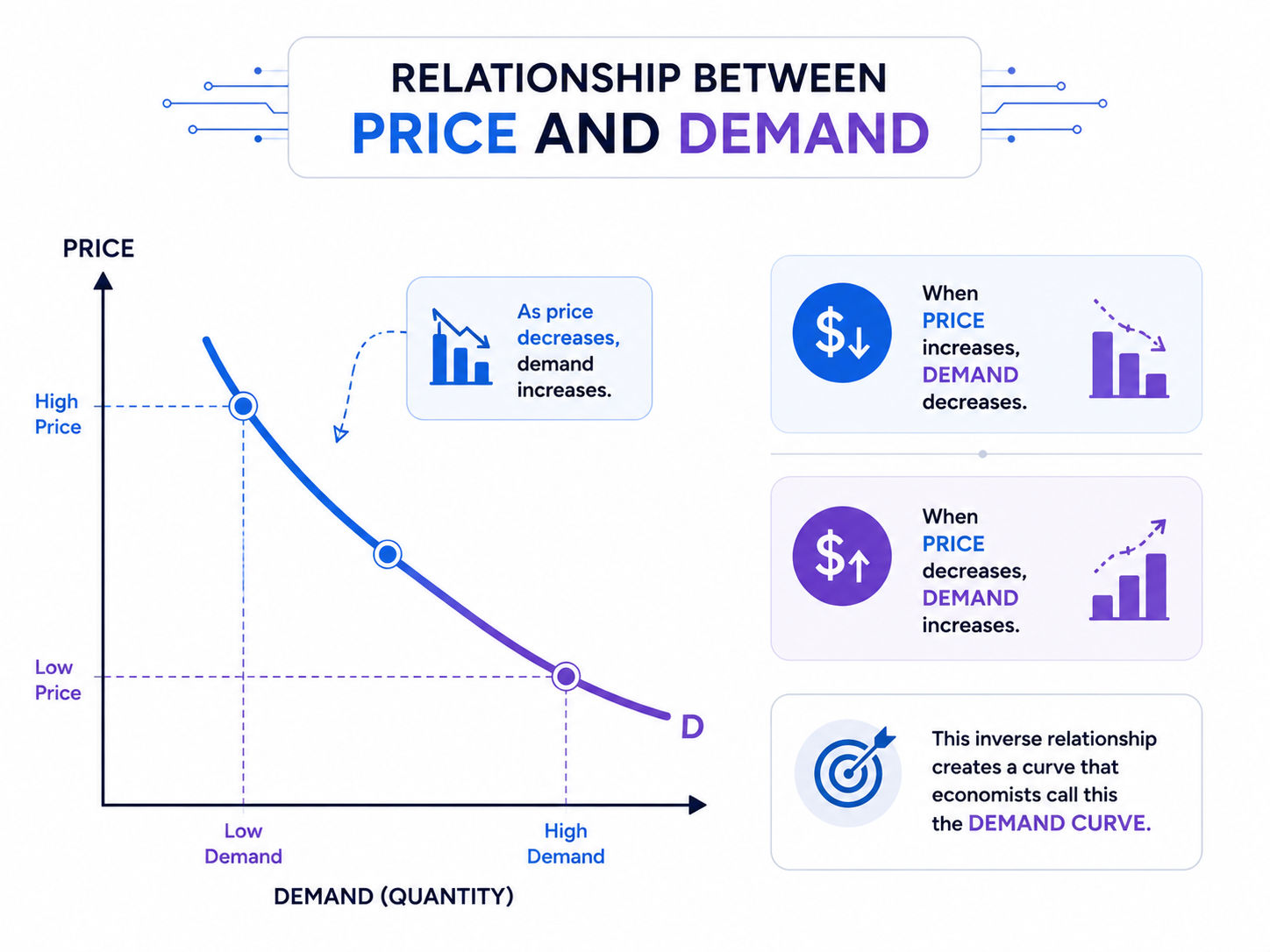
This inverse relationship creates a curve that economists call this the demand curve.
Price Level |
Quantity Demanded |
| High | Low |
| Moderate | Moderate |
| Low | High |
Also Read: Consumer Behavior in Marketing: Understanding the Psychology
Consumers naturally seek greater value for their money.
There are various factors that can influence consumer behavior:
The law of demand in economics remains relevant because it reflects a common pattern in human decision-making. Most people get careful when prices go up. Whereas will be willing to buy when prices come down.
Also Read: What is Hyperinflation? How does it Works? Causes, Effects [With Real World Examples]
Recommended Courses to upskill
Explore Our Popular Courses for Career Progression
IIIT Bangalore
Executive Diploma in Machine Learning and AI360° Career Support
O.P.Jindal Global University
MBA from O.P.Jindal Global UniversityLive Case Studies and Projects
So, to explain the law of demand, it is crucial to think about what makes people choose to buy things.
The law of demand is not only about the price of something. The price is usually the thing that affects what people decide to buy right now. The law of demand will help us understand how people make these choices.
A demand schedule shows how demand changes at different prices. Often, as prices decline, demand increases.
Price (₹) |
Quantity Demanded |
| 500 | 100 units |
| 400 | 150 units |
| 300 | 220 units |
| 200 | 320 units |
| 100 | 450 units |
The information from a demand schedule can be plotted on a graph.
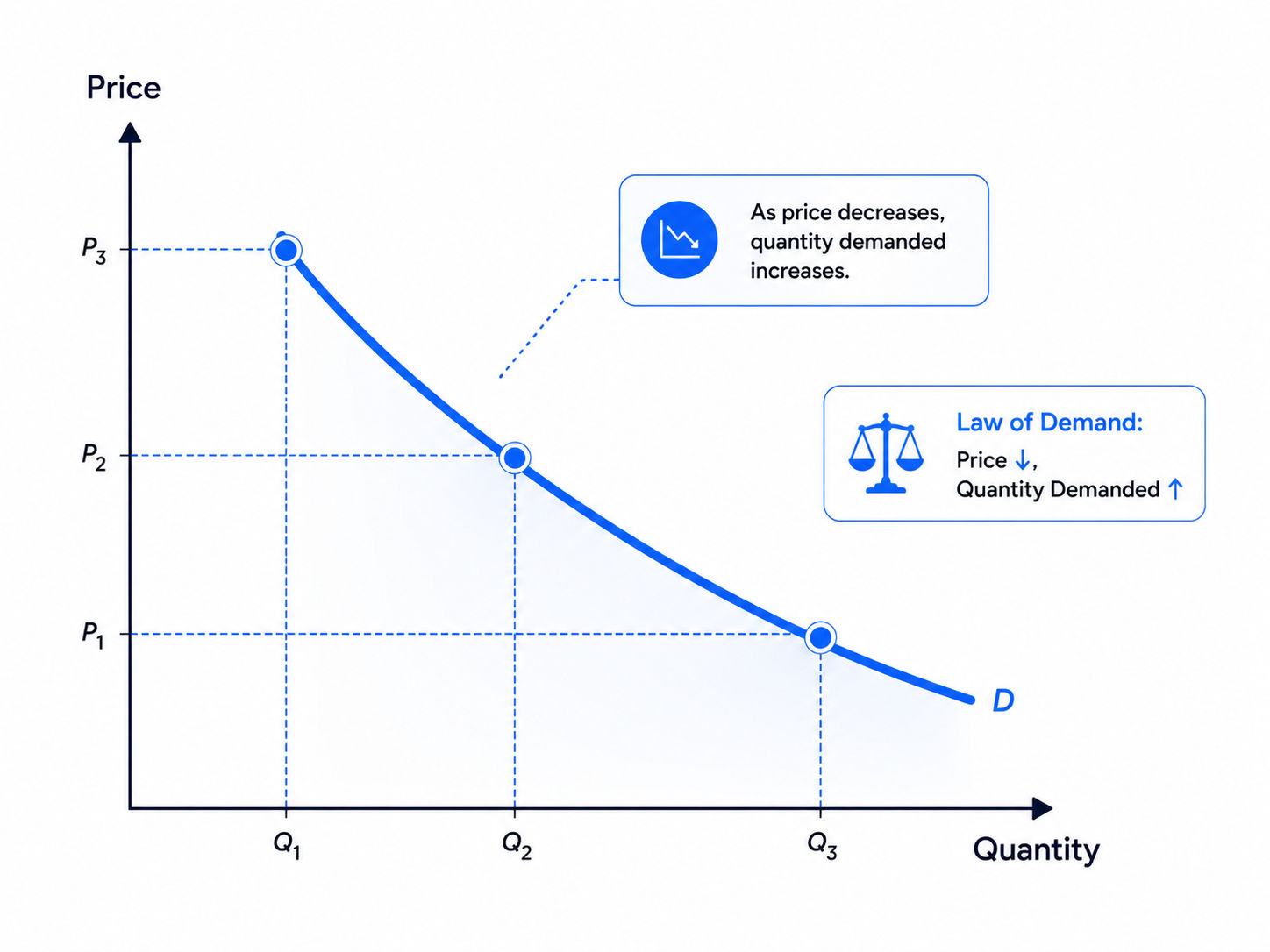
A demand curve usually goes down from left to right. This downward slope shows us the law of demand.
When prices fall, your purchasing power quietly rises
When prices fall, consumers effectively gain purchasing power.
For example:
Consumers often switch between alternatives.
Example:
Lower prices attract consumers who previously could not afford the product. This increases total demand.
Example 1: Online Shopping Sales
During festive sales:
Example 2: Airline Tickets
When airlines offer discounts:
Example 3: Electronics
Smartphone sales often increase after price reductions.
Companies that do not understand how people buy things will have problems with prices. They might set prices that're too high or too low.
The law of demand is a deal in economics, and that is why business schools all around the world still teach the law of demand to students.
Businesses rely heavily on demand analysis for:
Also Read: Revenue Management: How Businesses Decide What to Charge and When
Economists say that these assumptions are important because markets in the world are affected by a lot of things, not just the price of something.
The economists really want to make a point about these assumptions because real-world markets are influenced by factors besides the price.
The phrase " things remaining constant" is very important, in demand analysis. When many things change at the time, it gets hard to see how much the price affects things.
The idea of " things remaining constant" helps us understand the impact of price.
The law of demand operates under certain assumptions. These conditions help economists analyze how price alone influences consumer demand.
Summary Table of Assumptions
Assumption |
Impact |
| Stable income | Isolates price effect |
| Stable preferences | Maintains demand consistency |
| Constant related prices | Prevents external influence |
| No future expectations | Avoids speculative buying |
| Stable population | Keeps market size unchanged |
The theory assumes income does not change. If income rises significantly: Consumers may continue buying even at higher prices.
The model assumes tastes and preferences remain unchanged. For example: A sudden celebrity endorsement can increase demand regardless of price.
Substitutes and complementary products affect demand. Changes in related product prices can alter purchasing behavior.
Examples:
Consumers often change buying decisions based on future expectations.
For example: If people expect prices to rise next month, they may purchase more today.
The number of consumers is assumed to remain unchanged. Population growth can naturally increase demand even without price changes.
Although the principle is widely applicable, there are situations where the law of demand does not behave as expected.
These situations are called exceptions.
Giffen goods are low-income necessities.
In rare cases:
Consumers may be forced to buy more because they cannot afford better alternatives.
Luxury products sometimes become more desirable when prices rise.
Examples include:
Higher prices may signal status and exclusivity.
People often buy more when they expect future price increases.
Examples:
Future expectations override normal demand behavior.
Demand for necessities may remain strong regardless of price.
Examples:
Consumers prioritize necessity over cost.
Situation |
Demand Response |
| Normal Goods | Price up, demand down |
| Giffen Goods | Price up, demand up |
| Luxury Goods | Price up, demand up |
| Emergency Goods | Demand remains stable |
Subscribe to upGrad's Newsletter
Join thousands of learners who receive useful tips
The law of demand is not something you learn in school. It actually affects pricing, policy making, production planning, and marketing decisions
Businesses use demand analysis to:
A small pricing mistake can significantly impact revenue.
Countries' demand patterns often give us valuable insights into the economic condition of the country.
Governments use demand studies to:
Consumers gain because businesses start to listen to what they need. When businesses get a sense of how people behave when it comes to buying things, they usually start to price their products in a way that is fairer.
Certain information support in implementing better planning at both the national and organizational level.
The law of demand definition helps economists predict:
When we explain the law of demand in simple terms, we can say that it is a tool that helps us understand how consumers make certain decisions to purchase when the prices change.
The law of demand remains one of the most reliable economic principles, despite the market complexities.
Stakeholder |
Benefit |
| Businesses | Better pricing decisions |
| Governments | Improved policy design |
| Consumers | Greater value and choice |
| Economists | Market forecasting |
The law of demand explains one of the most basic realities of consumer behavior: people generally buy more when prices fall and less when prices rise. This simple principle forms the foundation of demand analysis, pricing strategies, and market forecasting.
Understanding the law of demand in economics helps students, businesses, policymakers, and consumers make better decisions. While exceptions exist, the principle remains highly relevant in modern markets. By learning how demand responds to price changes, you gain a clearer understanding of how economies function and how everyday purchasing decisions shape markets.
Want to explore more about law of demand? Book your free 1:1 personal consultation with our expert today.
The simplest way to explain the law of demand is that consumers usually buy more when prices fall and buy less when prices rise. This relationship assumes other factors remain unchanged. It reflects common purchasing behavior seen across most products and services in everyday markets.
The law of demand helps economists understand consumer behavior and market trends. It provides a framework for predicting how changes in price affect purchasing decisions. Businesses and governments also use it when making pricing and policy decisions.
Ceteris paribus means "all other things being equal." It indicates that factors such as income, preferences, and population remain constant while studying the effect of price changes. This assumption helps isolate the relationship between price and demand.
No. Some products, such as luxury goods and certain inferior goods, may behave differently. These situations are considered exceptions to the rule. However, most goods in everyday markets still follow the traditional demand pattern.
Demand refers to the overall willingness and ability to buy a product at different prices. Quantity demanded refers to the specific amount consumers purchase at a particular price. Understanding this distinction is important in economic analysis.
When income increases, consumers often buy more goods and services. Conversely, lower income may reduce spending. This factor can influence demand independently of price changes.
The demand curve slopes downward because lower prices encourage more purchases while higher prices discourage them. Income and substitution effects contribute to this pattern. This graphical representation supports the law of demand.
Yes. In some cases, such as luxury goods or speculative investments, demand may increase despite higher prices. These are considered exceptions rather than the norm.
Businesses analyze demand to determine pricing strategies, forecast sales, and manage inventory. Understanding consumer reactions helps improve profitability. Many marketing and pricing decisions rely on demand analysis.
Most everyday products follow the law of demand. Examples include clothing, electronics, groceries, furniture, and household items. Consumers typically buy more of these products when prices decline.
Yes. Even in online marketplaces, consumer purchasing behavior largely follows the law of demand. Discounts, promotions, and dynamic pricing strategies are based on this principle. The concept remains highly relevant despite technological advancements.
990 articles published
We are an online education platform providing industry-relevant programs for professionals, designed and delivered in collaboration with world-class faculty and businesses. Merging the latest technolo...
Get Free Consultation
By submitting, I accept the T&C and
Privacy Policy
Top Resources
Certification
3 Months
Certification
6 Months
O.P. Jindal Global University
Masters in International Accounting and Finance (Accredited by ACCA, UK)Master's Degree
12 Months