Law of Supply: Definition, Factors, and Real-World Examples
By upGrad
Updated on Jun 19, 2026 | 6 min read | 1.81K+ views
Share:

All courses
Certifications
More
By upGrad
Updated on Jun 19, 2026 | 6 min read | 1.81K+ views
Share:
Table of Contents
The law of supply is one of the most fundamental ideas in economics. It explains why producers behave the way they do when prices change, and once you understand it, you'll start seeing it everywhere, from petrol prices to vegetable vendors at your local market.
Simply put, when the price of a product rises, sellers usually offer more of it for sale. When the price falls, they supply less.
This blog breaks down what the law of supply actually means, the factors that shift it, how it connects to demand, and where it plays out in real life.
Explore upGrad's Management and MBA programs to develop a strong understanding of economics, business strategy, financial decision-making, operations management, supply chain management, and market dynamics.
Popular upGrad Programs
The law of supply states that as the price of a good or service rises, producers are willing and able to supply more of it. When prices fall, they supply less. That's the core idea.
Why does this happen? Higher prices mean higher profit potential. Sellers naturally want to take advantage of that. A farmer who gets Rs. 50 per kg for tomatoes will harvest more than when the price is Rs. 20 per kg. The incentive changes, so the behaviour changes.
This relationship between price and quantity supplied is direct and positive. It's the opposite of demand, which moves in the other direction.
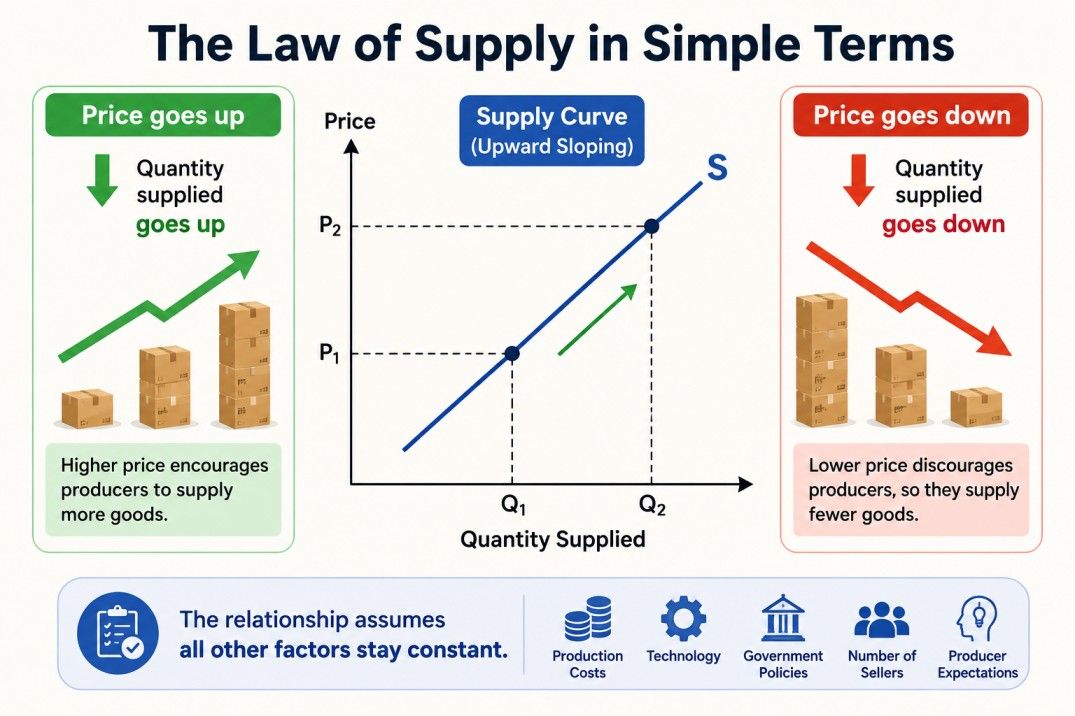
The law of supply works under a condition economists call ceteris paribus, meaning "all else being equal." In real markets, everything isn't always equal. That's where supply curves shift, and things get more interesting.
Free Courses
Imagine a mobile phone manufacturer in Pune. When the market price for a mid-range phone is Rs. 15,000, the company produces 10,000 units per month. The profit margin is decent. Now suppose demand spikes, and the market price climbs to Rs. 22,000. The same company pushes production to 18,000 units because it's now more profitable to do so.
That's the law of supply in action. Each time the price increases, the quantity supplied goes up. The relationship is consistent.
The type of supply depends on factors such as production time, availability of resources, storage capacity, and how easily producers can increase output when prices change. The law of supply is often analyzed through different types of supply elasticity, which measure how strongly producers respond to price changes. These include perfectly elastic supply, perfectly inelastic supply, relatively elastic supply, relatively inelastic supply, and unitary elastic supply. Each type helps explain how different industries and products react when market prices rise or fall.
Type of Supply |
Meaning |
Price Response |
Example |
| Perfectly Elastic Supply | Supply changes sharply. | Small price change, large supply change. | Financial markets |
| Perfectly Inelastic Supply | Supply is fixed. | No change in supply. | Rare artworks |
| Relatively Elastic Supply | Supply changes easily. | Supply rises more than price. | Electronics |
| Relatively Inelastic Supply | Supply changes slowly. | Supply rises less than price. | Agricultural crops |
| Unitary Elastic Supply | Equal proportionate change. | Supply changes same as price. | Industrial goods |
This is also what economists plot as the supply curve, an upward-sloping line on a price-quantity graph. The slope confirms the positive relationship between price and supply.
The supply curve is a graphical representation of the law of supply. It shows the relationship between the price of a product and the quantity producers are willing to supply. The curve typically slopes upward from left to right, indicating that higher prices encourage sellers to offer more goods in the market, while lower prices reduce the quantity supplied.

One thing to keep clear here: quantity supplied and supply are not the same. Quantity supplied changes when the price changes, staying on the same curve. Supply itself shifts when something other than price changes, like production costs or technology.
Also read: Difference between Individual Demand and Market Demand
Recommended Courses to upskill
Explore Our Popular Courses for Career Progression
IIIT Bangalore
Executive Diploma in Machine Learning and AI360° Career Support
O.P.Jindal Global University
MBA from O.P.Jindal Global UniversityLive Case Studies and Projects
Price isn't the only thing that influences how much gets produced. Several non-price factors can shift the entire supply curve left or right. These are called determinants of supply.
If raw materials, labour, or energy become more expensive, producers can't supply as much at the same price point. Their margins shrink, so they scale back. A spike in diesel prices hits transport companies hard. They don't just absorb it. They reduce output or raise prices.
Better technology usually increases supply. When a factory installs faster machinery, it produces more without raising costs. That shifts supply to the right.
More sellers in the market means more total supply. When new dairy farms enter a region, the overall milk supply goes up, even if each individual farm hasn't changed its output.
Subsidies increase supply. Taxes reduce it. A government subsidy on solar panels brings down manufacturing costs, so producers supply more at every price level.
This one's unpredictable. A drought cuts crop output regardless of what price the market offers. Weather, disasters, and seasonal patterns all affect supply in ways no producer can fully control.
If producers expect prices to rise soon, they may hold back current supply to sell later at a higher price. If they expect prices to fall, they'll flood the market now. Anticipation shapes behaviour.
Do read: Difference Between Substitute and Complementary Goods
You can't fully explain the law of supply without talking about law of demand. Together, they determine the market price and the quantity actually traded.
Here's the key difference:
Basis |
Law of Demand |
Law of Supply |
| Meaning | Explains how consumers respond to price changes. | Explains how producers respond to price changes. |
| Relationship with Price | Inverse relationship | Direct relationship |
| When Price Increases | Consumers buy less. | Producers supply more. |
| When Price Decreases | Consumers buy more. | Producers supply less. |
| Main Focus | Consumer purchasing behavior | Producer selling behavior |
| Curve Slope | Downward from left to right | Upward from left to right |
| Objective | Maximize consumer satisfaction | Maximize producer profits |
| Example | If smartphone prices rise, fewer consumers buy them. | If smartphone prices rise, manufacturers produce more units. |
These two forces pull in opposite directions. The point where they meet is called equilibrium. At equilibrium, the quantity producers want to supply matches the quantity consumers want to buy.
Think of it like a seesaw. When demand rises (say, during a festival), prices tend to go up. Higher prices signal producers to supply more. Over time, supply catches up, and prices stabilise again.
But markets don't always reach equilibrium quickly. Supply takes time to adjust. You can't build a new factory overnight. That's why prices can stay high for months before more supply enters the market and brings them back down.
What Happens When They're Out of Balance:
This self-correcting mechanism is central to how free markets function.
Do read: Accounting Profit: What It Is, How to Calculate It, and Key Differences
Let's look at where the law of supply shows up in everyday Indian markets.
Onions are one of the most talked-about commodities in India. When production drops due to poor monsoon, supply falls. Prices shoot up. Farmers who do have stock benefit, but consumers feel the pinch. When the next harvest is good, prices crash, sometimes so badly that farmers don't find it worth selling.
Land is limited in cities like Mumbai or Bengaluru. Even when demand rises sharply, supply doesn't respond quickly because construction takes years and permissions take longer. Prices stay high because supply can't catch up fast enough.
As EV prices have dropped and government subsidies have increased, manufacturers have ramped up production. More models are hitting the market. That's the law of supply responding to a combination of technology improvements, lower battery costs, and policy support.
Mangoes flood the market between April and June. Supply is high, prices are low. Come August, they're gone. The supply has dropped to near zero, and any mangoes available cost significantly more. Seasonal supply shifts are predictable but still move prices every year.
Also read: Essential Functions of Financial Management for Effective Business Strategy
The law of supply is useful, but it doesn't explain everything. There are situations where the expected relationship breaks down.
Exception |
Why the Law of Supply Doesn't Apply |
| Inelastic Supply | Some goods cannot be produced in greater quantities even when prices rise. For example, paintings by a deceased artist have a fixed supply, so higher prices do not increase availability. |
| Agricultural Supply Delays | Farmers cannot immediately increase crop production when prices rise. Growing wheat, rice, or other crops takes time, and market prices may change before the additional supply reaches the market. |
| Perishable Goods | Sellers of products like fish, fruits, or vegetables may lower prices to avoid spoilage and losses. In such cases, supply decisions are influenced by perishability rather than price changes. |
| Monopolistic Markets | A monopoly supplier may deliberately restrict output even when prices increase. Limiting supply can help maintain higher prices and profits, which goes against the typical prediction of the law of supply. |
Real markets are messy. The law of supply gives you a useful framework, but you always need to check what's actually happening on the ground.
The law of supply explains how producers respond to changes in price. When prices rise, businesses usually supply more goods. When prices fall, supply often decreases. This direct relationship forms the basis of many economic decisions.
Understanding the assumptions, supply curve, examples, and exceptions provides a deeper view of how markets function. When combined with demand, the law of supply helps explain price movements, production choices, and resource allocation across industries and economies.
Ready to start your journey? Book a free consultation with upGrad today to find the best path for your career.
A movement along the supply curve occurs when the price of a product changes, causing a change in quantity supplied. A shift in the supply curve happens when non-price factors such as technology, production costs, taxes, or government policies change. These factors affect supply at every price level.
The law of supply helps explain how producers make decisions in a market economy. It shows how businesses respond to price signals and allocate resources. Economists use this principle to study market behavior, predict production trends, and understand how industries react to changing economic conditions.
In highly competitive markets, businesses are more likely to increase output when prices rise because they want to capture additional profits. Competition also encourages efficiency and innovation, making it easier for firms to expand production and respond quickly to market opportunities.
Yes. Digital products such as software, online courses, and streaming services also follow supply principles. When demand and profitability increase, companies often expand server capacity, content production, or service offerings. However, digital goods usually have lower production constraints than physical products.
Inventory gives producers flexibility in responding to price changes. Businesses with large inventories can increase market supply immediately when prices rise. Companies with limited stock may need additional production time, which can delay their response and affect short-term market availability.
Global supply chains allow businesses to source materials and manufacture products across different countries. This can increase overall supply and reduce costs. However, disruptions such as trade restrictions, shipping delays, or geopolitical events can quickly affect supply levels worldwide.
In the short run, businesses face limitations such as factory capacity, labor availability, and existing contracts. Over the long run, firms can expand facilities, invest in equipment, and hire more workers. This makes supply generally more responsive to price changes over time.
Seasonal industries experience predictable fluctuations in production throughout the year. Agricultural products, tourism services, and holiday-related goods often see supply increase during peak seasons and decline during off-seasons. These changes influence prices and market availability.
Supply elasticity measures how much quantity supplied changes in response to a price change. Products with flexible production processes often have elastic supply, while products requiring significant time or resources tend to have inelastic supply. Understanding elasticity helps businesses make better production decisions.
Subsidies reduce production costs for businesses, making it more profitable to produce goods and services. As a result, firms often increase output and market supply. Governments commonly use subsidies in sectors such as agriculture, renewable energy, and manufacturing to encourage growth.
Business leaders use the law of supply to forecast production needs, manage inventory, and plan expansion strategies. Understanding how supply responds to price changes helps companies make informed decisions about pricing, resource allocation, and market entry while maintaining profitability.
987 articles published
We are an online education platform providing industry-relevant programs for professionals, designed and delivered in collaboration with world-class faculty and businesses. Merging the latest technolo...
Get Free Consultation
By submitting, I accept the T&C and
Privacy Policy
Top Resources
Certification
3 Months
Certification
6 Months
O.P. Jindal Global University
Masters in International Accounting and Finance (Accredited by ACCA, UK)Master's Degree
12 Months