Risk Mitigation: Definition, Process, Strategies, Types, Examples & Best Practices
By Sriram
Updated on Jul 07, 2026 | 10 min read | 7.21K+ views
Share:

All courses
Certifications
More
By Sriram
Updated on Jul 07, 2026 | 10 min read | 7.21K+ views
Share:
Table of Contents
This blog explains what is risk mitigation, its purpose, the risk mitigation meaning, key components of risk mitigation, and practical risk mitigation strategies. You'll also learn how to create an effective mitigation plan with real-world examples.
Understanding risk mitigation is just the beginning. Build stronger skills in project management, business strategy, and decision-making with an MBA course from upGrad, designed to prepare you for real-world business challenges through flexible online learning.
Popular MBA Programs
Every organisation faces uncertainty, from supplier delays to cyberattacks and changing market conditions. Risk mitigation helps reduce the likelihood or impact of these risks through proactive planning rather than reacting after problems occur.
The risk mitigation meaning is identifying potential risks, assessing their impact, and taking planned actions to minimize possible losses. If you're wondering what risk mitigation is, it's simply the process of preparing for potential problems before they become costly or disruptive. For example, a business may back up its data regularly or inspect equipment to reduce future risks.
Every business faces uncertainty, from operational disruptions to financial losses and cybersecurity threats. Risk mitigation helps organizations prepare for these challenges before they become major problems. Rather than eliminating every risk, it focuses on reducing their likelihood or impact while supporting informed decision-making.
Also Read: Why Organizational Skills Matter in the Workplace and How to Improve Them
Free Courses
Understanding the components of risk mitigation makes the entire process easier to follow. Although organizations may use different frameworks, most successful mitigation plans include the same core elements.
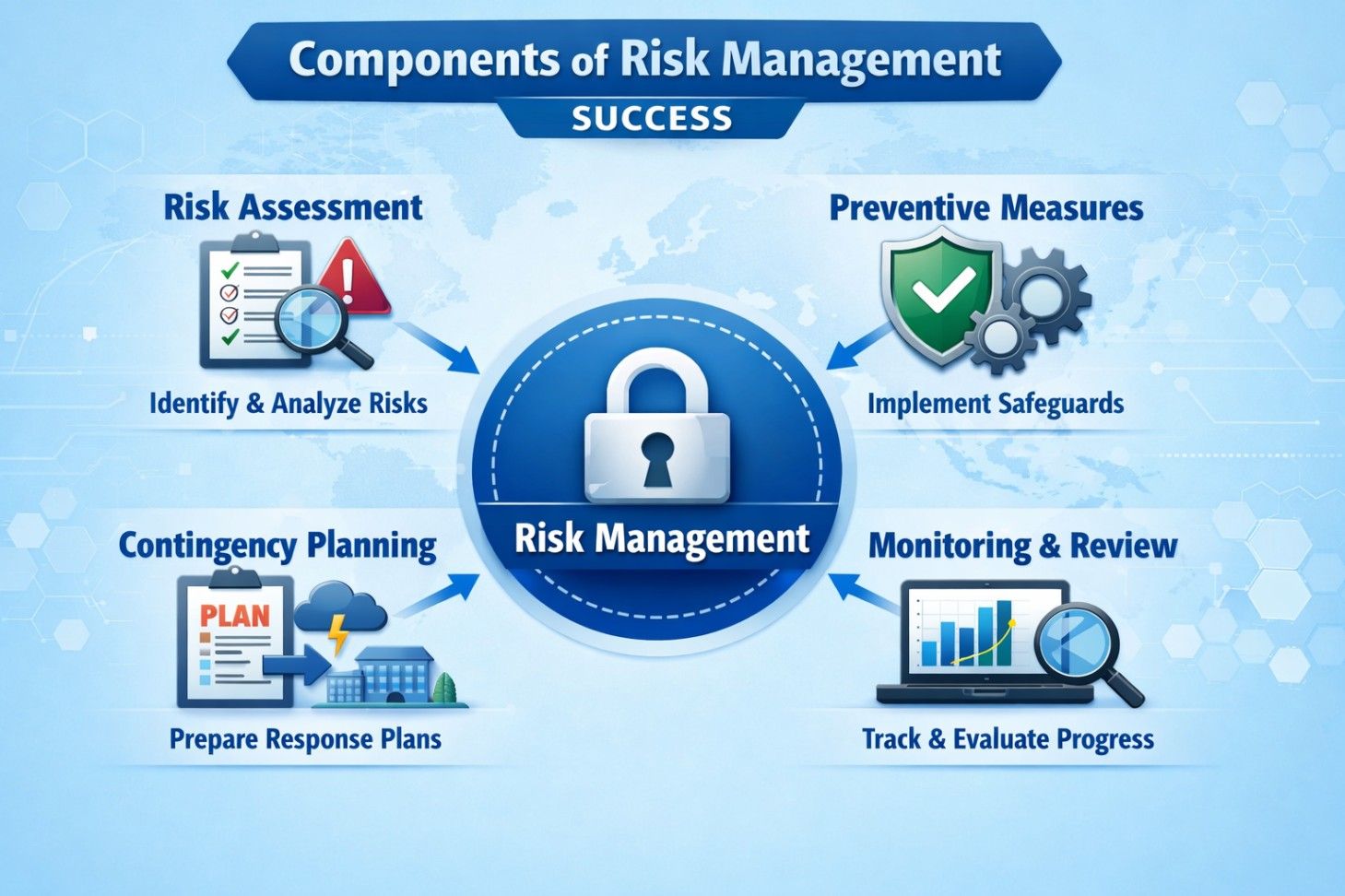
Together, these components of risk mitigation create a continuous cycle rather than a one-time activity. Businesses don't simply create a plan and forget it. They review risks regularly because new challenges emerge as projects, markets, and technologies evolve.
Also Read: Top 10 Management Skills Required to Become a Successful Manager
MBA Courses to upskill
Explore MBA Courses for Career Progression
O.P.Jindal Global University
MBA (with Career Acceleration Program by upGrad)Become interview ready with Career Services
PSB MBA + IIML Certification
MBA from Paris School of Business with Certification from IIM LucknowA structured risk mitigation process helps organizations identify, assess, and manage risks before they affect business operations. While the approach may vary, it generally follows these seven key steps.
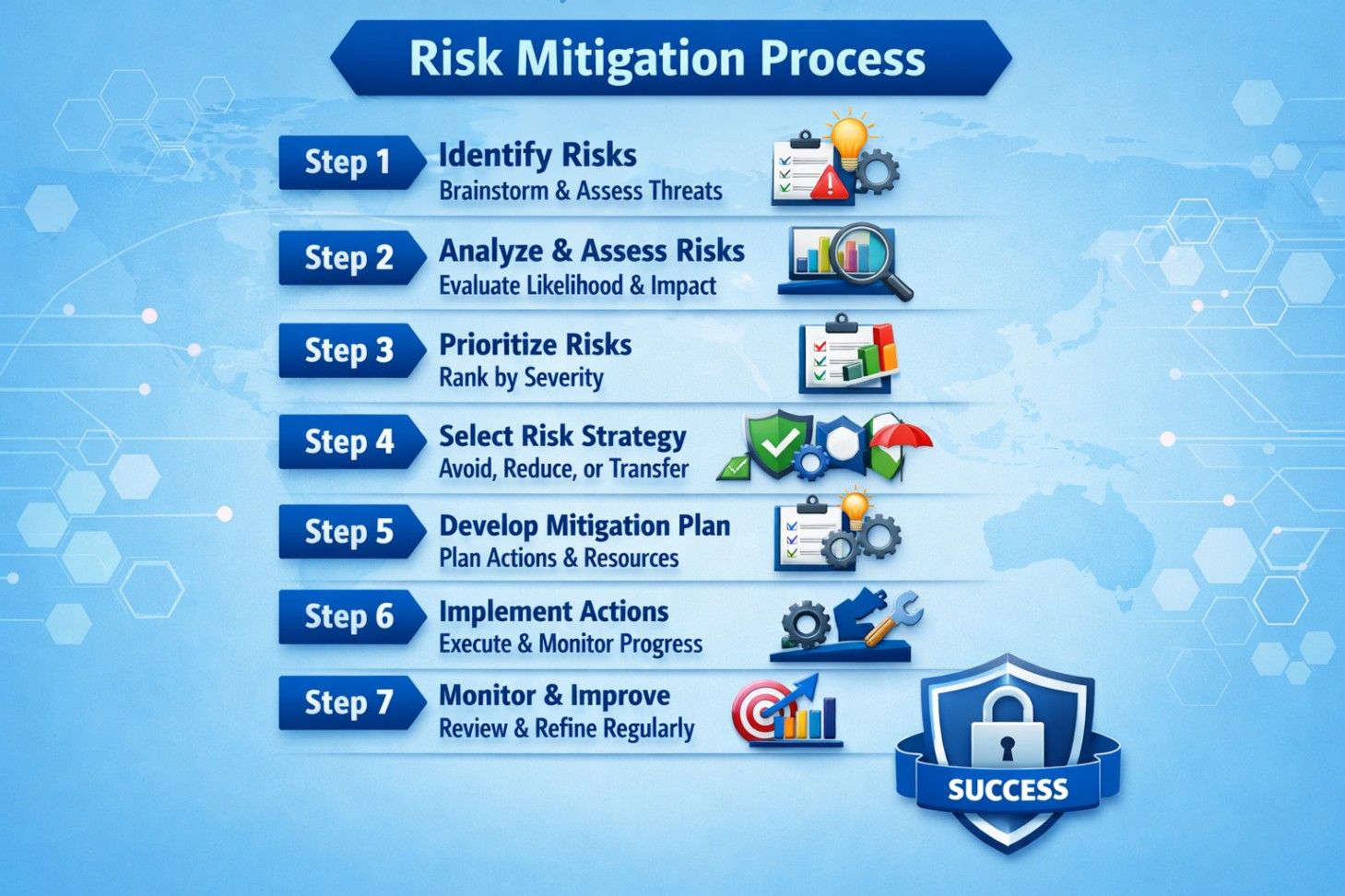
Not every risk requires the same response. The right approach depends on the likelihood of the risk, its potential impact, available resources, and business goals.
Most organisations rely on four core risk mitigation strategies to manage potential threats effectively.
Risk avoidance eliminates the activity that creates the risk. It's suitable when the potential consequences outweigh the expected benefits.
Risk reduction lowers either the probability of a risk occurring or its impact if it does.
This is one of the most commonly used risk mitigation strategies because it allows organizations to continue operating while minimizing exposure.
Risk transfer shifts part of the financial or operational responsibility to another party without eliminating the risk itself.
Risk acceptance involves acknowledging a low-impact or unavoidable risk and deciding to monitor it rather than spend resources to eliminate it. This decision is based on careful analysis, not ignoring the risk.
Also read : The Importance of Business Ethics: Why It Matters Today?
Many people use risk mitigation and risk management interchangeably, but they have different roles. Risk management is the overall process of identifying, assessing, prioritizing, treating, and monitoring risks. Risk mitigation is one stage within that process that focuses specifically on reducing the likelihood or impact of identified risks.
In simple terms, risk management is the complete framework, while risk mitigation is the action taken to minimize specific risks.
A simple workflow looks like this.
Risk Management Stage |
Purpose |
| Identify risks | Discover internal and external threats. |
| Assess risks | Measure likelihood and business impact. |
| Prioritize risks | Rank risks based on severity. |
| Risk mitigation | Select and implement appropriate responses. |
| Monitor and review | Measure outcomes and improve the plan continuously. |
Explore upGrad's MBA programs and take the next step toward becoming a confident business leader.
Organizations face different types of risks depending on their industry, operations, and business goals. Understanding these risk categories helps teams choose the right risk mitigation strategies instead of responding only after problems occur.
Risk Type |
Common Examples |
Risk Mitigation Approach |
| Operational Risks | Equipment failures, human error, supplier delays, process breakdowns, system outages | Preventive maintenance, process improvements, employee training |
| Financial Risks | Cash flow shortages, inflation, credit defaults, currency fluctuations, rising costs | Budget planning, emergency reserves, revenue diversification |
| Cybersecurity Risks | Data breaches, ransomware, phishing, unauthorized access | Security updates, multi-factor authentication, employee awareness training |
| Compliance Risks | Data privacy violations, workplace safety issues, regulatory non-compliance | Internal audits, compliance monitoring, regular training |
| Reputational Risks | Negative publicity, poor customer service, product defects | Crisis communication, quality control, customer feedback management |
| Environmental Risks | Floods, earthquakes, wildfires, extreme weather | Emergency response plans, insurance, business continuity planning |
| Strategic Risks | New market entry, product launches, mergers, changing customer demand | Market research, pilot projects, strategic planning, performance reviews |
Must Read: Understanding Business Law: Key Elements and Its Importance for Success
A risk mitigation plan is a structured document that outlines how an organization will manage identified risks before they affect business operations. It defines the actions needed to reduce or control risks, assigns responsibilities, and sets timelines for implementation.
An effective plan helps teams respond consistently, improve decision-making, and minimize disruptions throughout a project or business process.
A well-structured risk mitigation plan typically includes:
A well-designed risk mitigation plan turns risk analysis into practical action, helping organizations reduce uncertainty and respond more effectively to potential challenges.
Also Read: What is Project Management Process: Phases and Life Cycle
People often confuse these terms because they're closely related. They're connected, but they aren't interchangeable.
Risk management covers the entire process of dealing with uncertainty. Risk mitigation focuses specifically on reducing the likelihood or impact of identified risks.
Think of mitigation as one stage within the broader risk management lifecycle.
Risk Mitigation |
Risk Management |
| Focuses on reducing specific risks | Covers the complete risk lifecycle |
| Begins after risks are identified | Begins with identifying risks |
| Uses strategies such as avoidance and reduction | Includes identification, assessment, mitigation, monitoring, and review |
| Goal is minimizing impact | Goal is managing uncertainty across the organization |
Also Read: What is Risk Management Strategies? Top Strategies to Follow
These concepts are related, but they represent different decisions.Risk avoidance removes the activity that creates the risk.
Risk mitigation accepts that some level of risk exists and works to reduce its likelihood or consequences instead.
Here's a simple comparison.
Risk Mitigation |
Risk Avoidance |
| Reduces the impact or probability of risk | Eliminates the source of risk entirely |
| Risk remains at an acceptable level | Risk is removed by avoiding the activity |
| Suitable when business benefits outweigh the remaining risk | Suitable when the potential loss is unacceptable |
| Often combines several control measures | Usually involves cancelling or changing plans |
Also read : What is Production Management? Definition, Functions, Importance, and Scope
Effective risk mitigation helps organizations reduce uncertainty, improve decision-making, and prepare for unexpected challenges.
The table below highlights the key benefits and the value they bring to business operations.
Benefit |
Business Impact |
| Lower financial losses | Reduces unexpected costs |
| Better project outcomes | Improves delivery timelines |
| Stronger compliance | Helps meet legal requirements |
| Improved customer trust | Protects reputation |
| Business continuity | Reduces operational disruption |
| Better decisions | Supports informed planning |
Also Read: Why Become Business Analyst? Key Benefits & Career Insights
Following proven best practices helps organisations make their risk mitigation efforts more effective and adaptable over time.
Consistently applying these practices helps organizations reduce uncertainty and improve long-term business resilience.
Even a well-designed risk mitigation plan can fail if it's not implemented or maintained properly. Avoid these common mistakes to improve your risk management efforts.
Regular reviews, clear documentation, and continuous monitoring help keep risk mitigation strategies effective over time.
Also Read: Importance of Product Management in Software Industry: 11 Essential Insights for 2025
The following examples show how risk mitigation is applied across different industries to reduce potential risks before they affect business operations.
Industry |
Potential Risk |
Risk Mitigation Action |
| Project Management | Project delays due to limited resources | Hire temporary testers, adjust timelines, and automate testing. |
| Cybersecurity | Data breaches or unauthorized access | Enable multi-factor authentication, conduct regular security assessments, maintain encrypted backups, and provide employee training. |
| Construction | Workplace accidents | Perform equipment inspections, provide safety training, enforce protective gear, and conduct regular site audits. |
| Supply Chain | Supplier disruptions | Work with multiple suppliers across different locations to reduce dependency. |
| Financial Planning | Rising raw material costs | Negotiate long-term supplier contracts and review budgets regularly. |
These examples demonstrate how organisations use risk mitigation strategies to address different types of risks and improve business resilience across various industries.
Implementing risk mitigation isn't always straightforward. Organizations often face practical challenges that can reduce the effectiveness of their mitigation efforts.
Some common challenges include:
Addressing these challenges through continuous monitoring and regular reviews helps keep risk mitigation strategies effective and relevant.
Also Read: What are the Functions of Financial Management
Uncertainty is part of every business decision, but uncertainty doesn't have to lead to poor outcomes. A structured risk mitigation approach helps organizations identify potential threats, evaluate their impact, and take practical steps before problems grow into costly disruptions.
Whether you're managing a project, improving operations, or planning long-term growth, the fundamentals remain the same. Understand the risks, prioritize what matters most, choose appropriate risk mitigation strategies, measure their effectiveness, and review your plans regularly. Over time, this disciplined approach supports better decisions, stronger resilience, and more consistent business performance.
Ready to start your journey? Book a free consultation with upGrad today to find the best path for your career.
A risk mitigation plan focuses on reducing the likelihood or impact of a risk before it occurs. A contingency plan is used after a risk becomes a reality. Organizations often use both together so they can prevent avoidable issues while staying prepared for unexpected events.
Not every risk requires immediate action. Risks with a high probability or significant business impact usually need mitigation, while low-impact risks can often be monitored. Using a risk matrix helps organizations decide where to allocate resources without overreacting to minor issues.
The four primary types of risk mitigation are risk avoidance, risk reduction, risk transfer, and risk acceptance. Organizations choose the most appropriate approach based on the likelihood, impact, and cost of managing a specific risk. Many businesses combine multiple strategies for better protection.
The four common mitigation measures include avoiding the risk, reducing its likelihood or impact, transferring the risk to another party, and accepting the risk when it falls within acceptable limits. The right measure depends on business objectives, available resources, and overall risk tolerance.
Organizations measure success by tracking key performance indicators such as incident frequency, financial losses, project delays, compliance issues, and operational downtime. Comparing these metrics before and after implementing risk mitigation strategies helps determine whether the chosen actions are producing the expected results.
Although frameworks vary, the five core steps are identifying risks, assessing their likelihood and impact, prioritizing the most critical risks, implementing appropriate mitigation actions, and continuously monitoring outcomes. These steps create a structured process that keeps mitigation efforts relevant as business conditions evolve.
A common example is enabling multi-factor authentication and regularly backing up business data to reduce the impact of cyberattacks. In project management, assigning backup resources to critical tasks is another practical risk mitigation measure that helps prevent delays if key team members become unavailable.
Risk mitigation isn't the responsibility of one department alone. Senior leaders provide direction, managers oversee implementation, and employees identify and report risks during daily operations. When everyone participates, organizations build a stronger risk culture and respond more effectively to emerging challenges.
A risk mitigation plan should be reviewed whenever major business changes occur, such as new regulations, technology updates, project milestones, or operational changes. Even without significant events, many organizations review their plans quarterly or annually to keep them accurate and effective.
Yes. Small businesses often have fewer resources to recover from unexpected disruptions, making proactive planning even more valuable. Simple actions like maintaining emergency funds, backing up business data, reviewing supplier dependencies, and documenting critical processes can significantly reduce operational and financial risks.
Almost every industry benefits from risk mitigation, including construction, healthcare, finance, manufacturing, IT, logistics, and retail. While the risks vary across sectors, the goal remains the same: reduce uncertainty, improve business continuity, protect assets, and support better decision-making through proactive planning.
730 articles published
Sriram K is a Senior SEO Executive with a B.Tech in Information Technology from Dr. M.G.R. Educational and Research Institute, Chennai. With over a decade of experience in digital marketing, he specia...
Speak with MBA expert
By submitting, I accept the T&C and
Privacy Policy
From MBA to Dream Job - Explore Our Alumni Success Stories
Top Resources
Master's Degree
12 Months
Master's Degree
15 Months
Master's Degree
13 Months