Convenience Sampling: Definition, Method, Examples, Advantages and Limitations
By Sriram
Updated on Aug 12, 2026 | 9 min read | 4.33K+ views
Share:

All courses
Certifications
More
By Sriram
Updated on Aug 12, 2026 | 9 min read | 4.33K+ views
Share:
Table of Contents
Key Highlights
Explore the upGrad Online Doctorate in Business Administration in India and develop the skills to address complex business challenges through structured research and practical insights.
Popular upGrad Programs
Convenience sampling is a research method where participants are selected based on their availability and accessibility rather than random selection. Researchers choose people who are easy to reach and willing to participate.
For example, a student may survey classmates or a business may collect feedback from customers visiting its store.
Convenience sampling is commonly used for exploratory studies, pilot research, surveys, and projects with limited time or resources. Its suitability depends on the research objective and the level of generalisation required.
Yes. Convenience sampling is a non-probability sampling method because participants aren't selected randomly, so everyone in the population doesn't have an equal chance of being included.
Also read: What is the DBA Degree Format - Coursework, Research, Dissertation
Free Courses
Convenience sampling starts with a target population and then identifies people who are readily accessible within that population. Researchers recruit suitable participants until they reach the sample size needed for their study.
The convenience sampling method doesn't require the researcher to create a complex random-selection system, but participant selection still needs clear criteria so the study doesn't become completely arbitrary.
Simple Sampling Workflow
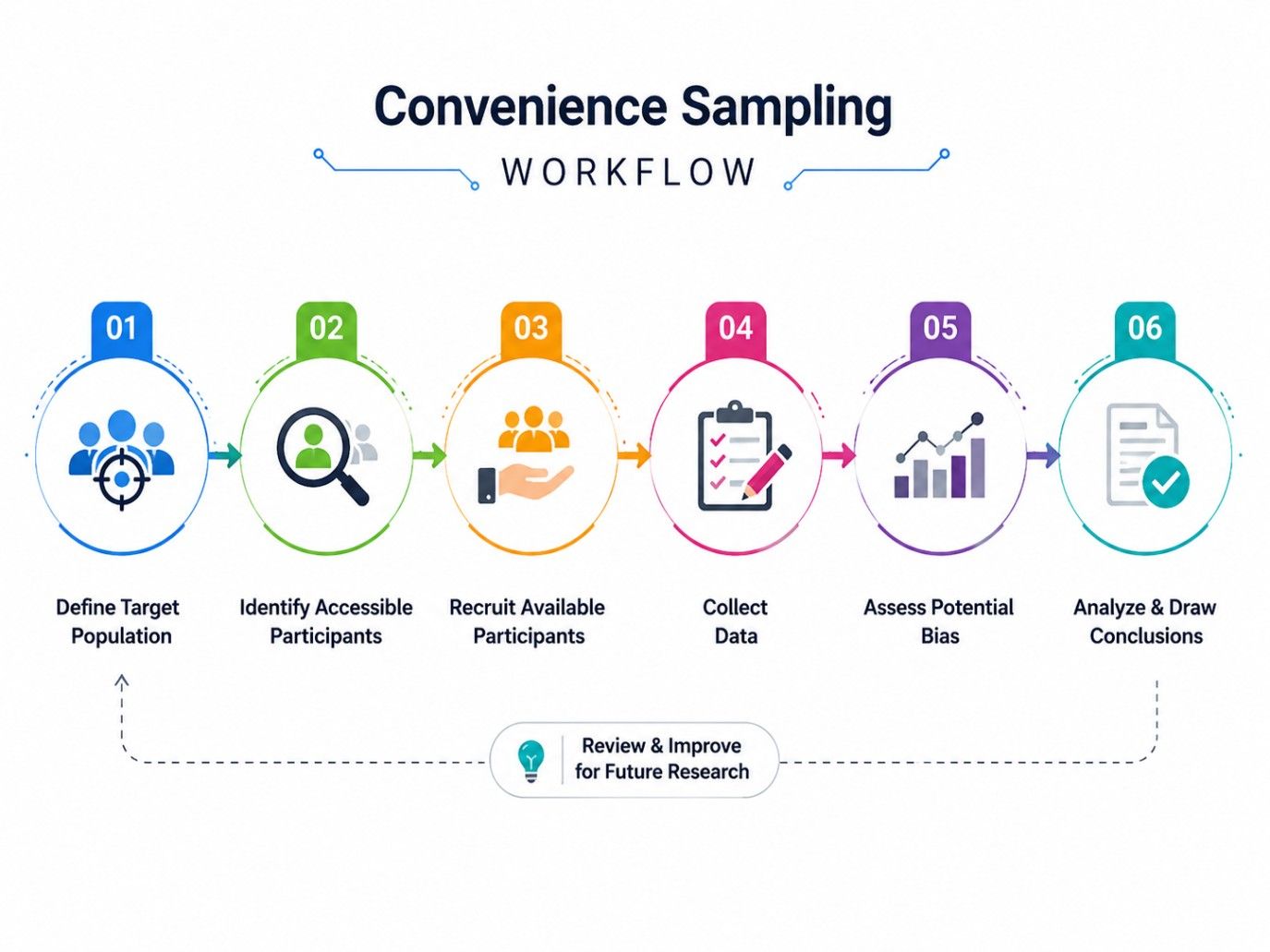
Say a researcher wants to know what students think about online learning. The researcher selects a sample of students at a local college, rather than randomly sampling students from each university.
The approach is time-saving, but students from that college might have a different experience than students elsewhere, limiting the confidence with which the findings can be applied to the wider student population.
Take your expertise further with the IIIT-B & IIMU Chief Data and AI Officer Programme Online by upGrad. Build practical skills in data, AI, and strategic decision-making to lead modern business initiatives.
Recommended Courses to upskill
Explore Our Popular Courses for Career Progression
IIIT Bangalore
Executive Diploma in Machine Learning and AI360° Career Support
O.P.Jindal Global University
MBA from O.P.Jindal Global UniversityLive Case Studies and Projects
The main characteristics of convenience sampling relate to accessibility, selection, speed, and the level of control the researcher has over who enters the sample.
It's easy to spot. Look at how participants were recruited.
Researchers select people who are nearby, available, reachable online, or already connected to the research setting. Accessibility is the defining feature of the method.
Participants don't receive an equal probability of selection. The researcher recruits people who can be reached within the available setting and timeframe.
This means that if there are plenty of suitable folks around, it can be pretty quick to recruit participants. Researchers don't have to contact a whole population or design an elaborate random-selection technique.
A convenience sample may have too many people in one age group, location, profession, education level, or social group.
This is important when researchers want to generalise to a much larger population because those who were most accessible may be different than those who were not available.
Convenient sampling can lead to selection bias because the ability to participate is partially determined by accessibility. Those who are hard to reach will be less likely to get into the sample.
The convenience sampling definition so shouldn't be solely about ease and speed. The selection basis is what makes the method different from probability sampling.
Read: List of Doctorate Degrees You Can Pursue at upGrad
There aren't universally separate statistical types of convenience sampling. Instead, the term can describe different recruitment situations where participants are selected because they're readily accessible.
Researchers recruit participants through websites, social media communities, email groups, online forums, or open survey links.
For example, a researcher might share a questionnaire with members of an online student community and collect responses from those who choose to participate.
Participants are recruited from an accessible physical location such as a college campus, shopping centre, workplace, clinic, or public event.A researcher studying customer preferences might approach shoppers who are already inside a particular store.
Researchers recruit people from an existing group that's easy to access, such as a classroom, company department, club, or community organisation.This approach is especially common in student research because the researcher can reach many participants through one existing group.
Researchers recruit participants from online crowdsourcing or participant-recruitment services that have people available to complete research tasks.
The participants can be reached quickly, but the researcher has to consider who is participating in these platforms and if those participants are representative of the intended population.
Read: Best PhD Programs in India in 2026: Which One Should You Choose?
Convenience sampling examples show how researchers select participants who are easy to access. The method can be used across education, business, healthcare, and online research settings.
Example |
Participants |
Why It's Used |
| Student research | Classmates in a library | They're readily available and easy to approach. |
| Customer feedback | Customers in a store | They're already present and can respond quickly. |
| Online survey | Members of an online community | Participants can be reached easily through the platform. |
| Workplace research | Employees from one department | They're accessible within the organisation. |
| Healthcare research | Patients at a clinic | They're available at the research location. |
These examples show the main idea clearly. Participants are selected because they're accessible, not through random selection.
Read: Doctorate for Working Professionals: Eligibility, Career Benefits, and Growth Opportunities
Convenience sampling makes participant recruitment easier and faster. It's especially useful when researchers have limited time, budget, or access to a complete sampling frame.
Convenience sampling is easy to conduct, but it can affect how representative the sample is. These limitations can influence the accuracy and broader use of research findings.
Do read : Is Doctorate in Business Administration worth it?
Convenience sampling selects participants based on accessibility, while random sampling uses a random process to select participants from a defined population or sampling frame.
The difference affects bias, representativeness, cost, and how confidently researchers can generalise findings.
Factor |
Convenience Sampling |
Random Sampling |
| Sampling type | Non-probability | Probability |
| Selection basis | Accessibility | Random selection |
| Selection probability | Not necessarily known | Defined through the sampling design |
| Bias risk | Higher | Generally lower |
| Cost | Usually lower | Often higher |
| Recruitment | Easier | More structured |
| Generalisability | More limited | Usually stronger |
Must read: Doctor of Business Administration Course Fees 2026: India & Global Costs, Scholarships, EMI Options
Convenience sampling and purposive sampling are both non-probability methods, but participants are selected for different reasons.
Convenience sampling prioritises accessibility. Purposive sampling prioritises specific characteristics that make a participant relevant to the research question.
Factor |
Convenience Sampling |
Purposive Sampling |
| Main selection basis | Accessibility | Research criteria |
| Participant choice | People who are readily available | People with relevant characteristics |
| Researcher involvement | Lower | More deliberate |
| Typical purpose | Quick or exploratory research | In-depth research on a defined group |
| Selection logic | Ease of access | Relevance to research objectives |
Convenience sampling works best when accessibility is a practical priority and the study doesn't depend heavily on population-level representation.
It has a place. It just needs the right job.
Consider using it for:
Researchers should reconsider it when representative population estimates are central to the study or when a suitable probability-based approach is practical.
For example, a pilot study testing whether survey questions are understandable might benefit from readily available participants. A national election survey designed to estimate voter preferences needs a much more carefully designed sample.
The choice should follow the research objective, not simply the easiest recruitment option.
Bias can't be completely removed simply by collecting more convenience-sampled responses. Researchers need to examine how participants entered the study and where the sample differs from the target population.Small changes can help.
Instead of relying on one classroom, website, clinic, or workplace department, researchers can recruit from several accessible sources when practical.
Define who should participate before recruitment starts. Clear criteria can prevent the sample from becoming dominated by whoever happens to respond first.
Check factors such as age, location, occupation, education, or other characteristics relevant to the research question.
Recruiting participants at different times, locations, or accessible groups can reduce dependence on one narrow source.
Researchers should state how participants were recruited and explain how that choice could affect the findings.
That transparency matters because readers need to understand the limits of the evidence rather than assuming the sample represents everyone.
Also read : Why Senior Executives Are Turning to Doctor of Business Administration (DBA) for Career Growth?
Clearly explain how participants were recruited, selected, and why convenience sampling suited the study. Keep the method transparent.
Include:
For example, state that undergraduate students available on a specific campus were recruited during the data-collection period. This helps readers understand how sampling may have affected the findings.
Convenience sampling is a practical choice when researchers need accessible participants and a fast way to collect initial data. Its main strengths are simplicity, speed, and lower recruitment demands.
Its biggest weakness is representation. A sample that's easy to reach isn't necessarily a good reflection of the wider population.
Use the method when it fits the research objective. Be clear about how participants were selected, assess possible bias, and avoid claims that extend beyond what the sample can reasonably support.
Ready to start your journey? Book a free consultation with upGrad today to find the best path for your career.
Convenience sampling selects participants who are readily accessible to the researcher. For example, a researcher studying student preferences might survey students available in a nearby classroom instead of selecting students randomly from the entire institution.
Random sampling uses a defined random selection process, giving population members a known chance of selection. Convenience sampling relies on accessibility instead. A person being easy to reach doesn't mean they had an equal chance of entering the sample.
Purposive sampling selects participants because they meet characteristics relevant to the research question. Convenience sampling selects people mainly because they're accessible. A researcher studying experienced entrepreneurs might deliberately recruit founders, while convenience sampling could involve interviewing available business owners.
Sampling methods are commonly grouped into probability and non-probability approaches. Examples include simple random, systematic, stratified, cluster, convenience, purposive, and quota sampling. The exact classification can vary by textbook, so researchers should follow the terminology used in their methodology framework.
Researchers use convenience sampling when they need accessible participants, especially for exploratory research, pilot studies, or projects with limited time and resources. It can help researchers gather preliminary information before conducting a larger study with a more structured sampling design.
There isn't one universal list of three random sampling types. Common probability methods include simple random, systematic, stratified, and cluster sampling. Some textbooks group these differently, so the number of categories depends on the classification system being used.
Yes. Convenience sampling is also called accidental sampling or availability sampling in some research-methods sources. These terms describe selecting participants because they're readily accessible rather than because they were chosen through a probability-based process.
Yes. One reason researchers choose convenience sampling is that they may not have a complete list of the population from which to randomly select participants. Online communities, classrooms, workplaces, and accessible locations can provide recruitment sources instead.
Yes. It's particularly useful when researchers want to test a questionnaire, recruitment process, interview guide, or research procedure before conducting a larger study. The pilot's purpose is usually to identify practical or design issues rather than make broad population-level claims.
It can be suitable for exploratory or preliminary medical research when accessible patients or clinical cases fit the study criteria. However, researchers need to consider whether patients from one clinic or healthcare setting differ from the wider patient population.
Yes, a study can use different sampling approaches at different stages, but researchers must describe each stage clearly. For example, a researcher might recruit a convenience sample first and then use random assignment for experimental conditions. Sampling and assignment are separate processes.
730 articles published
Sriram K is a Senior SEO Executive with a B.Tech in Information Technology from Dr. M.G.R. Educational and Research Institute, Chennai. With over a decade of experience in digital marketing, he specia...
Get Free Consultation
By submitting, I accept the T&C and
Privacy Policy
Top Resources
Certification
3 Months
Certification
6 Months
O.P. Jindal Global University
Masters in International Accounting and Finance (Accredited by ACCA, UK)Master's Degree
12 Months