Differential Privacy: A Complete Guide for Data Scientists
By Rahul Singh
Updated on Jun 11, 2026 | 11 min read | 4.07K+ views
Share:

All courses
Certifications
More
By Rahul Singh
Updated on Jun 11, 2026 | 11 min read | 4.07K+ views
Share:
Table of Contents
Differential privacy is a mathematical framework that enables data analysts and organizations to extract useful insights from datasets while protecting the privacy of individual records. It is designed to ensure that the results of an analysis remain nearly the same whether a specific person's data is included in the dataset or not.
This approach helps organizations use data for analytics, machine learning, and research without exposing sensitive personal information. By balancing data utility with privacy protection, differential privacy has become an important technique in modern data science and AI systems.
This guide covers everything you need to know about differential privacy. You will learn what it means, how it works mathematically, where it is being used today, and how it fits into modern data science workflows.
Popular Data Science Programs
Think of it this way. Imagine a hospital has medical records for 10,000 patients. A researcher wants to know the average age of diabetic patients. With differential privacy, the hospital can share that statistic, but in a way that guarantees no single patient's data can be traced back to them, even if someone tries hard to reverse-engineer the result.
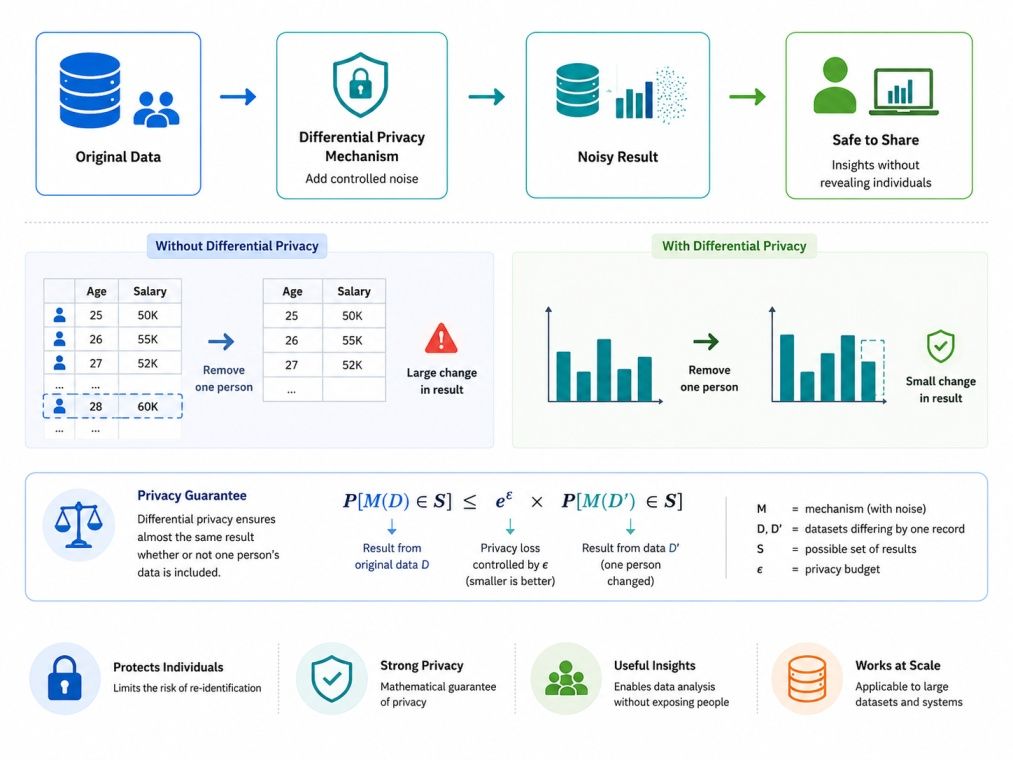
The core idea is simple: the output of any analysis should look almost the same whether or not any single individual's data is included. That "almost the same" is the privacy guarantee.
Here is a thought experiment used to explain differential privacy in almost every textbook and research paper on the subject:
Suppose you have a dataset with 1,000 people. You run a query and get a result. Now remove one person from the dataset and run the same query again. If the result barely changes, that single person's data did not meaningfully affect the output. An attacker cannot tell if that person was even in the dataset. That is differential privacy at work.
Also Read: Career in Data Science: Jobs, Salary, and Skills Required
Data scientists often work with sensitive datasets. Healthcare records, financial data, behavioral data from apps, location histories. The traditional approach was to anonymize the data by removing names or IDs. But researchers showed that anonymization alone is not enough. In many cases, it is possible to re-identify individuals by combining seemingly harmless data points.
Differential privacy fixes this problem at the mathematical level. It does not just hide names. It adds controlled randomness to the output so that even the most sophisticated statistical attack cannot extract individual-level information with any confidence.
Free Courses
The mechanism behind differential privacy is not magic. It is math. Specifically, it relies on adding carefully calibrated random noise to data or query outputs.
Differential privacy was formally defined by Cynthia Dwork in 2006. The definition goes like this:
A randomized algorithm M gives epsilon (ε) differential privacy if for all datasets D1 and D2 that differ in exactly one individual's record, and for all possible outputs S:
P[M(D1) ∈ S] ≤ e^ε × P[M(D2) ∈ S]
Do not let the formula intimidate you. Here is what it means in plain terms:
Also Read: Data Literacy in Data Science: Everything You Need to Know
Epsilon is the most important number in differential privacy. It is called the privacy budget.
Epsilon Value |
Privacy Level |
Trade-off |
| Very small (e.g., 0.1) | Very strong privacy | Less accurate results |
| Moderate (e.g., 1.0) | Balanced | Reasonable accuracy |
| Large (e.g., 10+) | Weak privacy | High accuracy, lower protection |
The lower the epsilon, the stronger the privacy guarantee. But lower epsilon also means more noise added to the data, which means less accurate results. Data scientists constantly navigate this trade-off.
Also Read: 9 Types of Data Scientists | Which One Should You Become?
The most common way to implement differential privacy is through the Laplace mechanism. Here is how it works:
For example, if the true average salary is Rs 60,000 and you add Laplace noise with scale 500, the reported result might be Rs 60,347 or Rs 59,721. Close enough to be useful. Far enough to protect individuals.
For cases where you need to release multiple statistics, the Gaussian mechanism is often preferred. It adds noise drawn from a normal (Gaussian) distribution. It works with a slightly different privacy definition called (ε, δ)-differential privacy, where δ is a small probability that the privacy guarantee might fail.
There are two main models of differential privacy:
Local is more private because even the data collector never sees clean data. But it typically requires more noise to achieve the same privacy guarantee, which can hurt accuracy.
Also Read: Data Scientist Salary in India
Data Science Courses to upskill
Explore Data Science Courses for Career Progression
IIIT Bangalore
Executive Post Graduate Certificate in Data Science & AIPlacement Assistance
Differential privacy is not just a theoretical concept. It is being used at scale, right now, by some of the world's largest technology companies and government agencies.
Also Read: Data Science vs Data Analytics: What are the Differences?
The U.S. Census Bureau made a major shift for the 2020 census by applying differential privacy to published demographic statistics. This was a landmark moment. For the first time, a major government institution formally adopted differential privacy as a standard protection for sensitive population data.
Medical research is one of the most promising areas for differential privacy. Hospitals can now participate in collaborative studies, sharing aggregated statistics without exposing patient records. This is especially relevant for rare disease research where small datasets make individuals more identifiable.
Differential privacy is increasingly being integrated into machine learning pipelines through a technique called DP-SGD (Differentially Private Stochastic Gradient Descent). This allows models to be trained on sensitive data while providing formal guarantees that the model's parameters do not memorize individual training examples.
Libraries like Google's TensorFlow Privacy and OpenDP make it straightforward to add differential privacy to existing ML workflows in Python.
Also Read: Understanding Gradient Descent in Logistic Regression: A Guide for Beginners
If you are a data scientist who wants to work with differential privacy, the good news is that the tooling has matured significantly. You do not need to implement the math from scratch.
Library |
Developed By |
Best For |
| TensorFlow Privacy | Differentially private ML training | |
| OpenDP | Harvard / OpenDP Project | General statistical queries |
| PySyft | OpenMined | Federated learning + DP |
| IBM Diffprivlib | IBM Research | Sklearn-compatible DP tools |
| Google's DP Library | Building DP pipelines |
Here is what a differentially private mean calculation looks like in Python:
import numpy as np
from diffprivlib.tools import mean

data = np.array([45000, 52000, 61000, 70000, 48000])

# Compute differentially private mean
dp_mean = mean(data, epsilon=1.0, bounds=(30000, 100000))
print(f"DP Mean Salary: {dp_mean:.2f}")
In just a few lines, you have a differentially private statistic. The epsilon controls the privacy budget. The bounds tell the library the plausible range of values, which is used to compute sensitivity.
Also Read: TensorFlow Tutorial
For training differentially private machine learning models, TensorFlow Privacy is the standard choice. The process involves:
This sounds complex but the library handles most of it. The main job of the data scientist is to choose an appropriate epsilon and monitor the privacy-accuracy trade-off over training.
Also Read: TensorFlow Cheat Sheet: Why TensorFlow, Function & Tools
Working with differential privacy in practice is not without friction. Here are the most common issues:
Also Read: Python Libraries Explained: List of Important Libraries
Differential privacy is powerful, but it is not a silver bullet. Understanding its limitations is important for anyone building real-world data systems.
Differential privacy protects against a specific class of attacks, namely those that try to infer whether a particular person was in the dataset. It does not protect against:
Also Read: A Complete Guide on OOPs Concepts in Python
There is always a tension between privacy and accuracy. Strong privacy means more noise. More noise means less accurate statistics. For some applications, especially those involving small populations or rare events, this trade-off can make differentially private results practically useless.
There is still no agreed-upon standard for what epsilon value is "private enough." ε = 1 is considered reasonable by many researchers, but in practice companies use a wide range of values. This lack of standardization makes it hard to compare the privacy properties of different systems.
In the global model, someone has to collect the raw data before adding noise. That curator must be trusted completely. If the curator is compromised or acts in bad faith, all privacy guarantees collapse. This is why local differential privacy is often preferred for consumer applications.
Subscribe to upGrad's Newsletter
Join thousands of learners who receive useful tips
Differential privacy is one of the most important ideas in modern data science. It gives us a formal, mathematical way to share insights about populations without exposing individuals. That is no small feat.
From Apple's keyboard telemetry to the U.S. Census to hospital research networks, differential privacy is already shaping how sensitive data is collected and used. As a data scientist, understanding this concept puts you ahead. It lets you build systems that are not just accurate, but trustworthy.
Want personalized guidance in Data Science and upskilling? Speak with an expert for a free 1:1 counselling session today.
Differential privacy is a way to analyze data and share results without revealing any individual's information. It works by adding carefully calculated random noise to query outputs so that the presence or absence of any single person in the dataset cannot be detected from the results.
Anonymization removes names or IDs from a dataset. Differential privacy is stronger because it adds mathematical noise to the output itself. Anonymized data can often be re-identified by combining multiple data points, but differentially private outputs are protected by a formal mathematical guarantee, regardless of what other data an attacker might have.
Epsilon (ε) is the privacy budget. It is a number that controls how much privacy protection a system provides. A smaller epsilon means stronger privacy but less accurate results. A larger epsilon means more accurate results but weaker privacy. Most practical systems aim for epsilon values between 0.1 and 10.
Yes. Apple uses it in iOS to collect anonymous usage statistics without seeing individual user data. Google uses it in Chrome and in federated learning systems. The U.S. Census Bureau applied it to the 2020 census. It is also used in healthcare research and advertising measurement.
In global differential privacy, a trusted curator collects raw data and adds noise before sharing results. In local differential privacy, each user adds noise to their own data before it is sent anywhere. Local DP is more private because even the data collector never sees the raw data, but it generally requires more noise to achieve the same privacy level.
Yes. The main technique is called DP-SGD, or Differentially Private Stochastic Gradient Descent. It clips gradients during training and adds noise to them, ensuring the final model does not memorize any single training example. TensorFlow Privacy is the most widely used library for this.
The privacy budget, measured by epsilon, is a limit on how much information can be extracted from a dataset through differentially private queries. Every query you run uses up some of the budget. Once the budget is exhausted, running more queries would weaken the privacy guarantee below an acceptable level. This is why careful query planning matters in production systems.
Sensitivity measures how much a query's output can change if one person's data is added to or removed from the dataset. It is used to calibrate how much noise needs to be added. High-sensitivity queries need more noise to achieve the same level of differential privacy.
Several mature libraries are available. IBM Diffprivlib integrates with familiar scikit-learn-style interfaces. TensorFlow Privacy is the standard for differentially private ML training. Google's DP library and the OpenDP project are both strong options for general statistical analysis. PySyft supports federated learning combined with differential privacy.
The biggest limitations are accuracy loss (more noise reduces result quality), difficulty choosing an appropriate epsilon, the privacy budget depletion problem when running many queries, and the need for a trusted data curator in the global model. It also does not protect against all types of statistical inference, particularly attacks that target group-level patterns rather than individuals.
Federated learning trains machine learning models across many devices without centralizing data. But even without seeing raw data, there is a risk that shared model updates reveal something about the training data. Differential privacy is often layered on top of federated learning to add noise to the model updates, combining the benefits of decentralized training with formal privacy guarantees.
96 articles published
Rahul Singh is an Associate Content Writer at upGrad, with a strong interest in Data Science, Machine Learning, and Artificial Intelligence. He combines technical development skills with data-driven s...
Speak with Data Science Expert
By submitting, I accept the T&C and
Privacy Policy
Start Your Career in Data Science Today
Top Resources
Executive Diploma
12 Months
Master's Degree
18 Months
Bootcamp
6 Months