What Is Federated Learning?
By Rahul Singh
Updated on May 06, 2026 | 10 min read | 3.69K+ views
Share:

All courses
Certifications
More
By Rahul Singh
Updated on May 06, 2026 | 10 min read | 3.69K+ views
Share:
Table of Contents
Federated learning is a decentralized machine learning approach where models are trained across multiple devices like smartphones or IoT systems without sharing raw data. Each device uses its own local data to train the model.
Instead of sending data to a central server, only model updates such as gradients are shared. This helps protect user privacy, reduces data transfer, and improves efficiency by keeping computation closer to where the data is generated.
In this blog, you’ll understand what federated machine learning is, how it works, why it matters, and where it’s used.
Popular AI Programs
To truly grasp what is federated learning, we must first look at how traditional artificial intelligence operates today. In a standard setup, a company collects massive amounts of raw data from millions of global users. All of this sensitive data is actively sent across the internet to one single central server. The central server then uses that massive pile of private data to train its software model.
The new approach completely flips this risky model upside down. Instead of moving private data to the software model, the system moves the software model directly to the private data. Your sensitive information never leaves your physical phone or computer.
People constantly ask what is federated learning in simple terms. Think of it like a teacher sending a blank test to a thousand different students.
Also Read: Learning Models in Machine Learning: 16 Key Types and How They Are Used
Traditional machine learning relies on centralized data. This creates challenges:
Federated machine learning solves these problems by keeping data local.
Free Courses
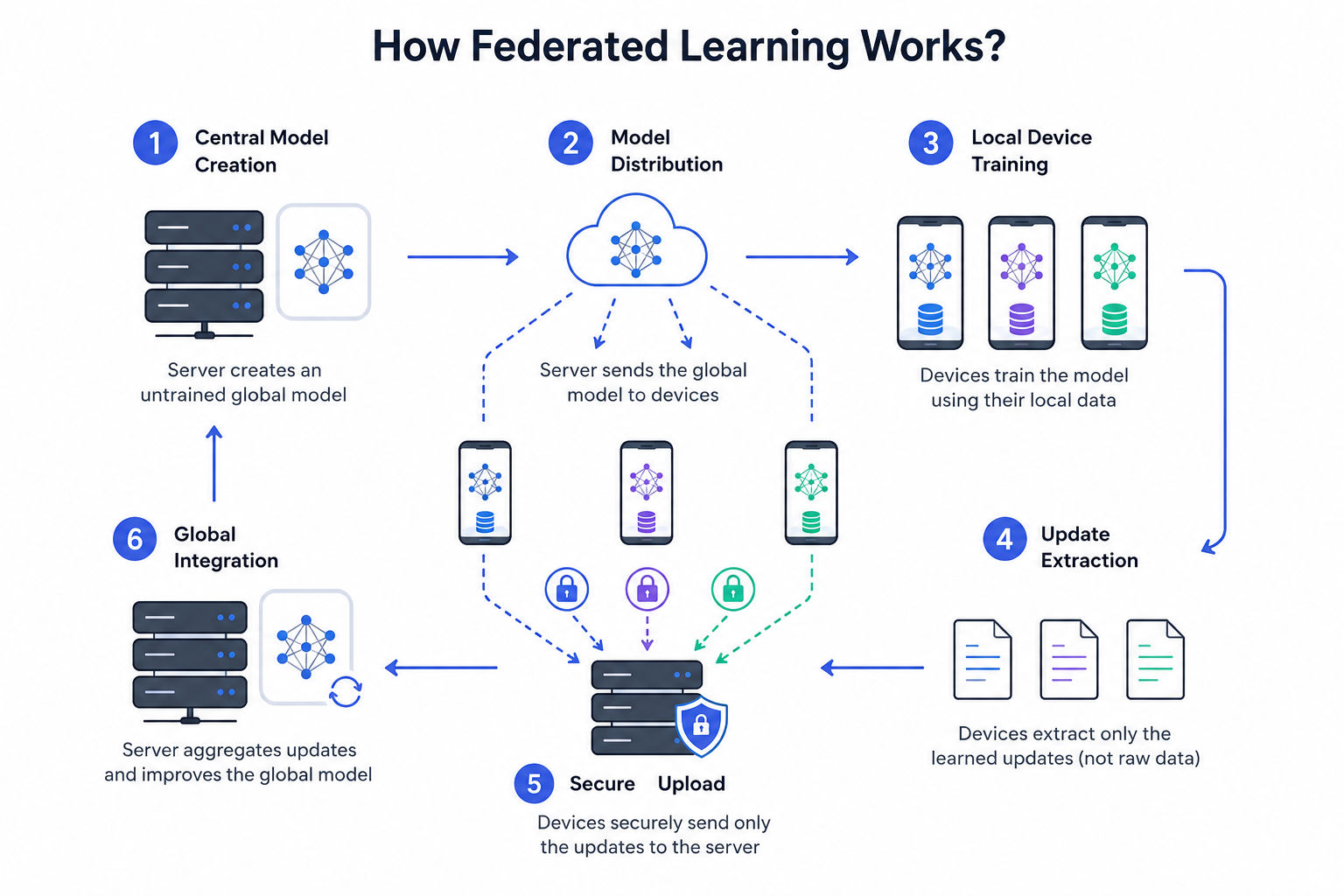
The actual background process happens in a few highly specific, continuous steps. This secure cycle repeats itself thousands of times to slowly build a highly accurate, incredibly smart algorithm.
Also Read: Feature Engineering for Machine Learning: Methods & Techniques
Here is a simple table comparing the old methods to this modern technology:
| Feature | Traditional Centralized AI | Federated Learning |
| Data Storage | Moved to a central cloud server | Stays strictly on the local device |
| Privacy Level | Highly vulnerable to mass hacking | Extremely secure and highly private |
| Bandwidth Use | Requires massive daily internet usage | Requires very minimal internet usage |
| Computing Power | Relies entirely on giant cloud servers | Uses the processing power of local phones |
This incredibly smart process entirely removes the dangerous need to hoard sensitive user data. The central software algorithm gets significantly smarter every single day.
AI Courses to upskill
Explore Artificial Intelligence Courses for Career Progression
Federated learning can be applied in different ways depending on how your data is distributed. The key factors are simple: whether the users are the same and whether the features are the same. Based on this, there are three main types.
Horizontal federated learning is used when the data across devices or users has the same structure but belongs to different users. In this case, each participant has similar types of data, but the data itself comes from different sources.
Example:
Also Read: Multiple Linear Regression in Machine Learning: Concepts and Implementation
Vertical federated learning is used when different organizations have data about the same users but with different features. Here, the users overlap, but the type of data each organization holds is different.
For instance, a bank may have financial data about customers, while an e-commerce platform has purchase history for the same users. Instead of sharing raw data, both parties collaborate to train a model. This allows them to combine insights without exposing sensitive information, leading to better predictions.
Federated transfer learning is used when both the users and the features are different across datasets. This is the most flexible but also the most complex type.
Example:
What happens:
Also Read: Automated Machine Learning Workflow: Best Practices and Optimization Tips
Type |
Users |
Features |
When to use |
| Horizontal | Different | Same | Mobile apps, IoT |
| Vertical | Same | Different | Banking + retail |
| Transfer | Different | Different | Cross-domain learning |
Federated learning gives you a privacy-first way to train models. You keep data on devices and still learn from them. At the same time, you deal with system complexity and coordination issues.
Use this section to decide when federated machine learning fits your use case.
Aspect |
Advantages |
Disadvantages |
| Privacy | Data stays on device, reduces exposure risk | Needs strong encryption and secure aggregation |
| Data usage | Uses distributed data that cannot be centralized | Data quality varies across devices |
| Performance | Scales across many devices | Depends on device capability and availability |
| Communication | Lower raw data transfer | Frequent updates increase network overhead |
| Security | Limits direct data access | Risk of malicious or poisoned updates |
| Personalization | Learns user-specific behavior | Hard to maintain consistency across models |
| Compliance | Easier to meet data regulations | Complex to manage across regions |
| Implementation | Supports modern distributed systems | Harder to design and maintain compared to traditional ML |
Also Read: Applied Machine Learning: Workflow, Models, and Uses
Federated learning is already used in real systems where data privacy matters. It allows organizations to train models across multiple sources without moving sensitive data.
You see its impact in industries that deal with personal, financial, and large-scale user data.
Healthcare systems generate sensitive patient data that cannot be shared easily. Federated machine learning allows hospitals to collaborate without exposing this data.
Example:
Also Read: Heart Disease Prediction Using Logistic Regression and Random Forest
Banks and financial institutions use federated learning to improve security and analytics. It helps them detect patterns without sharing confidential data.
Example: Banks identify fraud patterns without exposing customer transaction data
Many mobile apps use federated learning in the background. It helps improve user experience without sending personal data to servers.
Example:
Also Read: Regularization in Deep Learning: Techniques to Prevent Overfitting
Retail platforms use federated learning to understand customer behavior while respecting privacy. It helps improve personalization and planning.
Example: E-commerce platforms suggest products without tracking raw user data centrally
Industry |
Use Case |
Benefit |
| Healthcare | Patient data analysis | Privacy protection |
| Finance | Fraud detection | Secure data handling |
| Mobile | Keyboard predictions | Personalization |
| Retail | Recommendations | Better user experience |
These applications show how federated learning balances data privacy with practical machine learning use.
Also Read: Top 48 Machine Learning Projects [2026 Edition] with Source Code
Subscribe to upGrad's Newsletter
Join thousands of learners who receive useful tips
Federated learning is a powerful shift in how machine learning models are trained. By keeping data decentralized, it solves key problems related to privacy, compliance, and scalability. While it introduces some complexity, its benefits make it a strong choice for modern AI systems.
If you are exploring machine learning, understanding federated learning gives you an edge in building privacy-focused and scalable solutions. As industries move toward secure AI, federated machine learning will continue to play a central role.
Want personalized guidance on Machine Learning and upskilling? Speak with an expert for a free 1:1 counselling session today.
Federated learning is a method where models are trained across multiple devices without moving raw data to a central server. Each device learns locally and shares only updates. This approach improves privacy while still allowing systems to learn from distributed data sources.
Traditional machine learning collects data in one place and trains models centrally. Federated learning keeps data on devices and trains models locally. The main difference is how data is handled, with federated approaches focusing on privacy and decentralized training.
There are three main types: horizontal, vertical, and federated transfer learning. They differ based on whether users and features overlap. These types help you choose the right setup depending on how your data is distributed across systems.
It allows you to train models without exposing sensitive data. Instead of sharing raw information, only model updates are exchanged. This reduces the risk of data breaches and helps organizations follow strict privacy regulations.
Federated machine learning works by sending a global model to devices, training locally, and then aggregating updates. This cycle repeats to improve accuracy while keeping data decentralized. It is widely used in mobile apps and privacy-focused systems.
Yes, it can support near real-time systems, but it depends on network conditions and update frequency. Many applications use periodic updates instead of continuous training to balance performance and communication overhead.
Challenges include device variability, communication costs, security risks, and system complexity. Each device may have different data and processing power, which makes training and coordination more difficult compared to centralized systems.
Federated machine learning allows models to learn from user-specific data on each device. This leads to more personalized predictions without sharing sensitive information, making it useful for recommendation systems and mobile applications.
It is more secure than traditional methods, but not completely risk-free. Malicious updates and inference attacks are possible. To reduce risks, systems use techniques like encryption, secure aggregation, and validation of updates.
Federated learning is used in smartphones, healthcare, finance, and IoT systems. It helps train models on sensitive data while maintaining privacy, making it useful for applications where data cannot be shared directly.
Recent trends focus on improving privacy techniques like secure aggregation and differential privacy. There is also growing use in edge devices, healthcare, and finance. Researchers are working on making systems more efficient, reducing communication costs, and improving performance across diverse and distributed datasets.
96 articles published
Rahul Singh is an Associate Content Writer at upGrad, with a strong interest in Data Science, Machine Learning, and Artificial Intelligence. He combines technical development skills with data-driven s...
Speak with AI & ML expert
By submitting, I accept the T&C and
Privacy Policy
Top Resources
Master's Degree
18 Months
Executive Diploma
12 Months
IIIT Bangalore
Executive Programme in Generative AI & Agentic AI for LeadersIndia’s #1 Tech University
Dual Certification
5 Months