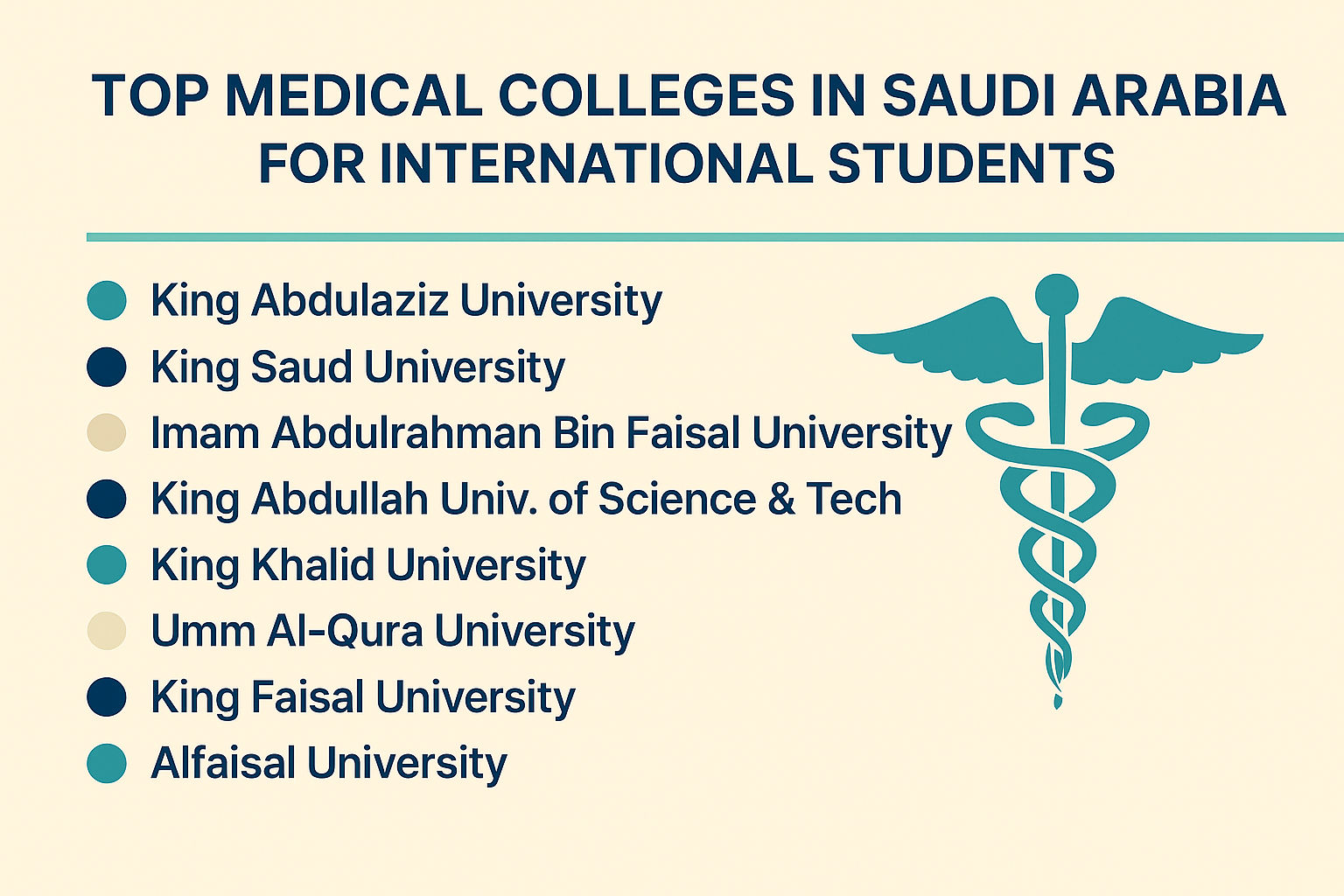
Saudi Arabia has a genuinely solid spread of medical colleges, several with world-class teaching hospitals attached and English-medium, problem-based learning curricula. The catch: the big public names, King Saud, King Abdulaziz, Imam Abdulrahman Bin Faisal, mostly exist for Saudi nationals through a centralised portal, so seats for outsiders are scarce unless you're coming in through a government scholarship.
For most Indian students looking seriously at medical colleges in Saudi Arabia, the actual door in is private, universities like Alfaisal University in Riyadh, Batterjee Medical College in Jeddah, and Fakeeh College, not the big public names that show up at the top of every ranking list you'll find with a quick search.
This guide sorts out that distinction properly, then walks through the program structure, fees, who actually qualifies, the NMC recognition rules that decide whether you can practice back in India, and what day-to-day life actually looks like as a medical student in the Kingdom.
Why Consider a Medical Degree in Saudi Arabia?
The clinical infrastructure is properly modern. Saudi Arabia has poured real money into hospital-affiliated medical training over the last several years, and it shows in the simulation centres and teaching hospitals built to standards you'd expect in the West, not a scaled-down version of it.
English-medium instruction is the norm at the universities that actually take Indian applicants, which sets this apart from some of the other MBBS-abroad destinations where you're stuck figuring out a new language before you can even start medicine properly.
There's also a practical, everyday comfort to it. A large Indian community already lives and works there, flights are direct, and the time difference barely disrupts a phone call home, small things, but they add up over six years.
And Vision 2030, the Kingdom's push to diversify its economy away from oil, has meant sustained funding into healthcare education specifically. This isn't a one-off investment that might dry up, it's a long-term national priority, which matters if you're picking a place to spend the better part of a decade.
What Is the MBBS Program Structure and Duration?
This is genuinely one of those areas where different sources quote different numbers, so it's worth untangling properly instead of picking whichever figure sounds cleanest. The standard path most universities follow is 5 years of academic study followed by 1 mandatory internship year, six years total. Some universities tack on an extra foundation year for students who need more grounding in English or the sciences before the actual medical coursework begins, which pushes the total to 7 years for those specific students.
Don't assume this foundation year applies to you by default. Confirm directly with whichever university you're shortlisting exactly which structure you'll be following, since this single detail changes your total cost and timeline more than almost anything else in this guide.
Which Are the Top Medical Colleges in Saudi Arabia?
Here's a proper look at what makes a list of medical colleges in Saudi Arabia, split the way it actually matters for Indian applicants, private versus public, rather than by prestige alone.
Top Private Medical Colleges
These are the colleges actually recruiting international students, with English-medium teaching as standard, not the exception.
Alfaisal University (Riyadh): Problem-based, self-directed curriculum in partnership with King Faisal Specialist Hospital. Widely seen as the strongest private option for international students, especially if you learn better through hands-on problem-solving than pure lecture-and-memorise.
Batterjee Medical College (Jeddah): The largest private medical college in the Middle East, running Medicine, Dentistry, and Nursing side by side. Scale most other private colleges in the region can't match.
Fakeeh College for Medical Sciences (Jeddah): Affiliated with Dr. Soliman Fakeeh Hospital. Known for strong clinical and research training, good pick if you want hands-on hospital exposure early.
Ibn Sina National College for Medical Studies (Jeddah): Runs established MBBS and pharmaceutical programs built specifically with international admissions in mind, not as an afterthought.
Top Public Medical Colleges
If you've been searching for a list of government medical colleges in Saudi Arabia hoping for an easier route in, read this section carefully.
King Saud University (Riyadh): Oldest and largest medical college in the country, with an extensive teaching hospital network. For internationals, the door in usually runs through the Ministry of Education's government scholarship, not a standard direct application.
King Abdulaziz University (Jeddah): Strong research output and a highly ranked program. Same access caveat applies.
Imam Abdulrahman Bin Faisal University (Dammam): Formerly the University of Dammam. Runs a well-regarded College of Medicine, worth knowing even if it's not the first name that comes up in a search.
King Saud bin Abdulaziz University for Health Sciences (Riyadh): Tied to the Ministry of National Guard Health Affairs, with genuinely advanced clinical simulation facilities.
Taibah University College of Medicine (Madinah): One of the few options if you're specifically searching for a medical college in Madinah, Saudi Arabia. It's WDOMS-listed and runs a 6-year English-taught MBBS program, but like the other government medical colleges in Saudi Arabia on this list, seats go overwhelmingly to Saudi nationals, with only a handful reserved for international applicants each year.
If a public university genuinely interests you, look specifically into the Saudi Government Scholarship or the King Abdullah Scholarship Program, rather than assuming a regular application works the way it does at a private college. For the wider picture of how Saudi Arabia's higher education system ranks beyond medicine, thistop universities in Saudi Arabia guide is a solid companion read.
Clinical Training and Hospital Affiliations
This is genuinely where these colleges pull apart from each other, more than rankings or reputation alone would suggest.
Alfaisal: Trains through King Faisal Specialist Hospital, one of the more advanced tertiary care centres in the region.
Fakeeh College: Routes clinical rotations through Dr. Soliman Fakeeh Hospital.
Public universities: Students typically rotate through large government hospital networks tied to their home institution.
Ask specifically about patient volume and specialty exposure at whichever hospital your shortlisted college is affiliated with. This varies a lot more than a university's overall reputation might suggest, and it's the kind of detail that actually shapes how prepared you feel walking into your internship year.
What Are the Eligibility Requirements for Indian Students?
Eligibility here isn't just about your marks, it's academics, language, and a regulatory checklist back home that decides whether any of this was worth it. Here's what actually matters.
Academic Eligibility
You'll need Class 12 with Physics, Chemistry, and Biology behind you, though cutoffs shift meaningfully by university. Some sources cite 50% as the floor, others expect 70 to 80% for the more competitive private colleges, so treat any single number online as a starting point, not gospel.
English Proficiency and Language of Instruction
Private universities that take international students teach consistently in English, and you'll typically needIELTS 6.0+ orTOEFL iBT 80+ to qualify.
Public universities are far more mixed. Some teach in Arabic, some in English, so this needs confirming university by university rather than assuming "Saudi Arabia teaches in English" as a blanket rule.
NMC Recognition and Return-to-India Licensing
Read this section twice before committing to any university, this is where students get burned without realising it until it's too late to fix.
To register with India's National Medical Commission after a foreign medical degree, your program needs to tick four boxes:
The university is listed in the World Directory of Medical Schools
The program runs at least 54 months, including a 12-month internship
Instruction is entirely in English
You qualified NEET-UG before enrolling
Most reputable private Saudi medical colleges meet all four comfortably. But get this confirmed in writing from your specific shortlisted university rather than assuming it applies uniformly across the Kingdom, because it genuinely doesn't.
What Are the Eligibility Requirements for Indian Students?
Eligibility here isn't just about your marks, it's academics, language, and a regulatory checklist back home that decides whether any of this was worth it. Here's what actually matters.
Academic Eligibility
You'll need Class 12 with Physics, Chemistry, and Biology behind you, though cutoffs shift meaningfully by university. Some sources cite 50% as the floor, others expect 70 to 80% for the more competitive private colleges, so treat any single number online as a starting point, not gospel.
English Proficiency and Language of Instruction
Private universities that take international students teach consistently in English, and you'll typically needIELTS 6.0+ orTOEFL iBT 80+ to qualify.
Public universities are far more mixed. Some teach in Arabic, some in English, so this needs confirming university by university rather than assuming "Saudi Arabia teaches in English" as a blanket rule.
NMC Recognition and Return-to-India Licensing
Read this section twice before committing to any university, this is where students get burned without realising it until it's too late to fix.
To register with India's National Medical Commission after a foreign medical degree, your program needs to tick four boxes:
The university is listed in the World Directory of Medical Schools
The program runs at least 54 months, including a 12-month internship
Instruction is entirely in English
You qualified NEET-UG before enrolling
Most reputable private Saudi medical colleges meet all four comfortably. But get this confirmed in writing from your specific shortlisted university rather than assuming it applies uniformly across the Kingdom, because it genuinely doesn't.
What Documents Do You Need for Admission?
Applying to medical colleges in Saudi Arabia means keeping these ready well before any application deadline creeps up on you, since gathering them last-minute is where most delays actually happen.
Passport with at least 18 months of remaining validity
Class 10th and Class 12th certificates and mark sheets, along with youracademic transcripts properly attested
NEET scorecard, if you're planning to return to India after graduating
Medical fitness certificate
Police clearance certificate, required by some universities
Passport-sized photographs matching the university's exact specification
What Are the Fees and Cost of Living?
Cost is usually the deciding factor once the eligibility questions around medical colleges in Saudi Arabia are sorted, so here's what you're actually looking at, tuition, living expenses, and the smaller costs that tend to slip through the cracks.
Tuition Fees by University Type
Here's how the numbers actually break down once you separate private from public, and the total picture including living costs.
University Category in Saudi Arabia
Estimated Annual Tuition Fee
Approximate Tuition Fee (INR)
Private Universities
SAR 60,000–95,000
₹15.12 lakh–₹23.94 lakh
Public Universities (Where International Students Are Eligible)
SAR 50,000–90,000
₹12.60 lakh–₹22.68 lakh
Estimated Total Annual Cost (Tuition + Living Expenses)
SAR 69,600–151,200
₹17.54 lakh–₹38.10 lakh
Cost of Living
Living expenses typically run SAR 20,000 to 30,000 a year, around ₹5.04L to ₹7.56L, covering accommodation, food, insurance, and getting around locally. This is broadly manageable on its own, and since Saudi Arabia has no personal income tax, whatever stipend or family support you're relying on stretches further than the headline number suggests at first glance.
Hidden and One-Time Costs
These are the ones that catch people off guard, mainly because they don't show up when you're only budgeting against the annual tuition figure.
Visa and Iqama processing fees: Often modest, but occasionally passed on to self-funded students rather than covered upfront.
Medical examination: Required for your residence permit, a cost most students forget to plan for.
Flights: Run noticeably higher during peak intake periods, so booking early genuinely saves money.
Initial setup costs: If you're renting privately instead of living in university housing, this is easy to underestimate.
What Scholarships Are Available?
Here's what's actually on offer at medical colleges in Saudi Arabia, and what each one is realistically worth.
Saudi Government Scholarship: Full tuition, monthly stipend of SAR 900–1,200 (₹19,700–₹26,200), free or subsidised accommodation, health insurance, and annual airfare. Tied to public university admission, and considerably more competitive than a standard private seat.
University-specific merit aid: Partial tuition reductions for strong academic profiles, offered by some private colleges. Inconsistent from one institution to the next, confirm directly with admissions.
If scholarships genuinely factor into your decision, merit aid at private universities is the more dependable route, rather than banking on a competitive government scholarship as your primary plan.
What Is the Admission Process Step by Step?
Shortlist your university. Weigh private options realistically alongside the public ones you've seen ranked highly, rather than defaulting to whichever name is most familiar.
Confirm eligibility and English-medium status directly with the admissions office, not just from third-party guides or forums.
Submit your application with academic transcripts, your NEET score if applicable, and proof of English proficiency.
Take any university-specific entrance test or interview, required by several private institutions as part of their process.
Receive your offer letter, then begin your student visa application, which your university sponsors and initiates on your behalf.
Complete visa formalities and travel, and let your university know your arrival date well in advance.
What Are the Visa Requirements?
International students, Indian nationals included, need a Student Visa, commonly called an Iqama, and this requires institutional sponsorship. That means your university starts the process once you've been accepted, you don't initiate it yourself.
You'll need an offer letter from your admitting medical college, a valid passport with at least 6 months of remaining validity, and medical fitness clearance. Processing typically takes 4 to 6 weeks after acceptance, so start the paperwork the moment your offer letter lands rather than waiting for a reminder from the university that may or may not come.
What Are the Career Prospects After MBBS in Saudi Arabia?
Your degree opens up three real paths, not just one, and which one makes sense depends entirely on where you want to end up practicing.
Practicing in Saudi Arabia (KSMLE Licensing)
Graduates who want to practice locally need to clear Saudi licensing requirements through the relevant health authority. Once that's done, genuinely strong opportunities open up across the Kingdom's rapidly expanding healthcare sector, a direct result of Vision 2030's investment priorities playing out in real time. This is also where most of the medical college jobs in Saudi Arabia conversation actually starts, since local licensing is the gateway to nearly all of them.
Returning to Practice in India (FMGE/NExT)
As covered earlier, this route depends entirely on whether your specific university meets the NMC's four conditions, WDOMS listing, program length, English-medium instruction, and prior NEET qualification. Confirm this in writing before you enrol, not after you've graduated and discovered a gap you can't do anything about.
Pursuing Further Specialization Abroad
Graduates with strong academic records sometimes use a Saudi MBBS as a stepping stone toward licensing exams in other countries entirely, USMLE for the US, PLAB for the UK. Both evaluate your degree independently of India's NMC requirements, giving you a genuine third pathway beyond just "practice locally" or "head back to India."
H2: How Does Saudi Arabia Compare to Other MBBS-Abroad Destinations?
Compared to some of the other popularMBBS-abroad options, medical colleges in Saudi Arabia typically cost more on tuition but come with stronger clinical infrastructure and a considerably easier cultural adjustment for Indian students specifically.
Its private universities also tend to have a meaningfully clearer path to NMC recognition, since English-medium instruction is the norm here rather than the exception, unlike destinations where the local language dominates clinical training and creates a real recognition risk that a lot of students don't discover until it's already too late to do anything about it.
If cost is your primary constraint, some other MBBS-abroad destinations generally still come in cheaper. If English-medium reliability and clinical infrastructure matter more to you than saving on tuition, medical colleges in Saudi Arabia's private tier are the stronger bet.
At private universities, the realistic route for most Indian applicants, tuition runs SAR 60,000–95,000/year (around ₹15.12L–23.94L). Add living costs of SAR 20,000–30,000/year (around ₹5.04L–7.56L), and your total annual spend typically lands between ₹17.54L and ₹38.1L, depending on the university and lifestyle. Public universities can be cheaper on paper, but access for international students is limited outside government scholarship routes.
How many medical colleges are there in Saudi Arabia?
Saudi Arabia has more than 30 medical colleges in total, spanning both public and private sectors. Only a subset of these actively recruit and teach international students in English, Alfaisal, Batterjee, Fakeeh College, and Ibn Sina National College among them, so the practical shortlist for Indian applicants is considerably smaller than the full national count.
Can I study MBBS in Saudi Arabia?
Yes, particularly through private universities that actively accept international applicants. You'll need Class 12 with Physics, Chemistry, and Biology, English proficiency (IELTS 6.0+ or TOEFL iBT 80+), and a NEET score if you plan to return to India afterward. Public university admission is possible too, but it's a narrower path, generally requiring a specific government scholarship rather than standard direct admission.
Is MBBS in Saudi Arabia worth it?
For students prioritising English-medium instruction, strong clinical infrastructure, and a manageable cultural adjustment, yes, particularly at reputable private universities where NMC recognition is more reliably achievable than in some other MBBS-abroad destinations. It's a harder "yes" if you're purely optimising for lowest cost, since Russia and Georgia generally undercut Saudi Arabia on tuition.
Is NEET compulsory for MBBS in Saudi Arabia?
Not for admission itself, some universities don't require it as an entry criterion, but it's compulsory if you intend to return to India and register with the NMC to practice. Since most students keep that option open, treating NEET as effectively mandatory is the safer approach regardless of what your specific university asks for at admission.
Are Saudi medical degrees recognized by the NMC?
It depends on the specific university and program, not a blanket yes across the country. Recognition requires WDOMS listing, a program of at least 54 months including a 12-month internship, English-medium instruction throughout, and prior NEET qualification. Most well-established private universities meet these, but always get this confirmed in writing from your shortlisted college before enrolling.
Do all Saudi medical colleges teach in English?
No. Private universities catering to international students are consistently English-medium, but public universities are more mixed, some teach in Arabic, others in English, depending on the specific institution. This is exactly why confirming language of instruction directly with your target university matters more here than in many other study destinations.
Can Indian students get scholarships for MBBS in Saudi Arabia?
Options exist, primarily the Saudi Government Scholarship and King Abdullah Scholarship Program, but these are tied more to public university admission and are genuinely competitive. Documentation on exact terms for Indian applicants specifically is thinner than you'd expect, so private university merit-based fee reductions are often the more dependable route if funding is a priority.
How long does it take to get a Saudi Arabia student visa?
Processing typically takes 4 to 6 weeks after you receive your admission offer. Since the visa is sponsored and initiated by your university rather than something you apply for independently, start your paperwork as soon as your offer letter arrives rather than waiting for the university to prompt you.
Can I work part-time while studying MBBS in Saudi Arabia?
Generally, no, or very restricted. Student visas in Saudi Arabia typically don't authorise outside paid employment, and medical programs are demanding enough that most students don't pursue part-time work anyway. Any permitted work usually needs to go through formal university-arranged research or teaching assistantship channels rather than outside employment.
What are the career options after MBBS in Saudi Arabia if I don't return to India?
Graduates can pursue local licensing to practice within Saudi Arabia's expanding healthcare sector, a direct result of Vision 2030 investment, or use their degree as a foundation for further licensing exams like USMLE (US) or PLAB (UK), both of which evaluate your qualification independently of India's NMC requirements. This gives you a genuine third path beyond the usual "stay or return to India" framing.
Sr. Content Writer & Study Abroad Expert |109 articles published
Kanika has 5+ years of experience as a writer and content developer. She has written for a wide range of industry verticals, including hospitality, restaurants, non-profits, finance, IT, HR, technolog...
Refer Your Friend & Earn upto ₹15000
Help your friend upgrade to a Global Career and earn rewards together.