MBBS abroad is a popular choice for Indian students facing tough competition and high private college fees at home. The full course often costs somewhere between ₹15 lakh and ₹50 lakh or more. Where you land in that range depends on the country and the university.
There's one rule set that matters more than any brochure. India's National Medical Commission (NMC) says your foreign course must run at least 54 months, plus a 12-month internship at the same university, all in English. You also need to qualify NEET if you ever want to practise in India.
In this article, you'll find the top countries, abroad MBBS fees, eligibility and the truth about MBBS abroad without NEET. You'll also learn how to apply, which scholarships exist and what your career looks like after you graduate.
Why Study MBBS Abroad?
Most Indian students study MBBS abroad for three reasons: cost, seats and English-medium teaching. Some universities charge far less than private medical colleges in India. The right choice, though, needs careful checking.
The four main reasons are below.
Affordable Medical Education
Fees at some foreign universities are much lower than at private colleges in India. Petre Shotadze Tbilisi Medical Academy in Georgia, for example, charges USD 7,000 (₹6,61,500) a year. That's a big draw for many families.
What usually makes it cheaper:
No donation or capitation fee: You pay the published tuition.
Lower living costs: Some cities are cheaper than Indian metros.
Fixed yearly fees: Many universities list a set amount per year.
International Exposure and Clinical Training
Studying abroad puts you in a new healthcare system. You train in hospitals linked to your university. You also live with students from many countries.
What you gain:
Hands-on training in teaching hospitals
Exposure to different patient groups
Experience living on your own
English-Medium Medical Programmes
NMC only accepts foreign degrees taught in English. So the medium matters more than anything else. Some universities teach early years in English and switch to the local language later.
Before you join, check:
Is the whole course taught in English?
Does the university confirm this in writing?
Do clinical years switch to another language?
Options Beyond Medical Seats in India
Seats at Indian government colleges are limited. Private college fees can be very high. To study MBBS abroad is a way for many students to still become doctors.
Keep this in mind:
You still need to qualify NEET to practise in India later.
You'll need to clear FMGE after graduating.
The course must meet every NMC rule.
Top Countries for MBBS Abroad
Seven countries draw most Indian students who choose MBBS abroad. Each has its own fees, language rules and recent alerts. Uzbekistan, for example, had three universities named in an NMC alert in April 2026.
The table below gives a quick comparison:
Country
Course Duration
Approx. Annual Tuition
NEET Requirement
Medium of Instruction
Russia
About 6 years
Varies by university
Needed to practise in India
English at many universities; check clinical years
Georgia
About 6 years
USD 5,500 to USD 7,000 (₹5,19,750 to ₹6,61,500) at some universities
Needed to practise in India
English
Uzbekistan
About 6 years
Varies by university
Needed to practise in India
English at some universities
Kazakhstan
About 6 years
Varies by university
Needed to practise in India
English; check clinical years
Kyrgyzstan
About 6 years
Varies by university
Needed to practise in India
English at many universities
China
About 6 years
Varies by university
Needed to practise in India
English at 45 listed universities, plus Chinese (HSK-4)
Philippines
BS plus MD
Varies by university
Needed to practise in India
English
Fees change every year, so check each university's official fee page. The country notes below cover what to watch.
MBBS in Russia
Russia is one of the oldest routes for Indian medical students. Many universities run English-medium General Medicine programmes of about six years. The Russian government also offers 300 scholarships to Indian students for 2026-27, including medicine.
What to check:
Language: Some universities teach clinical years partly in Russian. Ask for written proof of English medium.
Scholarship: The Russian Government scholarship covers tuition fees.
Compliance: Make sure the course and internship meet NMC rules.
MBBS in Georgia
Georgia offers English-medium MD programmes, and fees are published openly. Geomedi University charges USD 5,500 (₹5,19,750) a year. Petre Shotadze Tbilisi Medical Academy charges USD 7,000 (₹6,61,500).
What stands out:
Clear fees: Many universities publish fees in USD.
Living costs: Tbilisi Medical Academy lists housing at USD 250 to USD 600 (₹23,625 to ₹56,700) a month.
Note: Geomedi says international students can't work during their studies.
Uzbekistan needs extra care right now. On 1 April 2026, NMC issued an alert about three universities there: Bukhara State Medical Institute, Samarkand State Medical University and Tashkent State Medical University. One concern was that teaching wasn't in English.
Before you pick Uzbekistan:
Avoid the universities named in the NMC alert.
Get written proof of English medium.
Confirm hands-on clinical training.
MBBS in Kazakhstan
Kazakhstan runs about six years of medical study, including the internship. Fees and teaching language differ by university. Some sources say clinical subjects may be taught partly in Kazakh or Russian.
Kyrgyzstan is a common pick for MBBS in abroad for Indian students at low cost. Many universities teach in English. Results in FMGE vary a lot from university to university.
What to check:
How graduates from that university perform in FMGE
China allows 45 universities listed by its Ministry of Education to teach MBBS in English. There's a catch. You must reach HSK-4 level in Chinese, and NMC needs you to get a Chinese medical licence before you can take FMGE.
What this means for you:
Choose only from the 45 listed universities.
Plan to study Chinese seriously from year one.
Factor in the Chinese licence before you return.
MBBS in Philippines
The Philippines uses a BS plus MD structure. An Embassy of India advisory from June 2026 records that recognised schools offer a 54-month MD, teach in English and include a 12-month internship. That's a positive update, though rules here have changed before.
What to check:
The university is recognised by CHED.
The MD meets the 54-month rule.
The internship is at the same institution.
MBBS Abroad Fees for Indian Students
When it comes to MBBS abroad for Indian students, fees can look very different from country to country. Abroad MBBS fees also differ between universities in the same city. Always budget for tuition and living costs together.
The table below shows fees published by the universities themselves:
Country
University
Tuition Fees
Living Costs
Approx. Total
Georgia
Petre Shotadze Tbilisi Medical Academy
USD 7,000 (₹6,61,500) a year, plus USD 300 (₹28,350) registration
Housing: USD 250 to USD 600 (₹23,625 to ₹56,700) a month
Depends on city and housing
Georgia
Geomedi University
USD 5,500 (₹5,19,750) a year
USD 600 to USD 700 (₹56,700 to ₹66,150) a month
Depends on lifestyle
Malaysia
Manipal University College Malaysia
MYR 4,20,000 to MYR 4,50,000 (₹94,50,000 to ₹1,01,25,000) for the full course
Extra
Over ₹94 lakh for tuition alone
Students often ask about MBBS in Malaysia for Indian students: fees in rupees run much higher than in Central Asia. At Manipal University College Malaysia, tuition alone crosses ₹94 lakh for the full course. Before you choose Malaysia, check how the university handles the 12-month internship NMC needs at the same institution.
MBBS abroad for Indian students fees also depend on the year you join. Universities can raise fees each year, so confirm the latest amount before you pay.
Low-Cost MBBS Abroad Options
Students searching for MBBS in abroad for Indian students at low cost usually look at Kyrgyzstan, Kazakhstan, Russia and Georgia. Georgia stands out because its fees are published openly. Low cost should never mean skipping NMC rules.
To keep costs down safely:
Compare total cost: Tuition plus six years of living.
Check what's included: Some fees leave out hostel, books or insurance.
Apply for scholarships: The Russian Government scholarship covers tuition.
Avoid shortcuts: A cheap course that breaks NMC rules costs more in the end.
Tuition is only the start. Six years abroad bring many smaller costs. They add up quickly.
Plan for these:
Hostel or rent
Food and transport
Health insurance
Visa and residence permit fees
Registration fees, like Tbilisi Medical Academy's USD 300 (₹28,350)
Flights home
FMGE preparation and exam fees after you graduate
MBBS Abroad Eligibility for Indian Students
Eligibility for MBBS abroad has two layers. The university sets its admission rules. NMC sets the rules you must meet to practise in India later.
The four checks below cover both.
Academic Requirements
You need Class 12 with Physics, Chemistry and Biology. Most students need at least 50% in PCB. Reserved categories need 40%.
The basics:
Class 12 or equivalent with PCB
50% in PCB (40% for SC, ST and OBC)
English as a subject, at many universities
NEET Requirement
NEET is mandatory if you want to practise in India. This applies to everyone who joined a foreign medical course from the 2018-19 batch onward. Your NEET result stays valid for three years for admission abroad.
Key points:
Qualify NEET before you take admission abroad.
The university may not ask for it, though NMC will later.
Keep your NEET scorecard safe.
Age Requirement
You must be at least 17 years old by 31 December of your admission year. Most universities follow this rule. Some also set an upper age limit.
English Language Requirements
Most universities don't ask for IELTS. Some run their own English test instead. Geomedi University, for example, asks for B1-level English if you don't have a certificate.
What to expect:
A university English test or interview
Proof that your schooling was in English
IELTS or TOEFL only at some universities
MBBS Abroad Without NEET
Many students search for MBBS abroad without NEET. The honest answer has two parts. Some universities will admit you without NEET, but your degree won't let you practise in India.
The two parts below explain why.
NEET Requirements for Indian Students
A foreign university can accept you without a NEET score. That's their admission rule. NMC enforces NEET later, when you apply for FMGE.
What this means:
Admission: Possible at some universities without NEET.
Practice in India: Not possible without NEET.
Validity: Your NEET result works for three years for admission abroad.
So MBBS abroad without NEET only works if you never plan to practise in India.
NEET and Medical Licensing in India
NMC links NEET to your licence. Without NEET, you can't sit FMGE, and you can't register as a doctor in India. This rule has applied since the 2018-19 admission batch.
The full path to practise in India:
Step
What You Need
Before admission
Qualify NEET
During the course
54 months of study plus a 12-month internship at the same university, in English
After graduating
Clear FMGE
In India
Complete a 12-month supervised internship
If you're even slightly unsure about your future, qualify NEET first. Choosing MBBS abroad without NEET closes the door to practising in India.
Top Universities for MBBS Abroad
Picking the right university matters more than picking the country. Fees, language and FMGE results all vary by university. The list below sticks to universities with published fees.
A few examples to compare:
University
Country
Course
Duration
Approx. Fees
Petre Shotadze Tbilisi Medical Academy
Georgia
MD (English)
About 6 years
USD 7,000 (₹6,61,500) a year
Geomedi University
Georgia
Medicine (English)
About 6 years
USD 5,500 (₹5,19,750) a year
Manipal University College Malaysia
Malaysia
MBBS
5 years
MYR 4,20,000 to MYR 4,50,000 (₹94,50,000 to ₹1,01,25,000) for the full course
NMC doesn't approve individual foreign universities. It sets rules, and you must check the university against them. Ask every university for a written course structure.
Scholarships for undergraduate medicine are fewer than for master's degrees. A government scholarship for MBBS students is rare. Russia is the clearest exception for Indian students.
The two main types are below.
Government Scholarships
The Government of the Russian Federation offers 300 scholarships to Indian students for 2026-27, covering many fields, including medicine. This government scholarship for MBBS students covers tuition fees. Applications go through the official website, education-in-russia.com.
Key facts:
Coverage: Tuition fees.
Where: Almost all Russian universities, except Lomonosov Moscow State University and MGIMO.
Who selects: Russia does. India's Ministry of Education has no role in selection.
Timing: The 2026-27 round ran from September 2025 to January 2026.
Don't confuse these with Chevening or Fulbright. Those are for postgraduate study, not MBBS. A government scholarship for MBBS students abroad is hard to find, so apply early when one opens.
University Scholarships and Fee Waivers
Some universities cut fees for good marks. Manipal University College Malaysia offers an MBBS Special Bursary of up to MYR 40,000 (₹9,00,000), based on results. Others, like Geomedi University, say they don't offer scholarships to international students.
What to ask each university:
Is there a merit discount?
What marks are needed?
Does it apply every year or only the first?
How to Apply for MBBS Abroad?
Learning how to apply for MBBS abroad is simple once you know the order. Most universities take direct applications. The key is checking NMC rules before you pay anything.
Seven steps take you from shortlist to your first class.
Shortlist a Country and University
Start with two or three countries. Then pick universities with clear fees and English teaching. Avoid any university named in an NMC alert.
Check for each university:
Course length and internship structure
English medium in writing
Published fees
FMGE results of past graduates
Check Eligibility and NEET Requirements
Make sure you meet the basics before applying. You need 50% in PCB, or 40% for reserved categories. You also need to have qualified NEET, if you plan to practise in India.
Quick checklist:
Class 12 with PCB
NEET qualified
At least 17 years old by 31 December
Prepare the Required Documents
Gather your papers early. Indian boards and colleges can take time to issue certificates. Keep scanned and original copies ready.
Common documents:
Class 10 and 12 mark sheets
NEET scorecard
Passport
Birth certificate
Medical certificate, often with HIV and hepatitis tests
Apply on the university's official portal or through its authorised representative. Pay only to the university's official account. Keep every receipt.
Before you submit:
Check your details match your passport.
Upload every document.
Confirm the application fee.
Receive the Admission Letter
The admission letter confirms your seat. Read it carefully before you pay any tuition. Check the course length and the medium of teaching.
What to verify:
Course duration and internship
English medium
Fee amount and payment dates
Apply for a Student Visa
Each country has its own student visa process. You'll usually need your admission letter, passport and proof of funds. Apply as early as possible after you get your letter.
Usually needed:
Admission letter
Valid passport
Proof of funds
Medical certificate
Plan Travel and Accommodation
Book housing before you fly. Many universities offer hostels for first-year students. Plan your arrival around the start of classes.
Before you leave:
Confirm hostel or rent
Book flights
Carry original documents
Save the Indian embassy's contact details
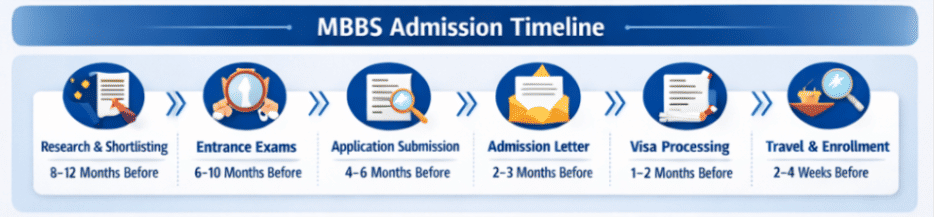
MBBS Abroad Intake and Admission Timeline
Most universities that offer MBBS abroad start classes in September. Some, like several in Georgia, also run a second intake. Plan backwards from your start date.
A typical timeline:
Admission Stage
Typical Timeline
Key Action
NEET result
After the exam
Download and save your scorecard
Shortlisting
Soon after results
Compare countries and universities
Applications
A few months before classes
Apply on official portals
Admission letter
A few weeks after applying
Check course length and medium
Visa
After the admission letter
Apply quickly
Travel
A few weeks before classes
Book housing and flights
Classes begin
Usually September
Start your course
Your NEET result stays valid for three years for admission abroad. So you can still join in a later year if needed.
Career After MBBS Abroad
Your career path after MBBS abroad depends on where you want to work. India needs FMGE. Other countries have their own licensing exams.
The three main paths are below.
Practising Medicine in India
To practise in India, you need to clear FMGE. It's still the active exam in 2026, held in June and December. NExT hasn't replaced it yet.
The steps after graduating:
Clear FMGE.
Complete a 12-month supervised internship in India.
Register with the medical council.
Practising Medicine Abroad
Many graduates work outside India. Each country has its own licensing exam, like USMLE for US and PLAB for UK. Your degree must also let you get a licence in the country where you studied, which NMC requires anyway.
What to plan for:
The licensing exam of your target country
Language tests, where needed
Local registration rules
Postgraduate Study and Other Career Options
After MBBS, many doctors specialise. In India, that means preparing for postgraduate entrance. Abroad, it means residency or specialist training.
Other paths include:
Postgraduate medical study in India or abroad
Clinical research
Public health
Hospital administration
Conclusion
MBBS abroad can be a smart path, but only when the course meets every NMC rule. Fees range widely, from about USD 5,500 (₹5,19,750) a year in parts of Georgia to over ₹94 lakh for the full course in Malaysia. Country choice, language and university quality all shape the result.
What to do next depends on your situation:
If budget is your main concern: Look at Georgia, Kyrgyzstan, Kazakhstan or Russia, and compare the full six-year cost.
If you want a government scholarship: Apply for Russia's tuition scholarship when the next round opens.
If you're considering Uzbekistan: Avoid the three universities named in NMC's April 2026 alert.
If you're thinking of China: Plan for HSK-4 and a Chinese medical licence.
If you're tempted by MBBS abroad without NEET: Remember you can't practise in India without it.
Check the 54-month and 12-month internship rule in writing before you pay. Get that right, and the rest of your plan becomes much easier.
Is NEET compulsory for MBBS in abroad 2021 onwards?
Yes, if you want to practise in India. NEET became mandatory for Indian students from the 2018-19 admission batch. NMC's Foreign Medical Graduate Licentiate Regulations 2021 kept this rule in place, along with the 54-month course and 12-month internship rules.
Can I study MBBS abroad without NEET?
Some foreign universities will admit you without a NEET score. That's their own admission rule. NMC checks NEET later, when you apply for FMGE, so MBBS abroad without NEET only works if you never plan to practise in India.
Can we study MBBS without NEET in abroad and still work in India?
No. Without NEET, you can't sit FMGE or register as a doctor in India. Even a fully English-medium, six-year degree won't help you if NEET is missing.
How to study MBBS abroad?
Start by qualifying NEET and checking you have at least 50% in PCB (40% for reserved categories). Then shortlist universities that meet NMC rules: 54 months of study, a 12-month internship at the same university, and English teaching throughout. After graduating, you'll need to clear FMGE to practise in India.
How to apply for MBBS abroad?
Apply on the university's official portal or through its authorised representative. Keep your Class 10 and 12 mark sheets, NEET scorecard, passport and medical certificate ready. Pay fees only into the university's official account, and keep every receipt.
What are MBBS abroad for Indian students fees in total?
The full course often costs between ₹15 lakh and ₹50 lakh or more, depending on the country. Abroad MBBS fees in Georgia, for example, start around USD 5,500 (₹5,19,750) a year at Geomedi University. Students looking for MBBS in abroad for Indian students at low cost often compare Georgia, Kyrgyzstan, Kazakhstan and Russia.
What is the cost of MBBS in Malaysia for Indian students, fees in rupees included?
Malaysia costs much more than Central Asia. At Manipal University College Malaysia, tuition for the full course is MYR 4,20,000 to MYR 4,50,000 (₹94,50,000 to ₹1,01,25,000). Living costs come on top of that.
Is there a government scholarship for MBBS students going abroad?
Yes, though options are limited. The Russian Government offers 300 scholarships to Indian students for 2026-27, covering tuition fees in fields including medicine. You apply through the official website, education-in-russia.com.
Does NMC approve foreign medical universities?
No. NMC doesn't approve or list individual foreign universities. It sets rules, and you have to check that your university's course meets them before you join.
Can I do my internship in India instead of abroad?
Not instead of. NMC needs a 12-month internship at the same foreign university where you studied. After clearing FMGE, you also complete a separate 12-month supervised internship in India.
Has NExT replaced FMGE for foreign medical graduates?
Not yet. FMGE is still the active exam in 2026, with sessions in June and December. NExT's start date for foreign graduates hasn't been confirmed.
Neha Uppal is a passionate content creator and editor. She carries 7.5+ years of experience working with leading edutech companies where she worked as a Faculty, Community Manager, and Content Markete...
Refer Your Friend & Earn upto ₹15000
Help your friend upgrade to a Global Career and earn rewards together.