MBBS in Russia is one of the most affordable options for international students, offering 6-year English-medium programs with a compulsory internship at government-approved universities. With low MBBS in Russia fees, annual tuition ranges from RUB 250,000–600,000 (INR 2.9L–6.96L), makingstudying in Russia cheaper than private medical colleges in India.
For those considering MBBS in Russia for Indian students, eligibility requires at least 50% in PCB in Class 12 and NEET qualification as per NMC norms. Top universities like Kazan State Medical University, Bashkir State Medical University, and RUDN are known for strong academics, clinical training, and global recognition.
Here are the key highlights for those planning to pursue MBBS in Russia in 2026:
Key Highlights
Details
Program Duration
6 years (5 years academics + 1-year internship)
Annual Tuition Fees
RUB 250,000–600,000 (INR 2.9L–6.96L) depending on university
Medium of Instruction
English for academics; Russian during clinical practice
NEET Requirement
NEET qualification mandatory for Indian students pursuing MBBS abroad
Recognition
NMC, WHO, ECFMG approval across major universities
Top Universities
Kazan SMU, Sechenov University, RUDN University
Top Universities in Russia for MBBS
Choosing the right MBBS university in Russia is crucial for quality education and global recognition.
Russia hosts several government-recognized medical universities accredited by WHO, NMC, UNESCO, and ECFMG, offering English-medium MBBS programs with strong research ecosystems and early clinical exposure
Below are some of the most reputable institutions based on global rankings, affordability, and clinical infrastructure:
Top MBBS Universities in Russia (2026)
University
Highlights / Strengths
Sechenov First Moscow State Medical University
Russia’s oldest and top-ranked medical institution; modern labs; annual tuition approx. RUB 500,000–800,000 (INR 5L–8L/year)
MBBS programs in Russia follow a structured 6-year format, integrating foundational sciences, pre-clinical subjects, and intensive clinical rotations in university-affiliated hospitals.
Students gain early exposure to patient-based learning from the third year onward, supported by modern labs and simulation centers.
One-year mandatory internship in teaching hospitals (Practical Training)
Eligibility & Admission Requirements for MBBS in Russia
MBBS eligibility criteria in Russia are aligned with NMC requirements for Indian students, emphasizing academic performance and NEET qualification.
A common question is is NEET required for MBBS in Russia, and the answer is yes, without NEET, students are not eligible for NExT/FMGE in India.
Most universities only require Class 12 marks and basic documentation, making MBBS in Russia for Indian students highly accessible.
Academic Eligibility Requirements for MBBS in Russia:
Tier
Academic Qualification
Top Universities
Minimum 50% in PCB in Class 12; English-medium schooling preferred
Mid-Tier Universities
50% in PCB + overall good academic consistency
Affordable Universities
50% PCB + basic documentation; seats available with fewer competitive requirements
Most Russian universities follow a transparent academic eligibility process, making MBBS in Russia accessible to a wide range of students.
NEET Requirements for MBBS in Russia:
Requirement
Details
NEET Qualification
Mandatory for all Indian students pursuing MBBS abroad as per NMC rules
Minimum Marks
NEET qualifying percentile (50th percentile for General category)
Purpose
Required for eligibility to appear for NExT/FMGE after earning the MBBS degree abroad
NEET ensures Indian students maintain eligibility for future medical licensing examinations in India.
Documents Required for MBBS in Russia:
Document
Purpose
10th & 12th Marksheets
Academic verification
NEET Scorecard
Mandatory proof of qualification
Passport
Required for international admission and visa processing
Passport-size Photos
Application and visa documentation
Medical Fitness Certificate
Required for visa submission and university records
The document checklist is kept simple, supporting easier application timelines for international candidates.
Cost of Studying MBBS in Russia
The overall MBBS in Russia fees are considerably lower than private MBBS programs in India. Tuition fees vary based on the university’s ranking and location, but remain affordable for international students.
Tuition Fees for MBBS in Russia
Annual tuition fees at Russian medical universities differ according to reputation, location, and medium of instruction.
Category
Approx. Annual Tuition Fees
Top Universities
RUB 350,000–600,000 (INR 4.06L–6.96L)
Mid-Tier Universities
RUB 250,000–350,000 (INR 2.9L–4.06L)
Affordable Universities
RUB 200,000–250,000 (INR 2.32L–2.9L)
This structure clearly shows why MBBS in Russia fees attract thousands of students every year.
Cost of Living in Russia
The monthly cost of living for MBBS students varies by city, with Moscow being the most expensive and cities like Kazan and Volgograd being more affordable.
Category
Approx. Monthly Cost
Accommodation (Hostel)
RUB 8,000–12,000 (INR 9,280–13,920)
Food & Groceries
RUB 5,000–8,000 (INR 5,800–9,280)
Transport
RUB 500–800 (INR 580–930)
Miscellaneous
RUB 2,000–4,000 (INR 2,320–4,640)
Russia remains cost-effective due to subsidized hostels and student-friendly public-transport tariffs.
Several Russian universities and governmental bodies offer financial support to international students based on merit, academic performance, and financial need.
These scholarships help reduce the overall tuition burden, especially for high-performing students.
Top Scholarships for MBBS in Russia
Scholarship Name
Eligibility
Coverage
Russian Government Scholarship
Strong academic background; international applicants
Tuition waiver + stipend
University Merit Scholarships
High semester GPA and academic consistency
Partial tuition reduction
International Student Support Grants
Need-based financial support
Partial tuition funding
Scholarships significantly lower the cost of studying MBBS in Russia for academically strong candidates.
MBBS Intakes & Admissions in Russia
Russia follows two major admission cycles for MBBS programs, with September serving as the primary intake.
Main MBBS Intakes:
September Intake (Primary): Most universities admit the majority of MBBS students during this cycle.
January/February Intake (Secondary): Available in selected universities with limited seats.
Applying early increases the chances of faster admission and visa processing.
Note: Universities begin accepting applications months in advance, allowing students to prepare documents and complete visa procedures smoothly.
How to Apply for MBBS in Russia?
Applying for MBBS in Russia is a structured process that involves meeting eligibility criteria, preparing academic documents, qualifying NEET, and following university-specific admission steps.
Most universities follow a simplified process, making admissions quick and accessible for international students.
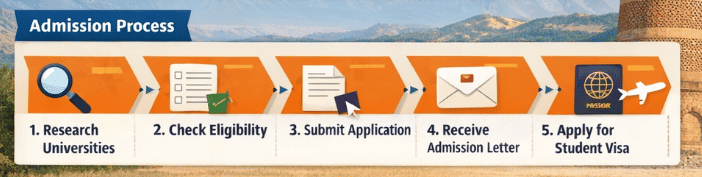
Below is the step-by-step process on how to apply for MBBS in Russia:
Step 1: Research Universities
Compare tuition fees, MBBS in Russia fees, NMC approval status, clinical facilities, and global rankings for top medical universities like Kazan SMU, Sechenov University, and RUDN.
Step 2: Check Eligibility Requirements
Ensure you have 50% in PCB in Class 12 and a valid NEET qualification, which is mandatory for Indian students planning FMGE/NExT.
Step 3: Submit the Online Application
Fill out the application form on the official university website and upload scanned documents, including mark sheets, NEET scorecard, and passport.
Step 4: Receive the Admission Letter
Once your application is reviewed, you will receive a Provisional Admission Letter confirming your seat.
Step 5: Apply for the Official Invitation Letter
Universities will request the Ministry of Internal Affairs to issue an official invitation letter, required for the Russian student visa.
Step 6: Start the Visa Application Process
Submit your invitation letter, passport, medical tests, photos, and financial proof to the Russian Embassy or VFS.
Step 7: Travel to Russia & Complete University Enrollment
After visa approval, travel to Russia, complete on-arrival formalities, and join your MBBS orientation.
Following these steps ensures a smooth and timely admission into MBBS programs in Russia.
Student Visa Requirements for MBBS in Russia
Indian students pursuing MBBS in Russia must obtain a Russian Student Visa, which is issued based on an official invitation letter from the university.
The visa allows full-time study, accommodation registration, and multiple entries during the study period. Students must submit all necessary medical, academic, and financial documents as part of the consular process.
Visa Requirements for MBBS Students in Russia:
Category
Details
Official Invitation Letter
Issued by the Russian Ministry of Internal Affairs for university-admitted students
Valid Passport
Must be valid for at least 18 months from the application date
Medical Insurance
Mandatory health coverage valid throughout the stay in Russia
HIV Test Report
Required medical clearance for visa acceptance
Academic Documents
10th & 12th mark sheets + NEET scorecard
Visa Application Form
Embassy-submitted form along with photographs
Visa processing timelines range between 2–4 weeks based on embassy workload.
Process to Apply for the Russian Student Visa:
Step
Action
Step 1
Secure admission to an NMC-recognized MBBS university in Russia
Step 2
Obtain official invitation letter from the university/Ministry
Step 3
Prepare visa documents (medical, academic, financial)
Step 4
Submit biometrics and visa application at the Russian Embassy/VFS
Step 5
Await visa approval and travel to Russia for university enrollment
Top Cities for MBBS Students in Russia
Students pursuing MBBS in Russia for Indian students often choose cities with strong medical universities, affordable cost of living, and multicultural environments.
These cities offer excellent infrastructure, clinical hospitals, and student-friendly amenities, making them ideal for long-term medical study.
Top Cities for MBBS in Russia:
City
Significance
Moscow
Home to Sechenov University and Pirogov University; premium hospitals and research centers
Kazan
Known for Kazan State Medical University; affordable lifestyle and high academic standards
Volgograd
Hosts Volgograd State Medical University; budget-friendly living costs
Simferopol (Crimea)
Home to Crimea Federal University; strong clinical exposure
Novosibirsk
High-quality research environment and affordable accommodation options
These cities offer globally recognized medical education environments that support strong career outcomes.
Top Job Opportunities After MBBS in Russia
MBBS graduates from Russia can pursue diverse medical careers across India, Russia, Europe, and the Middle East, depending on licensing exams.
Degrees from Russian universities are globally recognized, allowing students to appear for NExT/FMGE, USMLE, and PLAB after meeting requirements. Russian medical training emphasizes practical exposure, which strengthens clinical skills for future roles.
Top Roles & Career Opportunities After MBBS in Russia:
Role / Pathway
Approx. Details
Medical Practice in India
Requires clearing NExT/FMGE for license to practice in India
Residency (PG) in Russia
Specializations available in Surgery, Pediatrics, Gynecology, Cardiology, etc. (2–4 years)
USMLE (USA)
Graduates eligible for US licensing after meeting exam criteria
PLAB (UK)
Graduates can appear for PLAB to work/practice in UK
Clinical Research / Hospital Roles
Available across Europe and Middle Eastern countries
Conclusion
MBBS in Russia remains a cost-effective and globally recognized pathway for medical aspirants, with affordable fees, high-quality education, and strong clinical exposure. The availability of English-medium programs, NMC-recognized universities, and a simple admission process makes Russia an excellent choice for Indian students exploring MBBS abroad.
While students must prepare for language adaptation during clinical years and understand FMGE/NExT requirements, the overall benefits, global recognition, structured curriculum, and international career opportunities, make MBBS in Russia worth it for motivated medical aspirants.
Is MBBS in Russia worth it for Indian students in 2026?
The main disadvantages of studying MBBS in Russia include language barriers during clinical practice, varying FMGE pass rates, and limited hands-on exposure in some universities. Students must also adapt to cold weather conditions and a different education system, which may require additional adjustment and preparation.
How does MBBS in Russia compare with private medical colleges in India?
MBBS in Russia is more affordable, with total costs around INR 20–40 lakhs, compared to private colleges in India that may exceed INR 70 lakhs. While Russia offers global exposure and modern facilities, Indian colleges provide easier licensing pathways without additional exams like FMGE.
Are Russian MBBS degrees valid in India and other countries?
Yes, MBBS degrees from Russia are valid in India if the university is NMC-approved and students clear FMGE/NExT. These degrees are also recognized by global bodies like WHO and ECFMG, enabling graduates to pursue licensing exams such as USMLE and PLAB for international practice.
What is the FMGE/NExT passing rate for students from Russia?
FMGE passing rates for students graduating from Russia typically range between 15% and 30%, depending on the university and preparation level. Students who begin early preparation and follow structured coaching tend to perform better, as the exam focuses on clinical application aligned with Indian medical standards.
Do students face language barriers during MBBS in Russia?
Yes, students may face language barriers during clinical years, as patient interaction often requires Russian proficiency. While academic teaching is in English, universities provide basic Russian language training to help students communicate effectively in hospitals and improve clinical understanding.
Is Russian language compulsory for MBBS students in Russia?
Russian is not required for classroom learning since MBBS in Russia is taught in English. However, it becomes important during clinical training for patient communication. Universities usually include Russian language classes as part of the curriculum to support practical learning.
How safe is Russia for Indian students pursuing MBBS?
Russia is generally safe for Indian students, especially in major student cities like Moscow and Kazan. Universities offer secure hostels and support services. Students are advised to follow local guidelines and maintain awareness to ensure a safe and comfortable living experience.
Can Indian students work part-time while studying MBBS in Russia?
International students in Russia can work part-time with proper authorization, but MBBS programs are academically demanding. Most students focus on studies, as limited work opportunities may not significantly cover living expenses or contribute meaningfully to overall costs.
What are the accommodation options for MBBS students in Russia?
Most students stay in university hostels, which are affordable and located near campuses. These hostels offer basic amenities and shared rooms. Private apartments are also available but cost more, making hostels the preferred and practical option for international students.
How is the quality of clinical exposure in Russian medical universities?
Clinical exposure varies by university but generally begins from the third year. Top institutions offer hospital rotations, simulation labs, and patient interaction. However, language barriers can affect direct communication, so practical experience depends on student involvement and initiative.
Are there any hidden costs apart from MBBS in Russia fees?
Apart from tuition, students should budget for visa fees, medical insurance, hostel charges, food, and travel. Additional costs may include FMGE/NExT coaching and personal expenses, which can slightly increase the total cost beyond standard MBBS in Russia fees.
What is the medium of instruction in top medical universities in Russia?
Top medical universities in Russia offer MBBS programs in English for international students. However, during clinical practice, students may need Russian for patient interaction. This combination helps maintain academic clarity while preparing students for real-world medical environments.
How do students prepare for FMGE/NExT after MBBS in Russia?
Students prepare by using Indian medical textbooks, joining coaching programs, and starting early revision during their course. Regular mock tests and strong conceptual understanding are essential, as FMGE/NExT focuses on clinical knowledge aligned with Indian healthcare standards.
Can students transfer from one Russian medical university to another?
Yes, transfers are possible depending on seat availability and academic compatibility. Students must obtain approvals from both universities and submit required documents. Transfers are easier in early academic years, while later-stage transfers may involve stricter conditions.
What are the career options after MBBS in Russia apart from India?
Graduates can pursue postgraduate studies or medical practice abroad by clearing exams like USMLE (USA) or PLAB (UK). Other options include residency in Russia, clinical research, or healthcare roles in Europe and the Middle East, depending on licensing requirements.
Do Russian universities provide internships in hospitals?
Yes, MBBS in Russia includes a mandatory one-year internship in affiliated hospitals. This training provides hands-on experience across medical specialties and helps students develop practical clinical skills required for professional medical practice.
How recognized are Russian medical universities globally?
Russian medical universities are recognized by WHO, ECFMG, and NMC, allowing graduates to pursue global licensing exams. This recognition supports international career mobility and enables students to explore opportunities in multiple countries after completing their degree.
What challenges do Indian students commonly face in Russia?
Common challenges include language barriers, extreme weather conditions, cultural differences, and adapting to a new education system. Additionally, preparing for FMGE/NExT requires extra effort, making consistent study habits and early preparation essential for success.
When is the best time to start preparing for MBBS admission in Russia?
The ideal time to start preparation is right after Class 12 results or NEET qualification. Early planning helps in selecting universities, arranging documents, and securing admission in the September intake, ensuring smoother visa processing and timely course commencement.
Neha Uppal is a passionate content creator and editor. She carries 7.5+ years of experience working with leading edutech companies where she worked as a Faculty, Community Manager, and Content Markete...
Refer Your Friend & Earn upto ₹15000
Help your friend upgrade to a Global Career and earn rewards together.