What Is Information Technology?
By upGrad
Updated on Aug 18, 2026 | 13 min read | 67.57K+ views
Share:

All courses
Certifications
More
By upGrad
Updated on Aug 18, 2026 | 13 min read | 67.57K+ views
Share:
Table of Contents
Quick Overview:
In this blog, you'll learn what is Information Technology, how it works, its core components, functions, types, business applications, career opportunities, and the role it plays in digital transformation across modern industries.
Information Technology and Artificial Intelligence are transforming how businesses solve problems, automate processes, and make decisions. Advance your skills with upGrad's Artificial Intelligence Courses and gain hands-on experience with AI, machine learning, data science, and real-world applications.
Popular AI Programs
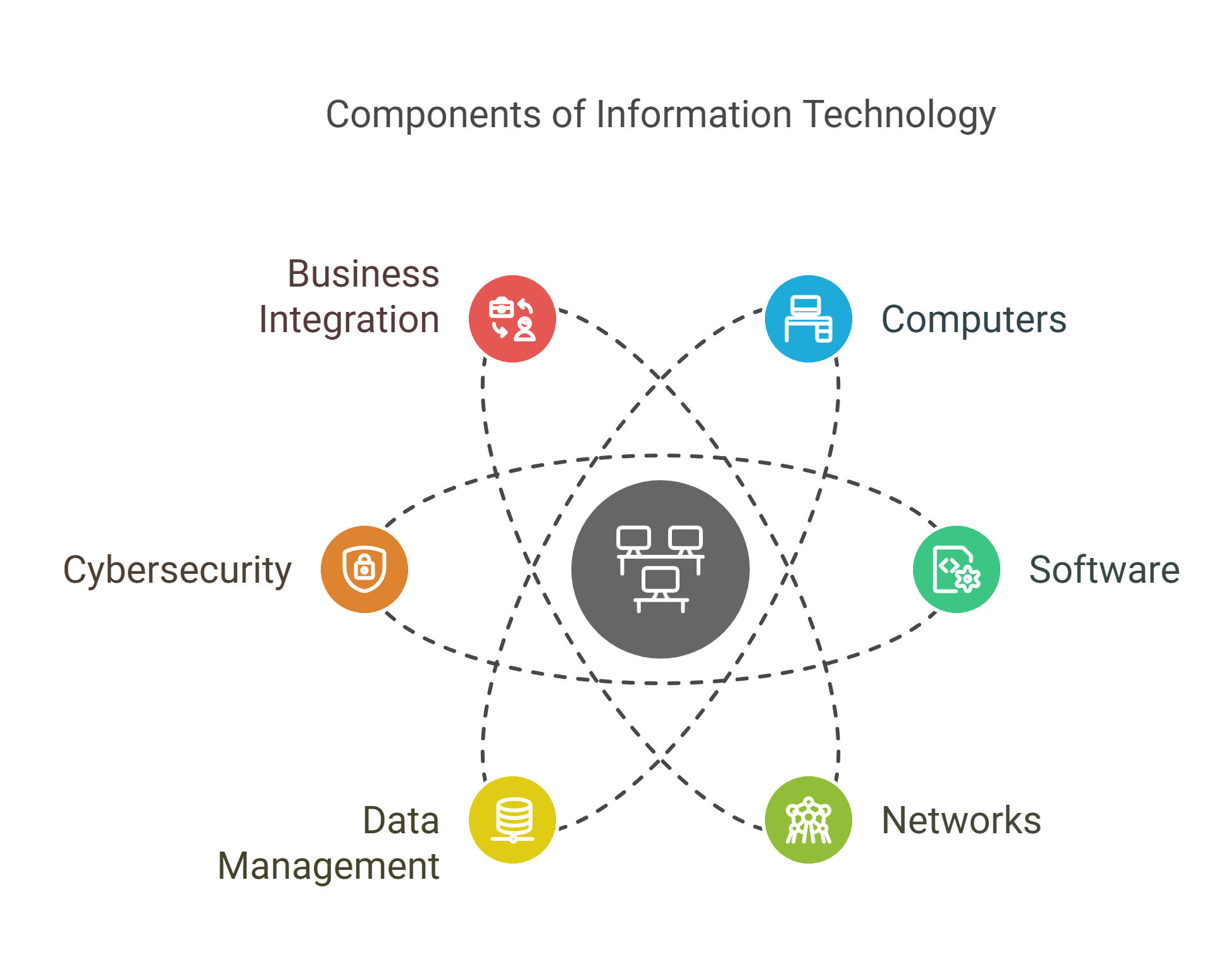
Information Technology (IT) uses computers, networks, and software to manage and exchange data. Once focused on business operations, IT shapes healthcare, education, and communication sectors. Evolving from basic tools to innovations like cloud computing and mobile tech, IT spans fields such as networking, software development, and cybersecurity.
It drives efficiency, data-driven decisions, and better user experiences across industries.
Also Read: Latest Technology Trends in 2026

The Information Technology role is critical in improving communication, driving innovation, and boosting productivity.
Key roles of IT include:
Also Read: Exploring the importance of technology in our daily life | Types of Technology: Applications & Examples
Understanding IT's importance sets the foundation for exploring its various types, each playing a critical role in modern businesses and industries.
Free Courses

Information Technology consists of key components that support business operations and drive innovation. The table below categorizes different types of Information Technology with examples to illustrate their applications.
Category |
Description |
Examples |
| Hardware | Physical devices that form the backbone of IT systems. | Computers, servers, printers, smartphones |
| Software | Programs and applications that run on hardware, enabling various functions. | Operating systems, office suites, mobile apps |
| Platforms | Tools or environments where software runs or is built. | Windows, Android, iOS, AWS |
| Networks | Systems that enable data transmission and communication between devices. | LAN, Wi-Fi, Ethernet, 5G networks |
| APIs (Application Programming Interfaces) | Interfaces that allow software components to interact. | REST APIs, SOAP APIs, GraphQL |
| Data | Raw facts that are processed and analyzed for use in decision-making. | Customer data, financial data, sensor data |
| Databases | Systems designed for storing, managing, and retrieving data. | MySQL, PostgreSQL, Oracle DB |
| Data Storage | Systems or devices for saving and retrieving data in various formats. | Hard drives, SSDs, cloud storage solutions |
| Analytics | Tools and processes for examining data to uncover trends, patterns, and insights. | Google Analytics, Power BI, Tableau |
| Content Delivery | Systems used to deliver digital content to users. | CDNs, streaming services, web hosting |
| Content Management | Systems for creating and managing digital content. | WordPress, Drupal, Adobe Experience Manager |
| Monitoring | Tools used to oversee and maintain IT systems. | Nagios, SolarWinds, Zabbix |
| Event Processing | Systems that process real-time events and data streams. | Apache Kafka, AWS Lambda |
| Process Automation | Software designed to automate repetitive tasks. | UiPath, Blue Prism, Zapier |
| Transaction Processing | Systems for handling business transactions. | Payment gateways, stock trading platforms |
| Artificial Intelligence (AI) | The technology simulates human intelligence for problem-solving. | Chatbots, recommendation engines, autonomous vehicles |
| Cloud Computing | On-demand delivery of computing resources over the internet. | AWS, Microsoft Azure, Google Cloud |
| Communications | Tools that enable communication in various forms. | Email, VoIP, video conferencing systems |
| Cybersecurity | Measures taken to protect systems and data from threats like malware and unauthorized access. IT professionals handle specific threats such as phishing, insider threats, and DDoS attacks. | Firewalls, encryption, antivirus software, phishing detection, intrusion detection systems |
| IT Infrastructure | The physical and virtual resources that support IT services. | Servers, data centers, networking hardware |
| Internet of Things (IoT) | A network of interconnected devices that exchange data. | Smart thermostats, wearable devices, connected cars |
| Machine Learning | A subset of AI where systems learn from data to make predictions and improve over time. Common industry use cases include fraud detection, customer behavior analysis, and predictive maintenance. | Fraud detection systems, recommendation engines, image recognition, predictive maintenance for machinery |
| Robotics | The use of robots for tasks traditionally performed by humans, often in industrial settings. | Industrial robots, autonomous drones |
| Software/Application Development | The process of designing, coding, and testing software applications. | Agile development, programming languages, IDEs |
AI Courses to upskill
Explore Artificial Intelligence Courses for Career Progression
Understanding what is information technology becomes easier when you see how an IT system processes and manages information. Information technology combines hardware, software, networks, databases, and cloud services to collect, process, store, and share data efficiently. It also overlaps with what is information and communication technology, which includes communication networks and digital technologies that enable information exchange across devices and systems.
The information processing lifecycle explains how raw data is transformed into meaningful information. This process forms the foundation of the definition of information technology, as every IT system follows these stages to deliver accurate and useful information.
This continuous process helps organizations manage information efficiently and support daily business operations.
An IT ecosystem is a collection of interconnected technologies that work together to deliver digital services. It demonstrates what is information and communication technology is in practice by combining computing resources with communication infrastructure.
Its key components include:
Together, these components create a complete environment for managing and delivering digital information.
Data flow describes how information moves through an IT system from its source to its final destination. Whether using traditional IT infrastructure or modern information and communication technology, the flow generally follows the same sequence.
A well-designed data flow improves accuracy, security, and decision-making across an organization.
Enterprise architecture provides a structured framework for organizing an organization's technology resources. It ensures that business processes, applications, data, and infrastructure work together to support organizational goals. Understanding this framework also helps clarify what is the difference between information technology and software industry. Information technology focuses on managing infrastructure, networks, security, databases, and business systems, while the software industry primarily develops and maintains software products and applications.
Layer |
Purpose |
| Business Layer | Defines business goals, processes, and organizational structure. |
| Application Layer | Includes software applications that support business operations. |
| Data Layer | Manages how data is collected, stored, secured, and shared. |
| Technology Layer | Covers hardware, cloud platforms, operating systems, and network infrastructure. |
| Security and Governance | Defines security policies, compliance requirements, risk management, and access controls. |
A well-planned enterprise architecture helps organizations improve collaboration, strengthen security, reduce operational costs, and scale their IT infrastructure as business needs evolve.
Stay ahead in the evolving IT industry with upGrad's Executive Post Graduate Certificate in AI-Native Software Engineering from IIT Kharagpur. Build practical skills in AI-driven software development and modern engineering practices.
Information technology supports almost every business operation, from managing data to protecting digital assets. Knowing what is information technology also means understanding the key functions that help organizations improve productivity, communication, and decision-making.
1. Data Management
IT collects, stores, organizes, and retrieves data efficiently. Businesses use databases and cloud storage to manage customer records, financial information, and operational data while ensuring quick access and data accuracy.
2. Communication
One of the most important functions of what is information and communication technology is enabling seamless communication. Email, video conferencing, messaging platforms, and collaboration tools help employees, customers, and partners stay connected from anywhere.
3. Automation
Information technology automates repetitive tasks such as payroll processing, inventory management, report generation, and customer support. This reduces manual effort, improves accuracy, and saves time.
4. Security
IT protects systems, networks, and sensitive information from cyber threats. Firewalls, encryption, multi-factor authentication, backups, and access controls help maintain data security and business continuity.
5. Decision Support
Businesses use IT to analyze data and generate reports that support informed decision-making. Dashboards, business intelligence tools, and data analytics help managers identify trends, monitor performance, and plan future strategies.
6. Resource Management
Information technology helps organizations manage hardware, software, networks, cloud resources, and IT services efficiently. Effective resource management reduces costs, improves system performance, and supports business growth.
Information Technology services support the maintenance, management, and optimization of IT systems. These services are integral for organizations that rely on IT to perform efficiently and securely.
Below are some of the key IT services and their real-world applications:
Also Read: Best Cloud Storage Services: Future-Proof Your Data
Also Read: Top 28+ IT Trending Technologies: Skills, Career Opportunities, Application
After exploring IT services and their use cases, let's look ahead to the emerging trends shaping the future of Information Technology.
Information technology plays a central role in digital transformation by helping organizations modernize operations, improve customer experiences, and make faster business decisions. Businesses that understand what is information technology can use digital technologies to stay competitive and adapt to changing market demands.
Cloud computing enables businesses to access computing resources over the internet instead of relying only on physical infrastructure.
Artificial intelligence helps businesses automate processes and extract insights from large volumes of data.
Automation uses software and digital tools to perform routine business activities with minimal human intervention.
Organizations use information technology to collect, analyze, and use data for informed decision-making.
Subscribe to upGrad's Newsletter
Join thousands of learners who receive useful tips

Information Technology in business has reshaped how organizations function, offering significant benefits in efficiency and decision-making. For instance, Enterprise Resource Planning (ERP) systems, like SAP, streamline workflows by integrating functions such as inventory management, finance, and HR, reducing manual errors and saving time.
Below are some key benefits that Information Technology brings to businesses:
Also Read: Benefits and Advantages of Big Data & Analytics in Business
Although these fields are closely related, they serve different purposes. Information Technology focuses on managing and supporting technology infrastructure, Information Systems combines technology with business processes, and Computer Science emphasizes the theory and development of computing systems. Understanding these differences helps students and professionals choose the right career path.
| Feature | Information Technology (IT) | Information Systems (IS) | Computer Science (CS) |
|---|---|---|---|
| Primary Focus | Managing and maintaining technology infrastructure | Using technology to support business processes | Designing and developing computing systems and software |
| Main Goal | Ensure reliable, secure, and efficient IT operations | Improve business performance through technology | Solve computational problems and build software solutions |
| Core Topics | Networks, cybersecurity, cloud computing, databases, IT support | Business analysis, enterprise systems, databases, project management | Programming, algorithms, data structures, AI, operating systems |
| Programming Requirement | Moderate | Basic to Moderate | High |
| Business Knowledge | Limited | High | Limited |
| Common Tools | Windows Server, Linux, Azure, AWS, Cisco, VMware | SAP, Oracle ERP, CRM platforms, SQL | Python, Java, C++, Git, TensorFlow |
| Best For | Managing and securing IT infrastructure | Bridging business needs with technology | Building software and solving technical problems |
| Career Path | IT Operations and Infrastructure | Business Technology and Management | Software Development and Research |
Quick Tip: Choose Information Technology if you enjoy managing systems and networks, Information Systems if you're interested in combining business with technology, and Computer Science if you want to build software, develop algorithms, or work in fields like AI and machine learning.

As businesses continue to integrate IT into their core operations, the demand for skilled professionals in fields like Artificial Intelligence, Machine Learning, and Blockchain increases.
The U.S. Bureau of Labor Statistics projects that jobs in computer and information technology will grow significantly faster than the average for all occupations from 2023 to 2033. In addition, the median annual salary for IT professionals in India was approximately ₹8.6 lakhs in 2023, nearly double the national median wage of around ₹4 lakhs, highlighting the strong earning potential in this field.
Below is a table summarizing some of the key IT careers, their responsibilities, and average annual salaries:
Career |
Responsibilities |
Average Annual Salary |
| Software Developer | Designing, coding, and testing software applications. Developing programs for businesses or personal use. | INR 7L |
| Data Scientist | Analyzing and interpreting complex data to help businesses make informed decisions. Developing algorithms for predictive analysis. | INR 13L |
| Cybersecurity Specialist | Protecting an organization’s data and networks from cyber threats. Implementing security measures and policies. | INR 11L |
| Network Engineer | Designing, implementing, and managing an organization's networks. Ensuring communication systems are reliable and secure. | INR 5L |
| IT Project Manager | Overseeing IT projects from initiation to completion. Managing timelines, budgets, and team coordination. | INR 15L |
| Database Administrator | Maintaining and securing databases. Ensuring data is stored efficiently and remains accessible to authorized users. | INR 7L |
Source: Glassdoor, Indeed
Also Read: Discover the top highest paying IT Jobs in India
After exploring IT career opportunities and salaries, let's see how upGrad can help you develop the skills to leverage these technologies effectively.
Understanding the definition of information technology is the first step toward building a strong foundation in today's digital world. From managing data and networks to supporting cloud computing, cybersecurity, and business operations, IT powers the technologies people and organizations rely on every day.
It is also important to know what is the difference between information technology and software industry. While the software industry focuses on developing applications and software products, information technology covers a much broader scope, including infrastructure, system administration, networking, security, databases, and technical support.
If you're ready to take the next step in your career, connect with upGrad’s career counseling for personalized guidance. You can also visit a nearby upGrad center for hands-on training to enhance your digital marketing skills and open new career opportunities!
Similar Reads:
Information Technology (IT) is the use of computers, software, networks, and hardware to create, store, process, and protect digital information. It helps businesses and organizations manage data, communicate efficiently, and run systems smoothly. IT plays a key role in everyday services like online banking, healthcare systems, and e-commerce platforms.
Information Technology is critical to modern businesses because it supports automation, enhances communication, secures sensitive data, and streamlines operations. IT enables companies to make data-driven decisions, optimize workflow, reduce manual errors, and stay competitive in fast-changing markets. It also allows businesses to scale operations, deliver better customer service, and innovate faster.
Common examples of IT include computer networks used in offices, cloud services like Google Drive or AWS, and cybersecurity systems that protect data. Other examples include websites, mobile applications, and database management systems. These technologies help organizations operate faster and more securely.
Learning IT provides access to high-paying job opportunities and equips you with relevant technical and analytical skills across industries. You’ll gain expertise in cutting-edge areas such as cloud computing, data analysis, ethical hacking, and app development. Beyond career growth, IT skills also improve your problem-solving ability and adaptability in a rapidly evolving digital landscape.
Key IT skills include basic programming, problem-solving, and understanding computer systems and networks. Knowledge of cybersecurity, cloud platforms, and data analysis is also valuable. Strong communication and continuous learning are important, as technology keeps changing.
To start a career in IT, you must build a strong foundation in computer science concepts and digital tools. You can take online courses or certifications in programming, networking, or systems administration. Gaining hands-on experience through internships, projects, or freelance work helps solidify your understanding and gives you a portfolio to showcase to potential employers.
IT certifications validate your skills and can significantly improve your job prospects. Some of the most respected certifications include CompTIA A+ for entry-level support, Cisco’s CCNA for networking, AWS Certified Solutions Architect for cloud computing, and Microsoft Certified Azure Solutions Architect for Microsoft technologies. These credentials can help you specialize and stand out in the job market.
upGrad offers comprehensive IT programs designed by industry experts and leading universities. Through upGrad, you’ll gain hands-on experience with real-world projects, receive one-on-one mentorship, and access a flexible online learning schedule. Their certifications are recognized globally, helping you achieve the credentials and confidence to advance in your IT career.
Some of the highest-paying IT roles include Chief Technology Officer (CTO), AI Engineer, Data Scientist, and Cybersecurity Architect. These jobs require advanced technical skills and experience. Salaries are high because these roles handle critical systems, data, and business strategy.
Information Technology improves efficiency by automating repetitive tasks, enabling faster communication, and supporting better decision-making through data analysis. It allows teams to collaborate remotely, reduces operational costs, and enhances customer service through AI and CRM systems. Ultimately, IT helps businesses operate more productively and respond quickly to market changes.
Breakthrough technologies such as artificial intelligence, machine learning, blockchain, quantum computing, and the Internet of Things (IoT) are shaping the future of IT. These innovations transform how data is processed, devices interact, and businesses operate. Staying current with these trends will be crucial for professionals who want to stay relevant in the tech landscape.
The main types of IT include hardware, software, networking, cloud computing, and cybersecurity. Hardware covers physical devices like servers and computers, while software includes operating systems and applications. Networking, cloud, and security technologies support connectivity, data storage, and protection.
While Computer Science focuses on designing and developing computing systems, Information Technology emphasizes the practical use of these systems to solve real-world problems, manage data, and support business operations.
Yes. Many IT roles, such as IT support, data entry, and certain cloud-based services, have beginner-friendly learning paths. Online IT courses, bootcamps, and certifications are available for individuals without prior coding or technical experience.
The IT sector faces challenges such as cybersecurity threats, data privacy issues, rapid technological change, skills shortages, and compliance with global regulations. Businesses must adopt adaptive strategies to stay competitive and secure.
Cloud computing is a critical component of IT, offering on-demand access to computing resources such as servers, storage, and applications. It reduces infrastructure costs, enhances scalability, and supports remote work capabilities.
Information Technology is integral to industries like banking and finance, healthcare, education, retail, manufacturing, telecommunications, and government services. Its applications range from online transactions to predictive analytics and automated operations.
With focused learning and certifications, you can qualify for entry-level IT roles within 6–12 months. However, advancing to specialized or senior positions may require several years of experience and continuous skill upgrades.
Cybersecurity is a specialized branch of IT that protects networks, systems, and data from unauthorized access or attacks. It involves practices like encryption, firewalls, penetration testing, and security monitoring.
Yes. Artificial Intelligence (AI) is a subset of IT that enables systems to simulate human intelligence, automate processes, and analyze large datasets. AI is increasingly used in IT solutions for automation, decision-making, and personalization.
Reference Links:
https://www.glassdoor.co.in/Salaries/software-developer-salary-SRCH_KO0,18.htm
https://www.glassdoor.co.in/Salaries/data-scientist-salary-SRCH_KO0,14.htm
https://www.glassdoor.co.in/Salaries/cyber-security-specialist-salary-SRCH_KO0,25.htm
https://www.glassdoor.co.in/Salaries/network-engineer-salary-SRCH_KO0,16.htm
https://www.glassdoor.co.in/Salaries/it-project-manager-salary-SRCH_KO0,18.htm
https://www.glassdoor.co.in/Salaries/database-administrator-salary-SRCH_KO0,22.htm
https://www.coursera.org/in/articles/software-developer-salary
https://onlineamrita.com/blog/average-salary-of-data-scientist-in-india/
https://www.coursera.org/in/articles/cybersecurity-salary
https://www.upgrad.com/blog/average-network-engineer-salary-in-india/
https://www.simplilearn.com/project-manager-salary-article
https://in.indeed.com/career/database-administrator/salaries
https://www.business-standard.com/industry/news/jobs-in-india-s-ites-sector-likely-to-grow-by-20-in-2025-report-125032401237_1.html
965 articles published
We are an online education platform providing industry-relevant programs for professionals, designed and delivered in collaboration with world-class faculty and businesses. Merging the latest technolo...
Speak with AI & ML expert
By submitting, I accept the T&C and
Privacy Policy
Top Resources
Master's Degree
18 Months
Executive Diploma
12 Months
IIIT Bangalore
Executive Programme in Generative AI & Agentic AI for LeadersIndia’s #1 Tech University
Dual Certification
5 Months