Data Science Algorithms: Types, Examples, and Applications
By Sriram
Updated on Jun 24, 2026 | 6 min read | 2.27K+ views
Share:

All courses
Certifications
More
By Sriram
Updated on Jun 24, 2026 | 6 min read | 2.27K+ views
Share:
Table of Contents
Data science algorithms are important for analytics and things like machine learning and artificial intelligence. They help companies find patterns in their data to make predictions about what might happen to make decisions automatically and get information from big sets of data.
Whether you are building a system that recommends things to people trying to figure out which customers might stop doing business with you or trying to catch people who are doing something, data science algorithms are what make all these things work.
This blog explains the most important data science algorithms, how they work, where they are used, and how beginners can understand them without getting lost in technical jargon. You'll also explore a practical list of data science algorithms, learn about the most common algorithms used in data science.
Explore Data Science Courses from upGrad and gain hands-on experience building, testing, and deploying models employers are actively searching for.
Popular Data Science Programs
Data science algorithms are like a set of instructions. They look at the data. Then they give us some ideas, or they try to predict what will happen.
Think of a data science algorithm like a recipe for making food. A recipe tells you what to do to make a meal, and a data science algorithm tells you what to do to solve a problem with data. Data science algorithms are really a list of steps that help us understand data and make good decisions.
For example:
All of these tasks rely on algorithms.
Also Read: Top Data Mining Techniques for Explosive Business Growth Revealed!
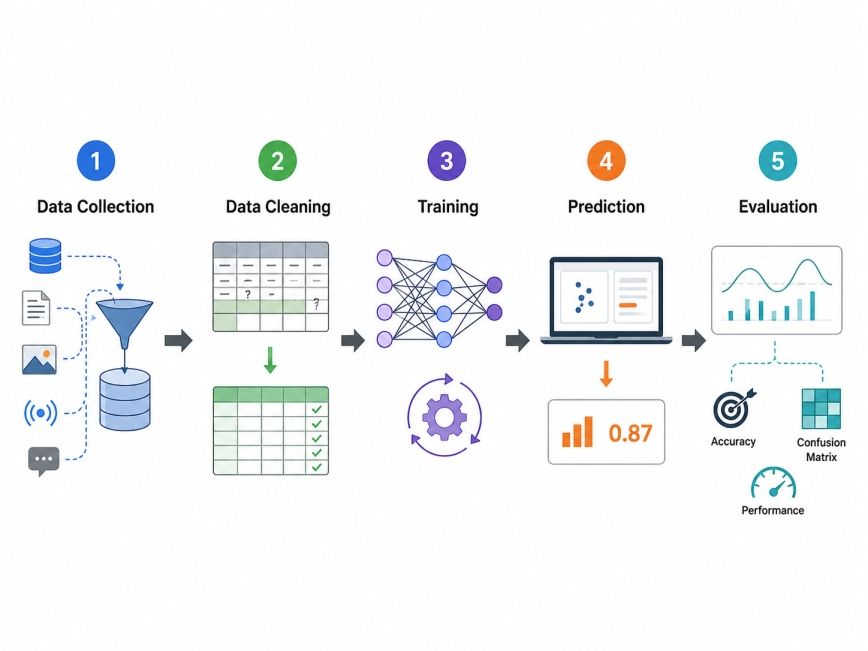
Most algorithms follow a similar process:
Step |
Description |
| Data Collection | Gather relevant data |
| Data Cleaning | Remove errors and inconsistencies |
| Training | Learn patterns from historical data |
| Prediction | Apply learned patterns to new data |
| Evaluation | Measure performance and accuracy |
The quality of results depends on:
Without algorithms, raw data is not very useful. Most businesses use machine learning algorithms a lot to make their operations run smoother and make decisions. IBM researchers found out that lots of organizations are using these algorithms to make things better.
Algorithms help:
A strong algorithm should:
Many beginners use these terms interchangeably. Machine learning algorithms are a subset of data science algorithms. This broader perspective helps explain why the algorithms used in data science extend beyond predictive modeling.
Data science includes:
Free Courses
There are hundreds of algorithms available today. However, a small group forms the foundation of most real-world projects. Below is a list of data science algorithms that you should know.
Regression predicts numerical values.
Examples:
Common applications:
Classification predicts categories.
Examples:
Applications include:
Clustering groups similar data points.
Popular methods:
Applications:
These discover relationships between variables.
Example:
Application:
Retailers use this to identify products frequently purchased together.
These reduce the number of features while retaining important information.
Examples:
Applications:
This list of data science algorithms is really useful for a lot of projects, in business, healthcare, finance, and technology.
Many professionals in data science algorithms spend a lot of time learning about these basic methods. They do this because data science algorithms are still very important even though artificial intelligence is getting better fast.
Algorithm |
Type |
Common Use Case |
| Linear Regression | Regression | Price prediction |
| Logistic Regression | Classification | Churn prediction |
| Random Forest | Classification | Risk assessment |
| K-Means | Clustering | Customer segmentation |
| PCA | Dimensionality Reduction | Feature reduction |
| SVM | Classification | Image recognition |
Data Science Courses to upskill
Explore Data Science Courses for Career Progression
IIIT Bangalore
Executive Post Graduate Certificate in Data Science & AIPlacement Assistance
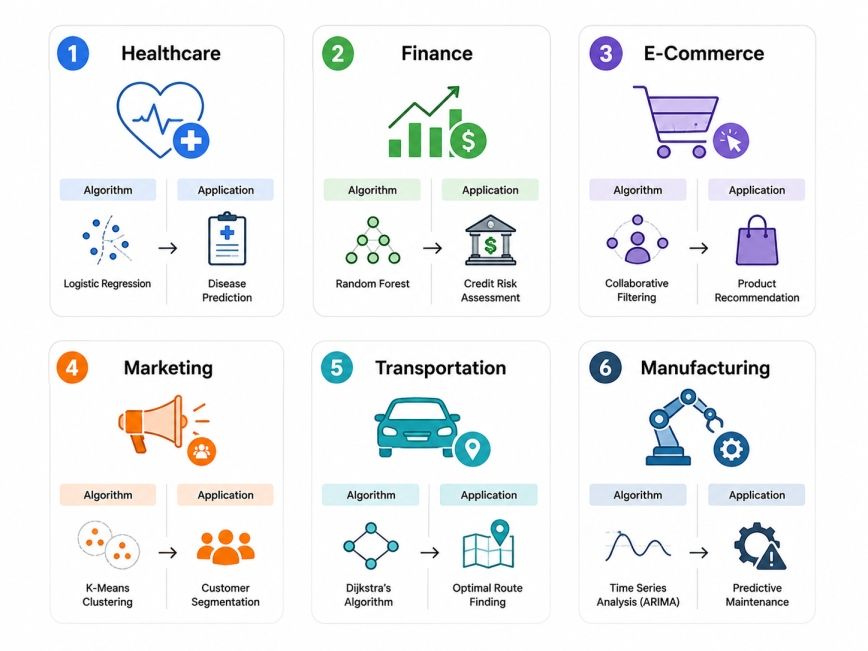
Learning theories is useful. Seeing algorithms in action makes their value clearer. The most successful organizations use algorithms used in data science to solve business problems every day.
Hospitals and healthcare providers use algorithms for:
For example, machine learning models can help identify early signs of diabetes or heart disease.
Banks depend heavily on data science.
Applications include:
Algorithms can analyze millions of transactions in real time to identify suspicious behavior.
Online retailers use algorithms to:
Recommendation systems used by companies like Amazon are powered by sophisticated predictive algorithms.
Marketing teams use data science for:
This helps businesses allocate budgets more effectively.
Ride-sharing and logistics companies rely on:
Manufacturers use algorithms to:
When it comes to getting things done, the way you do something is often more important than trying to do it in a complicated way. Experienced data scientists usually start with ways of doing things before they try more complicated methods.
This approach of keeping things simple often leads to results for the company, and that is what data scientists like to see from their data science work. Not every algorithm works for every problem.
Consider:
Scenario |
Recommended Algorithm |
| Predict sales | Linear Regression |
| Detect spam | Logistic Regression |
| Group customers | K-Means |
| Fraud detection | Random Forest |
| Image classification | SVM or Neural Networks |
A beginner often has a common question whether data algorithms are important for data science? The short answer is yes; they are.
How important they are depending on what you want to do in your data science career.
Algorithms improve:
For example, sorting and searching algorithms can significantly affect performance when handling millions of records.
Importance for Different Roles
Role |
Importance Level |
| Data Analyst | Moderate |
| Data Scientist | High |
| Machine Learning Engineer | Very High |
| AI Engineer | Very High |
| Research Scientist | Essential |
Many beginners focus only on predictive models.
However, real-world projects involve:
Strong algorithmic thinking helps solve these challenges.
You do not need the same depth as a software engineer preparing for competitive programming interviews.
Focus on:
Understanding these fundamentals makes you a stronger practitioner.
In my work with data, I find that understanding the business side and thinking statistically is often more important than knowing advanced algorithms. People who get both machine learning and traditional computer science concepts usually do better. Move up faster in technical jobs.
So, when others ask if data structures and algorithms are important, for a data science career, my answer is yes. Knowing data structures and algorithms gives you a base that helps your career grow over time and helps with machine learning and data science work.
Data science algorithms are the engines that power modern analytics, machine learning, and AI applications. From predicting customer behavior to detecting fraud and optimizing operations, algorithms transform raw data into actionable insights.
Understanding the major categories, exploring a practical list of data science algorithms, and learning how different algorithms used in data science solve business problems can help beginners build a strong foundation. While mastering machine learning techniques is important, understanding whether data structures and algorithms are important for data science is equally valuable for long-term success.
Start with the fundamentals. Learn how the core algorithms work. Then apply them to real-world projects. That combination of theory and practice is what ultimately builds strong data science skills.
Want to explore more about Data science algorithms? Book your free 1:1 personal consultation with our expert today.
The most commonly used algorithms include Linear Regression, Logistic Regression, Random Forest, Decision Trees, K-Means Clustering, Support Vector Machines, and Neural Networks. The choice depends on the problem being solved. Some algorithms predict numbers, others classify data, while some discover hidden patterns and relationships within datasets.
Algorithms in data science are structured with sets of instructions that analyze data and generate outcomes such as predictions, classifications, or recommendations. They help computers identify patterns within data and automate decision-making processes across industries including healthcare, finance, marketing, and technology.
The four common types are numerical data, categorical data, ordinal data, and binary data. Understanding data types is important because different algorithms and analytical methods work best with specific forms of data and feature structures.
Linear Regression is often considered one of the most widely used algorithms because of its simplicity and interpretability. It is commonly applied in forecasting, trend analysis, and predictive modeling where understanding relationships between variables is important.
Not exactly. Machine learning algorithms form a subset of data science algorithms. Data science also includes statistical techniques, optimization methods, data mining approaches, and analytical frameworks that may not involve machine learning.
Most experts recommend starting with Linear Regression and Logistic Regression. These algorithms introduce core concepts such as model training, prediction, feature importance, and evaluation without overwhelming beginners with complexity.
The choice depends on the business objective, data type, dataset size, and desired outcome. A classification problem requires different algorithms than a forecasting or clustering problem, making problem definition a critical first step.
No. There is no universal algorithm that works best in every situation. Different datasets have unique characteristics, and successful data scientists often compare multiple models before selecting the best-performing solution.
Basic coding skills are extremely helpful when implementing algorithms. Languages such as Python and R are widely used because they provide libraries that simplify model building, evaluation, and deployment.
Neural networks are designed to learn complex patterns from large datasets through multiple interconnected layers. Traditional algorithms are often easier to interpret, while neural networks usually deliver better performance on highly complex tasks such as image and speech recognition.
Industries including healthcare, banking, insurance, e-commerce, manufacturing, telecommunications, and transportation heavily rely on data science algorithms. These organizations use algorithms to improve efficiency, reduce costs, predict future outcomes, and deliver better customer experiences.
730 articles published
Sriram K is a Senior SEO Executive with a B.Tech in Information Technology from Dr. M.G.R. Educational and Research Institute, Chennai. With over a decade of experience in digital marketing, he specia...
Speak with Data Science Expert
By submitting, I accept the T&C and
Privacy Policy
Start Your Career in Data Science Today
Top Resources
Master's Degree
18 Months
Executive Diploma
12 Months
Bootcamp
6 Months