Market Basket Analysis: A Complete Guide
By Sriram
Updated on Jun 11, 2026 | 8 min read | 2.3K+ views
Share:

All courses
Certifications
More
By Sriram
Updated on Jun 11, 2026 | 8 min read | 2.3K+ views
Share:
Table of Contents
Market basket analysis is a way that helps businesses figure out which products people buy together. Have you ever thought about how online stores know what product to suggest next when you are shopping. Have you noticed that supermarkets put certain things close to each other on the shelves. They seem to know what you want. This often lies in a powerful technique called market basket analysis.
In this blog, you’ll learn about market basket analysis, how it works, and the key metrics behind it. You will also learn about common algorithms used for market basket analysis and real-life examples.
Explore Data Science Courses from upGrad to learn more about Market basket analysis and increase your skill and market value.
Popular Data Science Programs
Market basket analysis is a data mining technique to figure out what people usually buy together. It analyzes transaction data of what people have bought and finds patterns that are not easily visible at first.
This idea started in retail stores and now it is used across different types of industry, like e-commerce, banking, healthcare, streaming platforms, and recommendation systems. The main objective of market basket analysis is to learn what people like to purchase and use that information to sell, to make better suggestions and business decisions as well.
For example:
Product A |
Product B |
Observation |
| Bread | Butter | Often bought together |
| Chips | Soft Drinks | Frequently appear in the same basket |
| Mobile Phone | Phone Case | Strong purchase association |
Also Read: Data Science Summarized In One Picture
Free Courses
Market basket analysis in data mining is a form of association rule learning. Instead of predicting future values, it analyzes what people have bought and finds connections between items.
A good example of this is when people buy pasta, they also buy pasta sauce at the time. Market basket analysis helps us see these connections, like the one between pasta and pasta sauce by looking at what happens during transactions.
The technique answers questions such as:
Also Read: Top Data Mining Techniques for Explosive Business Growth Revealed!
Data Science Courses to upskill
Explore Data Science Courses for Career Progression
IIIT Bangalore
Executive Post Graduate Certificate in Data Science & AIPlacement Assistance
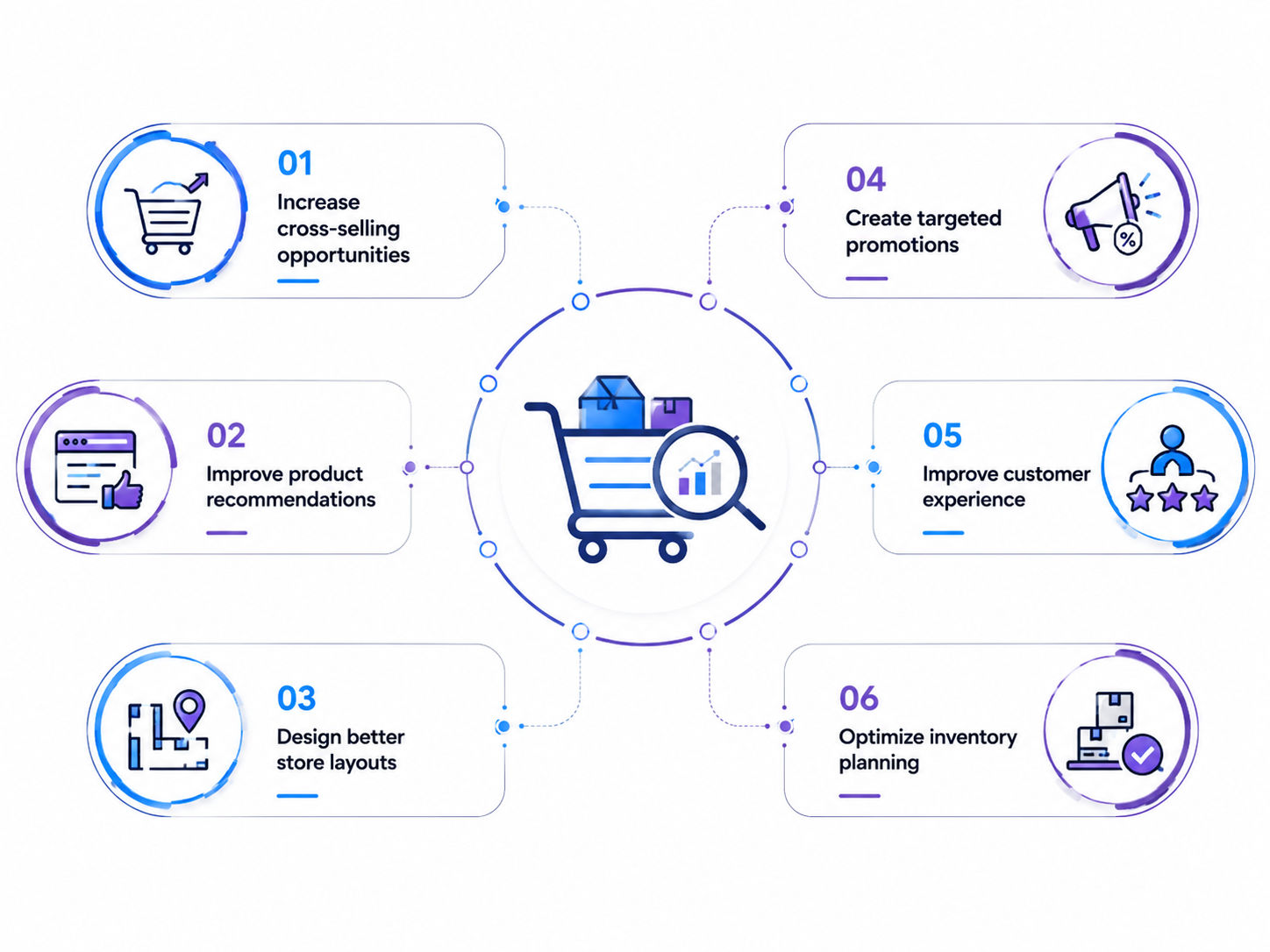
Large retailers and e-commerce sites use market basket analysis insights to suggest products that are often bought together and are personalized. This helps them sell more to customers.
Businesses use market basket analysis because it helps them:
Also Read: Understanding and Conducting a Market Research like Experts
Understanding the workflow makes the concept much easier.
A market basket analysis dataset contains transaction records where each row represents a purchase.
Example:
Transaction ID |
Items Purchased |
| T1 | Bread, Milk, Butter |
| T2 | Bread, Eggs |
| T3 | Milk, Butter |
| T4 | Bread, Milk |
This transaction-level data forms the foundation of the analysis.
The system identifies combinations of products that appear together frequently.
Examples:
These combinations are called frequent itemsets.
Rules are then generated using an "if-then" structure.
Examples:
These are called association rules.
Three important metrics determine whether a rule is meaningful.
Metric |
Meaning |
| Support | Frequency of occurrence |
| Confidence | Probability that Y occurs when X occurs |
| Lift | Strength of association beyond random chance |
Several algorithms support market basket analysis in data mining.
Popular options include:
Among these, Apriori remains the most widely taught and used approach because it efficiently identifies frequent itemsets from transaction data.
Also Read: Apriori Algorithm in Data Mining: Key Concepts, Applications, and Business Benefits in 2025
Subscribe to upGrad's Newsletter
Join thousands of learners who receive useful tips
To understand what is market basket analysis, it helps to look at real examples.
A typical market basket analysis dataset contains:
Transaction ID |
Product |
| 1001 | Bread |
| 1001 | Milk |
| 1001 | Butter |
| 1002 | Bread |
| 1002 | Eggs |
Multiple rows can belong to the same transaction.
The larger the dataset, the more reliable the associations become.
Suppose a supermarket analyzes 100,000 transactions
The results reveal:
Rule |
Confidence |
| Bread → Butter | 72% |
| Chips → Soft Drinks | 81% |
| Pasta → Pasta Sauce | 76% |
The retailer can use these findings to:
An online electronics store discovers:
Purchased Item |
Recommended Item |
| Smartphone | Phone Case |
| Laptop | Wireless Mouse |
| Camera | Memory Card |
These recommendations increase average order value and improve customer experience.
The same principles apply outside retail.
A streaming service may find:
These associations improve recommendation engines.
Banks use market basket analysis in data mining to identify products that customers commonly adopt together.
Examples include:
The insights help banks create better cross-selling strategies.
Despite its benefits, market basket analysis has limitations.
Some challenges include:
Analysts must combine business knowledge with statistical interpretation for meaningful outcomes.
Also Read: What is Data Mining? Key Concepts, How Does it Work?
When we look at the data about purchasing, it is really important to use market basket analysis, it identifies customer purchasing habits, understand what customers' behaviors are, and their preference.
The popularity of market basket analysis comes from its practical business value.
Recommendation engines are one of the most common applications.
Examples:
These suggestions rely heavily on association rules discovered from transaction data.
Physical retailers use analysis results to determine where products should be placed.
For example:
Better placement often leads to higher sales.
When businesses know which products are purchased together, they can improve stock planning.
Benefits include:
One big advantage of market basket analysis in data mining is identifying cross-selling opportunities. These recommendations can significantly increase revenue.
Examples:
Primary Product |
Suggested Product |
| Laptop | Laptop Bag |
| Smartphone | Earbuds |
| Printer | Ink Cartridge |
Businesses that segment customers based on purchasing behavior can gain an edge.
Common segments include:
These insights support personalized marketing campaigns.
Also Read: Discover How Classification in Data Mining Can Enhance Your Work!
Market basket analysis is one of the most practical techniques in modern analytics. It helps businesses understand which products customers purchase together and use those insights to improve recommendations, promotions, store layouts, and inventory planning.
Understanding what is market basket analysis, how association rules work, and how metrics such as support, confidence, and lift are calculated gives data professionals a strong foundation in association rule mining. As organizations increasingly rely on data-driven decision-making, market basket analysis continues to play an important role across retail, e-commerce, banking, healthcare, and digital platforms.
Want personalized guidance on Market basket analysis? Speak with an expert for a free 1:1 counselling session today.
Market basket analysis identifies associations between products using transaction data. Recommendation systems are broader and may use browsing history, user preferences, ratings, and machine learning models. Market basket analysis is often one component of a recommendation engine.
Retailers use market basket analysis to discover product combinations frequently purchased together. These insights help improve product placement, promotions, cross-selling opportunities, and overall customer experience while increasing sales.
Besides retail, industries such as banking, healthcare, telecommunications, insurance, media streaming, and e-commerce use market basket analysis. Any organization with transaction data can uncover useful associations through this technique.
A market basket analysis dataset requires transaction-level data. Each transaction should include the products or services purchased together. The more transactions available, the more reliable the resulting patterns become.
Yes. Market basket analysis is generally classified as an unsupervised learning technique within data mining. It focuses on discovering hidden relationships and patterns without predefined target variables.
Association rule mining is the process of finding relationships between items in a dataset. It generates rules that show which products tend to appear together within customer transactions.
Confidence measures the probability of purchasing one item when another item is purchased. Lift evaluates whether that relationship is stronger than what would occur randomly, making it a more reliable indicator.
Apriori and FP-Growth are the most commonly used algorithms. Both identify frequent itemsets and generate association rules, though FP-Growth is often more efficient with large datasets.
Yes. E-commerce companies widely use market basket analysis for product recommendations, bundle creation, cross-selling campaigns, and personalized shopping experiences based on customer behavior.
The technique identifies associations but cannot prove causation. It may also struggle with rare item combinations and large datasets that require significant computational resources for processing.
Beginners should start by understanding association rules, support, confidence, and lift. Learning basic Python libraries such as mlxtend and working with a simple market basket analysis dataset can help build practical skills quickly.
727 articles published
Sriram K is a Senior SEO Executive with a B.Tech in Information Technology from Dr. M.G.R. Educational and Research Institute, Chennai. With over a decade of experience in digital marketing, he specia...
Speak with Data Science Expert
By submitting, I accept the T&C and
Privacy Policy
Start Your Career in Data Science Today
Top Resources
Executive Diploma
12 Months
Master's Degree
18 Months
Bootcamp
6 Months