You're browsing from the United States

Some programs may not be available in your location

Switch to upGrad US
Explore Countries
logo

D'Amore McKim School of Business Northeastern University

MBA at Northeastern University

  • CountryUSA
  • Online11 months
  • On campus1 year 6 months
logo

Northeastern University

MPS in Applied AI at Northeastern University

  • CountryUSA
  • Online8 months
  • On campus1 year 3 months
logo

New York University

BS Information Systems & Technology at NYU USA

  • CountryUSA
  • Online1 year
  • On campus3 years
logo

New York University

BS Leadership and Management at NYU USA

  • CountryUSA
  • Online1 year
  • On campus3 years
logo

Drexel University

MS Robotics and Autonomy at Drexel University

  • CountryUSA
  • Online8 months
  • On campus1 year 3 months
logo

Drexel University

Master of Business Administration

  • CountryUSA
  • Online6 months
  • On campus1 year
logo

Northeastern University - College of Engineering

MS in Data Analytics Engineering at Northeastern University - College of Engineering

  • CountryUSA
  • Online8 months
  • On campus1 year 3 months
logo

DAmore McKim School of Business Northeastern University

MS Quantitative Finance at Northeastern University

  • CountryUSA
  • Online7 months
  • On campus1 year
logo

Northeastern University

BS Analytics at Northeastern University USA

  • CountryUSA
  • Online1 year
  • On campus3 years
logo

Northeastern University

BS IT at Northeastern University USA

  • CountryUSA
  • Online1 year
  • On campus3 years
logo

Clark University

MS Computer Science at Clark University

  • CountryUSA
  • Online8 months
  • On campus1 year
logo

DAmore McKim School of Business Northeastern University

MS Business Analytics, Northeastern University

  • CountryUSA
  • Online7 months
  • On campus9 months
logo

Yeshiva University

MS Biotechnology Management & Entrepreneurship at Yeshiva

  • CountryUSA
  • Online5 months
  • On campus1 year
logo

Northeastern University

MPS in Analytics at Northeastern University USA

  • CountryUSA
  • Online8 months
  • On campus1 year 3 months
logo

Northeastern University

MPS in Informatics at Northeastern University USA

  • CountryUSA
  • Online8 months
  • On campus1 year 3 months
logo

University of Detroit Mercy

Master of Health Services Administration at UDM

  • CountryUSA
  • Online7 months
  • On campus1 year
logo

Illinois Institute of Technology

BS Astrophysics at IllinoisTech Chicago

  • CountryUSA
  • Online1 year
  • On campus3 years
logo

Illinois Institute of Technology

BS Aerospace Engineering at IllinoisTech Chicago

  • CountryUSA
  • Online1 year
  • On campus3 years
logo

DePaul University

MA Sustainable Urban Development

  • CountryUSA
  • Online8 months
  • On campus1 year
logo

Clark University

MBA at Clark University

  • CountryUSA
  • Online7 months
  • On campus1 year
logo

Yeshiva University

MS AI at Yeshiva University

  • CountryUSA
  • Online8 months
  • On campus1 year
logo

Drexel University

MS Computer Engineering at Drexel University

  • CountryUSA
  • Online8 months
  • On campus1 year 3 months
logo

DAmore McKim School of Business Northeastern University

MS Fintech Management at Northeastern University

  • CountryUSA
  • Online11 months
  • On campus1 year
logo

Northeastern University - College of Engineering

MS in Industrial Engineering at Northeastern University - College of Engineering

  • CountryUSA
  • Online8 months
  • On campus1 year 3 months
logo

Drexel University

MS in Internet of Things at Drexel University

  • CountryUSA
  • Online8 months
  • On campus1 year 3 months
logo

Yeshiva University

MS CS at Yeshiva University

  • CountryUSA
  • Online8 months
  • On campus1 year
logo

Clark University

BS Biotechnology at Clark University, USA

  • CountryUSA
  • Online1 year
  • On campus3 years
logo

Washington State University

BS Neuroscience at WSU, USA

  • CountryUSA
  • Online1 year
  • On campus3 years
logo

Northeastern University

BS Biotechnology at Northeastern University USA

  • CountryUSA
  • Online1 year
  • On campus3 years
logo

Illinois Institute of Technology

BS Computer Engineering at IllinoisTech Chicago

  • CountryUSA
  • Online1 year
  • On campus3 years
logo

Colorado State University

BS Computer Science at Colorado State, USA

  • CountryUSA
  • Online1 year
  • On campus3 years
logo

Clark University

MS IT at Clark University

  • CountryUSA
  • Online8 months
  • On campus1 year
logo

Northeastern University

MS in Project Management (USA)

  • CountryUSA
  • Online7 months
  • On campus1 year 3 months
logo

Northeastern University

MS in Organizational Leadership at Northeastern University USA

  • CountryUSA
  • Online7 months
  • On campus1 year 3 months
logo

Touro University

MS in I/O Psychology at Touro University USA

  • CountryUSA
  • Online5 months
  • On campus1 year
logo

Northeastern University - College of Engineering

MS in Engineering Management at Northeastern University - College of Engineering

  • CountryUSA
  • Online8 months
  • On campus1 year 3 months
logo

Drexel University

MS in Engineering Management at Drexel University

  • CountryUSA
  • Online7 months
  • On campus1 year
logo

Drexel University

MS in Civil Engineering at Drexel University

  • CountryUSA
  • Online8 months
  • On campus1 year 3 months
logo

Northeastern University - College of Engineering

MS in Advanced and Intelligent Manufacturing at Northeastern University - College of Engineering

  • CountryUSA
  • Online8 months
  • On campus1 year 3 months
logo

Yeshiva University

MS DAV at Yeshiva University

  • CountryUSA
  • Online8 months
  • On campus1 year
logo

Drexel University

MS Engineering Management at Drexel University

  • CountryUSA
  • Online8 months
  • On campus1 year
logo

University of Massachusetts Lowell

MS Engineering Management at UMass Lowell

  • CountryUSA
  • Online7 months
  • On campus1 year
logo

Clark University

MS DA at Clark University

  • CountryUSA
  • Online8 months
  • On campus1 year
logo

DAmore McKim School of Business Northeastern University

MS Business Analytics at Northeastern University

  • CountryUSA
  • Online11 months
  • On campus9 months
logo

Clarkson University

MS Applied Data Science at Clarkson University

  • CountryUSA
  • Online8 months
  • On campus1 year
logo

Northeastern University

MPS Digital Media at Northeastern USA

  • CountryUSA
  • Online8 months
  • On campus1 year
logo

Touro University

MS AI at Touro University USA

  • CountryUSA
  • Online7 months
  • On campus9 months
logo

Touro University

MBA at Touro University USA

  • CountryUSA
  • Online6 months
  • On campus1 year
logo

DePaul University

MA Digital Communication & Media Arts at DePaul University

  • CountryUSA
  • Online8 months
  • On campus1 year
logo

DePaul University

Master of Business Administration at DePaul

  • CountryUSA
  • Online7 months
  • On campus1 year
logo

Drexel University

Master of Business Administration at Drexel University

  • CountryUSA
  • Online7 months
  • On campus1 year
logo

Northeastern University

BS Psychology at Northeastern University USA

  • CountryUSA
  • Online1 year
  • On campus3 years
logo

Northeastern University

BS Digital Communication & Media at Northeastern USA

  • CountryUSA
  • Online1 year
  • On campus3 years
logo

Washington State University

BS Mechanical Engineering at WSU, USA

  • CountryUSA
  • Online1 year
  • On campus3 years
logo

Northeastern University

BS Management at Northeastern University, USA

  • CountryUSA
  • Online1 year
  • On campus3 years
logo

Colorado State University

BS Hospitality Management at Colorado State, USA

  • CountryUSA
  • Online1 year
  • On campus3 years
logo

Colorado State University

BS Food Science at Colorado State, USA

  • CountryUSA
  • Online1 year
  • On campus3 years
logo

Northern Arizona University

BS Business Administration (Finance) at NAU

  • CountryUSA
  • Online1 year
  • On campus3 years
logo

Northern Arizona University

BS Business Administration (Management) at NAU, USA

  • CountryUSA
  • Online1 year
  • On campus3 years
logo

Northern Arizona University

BS Business Analytics at NAU

  • CountryUSA
  • Online1 year
  • On campus3 years
logo

Colorado State University

BS Business at Colorado State, USA

  • CountryUSA
  • Online1 year
  • On campus3 years
logo

Northern Arizona University

BS Computer Science at NAU, USA

  • CountryUSA
  • Online1 year
  • On campus3 years
logo

Clark University

BS Cybersecurity at Clark University, USA

  • CountryUSA
  • Online1 year
  • On campus3 years
logo

Colorado State University

BS Data Science at Colorado State, USA

  • CountryUSA
  • Online1 year
  • On campus3 years
logo

Utica University

Master of Business Administration at Utica University

  • CountryUSA
  • Online5 months
  • On campus9 months
logo

City University of Seattle

MBA at CityU Seattle

  • CountryUSA
  • Online11 months
  • On campus1 year
logo

Clarkson University

MBA at Clarkson University

  • CountryUSA
  • Online7 months
  • On campus1 year
logo

Utica University

MBA at Utica University

  • CountryUSA
  • Online7 months
  • On campus1 year
logo

University of Detroit Mercy

MHSA & MBA Dual Degree at University of Detroit

  • CountryUSA
  • Online7 months
  • On campus2 years
logo

University of West Florida

MS IT at UWF, Florida

  • CountryUSA
  • Online8 months
  • On campus1 year
logo

Central Washington University

MS IT Management at Central Washington University

  • CountryUSA
  • Online8 months
  • On campus1 year 4 months
logo

Clark University

MS PM at Clark University

  • CountryUSA
  • Online8 months
  • On campus1 year
logo

DePaul University

MS Supply Chain Management at DePaul University

  • CountryUSA
  • Online7 months
  • On campus1 year
logo

Touro University

MS Technology Leadership & PM, Touro University

  • CountryUSA
  • Online11 months
  • On campus1 year
logo

MIT Open Learning

Universal AI Program by MIT

  • CountryUSA
  • Online1 year
logo

Yeshiva University

MS in Digital Marketing and Media at Yeshiva University, USA

  • CountryUSA
  • Online8 months
  • On campus1 year
logo

UMass Dartmouth

MS in Data Science at UMass Dartmouth

  • CountryUSA
  • Online8 months
  • On campus1 year
logo

University of West Florida

MS Data Science at UWF, Florida

  • CountryUSA
  • Online8 months
  • On campus1 year
logo

University of Nevada, Las Vegas

MS Data Analytics at UNLV

  • CountryUSA
  • Online8 months
  • On campus1 year 3 months
logo

Touro University

MS DA at Touro University USA

  • CountryUSA
  • Online7 months
  • On campus9 months
logo

Troy University

MS CS at TROY University

  • CountryUSA
  • Online8 months
  • On campus1 year
logo

City University of Seattle

MS CS at CityU Seattle

  • CountryUSA
  • Online8 months
  • On campus1 year
logo

University of Nevada, Las Vegas

MS in Management Information Systems at UNLV

  • CountryUSA
  • Online8 months
  • On campus1 year
logo

Northern Arizona University

BS Software Engineering at NAU, USA

  • CountryUSA
  • Online1 year
  • On campus3 years
logo

WHU - Otto Beisheim School of Management

Master of Science in Management

  • CountryGermany
  • Online6 months
  • On campus1 year 6 months
logo

WHU - Otto Beisheim School of Management

Master of Science in Finance at WHU

  • CountryGermany
  • Online6 months
  • On campus1 year 6 months
logo

WHU - Otto Beisheim School of Management

Master of Science in Entrepreneurship

  • CountryGermany
  • Online6 months
  • On campus1 year 6 months
logo

WHU - Otto Beisheim School of Management

Master of Science in Business Analytics

  • CountryGermany
  • Online6 months
  • On campus1 year 6 months
logo

International School of Management

MSc in Business Intelligence & Data Science

  • CountryGermany
  • Online6 months
  • On campus1 year 4 months
logo

International School of Management

BSc Applied Data Science & Business Analytics, ISM

  • CountryGermany
  • Online1 year
  • On campus2 years
logo

International School of Management

BS in International Management

  • CountryGermany
  • Online1 year
  • On campus2 years
logo

Munich Business School

MBA General Management

  • CountryGermany
  • Online6 months
  • On campus6 months
logo

Munich Business School

Master in Finance (M.A.)

  • CountryGermany
  • Online7 months
  • On campus1 year
logo

SRH University of Applied Sciences

MBA 90 ECTS at SRH Germany

  • CountryGermany
  • Online6 months
  • On campus1 year
logo

SRH University of Applied Sciences

MA International Business & Leadership at SRH Germany

  • CountryGermany
  • Online6 months
  • On campus1 year 6 months
logo

International School of Management

MSc International Logistics & Supply Chain Management

  • CountryGermany
  • Online6 months
  • On campus1 year 4 months
logo

International School of Management

MSc International Management, ISM Germany.

  • CountryGermany
  • Online6 months
  • On campus1 year 4 months
logo

University of Applied Management

MS Computer Science 90 ECTS at UAM Germany

  • CountryGermany
  • Online6 months
  • On campus1 year
logo

International School of Management

Master of Business Administration 90 ECTS

  • CountryGermany
  • Online6 months
  • On campus1 year
logo

International School of Management

M.A. Strategic Marketing Management at ISM Germany

  • CountryGermany
  • Online6 months
  • On campus1 year 4 months
logo

International School of Management

MSc Finance

  • CountryGermany
  • Online7 months
  • On campus1 year 4 months
logo

Code University of Applied Sciences

B.Sc. Software Engineering

  • CountryGermany
  • Online1 year
  • On campus2 years 6 months
logo

International School of Management

MSc Psychology & Management at ISM

  • CountryGermany
  • Online6 months
  • On campus1 year 4 months
logo

Touro University, Germany

MS in Data Analytics

  • CountryGermany
  • Online6 months
  • On campus9 months
logo

Code University of Applied Sciences

B.A. Business Management & Entrepreneurship

  • CountryGermany
  • Online1 year
  • On campus2 years 6 months
logo

University of Applied Management

Executive MBA 60 ECTS at UAM Germany

  • CountryGermany
  • Online6 months
  • On campus6 months
logo

University of Applied Management

MBA 90 ECTS at UAM Germany

  • CountryGermany
  • Online6 months
  • On campus1 year
logo

SRH University of Applied Sciences

MA International Hospitality Management at SRH Germany

  • CountryGermany
  • Online6 months
  • On campus1 year 6 months
logo

University of Applied Management

BA Management at UAM Germany

  • CountryGermany
  • Online1 year
  • On campus2 years 6 months
logo

University of Applied Management

BEngg. Digital Engineering at UAM Germany

  • CountryGermany
  • Online1 year
  • On campus2 years 6 months
logo

University of Applied Management

BSc Software Developement at UAM Germany

  • CountryGermany
  • Online1 year
  • On campus2 years 6 months
logo

Touro University, Germany

MBA at Touro University Germany

  • CountryGermany
  • Online6 months
  • On campus1 year
logo

International School of Management

MBA 90 ECTS at ISM Germany

  • CountryGermany
  • Online7 months
  • On campus1 year
logo

International School of Management

MSc Business Intelligence & Data Science at ISM

  • CountryGermany
  • Online7 months
  • On campus1 year 4 months
logo

International School of Management

MSc Business Intelligence & Data Science at ISM Germany

  • CountryGermany
  • Online8 months
  • On campus1 year 4 months
logo

International School of Management

MSc Business Intelligence and Data Science

  • CountryGermany
  • Online6 months
  • On campus1 year 4 months
logo

International School of Management

MSc International Logistics & Supply Chain Management at ISM Germany

  • CountryGermany
  • Online8 months
  • On campus1 year 3 months
logo

International School of Management

MSc International Logistics & Supply Chain Management, ISM Germany

  • CountryGermany
  • Online7 months
  • On campus1 year 4 months
logo

International School of Management

MSc International Management at ISM Germany

  • CountryGermany
  • Online7 months
  • On campus1 year 4 months
logo

International School of Management

MSc International Management, ISM Germany

  • CountryGermany
  • Online8 months
  • On campus1 year 4 months
logo

International School of Management

MSc Psychology & Management

  • CountryGermany
  • Online7 months
  • On campus1 year 4 months
logo

Paris School Of Business

MSc in Marketing Analytics and Data Intelligence at PSB France

  • CountryFrance
  • Online8 months
  • On campus1 year
logo

Paris School Of Business

MSc in Luxury and Fashion Management at PSB France

  • CountryFrance
  • Online8 months
  • On campus1 year
logo

Paris School Of Business

MSc in International Finance at PSB, France

  • CountryFrance
  • Online8 months
  • On campus1 year
logo

Paris School Of Business

MSc Supply Chain Management at PSB France

  • CountryFrance
  • Online8 months
  • On campus1 year
logo

Excelia Business School

MSc in Sustainable Global Supply Chain Management at Excelia

  • CountryFrance
  • Online11 months
  • On campus1 year
logo

Excelia Business School

MSc in Sustainable Luxury and Creative Industries at Excelia

  • CountryFrance
  • Online11 months
  • On campus1 year
logo

EDC Paris Business School

MSc AI in Business Analytics at EDC Paris Business School

  • CountryFrance
  • Online6 months
  • On campus1 year 6 months
logo

EDC Paris Business School

MSc Digital Marketing & Data Driven Strategy at EDC Paris Business School

  • CountryFrance
  • Online6 months
  • On campus1 year 6 months
logo

EMLV Business School

MSc Digital Business Analytics at EMLV France

  • CountryFrance
  • Online11 months
  • On campus1 year
logo

EMLV Business School

MSc Luxury and Innovation Management at EMLV France

  • CountryFrance
  • Online11 months
  • On campus1 year
logo

Excelia Tourism School

MSc in International Hospitality at Excelia, France

  • CountryFrance
  • Online11 months
  • On campus1 year
logo

EDC Paris Business School

MSc Hospitality & Tourism Management at EDC Paris Business School

  • CountryFrance
  • Online6 months
  • On campus1 year 6 months
logo

EDC Paris Business School

MSc International Finance at EDC Paris Business School

  • CountryFrance
  • Online6 months
  • On campus1 year 6 months
logo

KEDGE Business School

MSc Data Analytics for Business at KEDGE, France

  • CountryFrance
  • Online7 months
  • On campus1 year 2 months
logo

Excelia Business School

MSc Digital Marketing at Excelia

  • CountryFrance
  • Online11 months
  • On campus1 year
logo

KEDGE Business School

MSc Global Supply Chain Management at KEDGE, France

  • CountryFrance
  • Online11 months
  • On campus1 year 2 months
logo

KEDGE Business School

MSc Marketing at KEDGE, France

  • CountryFrance
  • Online7 months
  • On campus1 year 2 months
logo

EDC Paris Business School

MSc International Business at EDC Paris Business School

  • CountryFrance
  • Online6 months
  • On campus1 year 6 months
logo

EDC Paris Business School

MSc Supply Chain Strategy at EDC Paris Business School

  • CountryFrance
  • Online6 months
  • On campus1 year 6 months
logo

ESDES Business School

MSc Impact Finance & Fintech Management at ESDES France

  • CountryFrance
  • Online11 months
  • On campus1 year 1 month
logo

ESDES Business School

MSc Circular Economy & Sustainable Innovation at ESDES France

  • CountryFrance
  • Online11 months
  • On campus1 year 1 month
logo

ESDES Business School

MSc Sustainable Tourism & Event Management at ESDES France

  • CountryFrance
  • Online11 months
  • On campus1 year 1 month
logo

KEDGE Business School

MSc Data Analytics for Business at KEDGE France

  • CountryFrance
  • Online6 months
  • On campus1 year
logo

Aivancity School for Technology, Business and Society

MSc Artificial Intelligence Engineering

  • CountryFrance
  • Online1 year
  • On campus1 year
logo

Aivancity School for Technology, Business and Society

MSc Data Engineering

  • CountryFrance
  • Online1 year
  • On campus1 year
logo

American Business College

Bachelor of Business Administration at ABC Paris

  • CountryFrance
  • Online1 year
  • On campus3 years
logo

Paris School Of Business

MSc AI, Business Analytics & Cybersecurity at PSB France

  • CountryFrance
  • Online8 months
  • On campus1 year
logo

Northeastern University, London

MSc Applied Artificial Intelligence

  • CountryUK
  • Online8 months
  • On campus1 year
logo

Northeastern University, London

Dual Master’s in Global Business and Artificial Intelligence

  • CountryUK
  • Online6 months
  • On campus1 year
logo

Northeastern University, London

MSc Project Management at Northeastern London

  • CountryUK
  • Online7 months
  • On campus1 year
logo

Northeastern University London

BSc Computer Science & Business (Hons) at NU London

  • CountryUK
  • Online1 year
  • On campus2 years
logo

Northeastern University London

BSc Business (Hons) at NU London

  • CountryUK
  • Online1 year
  • On campus2 years
logo

Northeastern University, London

MSc IBM at Northeastern London

  • CountryUK
  • Online7 months
  • On campus1 year
logo

Northeastern University London

BSc Data Science (Hons) at NU London

  • CountryUK
  • Online1 year
  • On campus2 years
logo

University of Sunderland

Master of Business Administration at Sunderland, UK

  • CountryUK
  • Online8 months
  • On campus7 months
logo

University of Roehampton

MSc Data Science with Work Placement at Roehampton

  • CountryUK
  • Online8 months
  • On campus1 year 9 months
logo

University of Roehampton

MBA with Placement at Roehampton

  • CountryUK
  • Online11 months
  • On campus1 year 9 months
logo

University of Roehampton

MSc Global Business Management at Roehampton

  • CountryUK
  • Online11 months
  • On campus1 year 9 months
logo

London Metropolitan University

BSc Computer Science (Hons) at LMU

  • CountryUK
  • Online1 year
  • On campus2 years
logo

London Metropolitan University

BSc Data Science (Hons) at LMU

  • CountryUK
  • Online1 year
  • On campus2 years
logo

London Metropolitan University

BA Business Management (Hons) at LMU

  • CountryUK
  • Online1 year
  • On campus2 years
logo

St Marys University Twickenham London

MSc International Business Management at St. Mary's London

  • CountryUK
  • Online11 months
  • On campus1 year

The Robots Are Coming Reading Answers

By Sunita Kadian

Updated on Mar 03, 2026 | 6.6K+ views

Share:

The Robots Are Coming IELTS Reading Answers provide the correct responses to questions based on The Robots Are Coming passage used in the IELTS exam, particularly in the IELTS Reading Section of the Academic module. The passage examines the growth of automation and its impact on jobs and society, testing skills such as identifying main ideas, understanding factual information, and recognizing writer viewpoints. The answers follow official IELTS marking standards and reflect how responses are evaluated in the actual exam. Reviewing these answers helps candidates check accuracy and understand expected answer formats.

Get a full access to our IELTS preparation material, for all four sections (Reading, Writing, Listening and Speaking).

The Robots Are Coming IELTS Reading Passage

A.

Can robots advance so far that they become the ultimate threat to our existence? Some scientists say no, and dismiss the very idea of Artificial Intelligence. The human brain, they argue, is the most complicated system ever created, and any machine designed to reproduce human thought is bound to fail. Physicist Roger Penrose of Oxford University and others believe that machines are physically incapable of human thought. Colin McGinn of Rutgers University backs this up by saying that Artificial Intelligence is like sheep trying to do complicated psychoanalysis. They don't have the conceptual equipment they need in their limited brains.

B.

Artificial Intelligence, or AI, differs from most technologies because scientists still understand little about intelligence. Physicists understand Newtonian mechanics well and the quantum theory of atoms and molecules, whereas the fundamental laws of intelligence remain a mystery. However, many mathematicians and computer scientists who are specialists in the area are optimistic about the possibilities. To them, it is only a matter of time before a thinking machine walks out of the laboratory. Over the years, various problems have impeded all efforts to create robots. To attack these difficulties, researchers tried to use the 'top-down approach', using a computer to program all the essential rules onto a single disc. Inserting this into a machine would make it self-aware and attain human-like intelligence.

C.

Significant progress was made in the 1950s and 1960s, but these prototype robots' shortcomings soon became clear. They were huge and took hours to navigate across a room. Meanwhile, a fruit fly, with a brain containing only a fraction of the computing power, can effortlessly navigate in three dimensions. Our brains, like the fruit fly's, unconsciously recognize what we see by performing countless calculations. This unconscious awareness of patterns is exactly what computers are missing. The second problem is robots' lack of common sense. Humans know that water is wet and mothers are older than their daughters. But no mathematics can express these truths. Children learn the intuitive laws of biology and physics by interacting with the real world. Robots know only what has been programmed into them.

D.

Because of the limitations of the top-down approach to Artificial Intelligence, attempts have been made to use a 'bottom-up' approach instead, to imitate evolution and how a baby learns. Rodney Brooks was the director of MIT's Artificial Intelligence Laboratory, famous for its lumbering ' top-down' walking robots. He changed the course of research when he explored the unorthodox idea of tiny 'insectoid' robots that learned to walk by bumping into things instead of mathematically computing their feet' precise position. Today, many of the descendants of Brooks' insectoid robots are on Mars gathering data for NASA (The National Aeronautics and Space Administration), running across the dusty landscape of the planet. For all their successes in mimicking the behavior of insects, however, robots using neural networks have performed miserably when their programmers have tried to duplicate in them the behavior of higher organisms such as mammals. MIT's Marvin Minsky summarises the problems of AI: 'The history of AI is sort of funny because the first real accomplishments were beautiful things, like a machine that could do well in a maths course. But then we started to try to make machines that could answer questions about simple children's stories. There's no machine today that can do that.

E.

Some people believe there will eventually be a combination of the top-down and bottom-up, which may provide the key to Artificial Intelligence. As adults, we blend the two approaches. It has been suggested that our emotions represent the quality that most distinguishes us as humans, and that it is impossible for machines ever to have emotions. Computer expert Hans Moravec thinks that in the future, robots will be programmed with emotions such as fear to protect themselves so that they can signal to humans when their batteries are running low, for example. Emotions are vital in decision-making. People who have suffered a certain kind of brain injury lose the ability to experience emotions and become unable to make decisions. Without emotions to guide them, they debate endlessly over their options. Moravec points out that as robots become more intelligent and can make choices, they could likewise become paralyzed with indecision. Future robots need to have emotions hardwired into their brains to aid them.

F.

There has yet to be a universal consensus on whether machines can be conscious or, in human terms, what consciousness means. Minsky suggests the thinking process in our brain is not localized but spread out, with different centres competing with one another at any given time. Consciousness may then be viewed as a sequence of thoughts and images issuing from these other, smaller 'minds', each one competing for our attention. Robots might eventually attain a 'silicon consciousness'. Robots might one day embody an architecture for thinking and processing information different from ours, but also indistinguishable from what happens, whether they really 'understand' becomes largely irrelevant. For all practical purposes, a robot with perfect mastery of syntax understands what is being said.

Avail ₹1000 Off on IELTS – Book Now with upGrad!

Planning to study abroad? IELTS is your essential first step - and upGrad is here to make it easier and more affordable.

Why Book Your IELTS Exam with upGrad?

  • Accepted by over 10,000 universities, employers, and immigration bodies worldwide
  • High IELTS scores can make you eligible for securing scholarships, strengthening your student and post-study visa applications.
  • ₹1000 instant discount when you book through upGrad

Claim Your Discount – Offer Valid for a Limited Time!

Summary of The Robots Are Coming IELTS Reading Passage

The passage “The Robots Are Coming” explores the rising influence of automation and artificial intelligence on the global workforce. It highlights how technological advancements are no longer limited to replacing manual or repetitive tasks but are now capable of handling complex cognitive roles. This shift poses a threat even to white-collar jobs, raising important questions about the future of employment.

While the author acknowledges the benefits of automation such as increased efficiency and economic progress, concerns around job displacement, income inequality, and the urgent need for upskilling are also discussed. The passage ultimately presents a balanced perspective, urging governments, industries, and educational systems to adapt quickly to these changes and ensure that human workers remain valuable in an AI-driven world.

IELTS Matching Information Questions in The Robots Are Coming Passage

There are many questions asked in the IELTS reading essay which ask readers to match the statements with the information given in the passage. Now this can be anything from matching statements to paragraphs as headings, or matching events or anything. Some of the most commonly occurring questions types asked are:

  • Matching statements with the paragraph as headings
  • Matching characters that appeared in the essay with the paragraph in which they appeared.
  • Matching paragraphs with any occurrence.
  • Matching the characters with their descriptions.

Basically there can be many possibilities of matching questions.

Matching Headings: Questions (1–5) 

Questions 1-5 are matching the headings (given in statements) with the paragraphs (A-F). There are 7 statements given and you have to match the paragraph whose description matches the best with the statements.

NB: You may use any letter more than once.

Statements:

  1. A scientist who believes that machines cannot replicate human thought.
  2. A description of a new approach to Artificial Intelligence inspired by how babies learn.
  3. The idea that robots may need emotions to make effective decisions in the future.
  4. The limitations of the top-down approach in developing Artificial Intelligence.
  5. A comparison between the brain's unconscious pattern recognition and computers' abilities.

What are IELTS reading band scores and how to get the maximum of them? Read our comprehensive guide to get an edge over it.

Matching Names with the Statements and Questions: Questions (6-10)

This task focuses on identifying expert opinions and their claims by scanning for names and reporting verbs like "believe" or "argue." Recognizing paraphrased ideas helps link experts to their viewpoints accurately. Understanding this skill is essential for matching features questions where answers are often paraphrased and dispersed throughout the text.

Match each person with the correct statement A-E.

  1. Roger Penrose
  2. Rodney Brooks
  3. Hans Moravec
  4. Marvin Minskey
  5. Colin McGinn

Statements:

  1. Believes that robots will need emotions to make decisions in the future.
  2. Argues that machines are physically incapable of human thought.
  3. Developed a new approach to robotics inspired by how living creatures learn.
  4. Suggests that the history of AI shows early successes but current limitations.
  5. Compares the attempt to create AI to an impossible task for animals.

Master IELTS for FREE

Unlock your potential with our expertly crafted IELTS FREE Course designed to help you achieve your desired band score. Don't miss this unique opportunity to start your journey towards global success.

In this Course you will find:

  • Expert instructions from experienced instructor.
  • Comprehensive coverage of all IELTS modules.
  • Flexible, self-paced online learning.
  • Interactive lessons and practice tests.
  • Exclusive tips and strategies.

Summary Completion One-Word Questions 

Choose ONE WORD ONLY from the passage for each answer.

Despite some advances, early robots had certain weaknesses. They were given the information they needed on a (11)…………… This was known as the 'top-down' approach and enabled them to do certain tasks, but they could not recognize (12)………………. Nor did they have any intuition or ability to make decisions based on experience. Rodney Brooks tried a different approach. Robots similar to those invented by Brooks are to be found on (13)………………. where they are collecting information.

Answers to The Robots Are Coming IELTS Reading Questions

For the questions asked, here are the answers with correct explanation

Answer 1: Paragraph A

Explanation: Paragraph A discusses physicist Roger Penrose and Colin McGinn, both of whom argue that machines are physically incapable of human thought.

Answer 2: Paragraph D

Explanation: Paragraph D explains the 'bottom-up' approach, where robots learn by interacting with their environment, similar to how babies learn.

Answer 3: Paragraph E

Explanation: Paragraph E discusses Hans Moravec's view that robots need emotions, such as fear, to help them make decisions and avoid indecision.

Answer 4: Paragraph D

Explanation: Paragraph D details why the top-down approach was limited and how it led to the exploration of the bottom-up approach.

Answer 5: Paragraph C

Explanation: Paragraph C compares how brains (including a fruit fly's) recognise patterns unconsciously, which computers currently cannot do.

Answer 6: B (Argues that machines are physically incapable of human thought)

Explanation: Penrose, a physicist at Oxford, is cited in Paragraph A as believing that machines are physically incapable of human thought. The passage states, "Physicist Roger Penrose of Oxford University and others believe that machines are physically incapable of human thought.

Answer 7: C (Developed a new approach to robotics inspired by how living creatures learn)

Explanation: The director of MIT's AI Lab - Brooks, is described in Paragraph D as pioneering the 'bottom-up' approach, inspired by how babies and insects learn. The passage notes, "he explored the unorthodox idea of tiny 'insectoid' robots that learned to walk by bumping into things instead of mathematically computing their feet' precise position."

Answer 8: A (Believes that robots will need emotions to make decisions in the future)

Explanation: Moravec is mentioned in Paragraph E, where he suggests that future robots will need emotions to make decisions, such as fear, to protect themselves. The passage says, "Hans Moravec thinks that in the future, robots will be programmed with emotions such as fear to protect themselves."

Answer 9: D (Suggests that the history of AI shows early successes but current limitations)

Explanation: Minsky is quoted in Paragraph D, reflecting on the history of AI: "The history of AI is sort of funny because the first real accomplishments were beautiful things… But then we started to try to make machines that could answer questions about simple children's stories. There's no machine today that can do that."

Answer 10: E (Compares the attempt to create AI to an impossible task for animals)

Explanation: McGinn is referenced in Paragraph A, comparing AI to sheep trying to do psychoanalysis: "Colin McGinn of Rutgers University backs this up by saying that Artificial Intelligence is like sheep trying to do complicated psychoanalysis. They don't have the conceptual equipment.

Answer 11: Disc

Explanation: The passage states: "To attack these difficulties, researchers tried to use the 'top-down approach', using a computer to program all the essential rules onto a single disc. Inserting this into a machine would make it self-aware and attain human-like intelligence."

Answer 12: Patterns

Explanation: The passage says, "This unconscious awareness of patterns is exactly what computers are missing." Early robots could not recognise patterns, unlike biological brains.

Answer 13: Mars

Explanation: The passage notes: "Today, many of the descendants of Brooks' insectoid robots are on Mars gathering data for NASA, running across the dusty landscape of the planet."

Effective Practice Tips for The Robots Are Coming IELTS Reading Passage

IELTS Reading practice The Robots Are Coming will give you an excellent chance to train your exam repertoire, especially in terms of being able to deal with passages containing aspects of technology and social and cultural developments, and future projections. 

You can make the best out of it only with a directional approach that does not just enhance your understanding but also your pace, vocabulary, and the quality of questions that you get right.

Now here are the tips for effective practice.

  • Time Yourself : Write a clock timer of 18-20 minutes and answer all the questions focusing on the clock. This develops stamina and pacing on actual exams.
  • Skim and Scan: Skim as far as you can, in 2-3 minutes, to figure out the main idea in the whole passage, and scan through each question, looking for keywords.
  • Keywords in questions: Mark out keywords in questions such as names, numbers or time so that you are able to find answers more easily.
  • Practice Paraphrasing Detection: the IELTS does not use identical words very often. Find out synonyms and paraphrases, particularly in Matching Headings and T/F/NG.
  • Take time to review mistakes in depth: review or practice your wrong answers after answering. Not only what, but why the right answer works.
  • Utilize a Vocabulary Journal: Write a record of new or difficult words as you read them. Write down their meanings and use your own words to start practising them in your own manner.

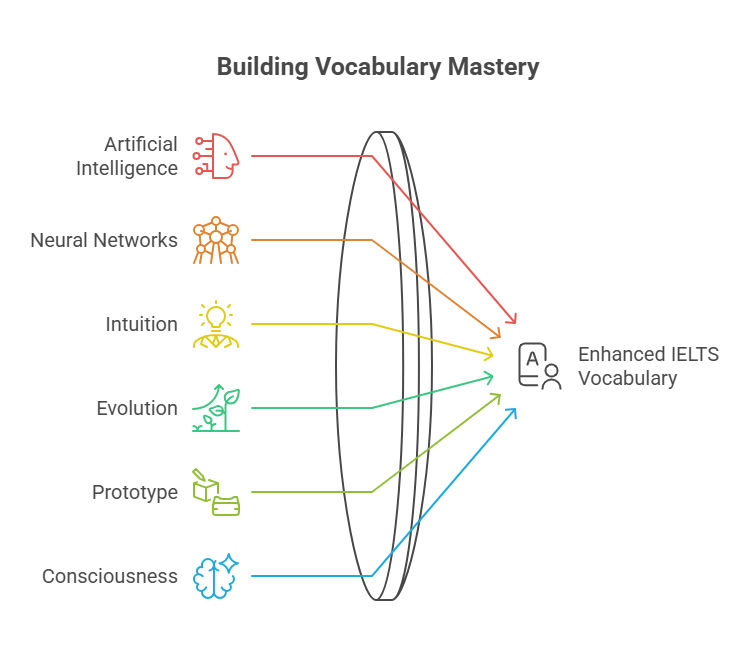
Important Vocabulary Used in The Robots Are Coming Passage

The essential feature of good results in IELTS Reading is a good vocabulary; the extent and richness of vocabulary explains an impressive amount of variation in reading scores together. The studies demonstrate that the candidates whose vocabulary size is more than 6,000 words have better results particularly on such more challenging question forms as Matching Headings and Multiple Choice.

The following is a more concentrated IELTS vocabulary list with definitions and how to use it in your own words based on robots are coming read the answers text:

Term

Meaning

Artificial Intelligence (AI) The simulation of human intelligence by machines
Top-Down Approach Programming all essential rules into a machine
Bottom-Up Approach Building intelligence by mimicking learning/evolution
Neural Networks Computer systems modeled on the human brain
Intuition The ability to understand something instinctively
Evolution Gradual development, especially from simple to complex
Prototype An initial or preliminary model of something
Consciousness The state of being aware of and able to think
Indecision Inability to make a decision
Syntax The arrangement of words and phrases

Conclusion

The “Robots are coming” passage is indeed an insightful and relevant passage for those preparing for IELTS. Practicing such IELTS reading practice tests can surely increase your caliber for scoring high and reducing the time of attempt. Whether it is Matching questions, True/False, summary completion questions, the key to ace in all these types of questions is reading carefully (skimming and scanning) and then attempting. If you're looking for accurate the robots are coming reading answers and a clear understanding of question strategies, this guide helps you approach the passage with confidence.

Are you ready? Enroll in upGrad today to take the first step towards learning abroad with your free 1:1 session with upGrad counselors.

Need another essay to practice? The Story of Platinum Reading Answers would be a good one to make a try.

Download E-Books for IELTS Preparation

IELTS IDIOMS GUIDE
ielts sample essays

Learn More about Study Abroad

What is Scholarship

Learn all about the scholarships like types of scholarships and how to get a one/

Scholarship

Provincial Nominee Program Canada

Learn all about Provincial Nominee Program (PNP) Canada/

PNP Program Canada

Fulbright Scholarship

Learn about the eligibility, benefits, procedure etc about Fulbright Scholarships/

Fulbright Scholarship

FAQs

Why does IELTS Reading include long passages instead of short texts?

Long passages allow examiners to test a range of skills, including understanding the main idea, identifying supporting details, and following logical arguments. Short passages wouldn’t give enough material to measure these abilities effectively. By practicing with longer passages, students also learn to manage time efficiently, which is crucial during the 60-minute test. 

Are IELTS Reading passages taken from real books and articles?

Yes, most passages are adapted from authentic sources such as newspapers, journals, magazines, and research papers. They are rewritten for exam purposes but maintain real-world language and academic style. This approach ensures that students are tested on practical reading comprehension, not just memorized topics. 

Do Academic and General Training Reading tests use the same passages?

No. Academic IELTS features longer, more complex passages, often discussing science, sociology, or technology. General Training texts are shorter and more practical, like workplace notices, advertisements, or general interest articles. Understanding this difference helps candidates prepare effectively for their specific module. 

How do examiners decide on the difficulty level of passages?

Difficulty is based on vocabulary, sentence structure, and reasoning complexity. Passage 1 is usually descriptive and straightforward, Passage 2 requires some inference, and Passage 3 is highly analytical. This progression tests a candidate’s ability to handle increasingly challenging material. 

Can the same topic appear twice in different IELTS Reading tests?

The exact passage will not be repeated, but similar themes like technology, environment, or history frequently appear. Practicing these common themes can give students confidence, as the skills needed to answer questions remain the same across passages. 

What’s the best way to handle tricky True/False/Not Given questions?

Carefully compare the statement with the passage. If the text explicitly confirms it, the answer is True. If the text contradicts it, the answer is False. If there’s no clear information, it’s Not Given. Many students lose marks here by assuming rather than verifying. 

Are the answers always in the same order as the passage?

Often, yes, especially for question types like True/False/Not Given or short-answer questions. However, for matching headings, sentence completion, or summary tasks, the answers may be scattered. Skimming and scanning skills are essential to find the correct information quickly. 

Do IELTS Reading passages test grammar knowledge directly?

Grammar isn’t tested directly, but understanding sentence structure is crucial. It helps in interpreting meaning, identifying subjects and verbs, and completing sentences correctly. Strong grammar awareness supports comprehension, especially in complex academic passages. 

How important is vocabulary for Reading passages?

Vocabulary is extremely important. While you don’t need to know every word, recognizing synonyms, paraphrasing, and academic terms is key. IELTS often rephrases questions differently from the passage, so the ability to understand meaning in context is vital. 

Can I underline or highlight words in the passage during the test?

Yes. In paper-based tests, candidates can underline, circle, or mark keywords. In computer-based tests, there’s a digital highlight tool. Highlighting helps track important information, locate answers faster, and reduces the chance of missing details under time pressure. 

How much should I practice reading passages before test day?

Experts recommend practicing 2–3 full passages daily, at least 3–4 weeks before the exam. This builds stamina for reading long texts, improves speed and accuracy, and familiarizes candidates with all question types. Regular practice also reduces anxiety on test day. 

Sunita Kadian

IELTS Expert |162 articles published

Sunita Kadian, co-founder and Academic Head at Yuno Learning is an expert in IELTS and English communication. With a background in competitive exam preparation (IELTS, GMAT, CAT, TOEFL), interview pre...

referer

Refer Your Friend & Earn upto ₹15000

Help your friend upgrade to a Global Career and earn rewards together.

Trending Searches

Editor's Pick

Australia

Canada

UK

USA

Exam

Other Countries