The IELTS Reading section includes different passages followed by questions that test your ability to understand information, identify specific details, and recognise paraphrased ideas. “Tattoo on Tikopia” is one such IELTS Reading passage.
The Tattoo on Tikopia IELTS Reading Answers passage explores the history and cultural importance of tattooing in Tikopia and the wider Polynesian region. It looks at how tattoos were made, what materials were used, and how different tattoo designs represented identity, ancestry, rank, and social status.
The passage includes Yes/No/Not Given, diagram completion, and note/table completion questions. To solve them well, students need to scan for specific details, recognise paraphrased information, follow historical and cultural descriptions, and check that every answer is supported by the passage.
Tattoo on Tikopia IELTS Reading Passage
The Tattoo on Tikopia IELTS Reading test passage discusses Polynesian culture and the isolated island of Tikopia before focusing on the traditional practice of tattooing. It explains the origins of the word “tattoo”, the materials and tools used in the process, and the cultural meanings attached to different tattoo designs.
Tattoo on Tikopia
A. There are still debates about the origins of Polynesian culture, but one thing we can ensure is that Polynesia is not a single tribe but a complex one. Polynesians which include Marquesans, Samoans, Niueans, Tongans, Cook Islanders, Hawaiians, Tahitians, and Maori, are genetically linked to indigenous peoples of parts of Southeast Asia. It's a subregion of Oceania, comprising a large grouping of over 1,000 islands scattered over the central and southern Pacific Ocean, within a triangle that has New Zealand, Hawaii and Easter Island as its corners.
B. Polynesian history has fascinated the western world since Pacific cultures were first contacted by European explorers in the late 18th century. The small island of Tikopia, for many people, even for many Solomon Islanders is so far away that it seems like a mythical land; a place like Narnia, that magical land in C. S. Lewis's classic, 'The Chronicles of Narnia.' Maybe because of it, Tikopia, its people, and their cultures have long fascinated scholars, travelers, and casual observers. Like the pioneers' Peter Dillion, Dumont D'Urville and John Coleridge Patterson who visit and write about the island in the 1800s, Raymond Firth is one of those people captured by the alluring attraction of Tikopia. As a result, he had made a number of trips to the island since the 1920s and recorded his experiences, observations, and reflections on Tikopia, its people, cultures and the changes that have occurred.
C. While engaged in the study of the kinship and religious life of the people of Tikopia, Firth made a few observations on their tattooing. Brief though these notes are, they may be worth putting on record as an indication of the sociological setting of the practice in this primitive Polynesian community. The origin of the English word 'tattoo' actually comes from the Tikopia word 'tatau'. The word for tattoo marks, in general, is tau, and the operation of tattooing is known as ta tau, ta being the generic term for the act of striking.
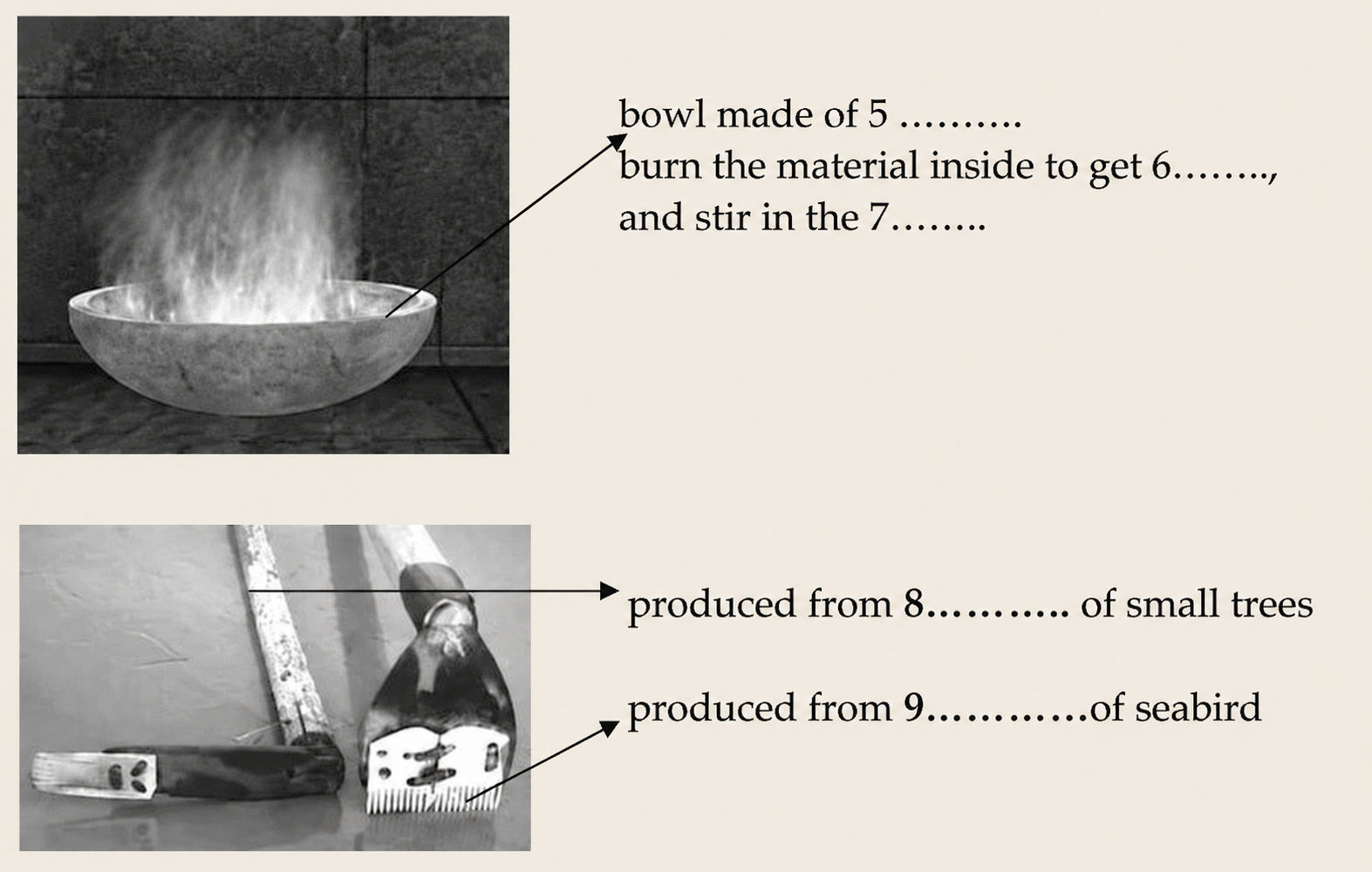
D. The technique of tattooing was similar through Polynesia. Traditional tattoo artists create their indelible tattoos using pigment made from the candlenut or kukui nut. First, they burn the nut inside a bowl made of half a coconut shell. They then scrape out the soot and use a pestle to mix it with liquid. Bluing is sometimes added to counteract the reddish hue of the carbon-based pigment. It also makes the outline of the inscribed designs bolder on the dark skin of tattooing subjects.
E. For the instruments used when tattooing, specialists used a range of chisels made from albatross wing bone which were hafted onto a handle which was made from the heartwood of the bush and struck with a mallet. The tattooer began by sketching with charcoal a design on the supine subject, whose skin at that location was stretched taut by one or more apprentices. The tattooer then dipped the appropriate points either a single one or a whole comb, into the ink (usually contained in a coconut-shell cup) and tapped it into the subject's skin, holding the blade handle in one hand and tapping it with the other. The blood that usually trickled from the punctures was wiped away either by the tattooer or his apprentice, the latter having also inevitably been painful, a test of fortitude that tattooers sought to shorten by working as fast as possible. In fact, tattoos nearly always festered and often led to sickness, and in some cases death.
F. In ancient Polynesian society, nearly everyone was tattooed. It was an integral part of ancient culture and was much more than a body ornament. Tattooing indicated ones' genealogy and/or rank in society. It was a sign of wealth, of strength and of the ability to endure pain. Those who went without them were seen as persons of lower social status. As such, chiefs and warriors generally had the most elaborate tattoos. Tattooing was generally begun at adolescence, and would often not be completed for a number of years. Receiving tattoos constituted an important milestone between childhood and adulthood, and was accompanied by many rites and rituals. Apart from signaling status and rank, another reason for the practice in traditional times was to make a person more attractive to the opposite sex.
G. The male facial tattoo is generally divided into eight sections of the face. The center of the forehead designated a person's general rank. The area around the brows designated his position. The area around the eyes and the nose designated his hapu, or sub-tribe rank. The area around the temples served to detail his signature. This signature was once memorized by tribal chiefs who used it when buying property, signing deeds, and officiating orders. The cheek area designated the nature of the person's work. The chin area showed the person's mana. Lastly, the jaw area designated a person's birth status.
H. A person's ancestry is indicated on each side of the face. The left side is generally the father's side, and the right side is the mothers. The manutahi design is worked on the men's back. It consists of two vertical lines drawn down the spine, with short vertical lines between them. When a man had the manutahi on his back, he took pride in himself. At gatherings of the people he could stand forth in their midst and display his tattoo designs with songs. And rows of triangles designed on the men's chest indicate his bravery.
I. Tattoo was a way of delivering information about its owner. It's also a traditional method to fetch spiritual power, protection and strength. The Polynesians use this as a sign of character, position and levels in a hierarchy. Polynesian people believe that a person's mana, their spiritual power or life force, is displayed through their tattoo.
The Tattoo on Tikopia IELTS Reading Answers section contains three main question types. Questions 1–4 are Yes/No/Not Given, Questions 5–9 are diagram completion, and Questions 10–14 are note/table completion.
Before checking the answers, try to locate the relevant part of the passage yourself. Pay attention to keywords, synonyms, and paraphrased information.
Questions 1–4: Yes/No/Not Given
Q1: Scientists like to do research in Tikopia because this tiny place is of great remoteness.
Answer: YES
Explanation: The passage gives a description of the Tikopia Island, which is considered a very isolated place that has captured the attention of many scholars and researchers. The isolation of the place is considered one of the factors that make it interesting for researchers. Thus, the statement is in agreement with the information provided in the passage.
Q2: Firth was the first scholar to study on Tikopia.
Answer: NO
Explanation: The passage does not state that Raymond Firth was the first scholar to conduct research in Tikopia. On the contrary, it states that other people have been there and written about the island before him.
Q3: Firth studied the cultural differences on Tikopia as well as on some other islands of the Pacific.
Answer: NOT GIVEN
Explanation: The passage discusses Firth's visits, the observations, and studies of Tikopia and its people. But there is no mention in the passage about him studying the cultural differences in Tikopia and also in other Pacific Islands. As there is no confirmation in the passage, the answer is NOT GIVEN.
Q4: The English word “tattoo” evolved from the local language of the island.
Answer: YES
Explanation: The passage connects the English word “tattoo” with the Tikopia word “tatau.” This supports the statement that the English word developed from a local term.
Questions 5–9: Diagram Completion
Q5: [Diagram completion question]
Answer: COCONUT SHELL
Explanation: The passage indicates that the bowl that contained the ingredients for preparing the tattoo ink was made out of a section of a coconut shell. Thus, coconut shell is the correct answer to this diagram part.
Q6: [Diagram completion question]
Answer: SOOT
Explanation: The passage describes burning the material and obtaining soot. This soot was then used to prepare the tattooing mixture, making it the correct answer for Question 6.
Q7: [Diagram completion question]
Answer: LIQUID
Explanation: The passage explains that a liquid was added to the soot during the preparation of the tattooing material. Therefore, liquid correctly completes the diagram.
Q8: [Diagram completion question]
Answer: HEARTWOOD
Explanation: The passage refers to heartwood as one of the materials used in making the traditional tattooing equipment. This matches the information shown in the diagram.
Q9: [Diagram completion question]
Answer: WING BONE
Explanation: The passage indicates that a wing bone was used in the process of making the traditional tattooing instrument. Thus, wing bone is the correct answer.
Questions 10–14: Note/Table Completion
These questions test your ability to locate specific details about the meaning and design of traditional Tikopian tattoos. Pay attention to descriptions of different parts of the face and body, as well as the shapes and patterns used in tattoo designs.
Q10: Which part of the face showed a person's general rank?
Answer: THE FOREHEAD
Explanation: The passage explains that different areas of the face represented different types of social information. The forehead was associated with general rank, so this is the correct answer.
Q11: Which part of the face showed information about a person's birth status?
Answer: CHIN AREA
Explanation: The passage connects the chin area with information about a person's birth status. Therefore, chin area correctly completes the notes.
Q12: Which side of the face represented the mother's ancestry?
Answer: MOTHER'S ANCESTRY
Explanation: The passage explains that different sides of the face represented different aspects of ancestry. The right side represented the mother's ancestry, making this the correct answer.
Q13: What type of lines were included in the manutahi tattoo design?
Answer: VERTICAL LINES
Explanation: The passage describes the manutahi tattoo design on a man's back. The design included vertical lines running down the spine. Therefore, vertical lines is the correct answer.
Q14: What shape appeared in rows on the chest?
Answer: TRIANGLES
Explanation: The passage describes rows of triangles on the chest and connects this tattoo design with bravery. Therefore, triangles is the correct answer.
How to Approach the Tattoo on Tikopia IELTS Reading Answers
The passage about the Tattoo on Tikopia IELTS Reading Answers passage is useful practice because it mixes the historical information, cultural details, specific vocabulary, and several IELTS Reading question types. The best approach while doing practice for these passages is to understand the main idea first and then look for the details required by each question.
Read for the Main Idea First
Do not start by trying to remember every detail. First, understand what the passage is mainly about.
The opening paragraphs introduce Polynesia and Tikopia before moving towards the history and practice of tattooing. Knowing this structure helps you understand where different types of information are likely to appear.
Tip: Spend a short amount of time understanding the topic and purpose of each paragraph before solving individual questions.
Look for Names, Dates, and Specific Details
Names, places, cultural terms, and other specific details can act as signposts.
For example, names such as Raymond Firth can help you quickly find the part of the passage discussing his connection with Tikopia. Similarly, terms related to tattooing can lead you towards the paragraphs containing information needed for the diagram and note-completion questions.
Tip: Underline important names and unusual terms in the questions before scanning the passage.
Watch for Paraphrasing
IELTS questions often express information differently from the passage.
For example, a question may describe Tikopia as being extremely remote, while the passage may use different words to explain its isolated location. The meaning is more important than an exact word match.
Tip: Look for synonyms and similar ideas instead of searching for the exact sentence from the question.
Understand the Historical Context
The passage moves from the wider history of Polynesian culture to Tikopia and then to the practice of tattooing.
Understanding this progression makes it easier to predict where certain answers will appear. When reading a historical or cultural passage, ask yourself:
Who is being discussed?
When did the event or practice occur?
Where did it happen?
Why was it important?
Tip: Keep the sequence of ideas in mind instead of treating every paragraph as a separate piece of information.
Eliminate Incorrect Options
For questions such as Yes/No/Not Given, carefully compare the statement with the passage.
Remove an option if:
The passage directly contradicts the statement.
The information belongs to another person or event.
Only part of the statement is supported.
The passage does not provide enough information to confirm it.
For Not Given, remember that the answer cannot be based on what you think is probably true. The information must actually be present in the passage.
Looking to strengthen your IELTS preparation before you take the test? Get practical guidance with upGrad’sfree IELTS course and work on your skills at your own pace.
Common Mistakes to Avoid in the “Tattoo on Tikopia” IELTS Reading
Historical and cultural passages often contain unknown people names, words and descriptions. You do not have to comprehend all parts to come up with correct answers. Remember the following tips while answering questions to the passage:
Do not look for identical words only: Words used in the question may differ from those used in the passage. Find synonyms and related phrases instead of identical keywords only.
Do not try to understand every word: There might be some cultural or historical terms that are unknown to you. Read words around them and figure out the meaning of the sentence based on the context.
Look for information in the same order: Passage starts with a general description of Polynesia and Tikopia, then talks about tattooing. Use paragraph order while looking for necessary information.
Do not select an answer that looks right: Your answer should be based on information given in the passage. Check it one more time in the passage before making your choice.
Do not waste too much time on any one question: If you are unable to find an answer quickly, simply move onto the next one. The more challenging question can be answered later.
Do not rely on memory: You might recall the general meaning but forget the specific detail. Double-check the answer with the passage before proceeding.
The Tattoo on Tikopia IELTS Reading Answers passage is a useful practice exercise for improving scanning, paraphrasing, and attention to detail. It also helps students practise working with historical and cultural information without relying on general knowledge.
For better accuracy, first understand the main idea, then use names and keywords to locate relevant sections. Always check for paraphrasing and confirm that your answer is supported by the passage. For completion questions, follow the word limit carefully and use words taken directly from the text where required.
1. Is Tattoo on Tikopia a difficult IELTS Reading passage?
The passage may seem challenging because it discusses an unfamiliar culture and traditional practices. However, the language and question types can be managed with regular practice. Students should focus on understanding the information rather than worrying about unfamiliar cultural references.
2. What is the main subject of the Tattoo on Tikopia passage?
The passage looks at tattooing traditions in Tikopia and explains their connection with Polynesian culture. It also discusses how tattooing was carried out and how different tattoo patterns could communicate information about people and their place in society.
3. Who was Raymond Firth in the Tattoo on Tikopia passage?
Raymond Firth was a British anthropologist known for his research on Tikopia. His work provided detailed information about the island's people, culture, and social life, making him an important figure in the passage's discussion of research on Tikopia.
4. Why is Tikopia important in the passage?
Tikopia is a small, isolated island in the Pacific that provides an interesting setting for studying traditional Polynesian life. Its geographical isolation helped preserve cultural practices and social traditions that researchers were able to study and document.
5. What does the word “tatau” mean in the passage?
“Tatau” is a word associated with tattooing in the Pacific region. The passage explains its connection with the English word “tattoo,” showing how language and cultural practices can influence one another over time.
6. What can students learn from the Tattoo on Tikopia IELTS Reading Answers?
The Tattoo on Tikopia IELTS Reading Answers can help students understand how information is tested through different question formats. Reviewing the explanations can also help them notice important details, recognise paraphrasing, and understand why some answers are supported while others are not.
7. Why does the passage include information about tattooing tools?
Details about tattooing tools provide information about how the traditional process was carried out. They also help readers understand the materials and methods used by people in Tikopia, while giving students specific information to locate in the passage.
8. What role did tattoos have in Tikopian society?
Tattoos had cultural and social importance rather than simply being decorative. The passage explains that tattoo designs and their locations could represent details connected with a person's identity, ancestry, rank, or position within Tikopian society.
9. How should I review my answers after completing this passage?
After completing the questions, compare each answer with the relevant section of the passage. Pay attention to mistakes caused by vocabulary, misunderstanding, or overlooking details. This makes practice more useful than simply checking your final score.
10. Can this passage help with IELTS Reading vocabulary?
Yes, the passage can introduce useful vocabulary related to anthropology, history, culture, and traditional practices. Instead of memorising isolated words, students should learn unfamiliar terms in context. This makes it easier to understand similar vocabulary in future IELTS Reading passages.
11. Where can I find reliable Tattoo on Tikopia IELTS Reading Answers?
You can use the Tattoo on Tikopia IELTS Reading Answers on this page as a study guide. However, always check the original passage when reviewing your answers. This helps you understand the evidence behind each answer instead of memorising the answer list alone.
upGrad Abroad Editorial Team |5038 articles published
We are a dedicated team of study-abroad experts, ensuring intensive research and comprehensive information in each of our blogs. With every piece written, we aim at simplifying the overseas education ...
Refer Your Friend & Earn upto ₹15000
Help your friend upgrade to a Global Career and earn rewards together.