IELTS consists of four sections: Reading, Listening, Writing, and Speaking. Among these, the IELTS Reading test assesses your ability to understand information, identify key ideas, recognise specific details, and follow how ideas are developed across a passage.
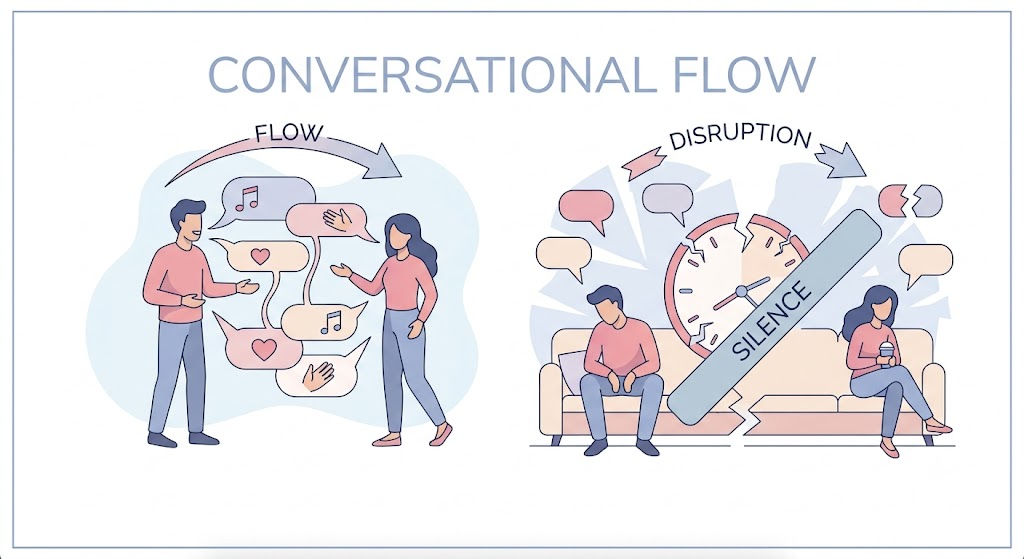
When Conversations Flow is one such IELTS Academic Reading passage that discusses how smooth conversations affect people's feelings, relationships, and sense of belonging. It also looks at conversational synchrony, interruptions, and how the flow of communication can influence the way people perceive others.
The passage is from Academic Reading Test 3, Passage 3 (The Official Guide to IELTS), with Questions 27–40 covering Yes/No/Not Given and Summary Completion question types.
For reference, here is the official When Conversations Flow IELTS Reading answer key:
Question Numbers
When Conversations Flow Reading Answers
27
YES
28
YES
29
NO
30
NOT GIVEN
31
NOT GIVEN
32
NO
33
behaviour/behavior/activities
34
turn-taking
35
interruptions
36
belong
37
distress levels
38
rejection
39
agreement
40
content
These are the answers for Academic Reading Test 3, Passage 3. You can now attempt the practice test below and then check the answers with the explanations to understand how each response is supported by the passage.
When Conversations Flow IELTS Reading Passage for Practice
Why does a smooth conversation feel natural, even though a short while of silence can make us feel awkward? The text below provides an answer and an explanation to this question, outlining the impact of conversational flow on our interactions, our relationships and our sense of belonging. It also addresses why people attempt to keep pace in conversation and what transpires when this is disrupted.
While reading, be on the lookout for the results of the studies and examples that illustrate these effects. They can assist you in realizing how something seemingly innocent, such as a pause during conversation, can affect the way that we view another person or relate to that person.
Now, here is a paraphrased version of the IELTS Reading test passage (for practice purposes). Carefully read the passage and then proceed to the questions that follow.
When Conversations Flow
Paragraph 1 We talk to others much of the day, and therefore we're very familiar with the art of talking. But why do we feel comfortable when in a conversation where there is flow, but feel uneasy and distressed when a conversation gets cut off with unexpected silence? To answer this question, we will first look at some of the effects of conversational flow. Then we will discuss how flow can be used to meet the needs of various societies.
Paragraph 2 The positive effects of conversational flow are similar to the effects of ‘processing fluency’. Processing fluency (how easily information is processed) has been found to affect judgments in many dimensions of social behavior. For example, if processing something is easier, it is more truthful and/or accurate.
Paragraph 3 Furthermore, they have greater confidence in their judgments about information that comes easily to them, and they like it easier than difficult. Research has shown that if the speaker responds immediately to present questions, they are perceived as more knowledgeable, but if they fill their speech with disfluent speech markers like ‘uh’ or remain silent for a moment too long, then they destroy that positive image.
Paragraph 4 Conversational flow is one of the social needs that is met by the human need to be in ‘synchrony’ - ‘in sync’ or ‘in harmony’ with each other. Many studies have shown how people attempt to synchronise with their partners by coordinating their behaviour. It is an interpersonal coordination that has been applied to a variety of human activities, from more complex tasks such as ballroom dancing to walking or talking with friends.
Paragraph 5 Interpersonal coordination is observed during conversations when individuals make their speech and utterances extend over a different amount of time in order to facilitate turn-taking without the person speaking over the other, nor having to use awkward pauses or wait for the other to finish. People are well trained at conversing, and they're able to take turns in mere milliseconds, which makes for a conversational flow of smoothly meshed behaviours. A lack of flow is characterized by interruptions, simultaneous speech, or mutual silence. These are important things to avoid when establishing and maintaining interpersonal relationships.
Paragraph 6 Need to belong has been recognized as one of the fundamental motivations of human beings, and is present in a variety of human behaviors. That conversational flow is related to belonging may be most easily illustrated by the consequences of flow disruptions. When the positive experience of flow is interrupted, such as with a moment of silence, what happens? We've all experienced awkward silences, and scientists have found even minor, brief breaks in a conversation can dramatically increase feelings of discomfort.
Paragraph 7 Silences are frequently cues in the movies for not adhering or confronting (Piazza, 2006). Even some researchers say that ‘silencing someone' is one of the most serious types of exclusion. Membership is crucial to our well-being, and we are very sensitive to signals of rejection and when we feel silenced, it is assumed that we are being rejected. When we don't get the flow in a conversation, it could be a sign that our relationship isn't as strong as it seemed.
Paragraph 8 Another aspect of synchrony is that people often try to validate their opinions to those of others. That is, people like to see others as having similar ideas or worldviews as they have themselves, because this informs people that they are correct and their worldviews are justified. One justification for a worldview that people can use is that if they are able to talk through their worldview effectively, they believe their interaction partners likely agree with them. The researchers tested this idea by watching the video.
Paragraph 9 Participants envisioned themselves as being one of three individuals in a video clip who spoke in a fluent manner or had a conversation in which flow was interrupted by a short pause. The videos were all the same, except that there was no sound. Following the video, participants were asked how they thought the people in the video were in agreement. Participants who watched the fluent conversation rated agreement to be higher than participants watching the conversation that was disrupted by a silence, even though participants were not consciously aware of the disruption. The subjective sense of being at odds seems to be a cue for people to know that they may have disagreements in any manner, not just with what is being said.
Paragraph 10 Generally, people are well-trained in having smooth conversations, and when a conversation breaks off, there is something wrong either in the interpersonal relationship or with the group itself. This means that those who don't speak very well can be mistakenly interpreted as less friendly than those who don't have a problem in communicating.
Paragraph 11 On a societal level, one could even imagine that a lack of conversational flow may hamper the integration of immigrants who have not completely mastered the language of their new country yet. In a similar sense, the ever- increasing number of online conversations may be disrupted by misinterpretations and anxiety that are produced by insurmountable delays in the Internet connection. Keeping in mind the effects of conversational flow on feelings of belonging and validation may help one to be prepared to avoid such misunderstandings in future conversations.
Now that you have read the passage, move on to the questions and test your understanding of the information discussed above.
Looking to strengthen your IELTS preparation before you take the test? Get practical guidance with upGrad’sfree IELTS course and work on your skills at your own pace.
When Conversations Flow Reading Questions
The questions below are based on the practice passage. Read each statement carefully, as some questions may require you to distinguish between what the passage clearly says, what it contradicts, and what it does not mention.
Questions 1–6: Yes/No/Not Given
Do the following statements agree with the information given in the passage?
In boxes 1–6 on your answer sheet, write:
YES — if the statement agrees with the information NO — if the statement contradicts the information NOT GIVEN — if there is no information about this
Unexpected silences can make people feel uncomfortable during a conversation.
Processing fluency affects how people make judgments about information.
Speakers who respond quickly to questions may be considered more knowledgeable.
People coordinate their behaviour only during activities such as ballroom dancing.
Even a brief interruption in a conversation can increase feelings of discomfort.
People who have difficulty speaking smoothly may sometimes be seen as less friendly.
Questions 7–14: Summary Completion
Complete the summary below.
Choose NO MORE THAN TWO WORDS from the passage for each answer.
Conversational Flow and Social Relationships
People tend to respond more positively to information that is easy to process. This idea is known as 7. __________, and it can also affect how people judge speakers. A person who responds quickly may appear more knowledgeable, while long pauses can damage this 8. __________.
Conversational flow is also linked with 9. __________, which means being in harmony with another person. During conversations, people coordinate their speech to allow 10. __________ to take place without interruptions or uncomfortable pauses.
A disruption in conversational flow can affect how people view their relationships. Silence may be understood as a sign of 11. __________, as people are sensitive to signals that they may be excluded.
Researchers also found that smooth conversations can affect how people judge 12. __________ between others. In one study, participants who watched a fluent conversation believed there was more agreement than those who watched a conversation interrupted by a 13. __________.
The effects of conversational flow may extend beyond personal relationships. Difficulties with communication may make it harder for 14. __________ to become integrated into a new society.
Once you have attempted the questions, check your responses below and see how each answer is supported by the passage.
When Conversations Flow IELTS Reading Answers with Explanation
Once you have attempted the questions, use the answers with Location below to check your responses. Each answer includes the paragraph where you can find the relevant information, followed by an explanation to help you understand why it is the correct answer and avoid similar traps.
Answers 1–6: Yes/No/Not Given
Answer 1: YES
Answer location: Paragraph 1
Explanation: The statement says that unexpected silences can make people uncomfortable. Paragraph 1 describes people feeling “uneasy and distressed” when a conversation is cut off by unexpected silence. These phrases express the same idea, so the statement agrees with the passage.
Do not look for the exact word uncomfortable. The passage uses different words to describe the same feeling, which is common in IELTS Reading.
Answer 2: YES
Answer location: Paragraph 2
Explanation: The statement says that processing fluency affects people's judgments. Paragraph 2 explains that processing fluency has been found to affect judgments in different areas of social behaviour.
The passage does not say that processing fluency affects only one type of judgment. Since the statement keeps the same general meaning, the answer is YES.
Answer 3: YES
Answer location: Paragraph 3
Explanation: The statement says that speakers who respond quickly may be considered more knowledgeable. Paragraph 3 says that speakers who respond immediately to questions are perceived as more knowledgeable.
Here, respond quickly and respond immediately have the same meaning. Also, “may be considered” matches the passage's use of “are perceived as”, so there is no contradiction.
Answer 4: NO
Answer location: Paragraph 4
Explanation: The statement says that people coordinate their behaviour only during activities such as ballroom dancing. Paragraph 4 gives ballroom dancing as one example, but it also mentions walking and talking with friends.
The word only is the key trap here. The passage clearly shows that coordination happens in several activities, so the statement contradicts the information.
Answer 5: YES
Answer location: Paragraph 6
Explanation: The statement says that even a brief interruption can increase feelings of discomfort. Paragraph 6 says that even “minor, brief breaks” in a conversation can dramatically increase feelings of discomfort.
The important match is brief interruption with minor, brief breaks. Do not confuse this with Paragraph 5, which talks about different types of disrupted flow. The specific link with discomfort appears in Paragraph 6.
Answer 6: YES
Answer location: Paragraph 10
Explanation: The statement says that people who have difficulty speaking smoothly may sometimes be seen as less friendly. Paragraph 10 says that people who do not speak very well can be mistakenly interpreted as less friendly.
The word mistakenly is important. The passage is not saying that these people are actually less friendly. It says that others may form this impression because of their communication difficulties, which agrees with the statement.
Answers 7–14: Summary Completion
Answer 7: Processing fluency
Answer location: Paragraph 2
Explanation: The summary first describes the idea that information is easier to process and then asks for the term used for this concept. Paragraph 2 directly introduces processing fluency and explains it as how easily information is processed.
A reader may choose social behavior because it appears later in the same sentence, but that refers to the area in which processing fluency can affect judgments, not the name of the concept.
Answer 8: Positive image
Answer location: Paragraph 3
Explanation: The summary says that a quick response can make a speaker appear more knowledgeable, while long pauses can damage this _____. Paragraph 3 explains that disfluent speech or remaining silent too long can destroy the speaker's positive image.
The likely confusion here is with knowledgeable. That describes how the speaker may be perceived, but the passage specifically says that a long pause can destroy the speaker's positive image.
Answer 9: Synchrony
Answer location: Paragraph 4
Explanation: The summary describes synchrony as being “in harmony” with another person. Paragraph 4 gives the term synchrony and immediately explains it as being “in sync” or “in harmony” with each other.
The phrase interpersonal coordination may also look suitable because it appears in the same paragraph. However, the summary asks for the idea that means being in harmony, which points to synchrony.
Answer 10: Turn-taking
Answer location: Paragraph 5
Explanation: The summary explains that people coordinate their speech so that conversation can happen without interruptions or awkward pauses. Paragraph 5 says this coordination helps to facilitate turn-taking.
A reader might consider conversational flow because it is discussed throughout the passage. However, the specific action being facilitated is taking turns while speaking, so turn-taking is the precise answer.
Answer 11: Rejection
Answer location: Paragraph 7
Explanation: The summary says that silence may be understood as a sign of something because people are sensitive to signals that they may be excluded. Paragraph 7 connects feeling silenced with being rejected.
Do not choose exclusion, even though that word also appears in the paragraph. Exclusion is discussed as a serious type of silencing, while the passage specifically says that people may assume they are being rejected when they feel silenced.
Answer 12: Agreement
Answer location: Paragraph 9
Explanation: The summary refers to a study in which people watched fluent and disrupted conversations and then judged how much the people in the video agreed. Paragraph 9 says that participants watching the fluent conversation rated agreement as higher.
The word disagreement may seem possible because the paragraph later mentions being “at odds”. However, the study measured the level of agreement, making that the correct answer.
Answer 13: Short pause
Answer location: Paragraph 9
Explanation: The summary asks what interrupted one of the conversations in the study. Paragraph 9 says that the flow was interrupted by a short pause.
You may notice that the paragraph also uses the word silence. However, the earlier description specifically says that the flow was interrupted by a short pause, which matches the wording of the summary and fits the two-word limit.
Answer 14: Immigrants
Answer location: Paragraph 11
Explanation: The summary refers to people who may find it harder to become integrated into a new society because they have communication difficulties. Paragraph 11 specifically discusses immigrants who have not completely mastered the language of their new country.
The phrase new country is an important clue. The passage is not talking about people who simply have difficulty speaking in general; it is referring specifically to immigrants adjusting to a new society.
How to Approach When Conversations Flow IELTS Reading Questions?
When Conversations Flow has two question types: Yes/No/Not Given and Summary Completion. The passage moves between conversational flow, synchrony, relationships, and communication, so similar ideas can sometimes lead you to the wrong answer.
Use these reading strategies to work through the questions more confidently:
Solve Yes/No/Not Given Questions Carefully
Think in three steps: Statement → Passage → Match
If the passage...
Your answer
Says the same thing
YES
Gives the opposite meaning
NO
Does not provide the information
NOT GIVEN
A useful example: Question 4 says people coordinate their behaviour only during activities such as ballroom dancing. Paragraph 4 also mentions walking and talking with friends.
→ The statement limits the idea too much. → Answer: NO
Watch out: Words such as only, always, and all can change the meaning of a statement.
Let the Missing Word Tell You What to Look For
For Summary Completion, do not jump straight to the passage. First, look at the sentence around the blank.
Question 9: “being in harmony with another person” → synchrony
Question 10: “coordinate their speech” → turn-taking
The words around the blank act like small clues. Once you understand the idea being described, finding the exact wording in the passage becomes much easier.
Read for Meaning, Not Matching Words
IELTS may change the wording between the question and the passage.
Question:feel uncomfortable Passage:feel uneasy and distressed
Same idea, different wording.
The same happens in Question 6:
Question:may be seen as less friendly Passage:mistakenly interpreted as less friendly
So, if the words look different, ask yourself, “Is the meaning still the same?”
Don't Stop at the First Matching Word
Sometimes more than one word in a paragraph looks relevant. Read the surrounding sentence before choosing.
For Question 11, Paragraph 7 mentions both exclusion and rejection.
But the passage specifically says that when people feel silenced, they may assume they are being rejected.
So, remember: a related word is not always the exact answer.
Keep an Eye on the Word Limit
For Questions 7–14:
NO MORE THAN TWO WORDS
Before submitting an answer, check two things:
✓ Does it give the exact idea from the passage? ✓ Does it stay within two words?
For example: ✓ positive image ✗ the positive image
A correct idea can still become an incorrect response if you ignore the word limit.
Looking for more IELTS Reading practice? Read these answer guides to practise different passage topics and question types:
For When Conversations Flow, accuracy comes from understanding how ideas about communication, synchrony, and belonging connect across the passage. Research findings and examples can help you locate the answers, but it is important to check the exact meaning before making your choice.
As you practise when conversations flow IELTS reading answers, focus on understanding why each answer works rather than simply checking the answer key. This can help you recognise paraphrased information and approach different IELTS Reading question types with greater confidence.
1. How many questions are there in When Conversations Flow IELTS Reading?
The original When Conversations Flow IELTS Reading passage has 14 questions, numbered 27 to 40. They include Yes/No/Not Given and Summary Completion questions from Academic Reading Test 3, Passage 3.
2. Which IELTS Reading skills can I practise with When Conversations Flow?
When Conversations Flow helps you practise finding information, understanding paraphrased ideas, following ideas in a passage, and answering different question types. Checking your mistakes can also show which skills need more practice.
3. How can I improve my score using When Conversations Flow IELTS Reading Answers?
Use the answers to understand your mistakes, not just to check your score. Read the explanation, find the supporting part of the passage, and compare it with the question.
4. Is When Conversations Flow good for practising IELTS Academic Reading?
Yes. When Conversations Flow is useful for IELTS Academic Reading practice. It includes detailed information and different question types, helping you practise reading carefully and finding the right information.
5. What should I look for when checking When Conversations Flow answers?
First, check where the answer is found in the passage. Then compare the question with that part of the text. Look for paraphrased words, key details, and the correct word limit.
6. How can I avoid mistakes while solving When Conversations Flow Reading Answers?
Do not choose an answer just because you see the same word in the passage. Read the full sentence and check its meaning. Also, follow the instructions and word limits carefully.
7. Can I attempt When Conversations Flow as a timed IELTS Reading test?
Yes. Try answering the questions within a fixed time. After that, check your answers and see whether your mistakes were caused by time pressure, missed details, or misunderstanding the passage.
8. How should I review my mistakes in When Conversations Flow?
Go back to the part of the passage linked to each wrong answer. Compare it with the question and find what you missed. This can help you avoid the same mistake in future IELTS Reading practice.
9. How can I get better at Yes/No/Not Given questions using this passage?
Focus on the meaning of the whole statement. Check whether the passage agrees with it, gives the opposite information, or does not mention the idea. Then choose YES, NO, or NOT GIVEN.
10. How can I practise Summary Completion with When Conversations Flow?
Read the summary first and notice what information is missing. Then find the related part of the passage and choose the words that fit the sentence. Always check the given word limit.
11. Where does When Conversations Flow fit into IELTS Academic Reading practice?
When Conversations Flow comes from Academic Reading Test 3, Passage 3, with Questions 27–40. It is useful for practising Yes/No/Not Given and Summary Completion questions.
upGrad Abroad Editorial Team |5020 articles published
We are a dedicated team of study-abroad experts, ensuring intensive research and comprehensive information in each of our blogs. With every piece written, we aim at simplifying the overseas education ...
Refer Your Friend & Earn upto ₹15000
Help your friend upgrade to a Global Career and earn rewards together.